2020 Honda CR-V vs 2020 Toyota RAV4
Overview | |
MSRP$25,950 | MSRP$25,150 |
Listings1179 | Listings1518 |
Ratings & Reviews | |
User Reviews | User Reviews |
Expert reviews8.7 out of 10 | Expert reviews7.5 out of 10 |
Pros
Cons
| Pros
Cons
|
2020 Toyota RAV4 Reviews SummaryAmericans love the Toyota RAV4. The compact crossover SUV is the most popular vehicle in the U.S. that isn’t a pickup truck, and when you live with one for a while, it’s easy to understand why so many people buy a RAV4. Available with a gasoline 4-cylinder or a gas-electric hybrid powertrain (covered as a separate model), and in a wide range of configurations including sporty XSE, luxurious Limited, and rugged Adventure, the 2020 RAV4 meets a variety of customer wants and needs. | |
2020 Honda CR-V Reviews SummaryHonda’s compact SUV has been satisfying buyers for more than two decades, with more than five million CR-V’s sold. Such a legacy means the CR-V has long had its wrinkles smoothed out into a comfortable and capable crossover package that’s only downside may be its sheer inoffensiveness. This year’s model gets engine and safety upgrades, which improve fuel economy and help to make Honda’s bestseller an even better value. | |
No video found | |
Popular Features & Specs | |
Engine2.5L 203 hp I4 | Engine1.5L 190 hp I4 |
Drive TrainFWD | Drive TrainFWD |
Seating Capacity5 | Seating Capacity5 |
Horsepower | Horsepower190 hp @ 5600 rpm |
MPG City27 | MPG City28 |
MPG Highway35 | MPG Highway34 |
Engine | |
Engine Name2.5L 203 hp I4 | Engine Name1.5L 190 hp I4 |
Torque | Torque179 lb-ft @ 2000 rpm |
Horsepower | Horsepower190 hp @ 5600 rpm |
DrivetrainFWD | DrivetrainFWD |
Fuel Economy | |
MPG City27 | MPG City28 |
MPG Highway35 | MPG Highway34 |
Interior | |
Seating Capacity5 | Seating Capacity5 |
Safety | |
Front Crash Overall4 | Front Crash Overall5 |
Side Crash Overall5 | Side Crash Overall5 |
Dimensions & Capacity | |
Cargo Space37.6 cu ft | Cargo Space39.2 cu ft |
Curb Weight3370 lbs | Curb Weight3337 lbs |
Height67.0 in | Height66.1 in |
Length180.9 in | Length182.1 in |
Width73.0 in | Width73.0 in |
Wheelbase105.9 in | Wheelbase104.8 in |
Maximum Payload1240 lbs | Maximum Payload1358 lbs |
Number of doors4 | Number of doors4 |
Maximum Towing Capacity1500 lbs | Maximum Towing Capacity1500 lbs |
Overview | ||
MSRP | $25,950 | $25,150 |
Listings | ||
Ratings & Reviews | ||
User reviews | ||
Expert reviews | 8.7 out of 10Read full review | 7.5 out of 10Read full review |
Pros & cons | Pros
Cons
| Pros
Cons
|
Summary | Americans love the Toyota RAV4. The compact crossover SUV is the most popular vehicle in the U.S. that isn’t a pickup truck, and when you live with one for a while, it’s easy to understand why so many people buy a RAV4. Available with a gasoline 4-cylinder or a gas-electric hybrid powertrain (covered as a separate model), and in a wide range of configurations including sporty XSE, luxurious Limited, and rugged Adventure, the 2020 RAV4 meets a variety of customer wants and needs. | Honda’s compact SUV has been satisfying buyers for more than two decades, with more than five million CR-V’s sold. Such a legacy means the CR-V has long had its wrinkles smoothed out into a comfortable and capable crossover package that’s only downside may be its sheer inoffensiveness. This year’s model gets engine and safety upgrades, which improve fuel economy and help to make Honda’s bestseller an even better value. |
Video | No video found | |
Popular Features & Specs | ||
Engine | 2.5L 203 hp I4 | 1.5L 190 hp I4 |
Drive Train | FWD | FWD |
Seating Capacity | 5 | 5 |
Horsepower | 190 hp @ 5600 rpm | |
MPG City | 27 | 28 |
MPG Highway | 35 | 34 |
Engine | ||
Engine Name | 2.5L 203 hp I4 | 1.5L 190 hp I4 |
Torque | 179 lb-ft @ 2000 rpm | |
Horsepower | 190 hp @ 5600 rpm | |
Drivetrain | FWD | FWD |
Fuel Economy | ||
MPG City | 27 | 28 |
MPG Highway | 35 | 34 |
Interior | ||
Seating Capacity | 5 | 5 |
Safety | ||
Front Crash Overall | 4 | 5 |
Side Crash Overall | 5 | 5 |
Dimensions & Capacity | ||
Cargo Space | 37.6 cu ft | 39.2 cu ft |
Curb Weight | 3370 lbs | 3337 lbs |
Height | 67.0 in | 66.1 in |
Length | 180.9 in | 182.1 in |
Width | 73.0 in | 73.0 in |
Wheelbase | 105.9 in | 104.8 in |
Maximum Payload | 1240 lbs | 1358 lbs |
Number of doors | 4 | 4 |
Maximum Towing Capacity | 1500 lbs | 1500 lbs |
The 2020 Toyota RAV4 underwent a significant redesign for the 2019 model year, resulting in a bolder, more angular appearance. This new look positioned the RAV4 as a tougher contender among compact SUVs like the Mazda CX-5 and the Honda CR-V, matching its proven durability with a rugged aesthetic.
The Adventure trim, introduced in the previous year, enhanced the RAV4's off-roading capabilities with features such as a torque-vectoring all-wheel-drive system, a traction control system with multiple driving modes, and downhill assist control. These features, combined with an impressive 8.6 inches of ground clearance, made the Adventure trim aptly named.
In 2020, the TRD Off-Road trim took the adventure promise even further. This trim featured smaller, lighter matte-black 18-inch alloy wheels, severe snow-rated all-terrain tires, and a special TRD suspension setup designed to handle various surfaces. Visually, apart from wheels, tires, and TRD badging, this trim looked similar to its Adventure counterpart.
The test vehicle for this review came in the Lunar Rock gray paint with a white roof, which was not only visually appealing but also practical in hiding dirt. Inside, the TRD Off-Road model included unique TRD logos on the front-seat head restraints and featured rubber floor mats and a rubber cargo mat, emphasizing its rugged intent. The interior maintained quality construction with a mix of soft-touch materials and rubberized surfaces that stood in stark contrast to the cheaper-looking plastic found in some areas.
The RAV4 TRD Off-Road was near the top of the RAV4 lineup, which started with the LE trim at $25,950 and extended to the Limited with AWD at $35,880. The tested model, fully equipped and including dealer-installed accessories, reached a price of $42,902.
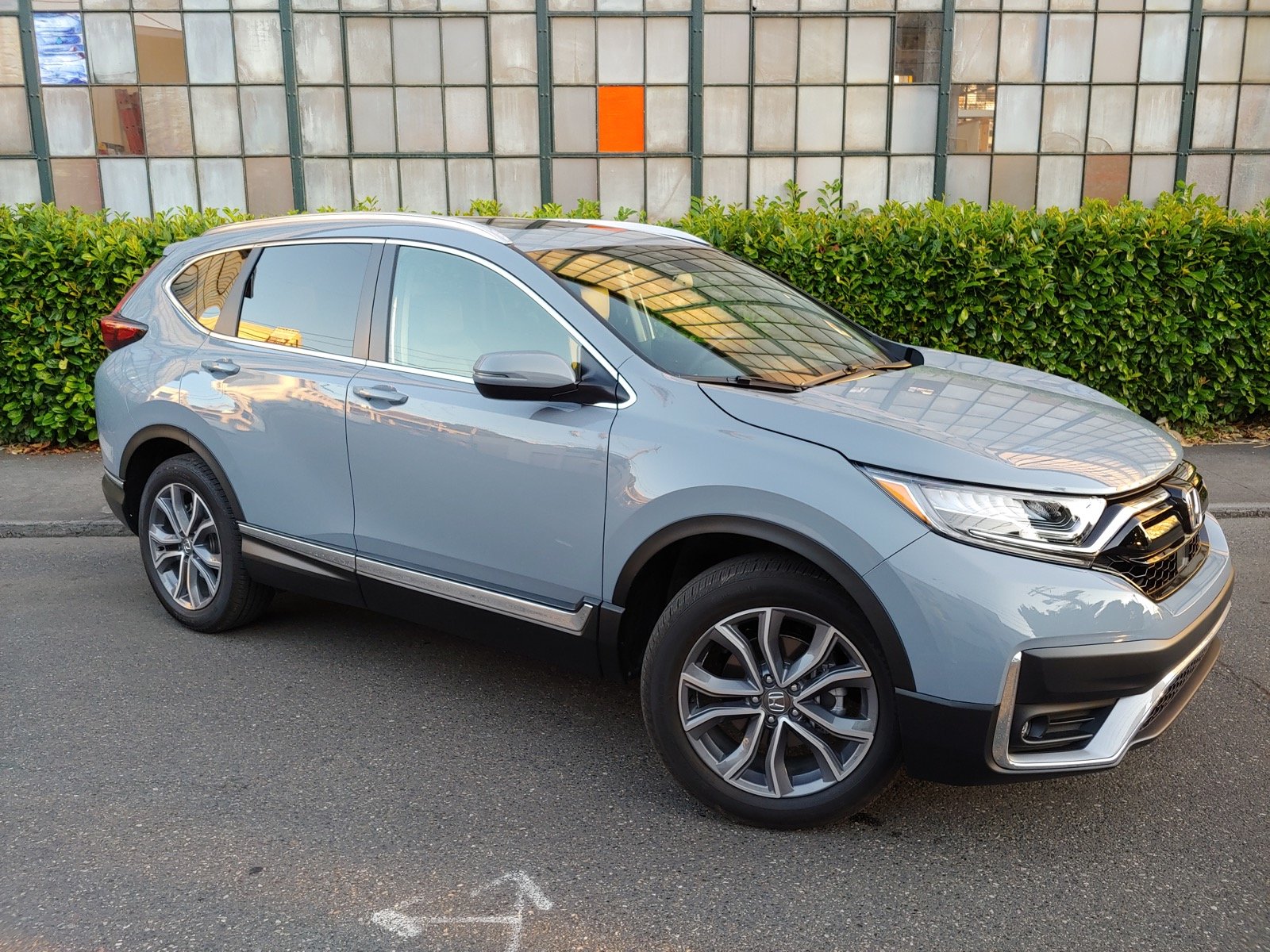
In contrast, the 2020 Honda CR-V, which had been on the market since the 2017 model year, showcased a design that was already familiar and widely appreciated. Honda’s designers favored curvier, more car-like lines, granting the CR-V a family resemblance to Honda’s sedans. Its overall design leaned more towards a station wagon than an SUV, establishing it as a modern family vehicle stylistically.
Inside, however, the CR-V presented a complex mix of materials. While higher trims featured wood-look trim and leather upholstery, these elements often clashed with low-quality plastics, reminding occupants of the CR-V's origins as a more affordable vehicle.
The CR-V started at $26,270 for the base FWD LX trim and offered simplicity in its four trim levels: LX, EX, EX-L, and Touring. AWD was available for an additional $1,500 across the lineup. Wheel sizes varied by trim, with 17-inch alloys standard and sizes increasing up to 19 inches on the Touring. The CR-V's fabric seats in lower trims could be upgraded to leather in higher trims, and a retractable moonroof was standard in all but the base LX trim.


The 2020 Toyota RAV4 featured a robust 2.5-liter 4-cylinder engine that delivered 203 horsepower and 184 pound-feet of torque. For those seeking better fuel efficiency, Toyota also offered a hybrid variant with up to 40 mpg in combined driving and 219 horsepower, though the TRD Off-Road trim did not include this hybrid option. An 8-speed automatic transmission handled power delivery, and while it generally performed well, it occasionally hesitated in gear selection.
The TRD Off-Road model's torque-vectoring AWD and multi-terrain select settings (Snow, Mud & Sand, and Rock & Dirt) combined with its 8.6-inch ground clearance, made it highly capable off-road. The SUV also featured Eco, Normal, and Sport driving modes for regular driving, alongside a downhill assist control system.
During practical use, the RAV4 TRD Off-Road excelled in urban environments, handling speed humps adeptly and navigating tight parking spots with the help of a 360-degree camera system. The test vehicle’s fuel economy averaged 23.4 mpg, slightly below the EPA’s estimate of 27 mpg in combined driving.
Meanwhile, the 2020 Honda CR-V received an updated 1.5-liter turbocharged 4-cylinder engine standard across all trims, producing 190 horsepower and 179 pound-feet of torque. This engine, paired with a continuously variable automatic transmission (CVT), provided a well-matched powertrain. The CVT, often criticized for sluggishness, performed effectively in the CR-V, delivering a responsive, car-like driving experience, especially in Sport mode.
The CR-V’s nimble handling, low curb weight of 3,337 pounds for the FWD LX model, and excellent fuel economy (30 mpg combined for FWD, 29 mpg for AWD) positioned it favorably in its class. The suspension provided a firm yet comfortable ride with minimal body roll, making it feel more like driving a small sedan than an SUV.
The RAV4 TRD Off-Road provided easy entry and exit, with seating positions designed for comfort, especially the 8-way adjustable driver’s seat. The SofTex upholstery in this trim, notorious for trapping heat, was best complemented by the Weather Package, which added heated and ventilated front seats and a heated steering wheel.
The rear seats offered ample legroom, making long journeys comfortable for both adults and children. Interior storage was plentiful, with a useful dashboard shelf and a total cargo capacity of 37.6 cubic feet behind the rear seats, expandable to 69.8 cubic feet with the seats folded. The vehicle’s test model also featured a sturdy roof rack, enhancing its utility.
The 2020 Honda CR-V excelled in packaging, offering a spacious cabin without feeling oversized. Its excellent seating position provided good head- and legroom, while the cargo area matched the class-leading Volkswagen Tiguan in volume. The CR-V featured a two-position load floor in the rear, offering flexibility between maximizing cargo space and creating a flat floor with the rear seats folded, resulting in an impressive 75.8 cubic feet of cargo space.
Clever storage solutions included a deep center console bin with a sliding cover, influenced by the design seen in Honda’s Odyssey minivan, and large door pockets extending behind the lower door panels. These thoughtful touches made the CR-V adept at handling day-to-day storage needs effectively.
The 2020 Toyota RAV4’s technology offerings were modern and user-friendly. Depending on the trim, it featured either a 7- or 8-inch touchscreen, although the latter could suffer from glare. The inclusion of Bluetooth, Apple CarPlay, Android Auto, Amazon Alexa, and SiriusXM was standard. The vehicle also offered a 4G LTE WiFi hotspot with a free three-month trial.
The RAV4 TRD Off-Road model boasted an intuitive infotainment system with useful voice-recognition technology. The test vehicle's optional Technology Package added wireless smartphone charging, a 360-degree surround-view camera, and a digital rear-view mirror with adjustable camera settings.
Conversely, the 2020 Honda CR-V’s infotainment system showed its age. The base LX trim came with a 5-inch screen, while higher trims featured a 7-inch touchscreen that was still smaller than desired. The system lacked hard buttons and depended on touch inputs, complicating operation. While Apple CarPlay and Android Auto were available on higher trims, they felt poorly integrated. Only the Touring trim received built-in navigation and wireless phone charging.
However, the CR-V did boast plentiful USB ports in the EX trim and above, ensuring all passengers remained connected on the go.
The 2020 RAV4 included Toyota Safety Sense 2.0, a suite of advanced safety features such as a Pre-Collision System with Pedestrian Detection, radar adaptive cruise control, lane departure alert with steering assist, and rear cross-traffic alert. The system performed smoothly, encouraging drivers to utilize these features.
Additionally, the RAV4 offered a free 1-year subscription to Safety Connect services, including automatic collision notification and SOS emergency assistance. The IIHS awarded the RAV4 a Top Safety Pick designation for models equipped with LED adaptive headlights.
Similarly, the 2020 Honda CR-V came with the “Honda Sensing” suite as standard, including forward-collision warning, automatic emergency braking, road-departure mitigation, and adaptive cruise control with lane-keeping assist. Higher trims added blind-spot monitoring and cross-traffic alert.
The CR-V earned a five-star rating from NHTSA and a Top Safety Pick designation from IIHS, although the latter was limited to Touring models due to improved LED headlights. The CR-V also faced a recall for rear subframe failure, affecting a limited number of vehicles.
CarGurus highlights

According to CarGurus experts, the overall rating for the 2020 Toyota RAV4 is 8.7 out of 10, while the 2020 Honda CR-V scores 7.5 out of 10. Given these ratings, if you’re deciding between these two vehicles, the 2020 Toyota RAV4 comes out on top for its modern technological offerings, robust off-road capabilities, and comprehensive safety features, making it the preferred choice in this comparison.
Choose the 2020 Honda CR-V if:
- You value a spacious and cleverly designed interior with excellent cargo capacity.
- You appreciate nimble, car-like handling and excellent fuel economy.
- You need a vehicle equipped with essential advanced safety features even at the base trim.




Choose the 2020 Toyota RAV4 if:
- You desire off-road capabilities combined with advanced driving modes and higher ground clearance.
- You prioritize a user-friendly and modern infotainment system with extensive connectivity options.
- You seek a vehicle with a comprehensive suite of standard safety features and excellent reliability.




CarGurus highlights
According to CarGurus experts, the overall rating for the 2020 Toyota RAV4 is 8.7 out of 10, while the 2020 Honda CR-V scores 7.5 out of 10. Given these ratings, if you’re deciding between these two vehicles, the 2020 Toyota RAV4 comes out on top for its modern technological offerings, robust off-road capabilities, and comprehensive safety features, making it the preferred choice in this comparison.
Choose the 2020 Honda CR-V if:
Shop Now- You value a spacious and cleverly designed interior with excellent cargo capacity.
- You appreciate nimble, car-like handling and excellent fuel economy.
- You need a vehicle equipped with essential advanced safety features even at the base trim.





Choose the 2020 Toyota RAV4 if:
Shop Now- You desire off-road capabilities combined with advanced driving modes and higher ground clearance.
- You prioritize a user-friendly and modern infotainment system with extensive connectivity options.
- You seek a vehicle with a comprehensive suite of standard safety features and excellent reliability.






By: CarGurus + AI
At CarGurus, our team of experienced automotive writers remain at the heart of our content operation, conducting hands-on car tests and writing insightful guides that are backed by years of industry experience. To complement this, we are harnessing AI to make our content offering more diverse and more helpful to shoppers than ever. To achieve this, our AI systems are based exclusively on CarGurus content, ratings and data, so that what we produce is both unique to CarGurus, and uniquely helpful to car shoppers.