2020 Honda CR-V vs 2021 Toyota RAV4

Overview | |
MSRP$25,150 | MSRP$26,350 |
Listings1518 | Listings1871 |
Ratings & Reviews | |
User Reviews | User Reviews |
Expert reviews7.5 out of 10 | Expert reviews7.3 out of 10 |
Pros
Cons
| Pros
Cons
|
2020 Honda CR-V Reviews SummaryHonda’s compact SUV has been satisfying buyers for more than two decades, with more than five million CR-V’s sold. Such a legacy means the CR-V has long had its wrinkles smoothed out into a comfortable and capable crossover package that’s only downside may be its sheer inoffensiveness. This year’s model gets engine and safety upgrades, which improve fuel economy and help to make Honda’s bestseller an even better value. | |
2021 Toyota RAV4 Reviews SummarySince its launch in 1997, the Toyota RAV4 has ridden a wave of crossover SUV popularity to become one of Toyota’s bestselling models. Introduced for the 2019 model year, the current-generation RAV4 tries to offer the rugged style of a traditional SUV, but underneath it’s still a car-based crossover pitched against the likes of the Ford Escape, Honda CR-V, Hyundai Tucson, Kia Sportage, Nissan Rogue, Subaru Forester, and Volkswagen Tiguan. Because it’s only in its third model year, this fifth-generation RAV4 doesn’t get many updates for 2021. The biggest news is the addition of the RAV4 Prime plug-in hybrid to the lineup, but that model actually went on sale last year. The only other changes are a new XLE Premium trim level for the RAV4 Hybrid, and a new front stainless steel front skid plate for the gasoline RAV4 TRD Off-Road model. Toyota offers compact SUV buyers more choices than most competitors. The RAV4 LE, XLE, XLE Premium, and Limited trim levels are available with hybrid and non-hybrid powertrains. Toyota also offers the gasoline-only RAV4 Adventure and TRD Off-Road trim levels, plus the RAV4 Hybrid XSE. The RAV4 Prime is also available in two trim levels—SE and XSE. We’ve covered the RAV4 Hybrid and RAV4 Prime in separate reviews, so this review will focus on the gasoline RAV4. Our test car was a RAV4 TRD Off-Road, which joined the lineup for the 2020 model year and is the first RAV4 model tuned by Toyota Racing Development, the automaker’s North American performance division. | |
No video found | No video found |
Popular Features & Specs | |
Engine1.5L 190 hp I4 | Engine2.5L 203 hp I4 |
Drive TrainFWD | Drive TrainFWD |
Seating Capacity5 | Seating Capacity5 |
Horsepower190 hp @ 5600 rpm | Horsepower |
MPG City28 | MPG City28 |
MPG Highway34 | MPG Highway35 |
Engine | |
Engine Name1.5L 190 hp I4 | Engine Name2.5L 203 hp I4 |
Torque179 lb-ft @ 2000 rpm | Torque |
Horsepower190 hp @ 5600 rpm | Horsepower |
DrivetrainFWD | DrivetrainFWD |
Fuel Economy | |
MPG City28 | MPG City28 |
MPG Highway34 | MPG Highway35 |
Interior | |
Seating Capacity5 | Seating Capacity5 |
Safety | |
Front Crash Overall5 | Front Crash Overall4 |
Side Crash Overall5 | Side Crash Overall5 |
Dimensions & Capacity | |
Cargo Space39.2 cu ft | Cargo Space37.6 cu ft |
Curb Weight3337 lbs | Curb Weight3370 lbs |
Height66.1 in | Height67.0 in |
Length182.1 in | Length180.9 in |
Width73.0 in | Width73.0 in |
Wheelbase104.8 in | Wheelbase105.9 in |
Maximum Payload1358 lbs | Maximum Payload1240 lbs |
Number of doors4 | Number of doors4 |
Maximum Towing Capacity1500 lbs | Maximum Towing Capacity1500 lbs |
Overview | ||
MSRP | $25,150 | $26,350 |
Listings | ||
Ratings & Reviews | ||
User reviews | ||
Expert reviews | 7.5 out of 10Read full review | 7.3 out of 10Read full review |
Pros & cons | Pros
Cons
| Pros
Cons
|
Summary | Honda’s compact SUV has been satisfying buyers for more than two decades, with more than five million CR-V’s sold. Such a legacy means the CR-V has long had its wrinkles smoothed out into a comfortable and capable crossover package that’s only downside may be its sheer inoffensiveness. This year’s model gets engine and safety upgrades, which improve fuel economy and help to make Honda’s bestseller an even better value. | Since its launch in 1997, the Toyota RAV4 has ridden a wave of crossover SUV popularity to become one of Toyota’s bestselling models. Introduced for the 2019 model year, the current-generation RAV4 tries to offer the rugged style of a traditional SUV, but underneath it’s still a car-based crossover pitched against the likes of the Ford Escape, Honda CR-V, Hyundai Tucson, Kia Sportage, Nissan Rogue, Subaru Forester, and Volkswagen Tiguan. Because it’s only in its third model year, this fifth-generation RAV4 doesn’t get many updates for 2021. The biggest news is the addition of the RAV4 Prime plug-in hybrid to the lineup, but that model actually went on sale last year. The only other changes are a new XLE Premium trim level for the RAV4 Hybrid, and a new front stainless steel front skid plate for the gasoline RAV4 TRD Off-Road model. Toyota offers compact SUV buyers more choices than most competitors. The RAV4 LE, XLE, XLE Premium, and Limited trim levels are available with hybrid and non-hybrid powertrains. Toyota also offers the gasoline-only RAV4 Adventure and TRD Off-Road trim levels, plus the RAV4 Hybrid XSE. The RAV4 Prime is also available in two trim levels—SE and XSE. We’ve covered the RAV4 Hybrid and RAV4 Prime in separate reviews, so this review will focus on the gasoline RAV4. Our test car was a RAV4 TRD Off-Road, which joined the lineup for the 2020 model year and is the first RAV4 model tuned by Toyota Racing Development, the automaker’s North American performance division. |
Video | No video found | No video found |
Popular Features & Specs | ||
Engine | 1.5L 190 hp I4 | 2.5L 203 hp I4 |
Drive Train | FWD | FWD |
Seating Capacity | 5 | 5 |
Horsepower | 190 hp @ 5600 rpm | |
MPG City | 28 | 28 |
MPG Highway | 34 | 35 |
Engine | ||
Engine Name | 1.5L 190 hp I4 | 2.5L 203 hp I4 |
Torque | 179 lb-ft @ 2000 rpm | |
Horsepower | 190 hp @ 5600 rpm | |
Drivetrain | FWD | FWD |
Fuel Economy | ||
MPG City | 28 | 28 |
MPG Highway | 34 | 35 |
Interior | ||
Seating Capacity | 5 | 5 |
Safety | ||
Front Crash Overall | 5 | 4 |
Side Crash Overall | 5 | 5 |
Dimensions & Capacity | ||
Cargo Space | 39.2 cu ft | 37.6 cu ft |
Curb Weight | 3337 lbs | 3370 lbs |
Height | 66.1 in | 67.0 in |
Length | 182.1 in | 180.9 in |
Width | 73.0 in | 73.0 in |
Wheelbase | 104.8 in | 105.9 in |
Maximum Payload | 1358 lbs | 1240 lbs |
Number of doors | 4 | 4 |
Maximum Towing Capacity | 1500 lbs | 1500 lbs |
The 2020 Honda CR-V, a staple from Honda’s compact crossover portfolio since 2017, carried an exterior design that was as familiar as it was enjoyable. Honda’s designers kept to a soft approach, resulting in curvy and car-like lines. The CR-V displayed a family resemblance to Honda’s sedans, noticeable in its front and rear fascias, while leaning more towards a station wagon than an SUV. This exterior styling exemplified modern family transportation.
Inside the CR-V, however, the scene was mixed. The interior, though featuring some nice textures and materials like wood-look trim and leather upholstery in pricier models, was interrupted by low-quality plastics. These juxtapositions reminded drivers that even high-end CR-V models were just upgraded versions of a basic commodity car, rather than truly premium products.
The base CR-V, starting at an MSRP of $26,270, came in four trims: LX, EX ($28,720), EX-L ($31,270), and the $33,470 Touring. All-wheel drive (AWD) was a $1,500 option across all trims. Notably, the CR-V offered standard 17-inch alloy wheels, with EX models getting 18-inch wheels and Touring models getting optional 19-inchers. Fabric seating adorned the two lower trims, while genuine leather was available on the higher trims. Roof rails, only fitted on the Touring model, were low profile.
Conversely, the 2021 Toyota RAV4 presented a rugged and adventurous exterior, reminiscent of traditional SUVs. The boxy fender flares, chiseled taillights, and a scowling front end sharply contrasted the softer, approachable looks of previous generations. The aggressive styling of the RAV4 stood out in the family car segment, projecting it as more than an ordinary vehicle.
The RAV4’s interior echoed this rugged persona, with large rubberized knobs and door handles designed not only for function but also for distinction. Despite this, the material quality did not significantly improve with higher trim levels. The TRD Off-Road model featured SofTex upholstery, a durable substitute to leather that befitted its outdoorsy nature. Unlike the Honda CR-V, real leather was not available, even on the top-of-the-line RAV4 Limited.


In 2020, Honda decided to streamline the CR-V lineup by standardizing the 1.5-liter turbocharged engine, which produced 190 horsepower and 179 pound-feet of torque. This engine was paired with a continuously variable automatic transmission (CVT). Despite common criticisms of CVTs, Honda’s engineers managed to make it reasonably responsive, ensuring the vehicle felt quick, especially in Sport mode. The CR-V's performance was distinctively car-like with balanced steering and nimble handling, contributing to an agile drive.
Weighing in at a mere 3,337 pounds for the FWD LX model, the CR-V was one of the lightest vehicles in its class, contributing to both its acceleration and handling. Fuel economy was efficient as well, with FWD models rated at 30 mpg combined and AWD versions at 29 mpg. The 2020 CR-V aligned with top competitors like the Subaru Forester and outperformed the Ford Escape and Toyota RAV4 by 1 mpg.
The 2021 Toyota RAV4, on the other hand, featured a 2.5-liter “Dynamic Force” inline-four engine generating 203 horsepower and 184 pound-feet of torque. This engine, paired with an eight-speed automatic transmission, promised impressive thermal efficiency. Yet, the gearbox’s sluggish and hesitant shifts translated to a frustrating driving experience. The steering, though quick to respond, lacked feel, leading to a detachment similar to a video game.
The RAV4 also included a “Sport” mode, but the added steering weight detracted more than it added. While equipped for off-road excursions, with a respectable ground clearance of 8.6 inches and a 3,500-pound towing capacity for Adventure and TRD Off-Road models, the RAV4’s on-road dynamics were less compelling. The TRD Off-Road’s specific suspension tuning and all-terrain tires fortified its off-road capability, making it capable of handling rugged terrains better than most crossovers.
Honda's reputation for expert cabin design shone through in the 2020 CR-V. Offering ample space comparable to the Volkswagen Tiguan, the CR-V’s cabin felt roomy without the bulkiness. Both head- and legroom were ample, accentuated by excellent seating positions and visibility. The cargo space, matching the Tiguan despite a shorter body length, offered 75.8 cubic feet with the rear seats folded.
The CR-V exhibited clever storage features, like a deep center console with a sliding cover and a two-position load floor in the rear. These smart designs maximized cargo capacity, making the CR-V a pragmatic choice for families needing versatile storage solutions. Even the door pockets offered extended space for extra storage.
The 2021 RAV4’s tall and upright roof provided generous headroom, and its extensive glass offered good visibility. However, legroom lagged behind some competitors. The front seats in the TRD Off-Road model were comfortable, but the rear seat cushions were flat and hard, detracting from long-journey comfort. The RAV4’s rear bench did not slide fore and aft, unlike the Ford Escape and Nissan Rogue.
Cargo space was notable, with 37.6 cubic feet available behind the rear seats, which was good but not class-leading compared to the CR-V. The higher cargo lip also made loading more cumbersome.
The 2020 Honda CR-V showed its age in terms of technology, with the base LX trim featuring an insufficient 5-inch screen with basic functionalities like Bluetooth and Pandora compatibility. The 7-inch touchscreen on higher trims still felt small compared to competitors and lacked the convenience of physical buttons, making it challenging to operate.
Honda equipped mid-range trims with two front USB ports and two high-powered rear ports, but only the top Touring trim offered a wireless phone charger. The overall infotainment experience, even with Apple CarPlay and Android Auto, was mediocre due to poor integration and user interface design.
Conversely, the 2021 RAV4 offered better standard technology. It included Apple CarPlay, Android Auto, Amazon Alexa, and SiriusXM. Most trims had a 7-inch touchscreen, with Limited trims getting an 8-inch screen and the RAV4 Prime featuring a 9-inch screen. Up to five USB ports were available, accompanied by a JBL premium audio system option.
The RAV4’s infotainment system, while straightforward and functional, wasn’t impressive. The screen was conveniently placed, with clear graphics and essential shortcut buttons. However, it wasn’t flashy, and certain advanced features like a head-up display were reserved only for the RAV4 Prime.
The 2020 Honda CR-V came with the comprehensive “Honda Sensing” system as standard, even at the base LX trim, providing features like forward-collision warning with automatic emergency braking, road-departure mitigation, and adaptive cruise control with lane-keeping assist. Higher trims like the EX and above included blind-spot and cross-traffic monitoring. In crash tests, the CR-V earned a five-star rating from NHTSA and received the IIHS Top Safety Pick, with some caveats for non-LED headlight trims.
The 2021 Toyota RAV4 also excelled in safety, earning a Top Safety Pick from IIHS and a five-star overall rating from NHTSA. The RAV4’s standard Toyota Safety Sense 2.0 offered a robust array of features like forward-collision warning, adaptive cruise control, and lane-departure warning with steering assist. Higher trims added blind-spot monitoring, rear cross-traffic alert, and park assist. However, mixed headlight scores prevented it from achieving the highest IIHS rating.
CarGurus highlights
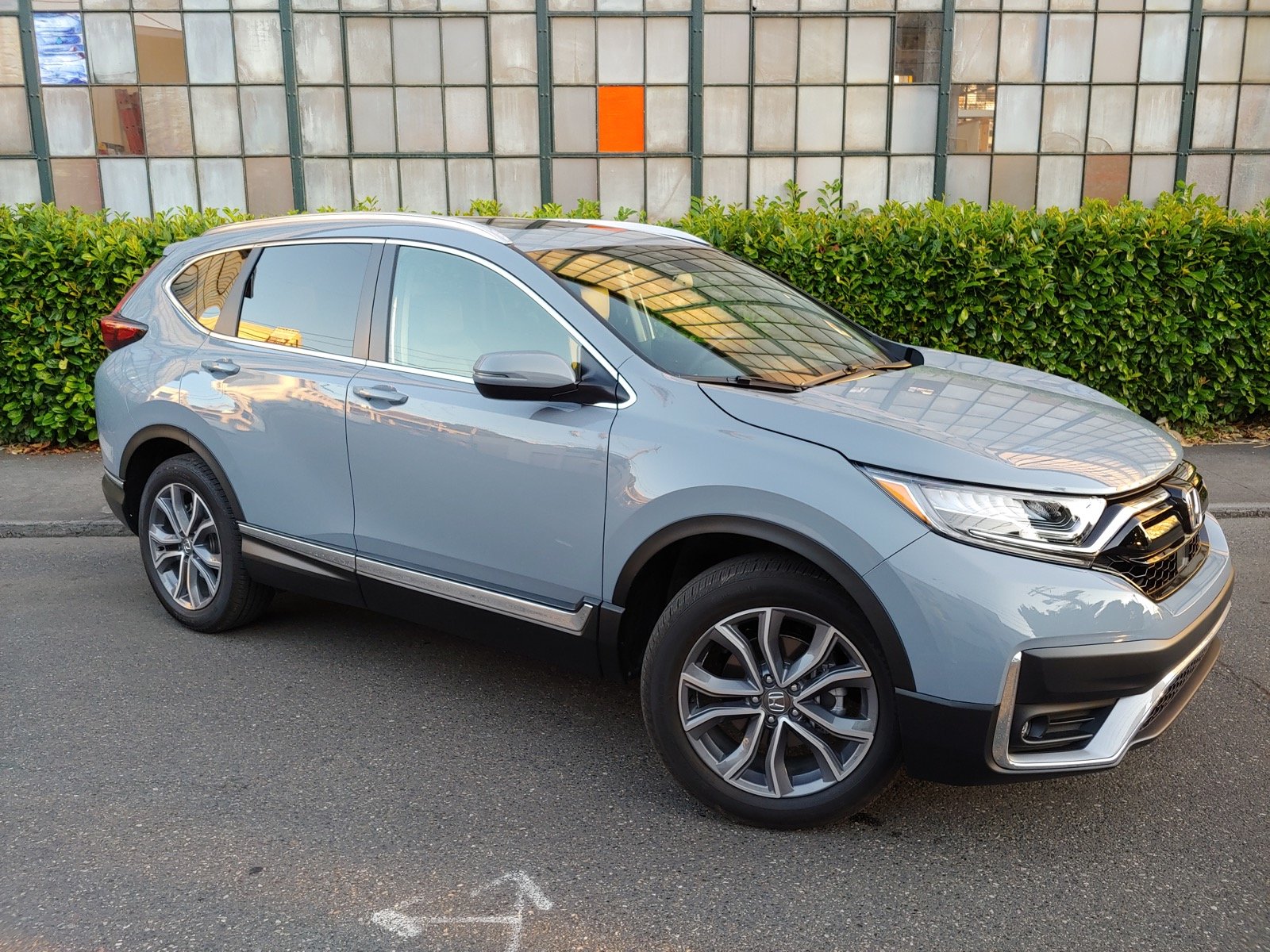
According to CarGurus experts, the overall rating for the 2020 Honda CR-V is 7.5 out of 10, while the 2021 Toyota RAV4 scores 7.3 out of 10. Based on these ratings, the clear recommendation is the 2020 Honda CR-V. Its superior fuel economy, more spacious interior, and balanced driving dynamics make it a highly versatile and practical choice for most consumers. The CR-V’s high level of standard safety features and favorable crash-test ratings further solidify its edge over the RAV4.
Choose the 2020 Honda CR-V if:
- You prioritize interior roominess and cargo space without the bulkiness of larger vehicles.
- You prefer a car-like drive with good fuel economy and nimble handling.
- You want a high level of standard safety features and excellent crash-test ratings.



Choose the 2021 Toyota RAV4 if:
- You are looking for rugged, SUV-like styling and off-road capabilities.
- You value standard advanced safety features and a strong overall safety rating.
- You desire modern infotainment options and the flexibility of larger or more advanced screen sizes.




CarGurus highlights
According to CarGurus experts, the overall rating for the 2020 Honda CR-V is 7.5 out of 10, while the 2021 Toyota RAV4 scores 7.3 out of 10. Based on these ratings, the clear recommendation is the 2020 Honda CR-V. Its superior fuel economy, more spacious interior, and balanced driving dynamics make it a highly versatile and practical choice for most consumers. The CR-V’s high level of standard safety features and favorable crash-test ratings further solidify its edge over the RAV4.
Choose the 2020 Honda CR-V if:
Shop Now- You prioritize interior roominess and cargo space without the bulkiness of larger vehicles.
- You prefer a car-like drive with good fuel economy and nimble handling.
- You want a high level of standard safety features and excellent crash-test ratings.







Choose the 2021 Toyota RAV4 if:
Shop Now- You are looking for rugged, SUV-like styling and off-road capabilities.
- You value standard advanced safety features and a strong overall safety rating.
- You desire modern infotainment options and the flexibility of larger or more advanced screen sizes.






By: CarGurus + AI
At CarGurus, our team of experienced automotive writers remain at the heart of our content operation, conducting hands-on car tests and writing insightful guides that are backed by years of industry experience. To complement this, we are harnessing AI to make our content offering more diverse and more helpful to shoppers than ever. To achieve this, our AI systems are based exclusively on CarGurus content, ratings and data, so that what we produce is both unique to CarGurus, and uniquely helpful to car shoppers.