2020 Toyota RAV4 Hybrid vs 2021 Toyota Highlander
Overview | |
MSRP$28,350 | MSRP$35,085 |
Listings578 | Listings1369 |
Ratings & Reviews | |
User Reviews | User Reviews |
Expert reviews8.7 out of 10 | Expert reviews7.5 out of 10 |
Pros
Cons
| Pros
Cons
|
2020 Toyota RAV4 Hybrid Reviews SummaryThe RAV4 Hybrid offers a nearly perfect package of compact crossover attributes: Standard all-wheel drive, a roomy passenger compartment, and excellent fuel economy. It’s a pretty good value, too, with pricing starting at $29,470, which includes plenty of standard multimedia and safety features. It’s no wonder sales of the hybrid version of Toyota’s bestseller almost doubled in 2019. | |
2021 Toyota Highlander Reviews SummaryToyota hardly needs any help selling three-row Highlanders. It already sits close to the top of the sales charts for its segment, and few vehicles carry the name recognition as the Highlander, which enters into its 20th year of production. But the three-row marketplace is a competitive one, and even after a 2020 redesign, Toyota would be foolish to rest on its laurels. As such, the Highlander enters this year with additional safety-feature technology listed as standard equipment. | |
No video found | |
Popular Features & Specs | |
Engine2.5L 219 hp I4 Hybrid | Engine3.5L 295 hp V6 |
Drive TrainAWD | Drive TrainFWD |
Seating Capacity5 | Seating Capacity8 |
Horsepower | Horsepower295 hp @ 6600 rpm |
EV Battery Capacity1.6 kWh | EV Battery Capacity |
MPG City41 | MPG City20 |
MPG Highway38 | MPG Highway28 |
Engine | |
Engine Name2.5L 219 hp I4 Hybrid | Engine Name3.5L 295 hp V6 |
Torque | Torque263 lb-ft @ 4700 rpm |
Horsepower | Horsepower295 hp @ 6600 rpm |
DrivetrainAWD | DrivetrainFWD |
Fuel Economy | |
EV Battery Capacity1.6 kWh | EV Battery Capacity |
MPG City41 | MPG City20 |
MPG Highway38 | MPG Highway28 |
Interior | |
Seating Capacity5 | Seating Capacity8 |
Safety | |
Front Crash Overall4 | Front Crash Overall4 |
Side Crash Overall5 | Side Crash Overall5 |
Dimensions & Capacity | |
Cargo Space37.6 cu ft | Cargo Space16.0 cu ft |
Curb Weight3710 lbs | Curb Weight4145 lbs |
Height67.0 in | Height68.1 in |
Length180.9 in | Length194.9 in |
Width73.0 in | Width76.0 in |
Wheelbase105.9 in | Wheelbase112.2 in |
Maximum Payload1210 lbs | Maximum Payload1685 lbs |
Number of doors4 | Number of doors4 |
Maximum Towing Capacity1750 lbs | Maximum Towing Capacity5000 lbs |
Overview | ||
MSRP | $28,350 | $35,085 |
Listings | ||
Ratings & Reviews | ||
User reviews | ||
Expert reviews | 8.7 out of 10Read full review | 7.5 out of 10Read full review |
Pros & cons | Pros
Cons
| Pros
Cons
|
Summary | The RAV4 Hybrid offers a nearly perfect package of compact crossover attributes: Standard all-wheel drive, a roomy passenger compartment, and excellent fuel economy. It’s a pretty good value, too, with pricing starting at $29,470, which includes plenty of standard multimedia and safety features. It’s no wonder sales of the hybrid version of Toyota’s bestseller almost doubled in 2019. | Toyota hardly needs any help selling three-row Highlanders. It already sits close to the top of the sales charts for its segment, and few vehicles carry the name recognition as the Highlander, which enters into its 20th year of production. But the three-row marketplace is a competitive one, and even after a 2020 redesign, Toyota would be foolish to rest on its laurels. As such, the Highlander enters this year with additional safety-feature technology listed as standard equipment. |
Video | No video found | |
Popular Features & Specs | ||
Engine | 2.5L 219 hp I4 Hybrid | 3.5L 295 hp V6 |
Drive Train | AWD | FWD |
Seating Capacity | 5 | 8 |
Horsepower | 295 hp @ 6600 rpm | |
EV Battery Capacity | 1.6 kWh | |
MPG City | 41 | 20 |
MPG Highway | 38 | 28 |
Engine | ||
Engine Name | 2.5L 219 hp I4 Hybrid | 3.5L 295 hp V6 |
Torque | 263 lb-ft @ 4700 rpm | |
Horsepower | 295 hp @ 6600 rpm | |
Drivetrain | AWD | FWD |
Fuel Economy | ||
EV Battery Capacity | 1.6 kWh | |
MPG City | 41 | 20 |
MPG Highway | 38 | 28 |
Interior | ||
Seating Capacity | 5 | 8 |
Safety | ||
Front Crash Overall | 4 | 4 |
Side Crash Overall | 5 | 5 |
Dimensions & Capacity | ||
Cargo Space | 37.6 cu ft | 16.0 cu ft |
Curb Weight | 3710 lbs | 4145 lbs |
Height | 67.0 in | 68.1 in |
Length | 180.9 in | 194.9 in |
Width | 73.0 in | 76.0 in |
Wheelbase | 105.9 in | 112.2 in |
Maximum Payload | 1210 lbs | 1685 lbs |
Number of doors | 4 | 4 |
Maximum Towing Capacity | 1750 lbs | 5000 lbs |
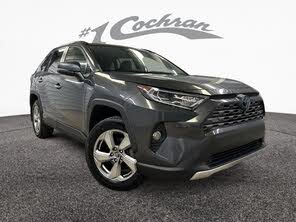
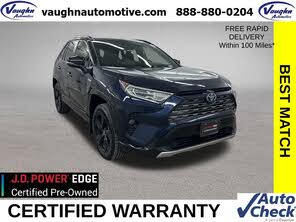
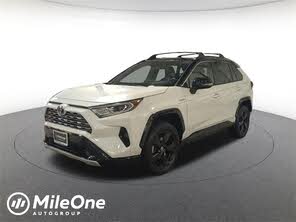
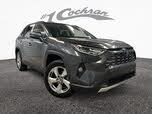
In 2020, the Toyota RAV4 Hybrid presented an entirely new design aesthetic as compared to its predecessors. Redesigned in 2019, the latest model abandoned the previous soft-roader styling for a more rugged and angular appearance, especially evident in the front fascia. The front of the RAV4 Hybrid featured stacked, trapezoidal apertures and a perforated grille giving it a mean and mechanical look that invoked the design language of Toyota's notable off-roader, the 4Runner. Complementary dark trim around the wheel wells and doorsills was a clear signal that this was more than just a thrifty grocery-getter; it was designed to be an adventure machine capable of tackling off-road terrains.
Available in four trims—LE, XLE, XSE, and Limited—the RAV4 Hybrid offered different aesthetic packages. Lower trims featured 17-inch wheels, while the XSE and Limited trims came with 18-inch wheels and tires that filled out the wheel wells more convincingly. Standard LED headlights and taillights provided ample illumination, although adaptive headlights that adjusted the beam sweep with steering were only available on the top trim.
Inside, the RAV4 Hybrid kept things simple and functional. While lacking in luxury materials like leather, it offered high-quality Softex upholstery even in the base trims. The cabin's overall design emphasized functionality, featuring shiny bits of trim that looked tasteful rather than cheap. The interior plastics and materials, although not as refined as some competitors like the Honda CR-V Hybrid, still offered a pleasing and coherent aesthetic.
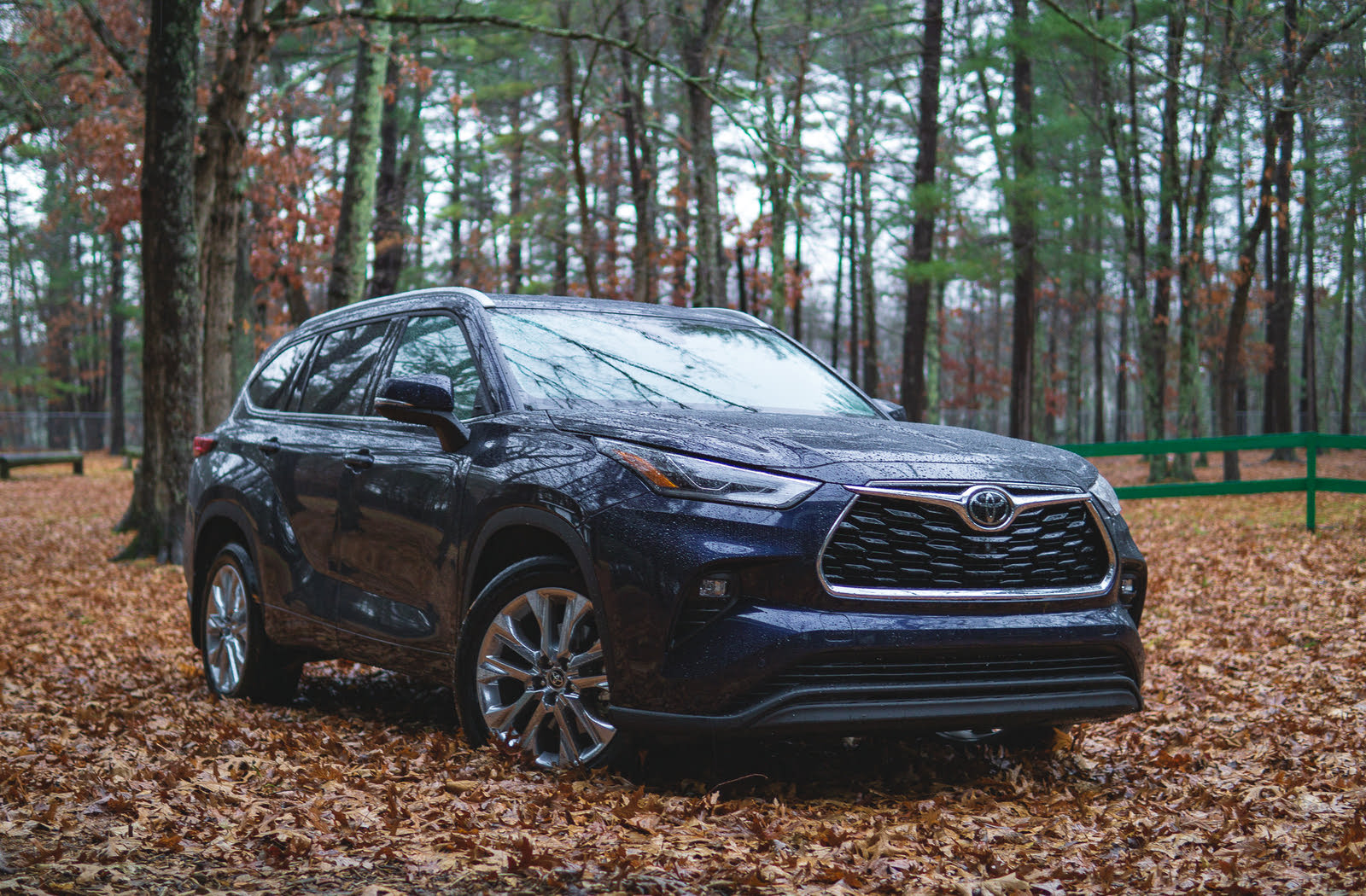
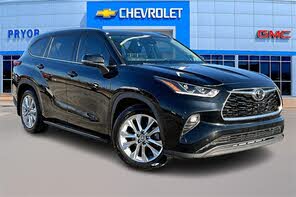
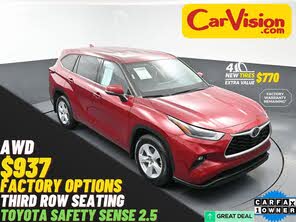
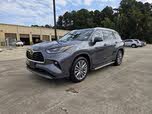
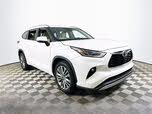
The 2021 Toyota Highlander, aimed to stand out among midsize SUVs and crossovers. It avoided the bland styling that plagued some of its competitors, presenting a distinct and appealing look. The front end wasn’t as dramatic as the bullet-train-inspired 2021 Sienna minivan but made a statement with wide headlights, a long hood, and an assertive, trapezoidal grille. A character line reminiscent of the Toyota Supra added dynamic interest to the profile, while the rear taillights were inspired by Lexus designs, although missing the vertical element.
The addition of the XSE trim introduced a sportier aesthetic to the Highlander lineup, featuring a more aggressive front end, a unique front fascia, and larger lower air intake, all complemented by 20-inch wheels with black accents. The Limited trim, featuring chrome roof rails and accents, looked stately and upscale, and it was this trim that especially shone when it came to the vehicle’s interior. Near-flawless fit and finish, tactile steering wheel, and refined trim materials, such as tan leather seats and dark brown accents, elevated the Limited trim. Even if the wood details were faux, they looked superb and added a touch of sophistication.


The 2020 Toyota RAV4 Hybrid wasn’t just about a rugged outward appearance; its powertrain offered compelling performance figures too. The hybrid system combined a 2.5-liter, 176-horsepower four-cylinder gasoline engine with two electric motors to generate a combined output of 219 horsepower, 16 more than the standard gasoline version. The RAV4 Hybrid boasted a combined EPA fuel economy rating of 40 miles per gallon, a significant improvement over the previous generation’s rating by eight mpg. Notably, we consistently achieved this rating during our tests.
The powertrain was noteworthy for its clever design. The first electric motor inside the hybrid transaxle delivered up to 118 hp to the front wheels, while a second electric motor under the cargo floor provided 54 hp to the rear wheels. This eliminated the need for a heavy driveshaft, making the RAV4 Hybrid weigh only about 200 pounds more than the standard model. This configuration optimized both handling and fuel economy. Smooth on-road behavior, easy handling thanks to light steering, and suspension tuned for comfort made the RAV4 Hybrid an excellent daily driver. Though not particularly sporty, the vehicle excelled in providing a seamless driving experience, with regenerative braking and electric motor assist working almost imperceptibly.
The 2021 Toyota Highlander opted for a robust 3.5-liter V6 engine that produced 295 horsepower and 263 pound-feet of torque. Mated to an eight-speed automatic transmission, this powertrain powered either front-wheel-drive or all-wheel-drive configurations. The Highlander wasn’t built for speed or performance enthusiasts but provided reliable and predictable driving characteristics suitable for a family vehicle. It compared favorably with its competition, offering similar horsepower and torque figures to vehicles like the Kia Telluride and Hyundai Palisade.
The Highlander leaned towards comfort with its suspension setup, but the XSE trim introduced a mildly sporty edge with unique suspension tuning including higher-rated springs, retuned shock absorbers, and a rear stabilizer bar. These improvements made for a slightly more engaging drive but didn’t transform the Highlander into a performance-oriented machine. The overall driving experience leaned towards stability and comfort, reflecting its primary role as a family-oriented SUV.
The interior of the 2020 Toyota RAV4 Hybrid showcased excellent ergonomics and design sensibility. The standard 7-inch touchscreen (with an optional 8-inch upgrade) sat prominently atop the dashboard, flanked by intuitive hard buttons and knobs for volume and tuning. Climate controls were logically placed below a pair of vents, making them easy to access. The center console provided ample space with a compartment for cell phones, optional Qi wireless charging, two cupholders, and a sizable storage bin underneath the armrest.
One notable drawback was the cabin's noise levels. Although the hybrid system mitigated some of the engine noise, road noise still penetrated the cabin. Nevertheless, the interior remained comfortable, especially on long trips. The rear seat offered impressive legroom, accommodating three adults comfortably. The hybrid system didn’t compromise cargo space, allowing the RAV4 Hybrid to retain its 98.9 cubic feet of passenger volume and 37.6 cubic feet of cargo capacity—competitive numbers within its class.
The 2021 Toyota Highlander focused on family comfort and practicality in its interior design. A set of shelves ahead of the front seats provided ample storage for cell phones and other small items, cleverly designed with a pass-through for charging cords. Higher trims included a wireless charging pad within the center console. Second-row seats offered generous legroom and the ability to slide forward and backward to balance space between the middle and third rows. While third-row seats could technically accommodate adults, it would be a tight squeeze unless the second-row passengers made some sacrifices in comfort.
One critique involved the placement of rear-seat climate control vents on the ceiling, which blew air directly onto passengers’ heads. Cargo capacity started at 16 cubic feet behind the third row, expanding to 48.4 cubic feet with the seats folded down, and a maximum of 84.3 cubic feet with both the second and third rows folded flat. While these figures were sufficient for most needs, they were overshadowed by minivan capacities.
The 2020 Toyota RAV4 Hybrid marked a milestone with the introduction of Android Auto, joining Apple CarPlay which was offered earlier. Standard across all trims, these features provided excellent compatibility for smartphones. SiriusXM Radio also came standard with a 3-month trial. Toyota’s Entune multimedia software, while functional, paled in comparison to the user-friendly and visually appealing interfaces of Android Auto and Apple CarPlay.
Navigation through Toyota’s system couldn’t compete with Google Maps or Apple Maps, both of which were accessible through connected smartphones. WiFi Connect offered additional convenience with a 3-month, 2GB trial. Despite the forward-thinking USB-C becoming more common, the RAV4 Hybrid only featured USB-A ports, including one on the dash and four additional charge points in higher trims.
The RAV4 Hybrid also featured advanced predictive technology, such as Predictive Efficient Drive, which optimized hybrid system efficiency using data inputs including navigation and driver behavior. Multiple drive modes were available, including "Eco" for enhanced fuel efficiency, "Sport" for heightened performance, and "Trail" mode for optimized AWD in off-road conditions.
In contrast, the 2021 Toyota Highlander offered advanced technology but added extra appeal with options for a larger touchscreen. Lower trims came with an 8-inch screen, while the Limited trim had a 12.3-inch touchscreen available as an option, and it was standard on the Platinum trim. Both systems were easy to use, although built-in navigation had limitations in locating points of interest compared to Google Maps. Fortunately, Android Auto and Apple CarPlay were standard across the lineup.
The 12.3-inch touchscreen stood out for its brightness, clarity, and responsiveness, making for a pleasant user experience. The JBL audio system sounded good, though not groundbreaking. The design maintained physical controls, including volume and tuning knobs, enhancing user convenience. Despite its impressive display, certain apps were constrained to an 8-inch portion of the screen, questioning the value of the larger unit.
The 2020 Toyota RAV4 Hybrid packaged its safety features under Toyota Safety Sense 2.0 as standard. This included essential features such as a pre-collision system with automatic emergency braking and pedestrian detection, dynamic radar adaptive cruise control, lane-departure alert with steering assist, automatic high beams, lane-tracing assist, and road-sign assist. Additional options included blind-spot monitoring and front-and-rear parking assist with automated braking.
Safety ratings were commendable, with the NHTSA awarding the RAV4 Hybrid a five-star rating overall. The vehicle earned four stars in the frontal crash test, five in the side crash test, and four in the rollover test. Although the IIHS had not specifically tested the hybrid model, the standard RAV4 achieved a Top Safety Pick designation.
The 2021 Toyota Highlander elevated its safety suite to Toyota Safety Sense 2.5+ (TSS 2.5+). This upgrade introduced new features like automatic emergency braking with pedestrian detection and intersection support, which could engage emergency braking if an oncoming vehicle at an intersection posed a risk. The suite also included road sign assist, adaptive cruise control, lane-departure warning, lane-keeping assist, lane-tracing assist, and automatic high beams.
The Highlander received top safety ratings from both the NHTSA and IIHS. The NHTSA awarded it five out of five stars, while the IIHS honored it with a Top Safety Pick+.
CarGurus highlights

According to CarGurus experts, the overall rating for the 2020 Toyota RAV4 Hybrid is 8.7 out of 10, while the 2021 Toyota Highlander scores 7.5 out of 10. Given these scores, the 2020 Toyota RAV4 Hybrid emerges as the better choice for most consumers. It offers superior fuel efficiency, commendable cargo space, and a well-rounded set of safety features and technology at a competitive price. If you’re looking for a versatile SUV that combines performance, economy, and the potential for adventure, the RAV4 Hybrid should be your top pick. Conversely, if a larger vehicle with advanced safety features, three-row seating, and luxury trims is more suited to your needs, the 2021 Toyota Highlander is still an excellent and reliable option. However, based on ratings and overall performance, the RAV4 Hybrid holds the edge.
Choose the 2020 Toyota RAV4 Hybrid if:
- You prioritize excellent fuel efficiency (40 mpg combined) and a lower environmental footprint.
- You seek a compact SUV with ample cargo space and rear legroom without compromising interior volume.
- You prefer a vehicle with off-road capability and a rugged, adventure-ready design.



Choose the 2021 Toyota Highlander if:
- You need a family-friendly, three-row SUV with robust build quality and luxury trim options.
- You desire a slightly sportier driving experience combined with exceptional safety features (TSS 2.5+).
- You prioritize advanced technology, including a larger available 12.3-inch touchscreen and extensive connectivity options.





CarGurus highlights
According to CarGurus experts, the overall rating for the 2020 Toyota RAV4 Hybrid is 8.7 out of 10, while the 2021 Toyota Highlander scores 7.5 out of 10. Given these scores, the 2020 Toyota RAV4 Hybrid emerges as the better choice for most consumers. It offers superior fuel efficiency, commendable cargo space, and a well-rounded set of safety features and technology at a competitive price. If you’re looking for a versatile SUV that combines performance, economy, and the potential for adventure, the RAV4 Hybrid should be your top pick. Conversely, if a larger vehicle with advanced safety features, three-row seating, and luxury trims is more suited to your needs, the 2021 Toyota Highlander is still an excellent and reliable option. However, based on ratings and overall performance, the RAV4 Hybrid holds the edge.
Choose the 2020 Toyota RAV4 Hybrid if:
Shop Now- You prioritize excellent fuel efficiency (40 mpg combined) and a lower environmental footprint.
- You seek a compact SUV with ample cargo space and rear legroom without compromising interior volume.
- You prefer a vehicle with off-road capability and a rugged, adventure-ready design.







Choose the 2021 Toyota Highlander if:
Shop Now- You need a family-friendly, three-row SUV with robust build quality and luxury trim options.
- You desire a slightly sportier driving experience combined with exceptional safety features (TSS 2.5+).
- You prioritize advanced technology, including a larger available 12.3-inch touchscreen and extensive connectivity options.








By: CarGurus + AI
At CarGurus, our team of experienced automotive writers remain at the heart of our content operation, conducting hands-on car tests and writing insightful guides that are backed by years of industry experience. To complement this, we are harnessing AI to make our content offering more diverse and more helpful to shoppers than ever. To achieve this, our AI systems are based exclusively on CarGurus content, ratings and data, so that what we produce is both unique to CarGurus, and uniquely helpful to car shoppers.