2021 Toyota RAV4 Hybrid vs 2021 Honda CR-V

Overview | |
MSRP$28,900 | MSRP$25,350 |
Listings887 | Listings1221 |
Ratings & Reviews | |
User Reviews | User Reviews |
Expert reviews8.5 out of 10 | Expert reviews7.8 out of 10 |
Pros
Cons
| Pros
Cons
|
2021 Toyota RAV4 Hybrid Reviews SummaryA 2021 Toyota RAV4 Hybrid pays for itself in a little more than three years. We’ll show you the math later in this review, but based on national averages, it goes from being more expensive to buy to saving you money after about 40 months of ownership. Toyota sells the 2021 RAV4 Hybrid in LE, XLE, XLE Premium, XSE, and Limited trim levels. Pricing runs from $28,650 to $37,180, plus a $1,175 destination charge that can vary depending on your region. The XLE Premium trim is new for the 2021 model year and adds a super chrome wheel finish, a power sunroof, SofTex leatherette upholstery, dual-zone automatic climate control, and more. | |
2021 Honda CR-V Reviews SummaryEven in a grim year, Honda is selling a staggering number of CR-Vs. The CR-V is the best-selling Honda by far. It’s also the second best-selling compact SUV, just behind the Toyota RAV4. And it's the fifth best-selling vehicle in the U.S., and if you take out all the commercial sales of full-size pickups it’s one of the two best-selling vehicles year in and year out. So it’s hard to argue against the CR-V formula. Honda’s been at this almost as long as crossovers have been a thing, launching the CR-V in 1997—a year after the RAV4 debuted. The funny thing is, aside from sales volume, there’s only one thing the CR-V particularly excels at. Aesthetics are subjective, but it would be hard to argue the CR-V is the best looking vehicle in its class. It’s not the cheapest. It’s not the best equipped, especially at the middle to lower trim levels. It’s not the fastest, nor is it the quietest, or the most fuel efficient. It’s not even the most reliable, showing up nowhere in J.D. Power's Most Reliable list. So what makes it so appealing to American consumers? Let’s see if we can figure that out. | |
No video found | No video found |
Popular Features & Specs | |
Engine2.5L 219 hp I4 Hybrid | Engine1.5L 190 hp I4 |
Drive TrainAWD | Drive TrainFWD |
Seating Capacity5 | Seating Capacity5 |
Horsepower | Horsepower190 hp @ 5600 rpm |
EV Battery Capacity1.6 kWh | EV Battery Capacity |
MPG City41 | MPG City28 |
MPG Highway38 | MPG Highway34 |
Engine | |
Engine Name2.5L 219 hp I4 Hybrid | Engine Name1.5L 190 hp I4 |
Torque | Torque179 lb-ft @ 2000 rpm |
Horsepower | Horsepower190 hp @ 5600 rpm |
DrivetrainAWD | DrivetrainFWD |
Fuel Economy | |
EV Battery Capacity1.6 kWh | EV Battery Capacity |
MPG City41 | MPG City28 |
MPG Highway38 | MPG Highway34 |
Interior | |
Seating Capacity5 | Seating Capacity5 |
Safety | |
Front Crash Overall4 | Front Crash Overall5 |
Side Crash Overall5 | Side Crash Overall5 |
Dimensions & Capacity | |
Cargo Space37.6 cu ft | Cargo Space39.2 cu ft |
Curb Weight3690 lbs | Curb Weight3337 lbs |
Height67.0 in | Height66.1 in |
Length180.9 in | Length182.1 in |
Width73.0 in | Width73.0 in |
Wheelbase105.9 in | Wheelbase104.8 in |
Maximum Payload1230 lbs | Maximum Payload1358 lbs |
Number of doors4 | Number of doors4 |
Maximum Towing Capacity1750 lbs | Maximum Towing Capacity1500 lbs |
Overview | ||
MSRP | $28,900 | $25,350 |
Listings | ||
Ratings & Reviews | ||
User reviews | ||
Expert reviews | 8.5 out of 10Read full review | 7.8 out of 10Read full review |
Pros & cons | Pros
Cons
| Pros
Cons
|
Summary | A 2021 Toyota RAV4 Hybrid pays for itself in a little more than three years. We’ll show you the math later in this review, but based on national averages, it goes from being more expensive to buy to saving you money after about 40 months of ownership. Toyota sells the 2021 RAV4 Hybrid in LE, XLE, XLE Premium, XSE, and Limited trim levels. Pricing runs from $28,650 to $37,180, plus a $1,175 destination charge that can vary depending on your region. The XLE Premium trim is new for the 2021 model year and adds a super chrome wheel finish, a power sunroof, SofTex leatherette upholstery, dual-zone automatic climate control, and more. | Even in a grim year, Honda is selling a staggering number of CR-Vs. The CR-V is the best-selling Honda by far. It’s also the second best-selling compact SUV, just behind the Toyota RAV4. And it's the fifth best-selling vehicle in the U.S., and if you take out all the commercial sales of full-size pickups it’s one of the two best-selling vehicles year in and year out. So it’s hard to argue against the CR-V formula. Honda’s been at this almost as long as crossovers have been a thing, launching the CR-V in 1997—a year after the RAV4 debuted. The funny thing is, aside from sales volume, there’s only one thing the CR-V particularly excels at. Aesthetics are subjective, but it would be hard to argue the CR-V is the best looking vehicle in its class. It’s not the cheapest. It’s not the best equipped, especially at the middle to lower trim levels. It’s not the fastest, nor is it the quietest, or the most fuel efficient. It’s not even the most reliable, showing up nowhere in J.D. Power's Most Reliable list. So what makes it so appealing to American consumers? Let’s see if we can figure that out. |
Video | No video found | No video found |
Popular Features & Specs | ||
Engine | 2.5L 219 hp I4 Hybrid | 1.5L 190 hp I4 |
Drive Train | AWD | FWD |
Seating Capacity | 5 | 5 |
Horsepower | 190 hp @ 5600 rpm | |
EV Battery Capacity | 1.6 kWh | |
MPG City | 41 | 28 |
MPG Highway | 38 | 34 |
Engine | ||
Engine Name | 2.5L 219 hp I4 Hybrid | 1.5L 190 hp I4 |
Torque | 179 lb-ft @ 2000 rpm | |
Horsepower | 190 hp @ 5600 rpm | |
Drivetrain | AWD | FWD |
Fuel Economy | ||
EV Battery Capacity | 1.6 kWh | |
MPG City | 41 | 28 |
MPG Highway | 38 | 34 |
Interior | ||
Seating Capacity | 5 | 5 |
Safety | ||
Front Crash Overall | 4 | 5 |
Side Crash Overall | 5 | 5 |
Dimensions & Capacity | ||
Cargo Space | 37.6 cu ft | 39.2 cu ft |
Curb Weight | 3690 lbs | 3337 lbs |
Height | 67.0 in | 66.1 in |
Length | 180.9 in | 182.1 in |
Width | 73.0 in | 73.0 in |
Wheelbase | 105.9 in | 104.8 in |
Maximum Payload | 1230 lbs | 1358 lbs |
Number of doors | 4 | 4 |
Maximum Towing Capacity | 1750 lbs | 1500 lbs |
The 2021 Toyota RAV4 Hybrid Limited, with an MSRP of $42,083 including the destination charge, was a vehicle that presented almost all possible features. Despite its high sticker price, the exterior didn’t betray that fully-loaded stature. It lacked the larger wheels found on the non-hybrid RAV4 Limited, and it would have benefited from an Adventure trim level like its non-hybrid sibling, though its electronic all-wheel-drive (AWD) system wasn’t suitable for more rugged adventures.
The RAV4 Hybrid struck a balance between cute and tough, though it would have looked bolder with a more imposing set of wheels. Those who preferred a softer or more refined design would have found the 2021 Toyota Venza, essentially a RAV4 Hybrid with a more polished exterior, more appealing.
Inside, the RAV4 Hybrid offered a blend of style, functionality, and practicality. The interior materials were a mix, ranging from high-quality elements to less impressive glossy hard plastics. A test vehicle experienced a faint rattle due to the license plate vibrating against the tailgate, highlighting some inconsistencies in build quality.
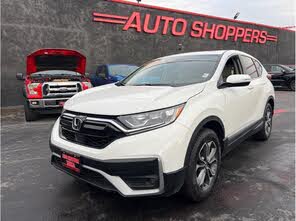
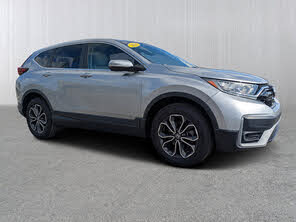
Conversely, the 2021 Honda CR-V didn’t stand out much from its peers in terms of design. Many crossovers have similar daylight openings and overall profiles. The CR-V’s few distinctive features included its grille and some chrome accents, but generally, the market for these vehicles wasn’t driven by exterior appearance alone.
The CR-V’s color options included eight shades, which were somewhat misleading. Half were different grays, accompanied by black and white. Aegean Blue Metallic and Radiant Red Metallic were its only vibrant colors, available only in higher trims. A nearby Honda dealership’s inventory reflected this with an abundance of white models and a scarcity in other colors. Interior choices were limited to black, gray, and ivory, with upscale trims offering added touches like wood panels and extra chrome.
In summary, the CR-V’s interior leaned modern, with angular seats and accented details. It drew some comparisons to rivals like the Kia Sportage and Hyundai Tucson, which provided more distinctive styling, particularly in mid-tier trims.


In 2021, the Toyota RAV4 Hybrid featured a hybrid powertrain combining a 2.5-liter four-cylinder gas engine with front and rear electric motors, and a lithium-ion battery pack. This configuration delivered a total of 219 horsepower, 16 more than the standard RAV4 but significantly less than the plug-in hybrid version, the RAV4 Prime. The front electric motor offered 149 pound-feet of torque, while the rear motor contributed 89 lb-ft. The hybrid system automatically provided AWD through the rear motor.
The RAV4 Hybrid’s various driving modes included Eco, Normal, Sport, Trail, and EV. In EV mode, the car emitted a peculiar whirring noise to alert pedestrians. The vehicle’s curb weight ranged between 3,690 and 3,780 pounds depending on the trim, which was about 200 pounds heavier than the non-hybrid version. Despite the extra weight, the electric motor’s immediate torque made for lively acceleration, though the gas engine was less pleasant sounding at higher revs.
The RAV4 Hybrid boasted an EPA rating of 40 mpg in combined driving, and in testing, it averaged 39.7 mpg. The continuously variable automatic transmission (CVT) operated smoothly, avoiding the common droning issue associated with CVTs. The regenerative braking system was similarly refined, with natural-feeling pedal modulation. Steering was well-weighted, providing good feedback through a comfortable wheel rim.
The suspension system used MacPherson strut fronts and multi-link rears, with an Active Cornering Assist system to improve handling. However, the P225/60R18 Michelin Primacy all-season tires provided limited grip, leading to noticeable understeer and noise when pushed hard into corners. The RAV4 Hybrid maintained flat cornering, though the driving dynamics weren’t particularly sporty or engaging. It excelled as a daily driver and even handled some light off-roading thanks to its 8.1 inches of ground clearance and Trail mode, though it struggled with very rough terrain.
The 2021 Honda CR-V wasn't built for high-performance thrills but performed adequately for its class. Powered by a 190-horsepower turbocharged four-cylinder engine, it reached 60 mph in about 7.8 seconds. This isn’t particularly fast, but comparable to other vehicles in its segment. The CR-V's continuously variable transmission (CVT) provided smooth, predictable acceleration but lacked the engagement of a traditional automatic transmission.
Most CR-V trims came with front-wheel drive as standard, with AWD available as an option. In contrast, the Subaru Forester featured standard AWD across its lineup. The CR-V used a MacPherson strut front and multi-link rear suspension, standard in this class, providing decent handling and ride quality without surprises.
The 2021 Toyota RAV4 Hybrid delivered commendable comfort. It featured an eight-way power-adjustable driver’s seat, a tilt/telescopic heated steering wheel, and heated and ventilated front seats. The passenger seat lacked height adjustment, but this wasn’t a major drawback. Rear-seat occupants enjoyed decent legroom and foot comfort, though the back seat itself was a bit low. Amenities included rear air conditioning vents and heated rear seats.
Drivers faced clearly legible instrumentation, albeit with a slight overuse of colors and graphics that changed with different driving modes. The dashboard had thoughtfully placed controls, oversized climate control knobs, and conveniently rubberized stereo knobs. The infotainment system was user-friendly and intuitive.
In terms of cargo space, the RAV4 Hybrid offered 37.5 cubic feet behind the rear seats, which expanded to 69.8 cubic feet with the seats folded down. Storage features included dashboard shelves and rear-seat armrests with cupholders, accommodating many needs.
The CR-V’s design prioritized function, seating five adults comfortably and carrying their gear adeptly. It boasted a passenger volume of 102.9 cubic feet, slightly more than the RAV4 Hybrid. Its cargo capacity also exceeded the Toyota’s, with 39.2 cubic feet behind the second row and 75.8 cubic feet with the seats folded. The CR-V provided three ways to access the cargo area depending on the trim level, including a hands-free power tailgate on the Touring trim.
For roof cargo, roof rails were standard only on the top Touring trim, whereas competitors like Subaru offered them on all but the base trim.
The 2021 Toyota RAV4 Hybrid featured varied infotainment systems ranging from a 7-inch to an 8-inch touchscreen, all supporting Apple CarPlay, Android Auto, Amazon Alexa compatibility, and SiriusXM radio with a three-month trial. Standard connectivity services included Safety Connect and WiFi Connect, offering free trials.
The top-tier infotainment system in the test vehicle featured an 11-speaker JBL premium audio system, dynamic navigation with voice recognition, and multiple connected services. The 8-inch display was practical, flanked by shortcut buttons and knobs for easy control. Voice recognition was impressive but had some limitations. Additionally, advanced camera-based technologies included options for a 360-degree camera system and a rearview camera mirror.
In contrast, the Honda CR-V’s base model came with a modest 5-inch screen supporting Bluetooth but little else. Higher trims featured a 7-inch high-definition touchscreen infotainment system with Apple CarPlay, Android Auto, and SMS text messaging functionalities. Audio systems varied, with the top-end Touring trim boasting a 300-watt system with a subwoofer.
CR-V trims from Special Edition upward included multiple charging ports, with the Touring trim adding a wireless phone charger. Satellite navigation with voice recognition was exclusive to the Touring trim.
The 2021 Toyota RAV4 Hybrid came standard with Toyota Safety Sense 2.0 (TSS 2.0), covering advanced driving assistance features such as adaptive cruise control, forward-collision warning, automatic emergency braking, lane-keep and centering assistance, and automatic high beams. Most trims offered blind-spot monitoring and rear cross-traffic warning, with rear automatic braking exclusive to the Hybrid Limited.
TSS 2.0 generally performed effectively but had some challenges, particularly in maintaining close gaps in traffic and responding predictably in heavy freeway conditions. The RAV4 Hybrid earned a five-star overall rating from the NHTSA and top marks from the IIHS except for certain headlight evaluations.
The 2021 Honda CR-V excelled in safety, earning both a five-star overall rating from the NHTSA and a Top Safety Pick award from the IIHS, though it missed the higher Top Safety Pick+ rating due to headlight and updated side crash test scores. It received a middling rating for its LATCH system’s ease of use.
Honda’s approach to safety was notable for making the Honda Sensing system standard across all trims. It included a multi-angle rearview camera, forward collision warning, lane departure warning, automatic emergency braking, road departure mitigation, lane-keeping assist, adaptive cruise control, and auto high beams. Blind-spot monitoring was standard from the EX trim upward.
CarGurus highlights
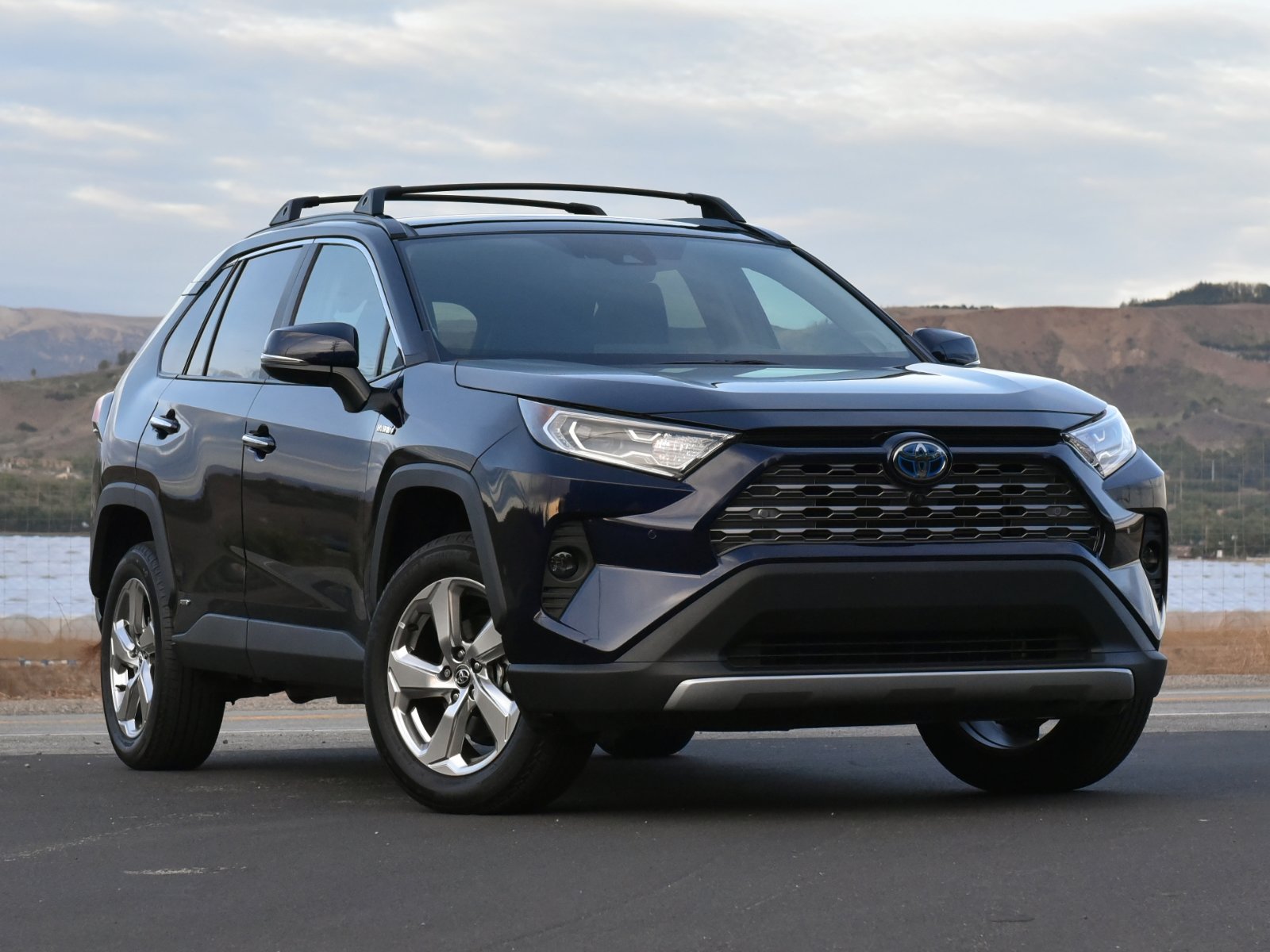
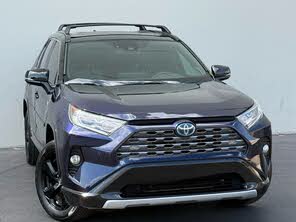
According to CarGurus experts, the overall rating for the 2021 Toyota RAV4 Hybrid was 8.5 out of 10, while the 2021 Honda CR-V scored 7.8 out of 10. Based on these ratings, the Toyota RAV4 Hybrid emerges as the stronger option, offering better technology, more standard safety features, and superior fuel efficiency. Hence, for those evaluating these two models, the Toyota RAV4 Hybrid is the recommended choice.
Choose the 2021 Toyota RAV4 Hybrid if:
- You prioritize fuel efficiency and want a hybrid powertrain with strong performance metrics.
- You prefer a vehicle with a comprehensive suite of tech features and a user-friendly infotainment system.
- You appreciate more standard safety features and high safety ratings.




Choose the 2021 Honda CR-V if:
- You value increased passenger and cargo space for both seating and storage needs.
- You want advanced safety features included as standard, even in the base trim.
- You prefer a vehicle with multiple charging options and a straightforward infotainment system.




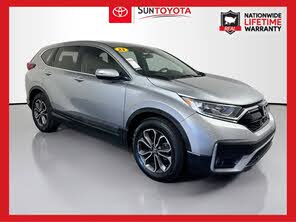
CarGurus highlights
According to CarGurus experts, the overall rating for the 2021 Toyota RAV4 Hybrid was 8.5 out of 10, while the 2021 Honda CR-V scored 7.8 out of 10. Based on these ratings, the Toyota RAV4 Hybrid emerges as the stronger option, offering better technology, more standard safety features, and superior fuel efficiency. Hence, for those evaluating these two models, the Toyota RAV4 Hybrid is the recommended choice.
Choose the 2021 Toyota RAV4 Hybrid if:
Shop Now- You prioritize fuel efficiency and want a hybrid powertrain with strong performance metrics.
- You prefer a vehicle with a comprehensive suite of tech features and a user-friendly infotainment system.
- You appreciate more standard safety features and high safety ratings.




Choose the 2021 Honda CR-V if:
Shop Now- You value increased passenger and cargo space for both seating and storage needs.
- You want advanced safety features included as standard, even in the base trim.
- You prefer a vehicle with multiple charging options and a straightforward infotainment system.




By: CarGurus + AI
At CarGurus, our team of experienced automotive writers remain at the heart of our content operation, conducting hands-on car tests and writing insightful guides that are backed by years of industry experience. To complement this, we are harnessing AI to make our content offering more diverse and more helpful to shoppers than ever. To achieve this, our AI systems are based exclusively on CarGurus content, ratings and data, so that what we produce is both unique to CarGurus, and uniquely helpful to car shoppers.