2021 Toyota 4Runner vs 2021 Honda CR-V
Overview | |
MSRP$36,765 | MSRP$25,350 |
Listings1097 | Listings1229 |
Ratings & Reviews | |
User Reviews | User Reviews |
Expert reviews6.2 out of 10 | Expert reviews7.8 out of 10 |
Pros
Cons
| Pros
Cons
|
2021 Toyota 4Runner Reviews SummaryDespite its design age, poor fuel economy, rough ride, iffy handling, and marginal safety ratings, the current-generation Toyota 4Runner remains a popular choice in a midsize SUV. Why? Its reputation for reliability and resale value, coupled with its undeniable utility, rugged image, and go-anywhere and do-anything capability, are the selling points. And if that's why you want a 2021 Toyota 4Runner, it won't disappoint you as long as you accept its shortcomings. | |
2021 Honda CR-V Reviews SummaryEven in a grim year, Honda is selling a staggering number of CR-Vs. The CR-V is the best-selling Honda by far. It’s also the second best-selling compact SUV, just behind the Toyota RAV4. And it's the fifth best-selling vehicle in the U.S., and if you take out all the commercial sales of full-size pickups it’s one of the two best-selling vehicles year in and year out. So it’s hard to argue against the CR-V formula. Honda’s been at this almost as long as crossovers have been a thing, launching the CR-V in 1997—a year after the RAV4 debuted. The funny thing is, aside from sales volume, there’s only one thing the CR-V particularly excels at. Aesthetics are subjective, but it would be hard to argue the CR-V is the best looking vehicle in its class. It’s not the cheapest. It’s not the best equipped, especially at the middle to lower trim levels. It’s not the fastest, nor is it the quietest, or the most fuel efficient. It’s not even the most reliable, showing up nowhere in J.D. Power's Most Reliable list. So what makes it so appealing to American consumers? Let’s see if we can figure that out. | |
No video found | No video found |
Popular Features & Specs | |
Engine4.0L 270 hp V6 | Engine1.5L 190 hp I4 |
Drive Train4X2 | Drive TrainFWD |
Seating Capacity7 | Seating Capacity5 |
Horsepower270 hp @ 5600 rpm | Horsepower190 hp @ 5600 rpm |
MPG City16 | MPG City28 |
MPG Highway19 | MPG Highway34 |
Engine | |
Engine Name4.0L 270 hp V6 | Engine Name1.5L 190 hp I4 |
Torque278 lb-ft @ 4400 rpm | Torque179 lb-ft @ 2000 rpm |
Horsepower270 hp @ 5600 rpm | Horsepower190 hp @ 5600 rpm |
Drivetrain4X2 | DrivetrainFWD |
Fuel Economy | |
MPG City16 | MPG City28 |
MPG Highway19 | MPG Highway34 |
Interior | |
Seating Capacity7 | Seating Capacity5 |
Safety | |
Front Crash Overall4 | Front Crash Overall5 |
Side Crash Overall5 | Side Crash Overall5 |
Dimensions & Capacity | |
Cargo Space47.2 cu ft | Cargo Space39.2 cu ft |
Curb Weight4400 lbs | Curb Weight3337 lbs |
Height71.5 in | Height66.1 in |
Length190.2 in | Length182.1 in |
Width75.8 in | Width73.0 in |
Wheelbase109.8 in | Wheelbase104.8 in |
Maximum Payload1700 lbs | Maximum Payload1358 lbs |
Number of doors4 | Number of doors4 |
Maximum Towing Capacity5000 lbs | Maximum Towing Capacity1500 lbs |
Standard Towing Capacity5000 lbs | Standard Towing Capacity |
Overview | ||
MSRP | $36,765 | $25,350 |
Listings | ||
Ratings & Reviews | ||
User reviews | ||
Expert reviews | 6.2 out of 10Read full review | 7.8 out of 10Read full review |
Pros & cons | Pros
Cons
| Pros
Cons
|
Summary | Despite its design age, poor fuel economy, rough ride, iffy handling, and marginal safety ratings, the current-generation Toyota 4Runner remains a popular choice in a midsize SUV. Why? Its reputation for reliability and resale value, coupled with its undeniable utility, rugged image, and go-anywhere and do-anything capability, are the selling points. And if that's why you want a 2021 Toyota 4Runner, it won't disappoint you as long as you accept its shortcomings. | Even in a grim year, Honda is selling a staggering number of CR-Vs. The CR-V is the best-selling Honda by far. It’s also the second best-selling compact SUV, just behind the Toyota RAV4. And it's the fifth best-selling vehicle in the U.S., and if you take out all the commercial sales of full-size pickups it’s one of the two best-selling vehicles year in and year out. So it’s hard to argue against the CR-V formula. Honda’s been at this almost as long as crossovers have been a thing, launching the CR-V in 1997—a year after the RAV4 debuted. The funny thing is, aside from sales volume, there’s only one thing the CR-V particularly excels at. Aesthetics are subjective, but it would be hard to argue the CR-V is the best looking vehicle in its class. It’s not the cheapest. It’s not the best equipped, especially at the middle to lower trim levels. It’s not the fastest, nor is it the quietest, or the most fuel efficient. It’s not even the most reliable, showing up nowhere in J.D. Power's Most Reliable list. So what makes it so appealing to American consumers? Let’s see if we can figure that out. |
Video | No video found | No video found |
Popular Features & Specs | ||
Engine | 4.0L 270 hp V6 | 1.5L 190 hp I4 |
Drive Train | 4X2 | FWD |
Seating Capacity | 7 | 5 |
Horsepower | 270 hp @ 5600 rpm | 190 hp @ 5600 rpm |
MPG City | 16 | 28 |
MPG Highway | 19 | 34 |
Engine | ||
Engine Name | 4.0L 270 hp V6 | 1.5L 190 hp I4 |
Torque | 278 lb-ft @ 4400 rpm | 179 lb-ft @ 2000 rpm |
Horsepower | 270 hp @ 5600 rpm | 190 hp @ 5600 rpm |
Drivetrain | 4X2 | FWD |
Fuel Economy | ||
MPG City | 16 | 28 |
MPG Highway | 19 | 34 |
Interior | ||
Seating Capacity | 7 | 5 |
Safety | ||
Front Crash Overall | 4 | 5 |
Side Crash Overall | 5 | 5 |
Dimensions & Capacity | ||
Cargo Space | 47.2 cu ft | 39.2 cu ft |
Curb Weight | 4400 lbs | 3337 lbs |
Height | 71.5 in | 66.1 in |
Length | 190.2 in | 182.1 in |
Width | 75.8 in | 73.0 in |
Wheelbase | 109.8 in | 104.8 in |
Maximum Payload | 1700 lbs | 1358 lbs |
Number of doors | 4 | 4 |
Maximum Towing Capacity | 5000 lbs | 1500 lbs |
Standard Towing Capacity | 5000 lbs | |
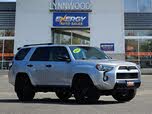
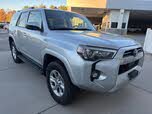
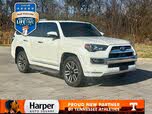
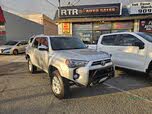
The 2021 Toyota 4Runner had not seen a complete redesign in 12 years, although it had received periodic updates. This meant that a used 4Runner was quite similar to a new one, minus some of the latest infotainment and safety technologies. The 4Runner's design was not conventionally attractive, with most versions adopting a somewhat aggressive look, except for the chrome-laden Limited trim. Despite this, the two-box body with flared fenders and trapezoidal wheel arches had aged well, maintaining balanced proportions, timeless styling, and undeniable utility. The 4Runner was like a reliable tool, not needing frequent redesigns to remain effective.
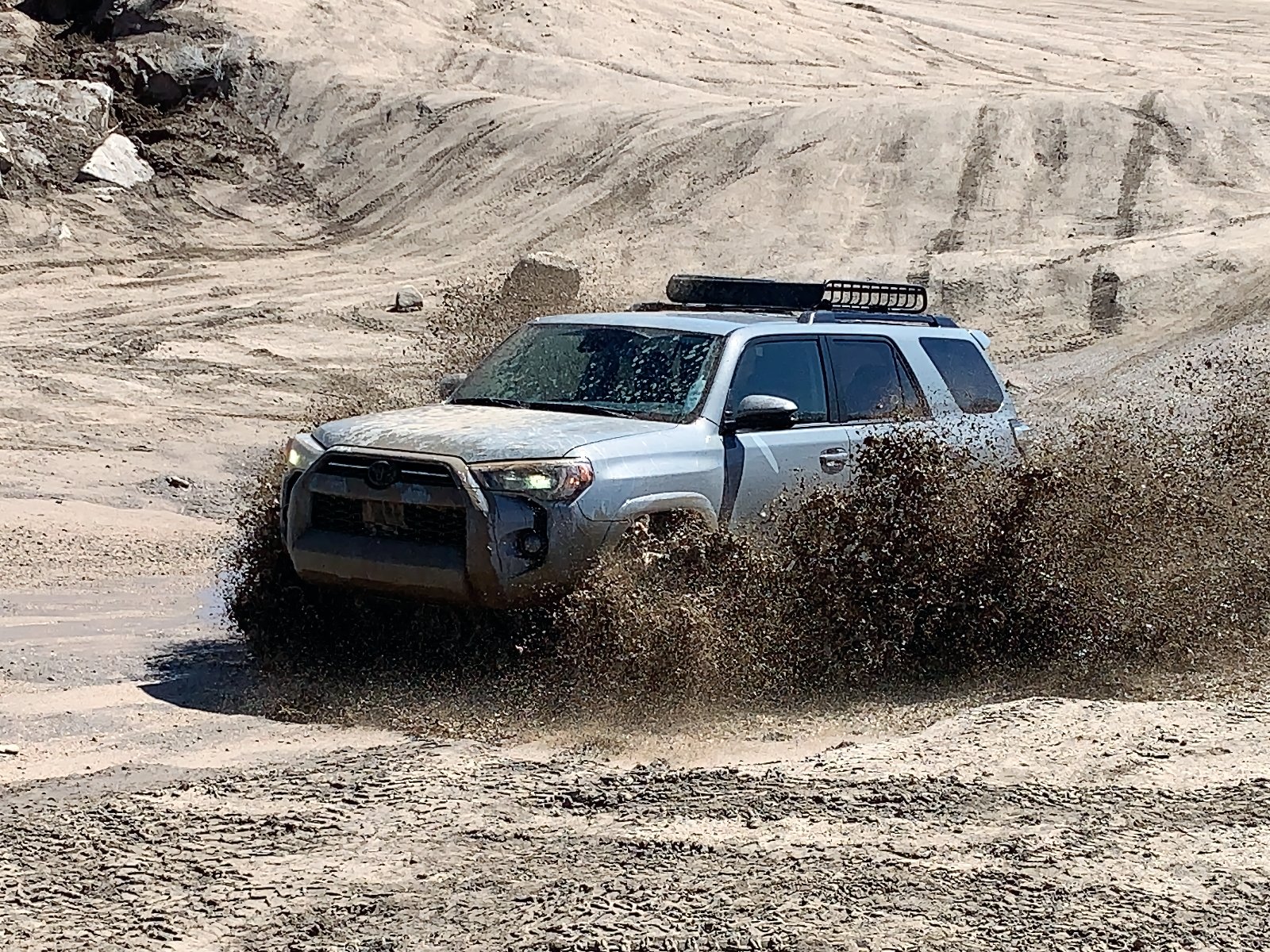
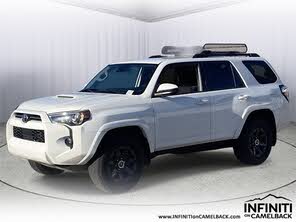
Toyota offered the 4Runner in several trims: SR5, TRD Off-Road, Limited, and TRD Pro, with special editions like the Trail Special Edition, Venture Special Edition, and Nightshade Special Edition. Pricing ranged from $36,950 for the SR5 with rear-wheel drive to $50,570 for the TRD Pro with standard four-wheel drive. The Trail Special Edition, priced at $38,565 for the RWD model, added features like a premium audio upgrade, a cargo cover, and a TRD front skid plate, bringing the total to $43,729. Toyota planned to build only 4,000 units of this edition, available in colors like white, black, Cement (gray), and Army Green, and featuring dark gray TRD Off-Road wheels and a Yakima RoadWarrior rooftop cargo basket.
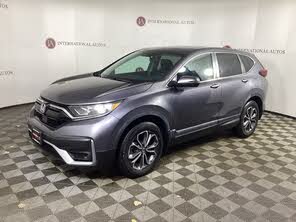
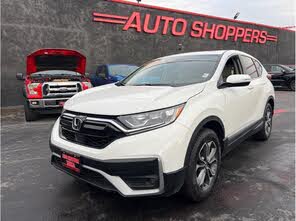
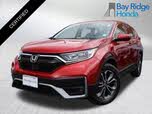
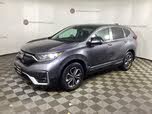
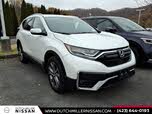
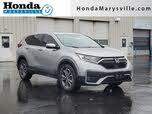
The 2021 Honda CR-V's design was typical of compact crossovers, with a nearly identical styling to its competitors. The daylight opening—the side window shape—was similar across the board, making the CR-V blend in with the crowd. However, details like the grille opening and some chromed plastic features set it apart slightly. The CR-V was not a vehicle bought for its exterior looks.
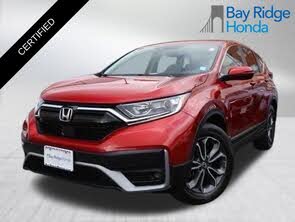
Honda offered the CR-V in eight colors, though many were shades of gray, black, or white. The more vibrant colors, like Aegean Blue Metallic and Radiant Red Metallic, were limited to higher trims. The interior came in black, gray, and ivory cloth or leather, depending on the trim level. Higher trims featured wood panels and more chrome for an upscale appearance. The seats had a modern, angular design, offering a more contemporary look compared to some competitors. Vehicles like the Kia Sportage and Hyundai Tucson had an edge in styling, especially at mid-tier trims.


The 2021 Toyota 4Runner was tested at the Hungry Valley State Vehicular Recreational Area, where it showcased its off-road capabilities. The 4Runner's A-Trac off-road traction control system proved beneficial, especially on challenging terrains like the Frame Twister. The Trail Special Edition handled mud, hills, and ruts with ease. Upgrading to the TRD Off-Road or TRD Pro added features like a locking rear differential, Multi-Terrain Select, and Crawl Control for more extreme off-roading.
Every 4Runner came with a 4.0-liter V6 engine producing 270 horsepower at 5,600 rpm and 278 pound-feet of torque at 4,400 rpm, paired with a five-speed automatic transmission. The maximum tow rating was 5,000 pounds. On regular roads, the 4Runner felt slow, heavy, and clunky, with challenging steering and braking. Its truck-like driving characteristics were part of its charm, but not everyone could live with them daily. Fuel economy was poor, averaging 16.8 mpg during testing, with an EPA rating of 17 mpg combined.
The 2021 Honda CR-V was not built for high performance but offered smooth, steady acceleration and predictable cornering. All trims featured a 190-horsepower turbocharged four-cylinder engine, with a 0-60 mph time of about 7.8 seconds. The CR-V's continuously variable transmission (CVT) provided a less engaging driving experience compared to competitors with conventional transmissions, like the Kia Sportage and Hyundai Tucson.
The CR-V came standard with front-wheel drive, with all-wheel drive as an option. Its unitized body structure and MacPherson strut front suspension with a multi-link rear suspension were standard for the class. Handling and ride quality were decent, with no real surprises.
The 2021 Toyota 4Runner sat high off the ground, which could be challenging for shorter individuals without running boards. Once inside, the 4Runner offered comfortable seating with proper support in both the front and rear. The back seat provided ample legroom, good visibility, air conditioning vents, and USB charging ports. The sunroof, power windows, and rear tailgate glass created an open-air feeling similar to a Jeep Wrangler.
A third-row seat was available but not included in the test vehicle, which featured a sliding cargo deck holding up to 440 pounds. Cargo space measured up to 47.2 cubic feet behind the back seat and 89.7 cubic feet with the rear seat folded down. The Trail Special Edition's roof rack added to the cargo capacity, making it suitable for various adventures.
The 2021 Honda CR-V was designed to fit five people comfortably and carry their gear. It offered 102.9 cubic feet of passenger volume, more than the Toyota RAV4. With the rear seats folded, the CR-V provided 75.8 cubic feet of cargo space. Accessing the cargo area varied by trim, with manual, power, and hands-free tailgate options.
The CR-V's interior featured charging ports throughout, including USB ports in the front console and second row, and a 12-volt outlet in the center console. The Touring trim added a wireless phone charger. Roof rails were standard only on the top Touring trim.
The 2021 Toyota 4Runner Trail Special Edition lacked advanced technology. It featured a windshield wiper de-icer and a 120-volt AC power outlet in the cargo area. The standard 8-inch touchscreen infotainment system included Bluetooth, Apple CarPlay, Android Auto, Amazon Alexa compatibility, SiriusXM satellite radio, and five USB ports. The premium audio upgrade added dynamic navigation, point-of-interest search, voice recognition, and a one-year subscription to Destination Assist concierge services.
The 2021 Honda CR-V's base LX trim had a 5-inch color screen with Bluetooth connectivity. Other trims featured a 7-inch high-definition touchscreen with Apple CarPlay, Android Auto, and SMS text messaging. The Special Edition and EX trims had a 180-watt audio system with six speakers, while the EX-L added two more speakers. The Touring trim had a 300-watt system with a subwoofer and satellite navigation.
Charging ports were abundant in the CR-V, with USB ports in the front console and second row, and a 12-volt outlet in the center console. The Touring trim included a wireless phone charger.
The 2021 Toyota 4Runner came with Toyota Safety Sense P (TSS-P), which included adaptive cruise control, forward-collision warning, automatic emergency braking, lane departure warning, and automatic high-beam headlights. However, it lacked a blind-spot warning system and rear cross-traffic warning. The 4Runner received a three-star rollover resistance rating from the NHTSA and a "Good" roof crush strength rating from the IIHS. However, it had lower ratings for driver protection in small overlap frontal-impact collisions and front passenger protection in frontal-impact crashes.
The 2021 Honda CR-V excelled in safety, earning a five-star NHTSA overall crash test rating and an IIHS Top Safety Pick award. It did not receive the highest IIHS Top Safety Pick+ rating due to lower scores in headlight evaluation and the updated side crash test. The CR-V's LATCH child safety seat anchoring system received an "Acceptable" rating.
Honda's approach to safety was commendable, making advanced safety features standard across all trims. The Honda Sensing system included a multi-angle rearview camera, forward collision warning, lane departure warning, automatic emergency braking, road departure mitigation, lane keeping assist, adaptive cruise control, and auto high-beam headlamps. Blind spot monitoring with rear cross-traffic alert was standard from the EX trim onwards.
CarGurus highlights

According to CarGurus experts, the overall rating for the 2021 Toyota 4Runner is 6.2 out of 10, while the 2021 Honda CR-V scores 7.8 out of 10. Based on these ratings, the 2021 Honda CR-V is the better choice for most consumers, offering superior safety, comfort, and technology features.
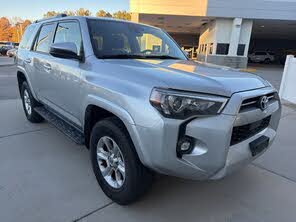
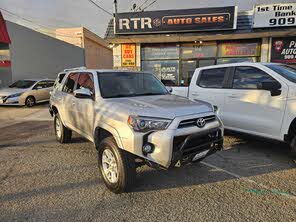
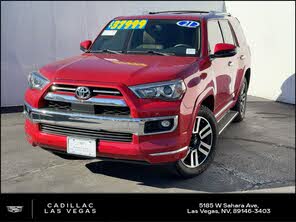
Choose the 2021 Toyota 4Runner if:
- You need a rugged, off-road-capable SUV with proven durability.
- You prefer a vehicle with a timeless, utilitarian design.
- You value a high seating position and ample cargo space for outdoor adventures.





Choose the 2021 Honda CR-V if:
- You prioritize safety and want advanced safety features standard on all trims.
- You need a comfortable, spacious interior with ample cargo space.
- You prefer a smooth, steady driving experience with decent fuel economy.


CarGurus highlights
According to CarGurus experts, the overall rating for the 2021 Toyota 4Runner is 6.2 out of 10, while the 2021 Honda CR-V scores 7.8 out of 10. Based on these ratings, the 2021 Honda CR-V is the better choice for most consumers, offering superior safety, comfort, and technology features.
Choose the 2021 Toyota 4Runner if:
Shop Now- You need a rugged, off-road-capable SUV with proven durability.
- You prefer a vehicle with a timeless, utilitarian design.
- You value a high seating position and ample cargo space for outdoor adventures.





Choose the 2021 Honda CR-V if:
Shop Now- You prioritize safety and want advanced safety features standard on all trims.
- You need a comfortable, spacious interior with ample cargo space.
- You prefer a smooth, steady driving experience with decent fuel economy.






By: CarGurus + AI
At CarGurus, our team of experienced automotive writers remain at the heart of our content operation, conducting hands-on car tests and writing insightful guides that are backed by years of industry experience. To complement this, we are harnessing AI to make our content offering more diverse and more helpful to shoppers than ever. To achieve this, our AI systems are based exclusively on CarGurus content, ratings and data, so that what we produce is both unique to CarGurus, and uniquely helpful to car shoppers.