2019 Toyota RAV4 vs 2020 Ford Edge
Overview | |
MSRP$25,650 | MSRP$31,100 |
Listings249 | Listings195 |
Ratings & Reviews | |
User Reviews | User Reviews |
Expert reviews8.0 out of 10 | Expert reviews8.0 out of 10 |
Pros
Cons
| Pros
Cons
|
2019 Toyota RAV4 Reviews SummaryThere’s a reason small SUVs like the 2019 Toyota RAV4 are among the most popular vehicles on the new car market. Consider the RAV4 and its rivals, the Honda CR-V, Mazda CX-5, and Ford Escape—what do they have in common? To put it simply, these vehicles are asked to do it all. Daily commuter car? Check. Family-hauler to school, practice, and the mall? Check, check, and check. Road-trip vehicle? Yeah, that too. On top of it all, these vehicles have to be affordable, efficient, and reliable. Sales of traditional sedans have been dwindling, but if sedans could do as much as crossovers can, they would still be popular vehicles. The RAV4 is one of the oldest vehicles in the segment, and its story tells us how these small SUVs became so popular. The previous RAV4 was an extremely competent vehicle for Toyota, covering all the things we ask of compact SUVs. But the new 2020 RAV4 goes a few steps further. It has standout Tonka-truck styling, a surprisingly upscale interior, and something that it had lost since debuting more than two decades ago: a bit of off-road ability. We’ll see whether this makes it better than the RAV4 it replaces, and if it allows the 2020 RAV4 to stand out in a crowded small SUV market. | |
2020 Ford Edge Reviews SummaryThe Ford Edge isn’t exactly memorable, which isn’t a bad thing. It isn’t a good thing either. Cars can be remembered for attractive design, fun driving dynamics, or being a solid value. They can also be remembered in a negative light for a polarizing design, poor build quality, or being unsafe to the point of scandal. But the 2020 Ford Edge is just... there. It is a midsize two-row SUV that doesn’t offend, but also doesn’t “wow.” But just as critically, the Edge is getting long in the tooth. In the SUV segment, constant iteration is necessary for survival, and the Edge is in need of a redesign. But in lieu of new blood, Ford has done well to keep the Edge fitted with the latest infotainment and safety technology. It also offers a performance variant, called the Edge ST. This is something that you won’t find in the Edge’s competitors, the Nissan Murano and Honda Passport. But is it enough to keep the Edge relevant against its more contemporary rivals? Read on to find out. | |
No video found | |
Popular Features & Specs | |
Engine2.5L 203 hp I4 | Engine2.0L 250 hp I4 |
Drive TrainFWD | Drive TrainFWD |
Seating Capacity5 | Seating Capacity5 |
Horsepower203 hp @ 6000 rpm | Horsepower250 hp @ 5500 rpm |
MPG City26 | MPG City21 |
MPG Highway35 | MPG Highway29 |
Engine | |
Engine Name2.5L 203 hp I4 | Engine Name2.0L 250 hp I4 |
Torque184 lb-ft @ 5000 rpm | Torque280 lb-ft @ 3000 rpm |
Horsepower203 hp @ 6000 rpm | Horsepower250 hp @ 5500 rpm |
DrivetrainFWD | DrivetrainFWD |
Fuel Economy | |
MPG City26 | MPG City21 |
MPG Highway35 | MPG Highway29 |
Interior | |
Seating Capacity5 | Seating Capacity5 |
Safety | |
Front Crash Overall4 | Front Crash Overall5 |
Side Crash Overall5 | Side Crash Overall5 |
Dimensions & Capacity | |
Cargo Space37.5 cu ft | Cargo Space39.2 cu ft |
Curb Weight3370 lbs | Curb Weight4027 lbs |
Height67.0 in | Height68.3 in |
Length180.9 in | Length188.8 in |
Width73.0 in | Width85.8 in |
Wheelbase105.9 in | Wheelbase112.2 in |
Maximum Payload1240 lbs | Maximum Payload1243 lbs |
Number of doors4 | Number of doors4 |
Maximum Towing Capacity1500 lbs | Maximum Towing Capacity1500 lbs |
Overview | ||
MSRP | $25,650 | $31,100 |
Listings | ||
Ratings & Reviews | ||
User reviews | ||
Expert reviews | 8.0 out of 10Read full review | 8.0 out of 10Read full review |
Pros & cons | Pros
Cons
| Pros
Cons
|
Summary | There’s a reason small SUVs like the 2019 Toyota RAV4 are among the most popular vehicles on the new car market. Consider the RAV4 and its rivals, the Honda CR-V, Mazda CX-5, and Ford Escape—what do they have in common? To put it simply, these vehicles are asked to do it all. Daily commuter car? Check. Family-hauler to school, practice, and the mall? Check, check, and check. Road-trip vehicle? Yeah, that too. On top of it all, these vehicles have to be affordable, efficient, and reliable. Sales of traditional sedans have been dwindling, but if sedans could do as much as crossovers can, they would still be popular vehicles. The RAV4 is one of the oldest vehicles in the segment, and its story tells us how these small SUVs became so popular. The previous RAV4 was an extremely competent vehicle for Toyota, covering all the things we ask of compact SUVs. But the new 2020 RAV4 goes a few steps further. It has standout Tonka-truck styling, a surprisingly upscale interior, and something that it had lost since debuting more than two decades ago: a bit of off-road ability. We’ll see whether this makes it better than the RAV4 it replaces, and if it allows the 2020 RAV4 to stand out in a crowded small SUV market. | The Ford Edge isn’t exactly memorable, which isn’t a bad thing. It isn’t a good thing either. Cars can be remembered for attractive design, fun driving dynamics, or being a solid value. They can also be remembered in a negative light for a polarizing design, poor build quality, or being unsafe to the point of scandal. But the 2020 Ford Edge is just... there. It is a midsize two-row SUV that doesn’t offend, but also doesn’t “wow.” But just as critically, the Edge is getting long in the tooth. In the SUV segment, constant iteration is necessary for survival, and the Edge is in need of a redesign. But in lieu of new blood, Ford has done well to keep the Edge fitted with the latest infotainment and safety technology. It also offers a performance variant, called the Edge ST. This is something that you won’t find in the Edge’s competitors, the Nissan Murano and Honda Passport. But is it enough to keep the Edge relevant against its more contemporary rivals? Read on to find out. |
Video | No video found | |
Popular Features & Specs | ||
Engine | 2.5L 203 hp I4 | 2.0L 250 hp I4 |
Drive Train | FWD | FWD |
Seating Capacity | 5 | 5 |
Horsepower | 203 hp @ 6000 rpm | 250 hp @ 5500 rpm |
MPG City | 26 | 21 |
MPG Highway | 35 | 29 |
Engine | ||
Engine Name | 2.5L 203 hp I4 | 2.0L 250 hp I4 |
Torque | 184 lb-ft @ 5000 rpm | 280 lb-ft @ 3000 rpm |
Horsepower | 203 hp @ 6000 rpm | 250 hp @ 5500 rpm |
Drivetrain | FWD | FWD |
Fuel Economy | ||
MPG City | 26 | 21 |
MPG Highway | 35 | 29 |
Interior | ||
Seating Capacity | 5 | 5 |
Safety | ||
Front Crash Overall | 4 | 5 |
Side Crash Overall | 5 | 5 |
Dimensions & Capacity | ||
Cargo Space | 37.5 cu ft | 39.2 cu ft |
Curb Weight | 3370 lbs | 4027 lbs |
Height | 67.0 in | 68.3 in |
Length | 180.9 in | 188.8 in |
Width | 73.0 in | 85.8 in |
Wheelbase | 105.9 in | 112.2 in |
Maximum Payload | 1240 lbs | 1243 lbs |
Number of doors | 4 | 4 |
Maximum Towing Capacity | 1500 lbs | 1500 lbs |
When comparing the 2019 Toyota RAV4 and the 2020 Ford Edge, both vehicles demonstrated distinct aesthetic philosophies and design elements that catered to different tastes and preferences.
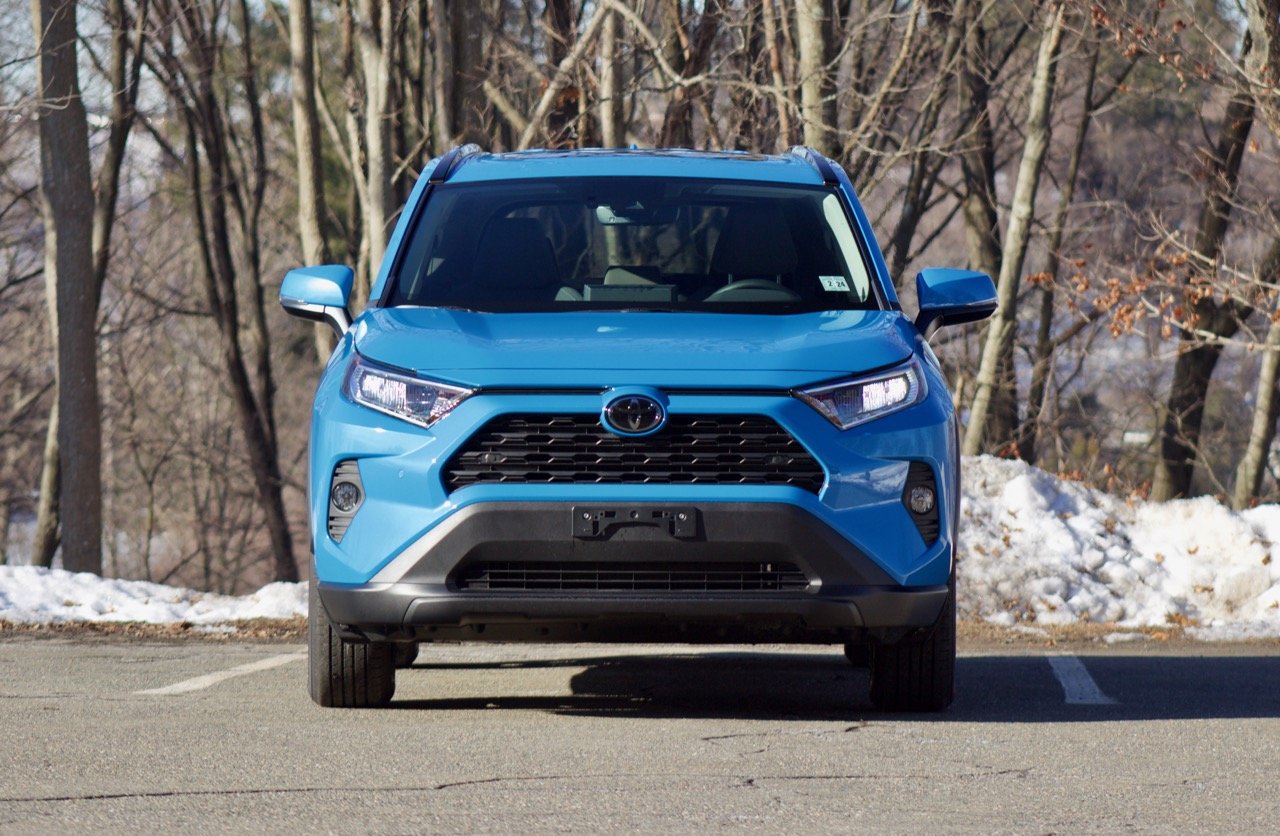
The 2019 Toyota RAV4 immediately stood out with its bold, chunky design and sharp edges, clearly inspired by the rugged Toyota Tacoma pickup. This aggressive, futuristic look conveyed a strong presence, which was consistent along the entire side profile and extended to the back, where the taillights seemed influenced by Toyota’s luxury brand, Lexus. The character line breaking up the rear C-pillar, although common among new vehicles, was not particularly visually appealing in the RAV4. About half of the RAV4's color options matched the body to the roof, while seven options offered a contrasting-color roof in gray or black, adding visual interest especially useful in the two-tone variations. However, this black strip across the rear pillar appeared unnecessary in the monotone color schemes, adding to design clutter.
Inside, the RAV4's cabin was surprisingly simple and elegant, featuring many elements within the new floating touchscreen and a “pod” packaging the remaining controls from the center of the dash to the cupholders. Trim levels ranging from the base LE to the upscale Limited provided varying levels of exterior and interior features, adding everything from steel 17-inch wheels and LED lighting in the base model to 19-inch chrome-finished alloy wheels, heated front seats, and ambient interior lighting in the top-tier Limited trim.
In contrast, the 2020 Ford Edge leveraged a fresh styling update from 2019, likening it to a crossover version of the Ford Fusion sedan. It shared angular headlights and a large, trapezoidal grille reminiscent of the Fusion. Despite these updates, the interior reflected signs of aging. The center console, with its small and awkwardly arranged climate and radio controls, only showed subtle changes since 2015. The contemporary rotary shifter, however, aided in solving some space and packaging issues. Cabin quality was solid with plenty of soft-touch materials but these efforts were compromised by the heavy use of hard plastics, especially in the center console.
Trim levels for the Edge, from the basic SE to the performance-focused ST, offered a diverse range of features. The base SE included practical features like a 10-way power-adjustable driver’s seat, WiFi hotspot, and Ford’s SYNC 3 infotainment system, while higher trims like the Titanium introduced more premium features such as genuine leather upholstery, a 10-way power-adjustable front passenger seat, and a B&O by Bang & Olufsen 12-speaker premium sound system.


Performance-wise, both the 2019 RAV4 and the 2020 Edge had their strengths and weaknesses.
The 2019 Toyota RAV4 came equipped uniformly with a 2.5-liter 4-cylinder engine, producing 203 horsepower and 184 pound-feet of torque, matched with an 8-speed automatic transmission. This engine could be configured with front-wheel drive or two flavors of all-wheel drive—standard AWD or a torque-vectoring AWD available on the Adventure and Limited trims. The base AWD provided selectable drive modes such as Snow, Sand & Mud, and Rock & Dirt, displaying Toyota's attempt to revive some off-road capability.
The torque-vectoring AWD system was more advanced, allowing real-time power division between wheels which could enhance off-road performance. In day-to-day driving, the 2.5-liter engine excelled at highway speeds but felt sluggish in stop-and-go traffic due to a lack of low-end power. The ride quality was generally comfortable, but steering felt twitchy and rear-heavy, making fast corners awkward.
The RAV4’s fuel economy was commendable, with front-wheel-drive models returning 26 mpg city, 35 highway, and 30 combined. AWD variants offered slightly lower numbers, and in one week, a combined 29.3 miles per gallon was observed.
The 2020 Ford Edge differed in that it provided a 2.0-liter turbocharged four-cylinder engine as standard, which delivered 250 horsepower and 275 pound-feet of torque. Power was sent to the front or all-wheel drive through an eight-speed automatic transmission. This engine offered solid low-end acceleration, ideal for city driving, although it struggled a bit at higher speeds.
For a more engaging driving experience, the Edge ST trim was the go-to model. It featured a robust 2.7-liter EcoBoost V6 engine, producing 335 horsepower and 380 pound-feet of torque, coupled with standard AWD. It showcased impressive performance, particularly in mid to high revs, and had enhanced cornering capabilities and heavy steering appropriate for a performance-oriented vehicle. Offering a Sport mode that improved throttle responsiveness and transmission mapping further elevated the driving experience.
Form and function were areas where both vehicles shone, although their approaches varied slightly.
The 2019 Toyota RAV4 prioritized a clean, upscale interior with practical elements. The center stack contained climate controls, a tray for small items, drive-mode controls, and a compact shifter design to save space. Additionally, there was a deep center console bin and an integrated tray on the passenger side, providing ample storage options.
Cargo space in the RAV4 was noteworthy, offering 37.6 cubic feet with the rear seats up and expanding to 69.8 cubic feet with them folded. While this was slightly lower than the previous model year, it still exceeded models like the Mazda CX-5 and Jeep Cherokee, though it fell short against the Honda CR-V and Subaru Forester with their approximate 75 cubic feet capacity.
The 2020 Ford Edge, on the other hand, enjoyed a strong advantage in cabin layout. It offered a commanding road view without being overly upright, with plenty of deep compartments and cubbies designed for convenience. The spacious second-row head and legroom negated any need for front seat adjustments to accommodate rear passengers.
Regarding cargo capacity, the Edge provided 39.2 cubic feet behind the rear seats, which increased to 73.4 cubic feet when the 60/40 split-fold rear seats were folded down. This figure outperformed vehicles such as the Jeep Grand Cherokee and Nissan Murano but was marginally less than the Honda Passport’s 77.9 cubic feet. The SEL and Titanium trims featured a hands-free foot-activated power rear liftgate, enhancing practicality.
Technologically, the 2019 RAV4 and the 2020 Edge offered robust infotainment and connectivity solutions.
The 2019 Toyota RAV4 came standard with a 7-inch touchscreen running Toyota’s Entune 3.0 system, easy to use and featuring Apple CarPlay but not Android Auto. Higher trims included up to five USB ports and the Adventure model added a panoramic reversing camera and a larger 8-inch infotainment screen. The Limited trim optionally offered a JBL premium stereo. The Entune system, whether in 7-inch or 8-inch form, was user-friendly with a combination of touch controls and physical dials for major functions, enhancing driver usability.
The 2020 Ford Edge featured Ford’s SYNC 3 infotainment system as standard across all trims. This system included an 8-inch touchscreen, logical menu navigation thanks to a row of icons across the bottom and a home button in the upper left corner. Both Apple CarPlay and Android Auto were integrated, eliminating the necessity for navigation upgrades if users preferred using their smartphone maps apps. Optional voice-activated navigation, standard on higher trims, and a pre-paid subscription service for five years with real-time traffic updates were noteworthy enhancements.
Standard technology also included two smart-charging USB ports. Higher trims offered semi-digital instrument panels and a dual rear-seat entertainment system, providing versatile technological options.
CarGurus highlights

According to CarGurus experts, the overall rating for the 2019 Toyota RAV4 is 8.0 out of 10, while the 2020 Ford Edge scores 8.1 out of 10. Based on these ratings, the 2020 Ford Edge edges out slightly as the better overall choice. It offers a more powerful engine, advanced technological and safety features, and a more spacious interior, providing excellent comfort and practicality for everyday use.
Choose the 2019 Toyota RAV4 if:
- You value rugged off-road capability paired with modern design and robust standard safety features.
- You prefer a user-friendly infotainment system with integrated Apple CarPlay.
- You seek a fuel-efficient vehicle for combined city and highway driving.


Choose the 2020 Ford Edge if:
- You desire a spacious and comfortable cabin with abundant second-row legroom and headroom.
- You prefer a vehicle offering robust technological integration including both Apple CarPlay and Android Auto.
- You want a car with top safety ratings and advanced driver-assistance features included as standard.


CarGurus highlights
According to CarGurus experts, the overall rating for the 2019 Toyota RAV4 is 8.0 out of 10, while the 2020 Ford Edge scores 8.1 out of 10. Based on these ratings, the 2020 Ford Edge edges out slightly as the better overall choice. It offers a more powerful engine, advanced technological and safety features, and a more spacious interior, providing excellent comfort and practicality for everyday use.
Choose the 2019 Toyota RAV4 if:
Shop Now- You value rugged off-road capability paired with modern design and robust standard safety features.
- You prefer a user-friendly infotainment system with integrated Apple CarPlay.
- You seek a fuel-efficient vehicle for combined city and highway driving.
Choose the 2020 Ford Edge if:
Shop Now- You desire a spacious and comfortable cabin with abundant second-row legroom and headroom.
- You prefer a vehicle offering robust technological integration including both Apple CarPlay and Android Auto.
- You want a car with top safety ratings and advanced driver-assistance features included as standard.

By: CarGurus + AI
At CarGurus, our team of experienced automotive writers remain at the heart of our content operation, conducting hands-on car tests and writing insightful guides that are backed by years of industry experience. To complement this, we are harnessing AI to make our content offering more diverse and more helpful to shoppers than ever. To achieve this, our AI systems are based exclusively on CarGurus content, ratings and data, so that what we produce is both unique to CarGurus, and uniquely helpful to car shoppers.

