Land Rover Range Rover vs Hyundai Venue

Overview | |
MSRP$107,900 | MSRP$20,550 |
Listings862 | Listings139 |
Ratings & Reviews | |
User Reviews | User Reviews |
Expert reviews7.7 out of 10 | Expert reviews5.2 out of 10 |
Pros
Cons
| Pros
Cons
|
Reviews SummaryFew automotive nameplates carry the star power of the Land Rover Range Rover. Arguably the first luxury SUV, it blazed a trail for high-end utility vehicles like the Lexus LX and Mercedes-Benz G-Wagen, and it now counts more suburb-oriented models like the BMW X7, Cadillac Escalade, Infiniti QX80, Lincoln Navigator, and Mercedes-Benz GLS-Class among its competition. Changes for 2025 are limited to some reshuffling of options. Verdict: The Range Rover excels in refinement, while offering competitive interior space and towing capacity. But its user interface remains a weak point. | |
Reviews SummaryAutomakers have traditionally had a hard time making money on entry-level subcompact cars, because they have low profit margins, but America has largely moved away from cars to crossover SUVs—and higher prices. That allows car companies to offer an entry-level subcompact SUV for thousands more than a similar sedan or hatchback. Such is the case with the Hyundai Venue, which costs more than its predecessor, the subcompact Accent that was dropped after the 2022 model year. While the price is higher, the advantage for buyers is a vehicle that generally has more cargo space and is more practical. We recently drove the 2026 Hyundai Venue SEL w/2-Tone Roof (yes, that’s the trim level name) to find out if a subcompact crossover is a better buy than a cheaper subcompact car. Verdict: The Hyundai Venue sacrifices refinement for a price point that isn’t as low as a comparable subcompact car. We’d be tempted to spend a little more for a slightly larger compact car with more power, features, and refinement. | |
No video found | No video found |
Popular Features & Specs | |
Engine3.0L 395 hp I6 | Engine1.6L 121 hp I4 |
DrivetrainAWD | DrivetrainFWD |
Seating Capacity5 | Seating Capacity5 |
Horsepower395 hp @ 5500 rpm | Horsepower121 hp @ 6300 rpm |
EV Battery Capacity0.2 kWh | EV Battery Capacity |
MPG City19 | MPG City29 |
MPG Highway24 | MPG Highway33 |
Engine | |
Engine Name3.0L 395 hp I6 | Engine Name1.6L 121 hp I4 |
Torque406 lb-ft @ 2000 rpm | Torque113 lb-ft @ 4500 rpm |
Horsepower395 hp @ 5500 rpm | Horsepower121 hp @ 6300 rpm |
DrivetrainAWD | DrivetrainFWD |
Fuel Economy | |
EV Battery Capacity0.2 kWh | EV Battery Capacity |
MPG City19 | MPG City29 |
MPG Highway24 | MPG Highway33 |
Interior | |
Leather SeatsStandard | Leather Seats |
Seating Capacity5 | Seating Capacity5 |
Key Features | |
Navigation SystemStandard | Navigation System |
Sunroof/MoonroofStandard | Sunroof/Moonroof |
Safety | |
Front Crash Overall | Front Crash Overall4 |
Side Crash Overall | Side Crash Overall5 |
Dimensions & Capacity | |
Cargo Space40.7 cu ft | Cargo Space18.7 cu ft |
Curb Weight5240 lbs | Curb Weight2612 lbs |
Height73.6 in | Height61.6 in |
Length198.9 in | Length159.1 in |
Width87.0 in | Width69.7 in |
Wheelbase118.0 in | Wheelbase99.2 in |
Maximum Payload2145 lbs | Maximum Payload1158 lbs |
Number of doors4 | Number of doors4 |
Maximum Towing Capacity7715 lbs | Maximum Towing Capacity |
Overview | ||
MSRP | $107,900 | $20,550 |
Listings | ||
Ratings & Reviews | ||
User reviews | ||
Expert reviews | 7.7 out of 10Read full review | 5.2 out of 10Read full review |
Pros & cons | Pros
Cons
| Pros
Cons
|
Summary | Few automotive nameplates carry the star power of the Land Rover Range Rover. Arguably the first luxury SUV, it blazed a trail for high-end utility vehicles like the Lexus LX and Mercedes-Benz G-Wagen, and it now counts more suburb-oriented models like the BMW X7, Cadillac Escalade, Infiniti QX80, Lincoln Navigator, and Mercedes-Benz GLS-Class among its competition. Changes for 2025 are limited to some reshuffling of options. Verdict: The Range Rover excels in refinement, while offering competitive interior space and towing capacity. But its user interface remains a weak point. | Automakers have traditionally had a hard time making money on entry-level subcompact cars, because they have low profit margins, but America has largely moved away from cars to crossover SUVs—and higher prices. That allows car companies to offer an entry-level subcompact SUV for thousands more than a similar sedan or hatchback. Such is the case with the Hyundai Venue, which costs more than its predecessor, the subcompact Accent that was dropped after the 2022 model year. While the price is higher, the advantage for buyers is a vehicle that generally has more cargo space and is more practical. We recently drove the 2026 Hyundai Venue SEL w/2-Tone Roof (yes, that’s the trim level name) to find out if a subcompact crossover is a better buy than a cheaper subcompact car. Verdict: The Hyundai Venue sacrifices refinement for a price point that isn’t as low as a comparable subcompact car. We’d be tempted to spend a little more for a slightly larger compact car with more power, features, and refinement. |
Video | No video found | No video found |
Popular Features & Specs | ||
Engine | 3.0L 395 hp I6 | 1.6L 121 hp I4 |
Drivetrain | AWD | FWD |
Seating Capacity | 5 | 5 |
Horsepower | 395 hp @ 5500 rpm | 121 hp @ 6300 rpm |
EV Battery Capacity | 0.2 kWh | |
MPG City | 19 | 29 |
MPG Highway | 24 | 33 |
Engine | ||
Engine Name | 3.0L 395 hp I6 | 1.6L 121 hp I4 |
Torque | 406 lb-ft @ 2000 rpm | 113 lb-ft @ 4500 rpm |
Horsepower | 395 hp @ 5500 rpm | 121 hp @ 6300 rpm |
Drivetrain | AWD | FWD |
Fuel Economy | ||
EV Battery Capacity | 0.2 kWh | |
MPG City | 19 | 29 |
MPG Highway | 24 | 33 |
Interior | ||
Leather Seats | Standard | |
Seating Capacity | 5 | 5 |
Key Features | ||
Navigation System | Standard | |
Sunroof/Moonroof | Standard | |
Safety | ||
Front Crash Overall | 4 | |
Side Crash Overall | 5 | |
Dimensions & Capacity | ||
Cargo Space | 40.7 cu ft | 18.7 cu ft |
Curb Weight | 5240 lbs | 2612 lbs |
Height | 73.6 in | 61.6 in |
Length | 198.9 in | 159.1 in |
Width | 87.0 in | 69.7 in |
Wheelbase | 118.0 in | 99.2 in |
Maximum Payload | 2145 lbs | 1158 lbs |
Number of doors | 4 | 4 |
Maximum Towing Capacity | 7715 lbs | |
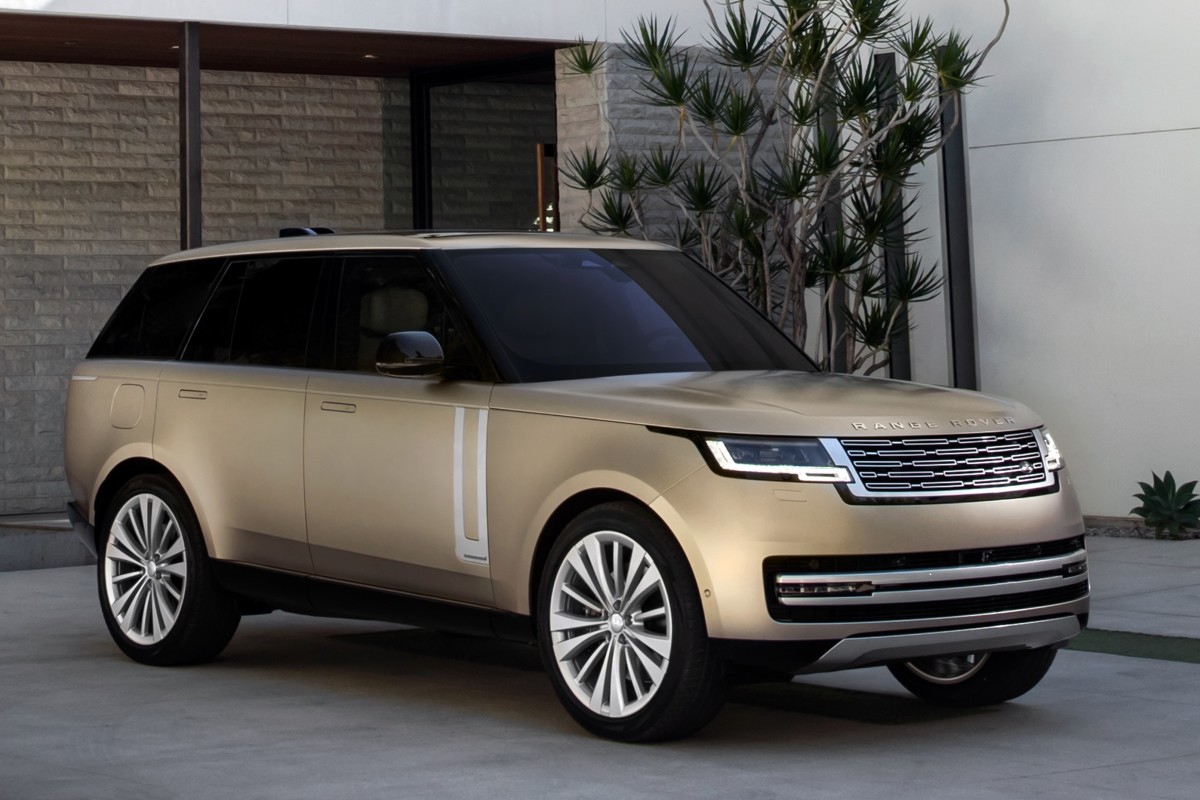
The 2025 Land Rover Range Rover was a testament to understated luxury, maintaining its classic design lineage while offering multiple configurations. Buyers had the choice between standard-wheelbase and long-wheelbase versions, with the latter available with a third row of seats. The trim levels—SE, Autobiography, and SV—were not universally available across all body styles, adding a layer of exclusivity. The exterior design, with its updated headlights and taillights, subtly evolved from the previous generation, maintaining a sophisticated presence without the ostentation of some of its high-end competitors. Inside, the minimalist dashboard featured a touchscreen, an engine start button, and a shifter, with a focus on simplicity and attention to detail, although some materials felt less premium than expected for its price range.
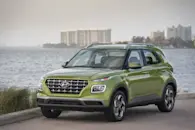
The 2026 Hyundai Venue, classified as a crossover SUV, presented a compact and functional design that leaned more towards a tall hatchback. Its exterior featured SUV-like elements such as a bluff nose, roof rails, and black wheel flares, giving it a rugged appearance despite its smaller stature. The Venue's interior was simple and functional, with a digital instrument cluster and a small touchscreen that resembled an iPad. The use of body-color trim around the air vents and shifter added a touch of flair, but the overall design prioritized practicality over luxury. The Venue's compact size made it ideal for urban environments, offering ease of maneuverability and parking.
The 2025 Land Rover Range Rover offered a range of powertrain options, all paired with an eight-speed automatic transmission and four-wheel drive. The entry-level engine was a turbocharged 3.0-liter inline-six with a mild hybrid system, delivering 395 horsepower and 405 pound-feet of torque. A plug-in hybrid version of this engine produced 543 hp and 406 lb-ft of torque. The V8 option, sourced from BMW, was a twin-turbocharged 4.4-liter engine, generating 523 hp and 553 lb-ft in SE and Autobiography models, and 606 hp and 553 lb-ft in the Range Rover SV. The SV model could accelerate from zero to 60 mph in 4.3 seconds, reaching a top speed of 162 mph. Despite its size, the Range Rover excelled in comfort and refinement, with excellent ride quality and body control. Off-road capabilities were enhanced by features like a two-speed transfer case, Terrain Response drive modes, and height-adjustable air suspension, providing 11.6 inches of ground clearance and the ability to wade through 35.4 inches of water.
In contrast, the 2026 Hyundai Venue was powered by a naturally aspirated 1.6-liter four-cylinder engine, producing a modest 121 horsepower and 113 pound-feet of torque. This power was channeled through a continuously variable transmission (CVT) to the front wheels, with no all-wheel drive option. The Venue's acceleration was modest, with a 0-60 mph time of 8.5–8.8 seconds, aided by its lightweight 2,738-pound frame. While the Venue felt peppy in city traffic, its performance lagged at highway speeds, with the CVT slow to respond. Handling was a strong point, thanks to its compact dimensions and low weight, making it agile in urban settings. However, the ride could be jiggly on rough surfaces due to its solid rear axle.
The 2025 Land Rover Range Rover offered a spacious interior, with three-row models accommodating seven passengers and two-row models seating five. The long-wheelbase version provided an impressive 48 inches of second-row legroom, unmatched among luxury SUVs. Cargo space was limited with the third row in place, offering 11 cubic feet, but expanded to 40.7 cubic feet with the third row folded and 83.5 cubic feet with both rear rows down. The split tailgate and air suspension facilitated loading and unloading. Standard features included three-zone automatic climate control, with options for four-zone climate control and additional amenities on higher trims. The Range Rover's towing capacity was a robust 8,200 pounds, comparable to other luxury SUVs.
The 2026 Hyundai Venue's interior featured cloth and synthetic leather seats with manual adjustments, providing adequate comfort. Headroom was ample, but legroom was limited for taller occupants. The rear seat could accommodate two adults comfortably, but three would be cramped. The rear seats folded in a 60/40 split, expanding cargo space to 31.9 cubic feet, though it was modest compared to larger crossovers. The Venue's interior materials reflected its budget-friendly nature, with extensive use of hard plastics and minimal sound deadening.
The 2025 Land Rover Range Rover came equipped with a 13.7-inch digital instrument cluster and a 13.1-inch touchscreen, featuring wireless Apple CarPlay and Android Auto. A 35-speaker Meridian audio system was available on higher trims. The Pivi Pro infotainment system, while improved, suffered from a lack of physical controls, making it less intuitive. The natural-language voice recognition system helped mitigate some of these issues, allowing for easy control of certain functions.
The 2026 Hyundai Venue featured an 8-inch touchscreen for basic infotainment, with wireless Apple CarPlay and Android Auto. While lacking advanced features like navigation and a premium audio system, the Venue's infotainment was functional and user-friendly. The digital instrument cluster provided limited information, and the audio system was a basic six-speaker setup.
The 2025 Land Rover Range Rover included standard driver-assistance features such as automatic emergency braking, forward collision warning, adaptive cruise control, and a 360-degree camera system. While lacking advanced systems like Super Cruise, the Range Rover's safety features were effective, though the parking aids were overly sensitive. Crash-test ratings were unavailable at the time of publication.
The 2026 Hyundai Venue offered a solid suite of standard safety features, including forward-collision warning, automatic emergency braking, and lane-keep assist. Higher trims added blind-spot monitors and rear cross-traffic alert. The Venue received a four-star rating from the NHTSA, with mixed results from the IIHS. The driver attention monitor was overly sensitive, but the safety systems generally performed well.
CarGurus highlights
According to CarGurus experts, the overall rating for the 2025 Land Rover Range Rover is 7.7 out of 10, while the 2026 Hyundai Venue scores 5.2 out of 10. Based on these ratings, the Land Rover Range Rover is the recommended choice for those seeking a luxurious and capable SUV, offering superior performance, comfort, and technology compared to the more budget-oriented Hyundai Venue.
Choose the 2025 Land Rover Range Rover if:
- You prioritize luxury and comfort with a spacious interior and advanced off-road capabilities.
- You desire a powerful engine lineup with options for hybrid and V8 powertrains.
- You value a high towing capacity and a refined driving experience.


Choose the 2026 Hyundai Venue if:
- You need a budget-friendly, compact vehicle ideal for urban environments.
- You prefer a simple and functional design with essential safety features.
- You want a vehicle with wireless smartphone integration for basic infotainment needs.


CarGurus highlights
According to CarGurus experts, the overall rating for the 2025 Land Rover Range Rover is 7.7 out of 10, while the 2026 Hyundai Venue scores 5.2 out of 10. Based on these ratings, the Land Rover Range Rover is the recommended choice for those seeking a luxurious and capable SUV, offering superior performance, comfort, and technology compared to the more budget-oriented Hyundai Venue.
Choose the 2025 Land Rover Range Rover if:
Shop Now- You prioritize luxury and comfort with a spacious interior and advanced off-road capabilities.
- You desire a powerful engine lineup with options for hybrid and V8 powertrains.
- You value a high towing capacity and a refined driving experience.
Choose the 2026 Hyundai Venue if:
Shop Now- You need a budget-friendly, compact vehicle ideal for urban environments.
- You prefer a simple and functional design with essential safety features.
- You want a vehicle with wireless smartphone integration for basic infotainment needs.

By: CarGurus + AI
At CarGurus, our team of experienced automotive writers remain at the heart of our content operation, conducting hands-on car tests and writing insightful guides that are backed by years of industry experience. To complement this, we are harnessing AI to make our content offering more diverse and more helpful to shoppers than ever. To achieve this, our AI systems are based exclusively on CarGurus content, ratings and data, so that what we produce is both unique to CarGurus, and uniquely helpful to car shoppers.

