2021 Subaru Forester vs 2021 Toyota Highlander
Overview | |
MSRP$35,085 | MSRP$24,795 |
Listings248 | Listings194 |
Ratings & Reviews | |
User Reviews | User Reviews |
Expert reviews7.5 out of 10 | Expert reviews7.5 out of 10 |
Pros
Cons
| Pros
Cons
|
2021 Toyota Highlander Reviews SummaryToyota hardly needs any help selling three-row Highlanders. It already sits close to the top of the sales charts for its segment, and few vehicles carry the name recognition as the Highlander, which enters into its 20th year of production. But the three-row marketplace is a competitive one, and even after a 2020 redesign, Toyota would be foolish to rest on its laurels. As such, the Highlander enters this year with additional safety-feature technology listed as standard equipment. | |
2021 Subaru Forester Reviews SummaryThe Subaru Forester was one of the original compact crossover SUVs. Along with the Ford Escape, Honda CR-V, and Toyota RAV4, it helped introduce a vehicular genre that is now displacing traditional sedans from American driveways. That means the Forester has more competition than ever. What was once a small market segment has swelled with the addition of compact SUVs like the Hyundai Tucson, Kia Sportage, Mazda CX-5, Nissan Rogue, Volkswagen Tiguan, and the modern version of the Jeep Cherokee. To keep pace with the competition, the Forester has packed on technology—and pounds. While the first-generation Forester (affectionately nicknamed “toaster” by fans because of its boxy shape) was genuinely compact, the current version has the footprint of a midsize SUV from two decades ago. This version was introduced for the 2019 model year, so it doesn’t change much for 2021. The only news is the addition of three standard safety features—steering-responsive LED headlights, automatic high beams, and a rear seatbelt reminder—standard fog lights and keyless access with push-button start for the Premium trim level, and additional equipment reshuffling on other trim levels. The 2021 Subaru Forester is available in five trim levels—Base, Premium, Sport, Limited, and Touring—all with standard all-wheel drive (AWD). Our test car was the mid-range Sport model. | |
Popular Features & Specs | |
Engine3.5L 295 hp V6 | Engine2.5L 182 hp H4 |
Drive TrainFWD | Drive TrainAWD |
Seating Capacity8 | Seating Capacity5 |
Horsepower295 hp @ 6600 rpm | Horsepower182 hp @ 5800 rpm |
MPG City20 | MPG City26 |
MPG Highway28 | MPG Highway33 |
Engine | |
Engine Name3.5L 295 hp V6 | Engine Name2.5L 182 hp H4 |
Torque263 lb-ft @ 4700 rpm | Torque178 lb-ft @ 4400 rpm |
Horsepower295 hp @ 6600 rpm | Horsepower182 hp @ 5800 rpm |
DrivetrainFWD | DrivetrainAWD |
Fuel Economy | |
MPG City20 | MPG City26 |
MPG Highway28 | MPG Highway33 |
Interior | |
Seating Capacity8 | Seating Capacity5 |
Safety | |
Front Crash Overall4 | Front Crash Overall5 |
Side Crash Overall5 | Side Crash Overall5 |
Dimensions & Capacity | |
Cargo Space16.0 cu ft | Cargo Space31.1 cu ft |
Curb Weight4145 lbs | Curb Weight3453 lbs |
Height68.1 in | Height67.5 in |
Length194.9 in | Length182.1 in |
Width76.0 in | Width80.9 in |
Wheelbase112.2 in | Wheelbase105.1 in |
Maximum Payload1685 lbs | Maximum Payload1438 lbs |
Number of doors4 | Number of doors4 |
Maximum Towing Capacity5000 lbs | Maximum Towing Capacity1500 lbs |
Overview | ||
MSRP | $35,085 | $24,795 |
Listings | ||
Ratings & Reviews | ||
User reviews | ||
Expert reviews | 7.5 out of 10Read full review | 7.5 out of 10Read full review |
Pros & cons | Pros
Cons
| Pros
Cons
|
Summary | Toyota hardly needs any help selling three-row Highlanders. It already sits close to the top of the sales charts for its segment, and few vehicles carry the name recognition as the Highlander, which enters into its 20th year of production. But the three-row marketplace is a competitive one, and even after a 2020 redesign, Toyota would be foolish to rest on its laurels. As such, the Highlander enters this year with additional safety-feature technology listed as standard equipment. | The Subaru Forester was one of the original compact crossover SUVs. Along with the Ford Escape, Honda CR-V, and Toyota RAV4, it helped introduce a vehicular genre that is now displacing traditional sedans from American driveways. That means the Forester has more competition than ever. What was once a small market segment has swelled with the addition of compact SUVs like the Hyundai Tucson, Kia Sportage, Mazda CX-5, Nissan Rogue, Volkswagen Tiguan, and the modern version of the Jeep Cherokee. To keep pace with the competition, the Forester has packed on technology—and pounds. While the first-generation Forester (affectionately nicknamed “toaster” by fans because of its boxy shape) was genuinely compact, the current version has the footprint of a midsize SUV from two decades ago. This version was introduced for the 2019 model year, so it doesn’t change much for 2021. The only news is the addition of three standard safety features—steering-responsive LED headlights, automatic high beams, and a rear seatbelt reminder—standard fog lights and keyless access with push-button start for the Premium trim level, and additional equipment reshuffling on other trim levels. The 2021 Subaru Forester is available in five trim levels—Base, Premium, Sport, Limited, and Touring—all with standard all-wheel drive (AWD). Our test car was the mid-range Sport model. |
Video | ||
Popular Features & Specs | ||
Engine | 3.5L 295 hp V6 | 2.5L 182 hp H4 |
Drive Train | FWD | AWD |
Seating Capacity | 8 | 5 |
Horsepower | 295 hp @ 6600 rpm | 182 hp @ 5800 rpm |
MPG City | 20 | 26 |
MPG Highway | 28 | 33 |
Engine | ||
Engine Name | 3.5L 295 hp V6 | 2.5L 182 hp H4 |
Torque | 263 lb-ft @ 4700 rpm | 178 lb-ft @ 4400 rpm |
Horsepower | 295 hp @ 6600 rpm | 182 hp @ 5800 rpm |
Drivetrain | FWD | AWD |
Fuel Economy | ||
MPG City | 20 | 26 |
MPG Highway | 28 | 33 |
Interior | ||
Seating Capacity | 8 | 5 |
Safety | ||
Front Crash Overall | 4 | 5 |
Side Crash Overall | 5 | 5 |
Dimensions & Capacity | ||
Cargo Space | 16.0 cu ft | 31.1 cu ft |
Curb Weight | 4145 lbs | 3453 lbs |
Height | 68.1 in | 67.5 in |
Length | 194.9 in | 182.1 in |
Width | 76.0 in | 80.9 in |
Wheelbase | 112.2 in | 105.1 in |
Maximum Payload | 1685 lbs | 1438 lbs |
Number of doors | 4 | 4 |
Maximum Towing Capacity | 5000 lbs | 1500 lbs |
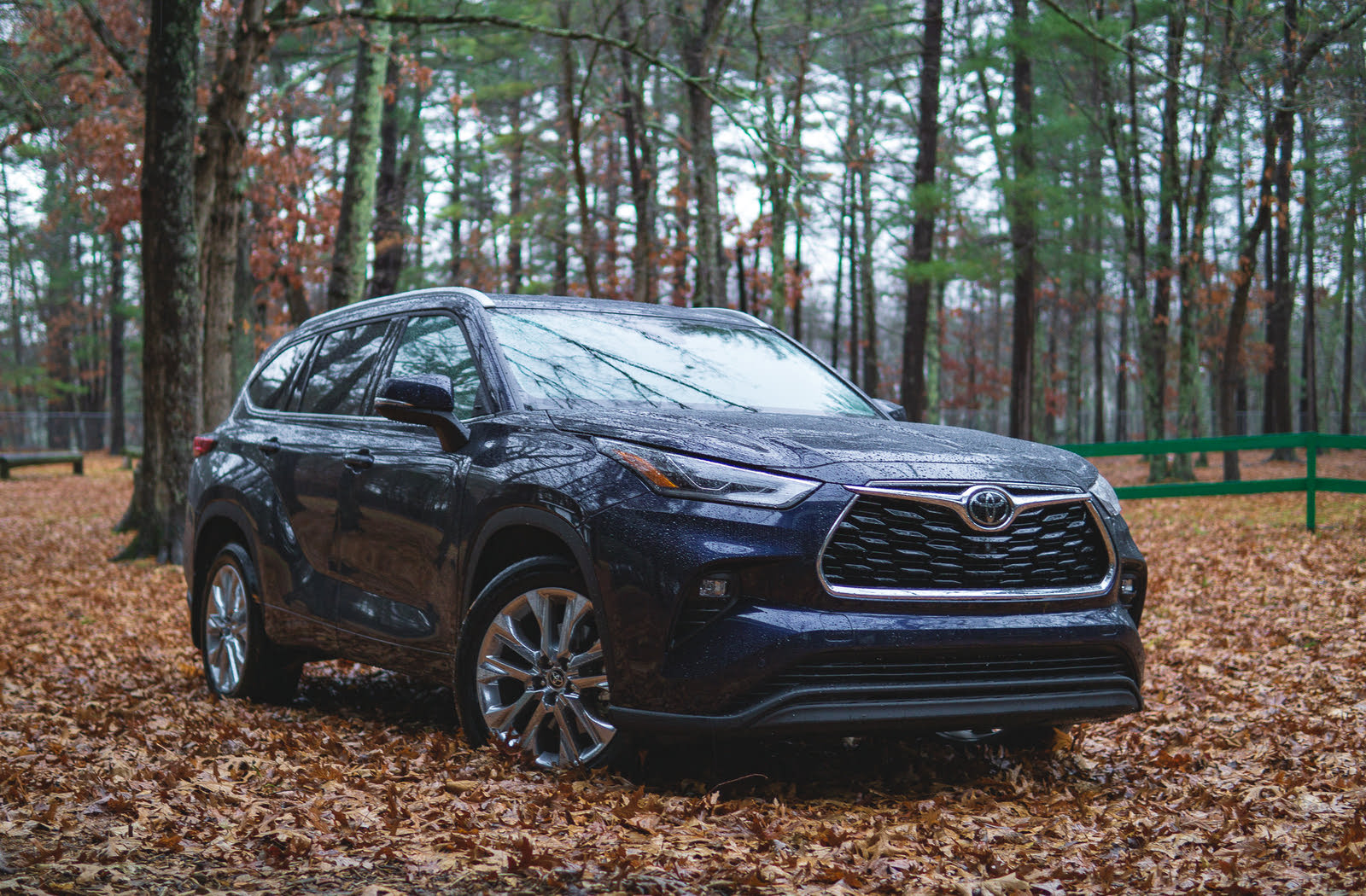
The 2021 Toyota Highlander was anything but boring in its design. It stood out among its midsize SUV peers with a front end that, while not as dramatis as the 2021 Sienna minivan, was still assertive with its wide headlights, long hood, and bold trapezoidal grille. The side profile was accentuated by a character line akin to that seen on the Supra sports car, and the rear showcased taillights reminiscent of a Lexus model, though lacking a vertical element. Overall, it gave the impression of being longer and lower than its predecessor without sacrificing size.
For this model year, Toyota introduced the XSE trim to the Highlander lineup, targeting a sportier aesthetic. The XSE featured more aggressive styling with a unique front end, 20-inch wheels with black accents, a meaner front fascia, and a larger lower air intake. However, the XSE trim, despite some suspension tuning, leaned more towards an appearance package than performance enhancement.
The Highlander Limited trim, which we tested, exuded an upscale look with chrome roof rails and accents. The interior, particularly in this trim, was luxurious with near-flawless fit and finish, tan leather seats accented by dark brown trim, and wood details that, though not real, looked fabulous. Comfort and convenience were prioritized, making it a suitable family car.
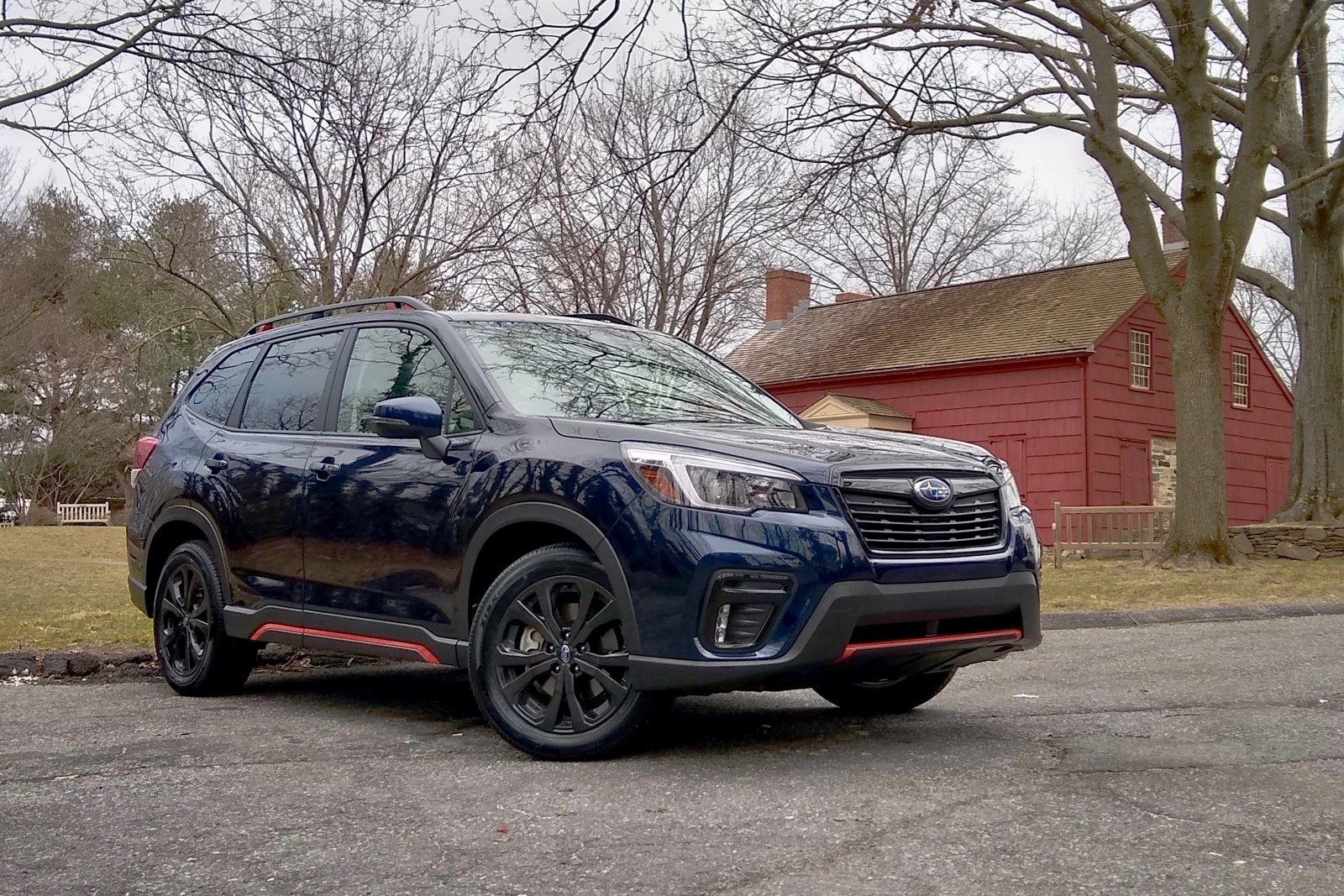
Conversely, the 2021 Subaru Forester’s design, though redesigned for the 2019 model year, seemed aged due to its carryover styling from its predecessor. The primary noticeable update was in the taillights, featuring a distinctive cross shape. Subaru stuck to its rugged, boxy, upright design, appealing to SUV shoppers who preferred a no-nonsense aesthetic. The base trim's 17-inch steel wheels gave it a plain look, yet it retained a clean and unpretentious look, particularly in Sport models with orange striping, a rear spoiler, and black 18-inch alloy wheels.
The Forester’s rugged aesthetic was backed by its shared platform with other Subaru models, offering a reliable performance foundation. The interior stuck to durable materials, and while not the prettiest, suggested longevity. Sport models introduced orange accents, adding some zest to its cabin, though leather upholstery was reserved for Limited and Touring trims.




Performance-wise, the 2021 Toyota Highlander was equipped with a robust 3.5-liter V6 engine, producing 295 horsepower and 263 pound-feet of torque. Paired with an eight-speed automatic transmission, the engine could power either front-wheel drive or all-wheel drive configurations. The Highlander didn't aim for high-speed thrills but offered smooth and predictable performance with a reputation for reliability. It held its own against competitors like the Hyundai Palisade, Kia Telluride, and Honda Pilot in terms of horsepower, though it lagged behind the Ford Explorer ST in terms of sheer power.
The Highlander’s driving dynamics were consistent with its family-focused design, with a softer suspension that prioritized comfort over cornering prowess. The XSE trim did offer stiffer springs, retuned shocks, and additional suspension tweaks, but still fell short of delivering a sporty driving experience.
In contrast, the 2021 Subaru Forester sported a 2.5-liter four-cylinder engine, delivering 182 horsepower and 176 pound-feet of torque, mated to a CVT (Continuously Variable Transmission). This engine had a boxer configuration, lowering the center of gravity for improved stability. While sufficient for most daily driving needs, the engine struggled to deliver strong acceleration, particularly noticeable during highway merges and overtaking.
The Forester’s suspension tuned provided a comfortable ride by soaking up bumps well but introduced significant body roll and bounce on uneven surfaces. The Forester’s unique advantage was in its standard AWD and X-Mode, enhancing off-road capabilities with various settings like "Snow/Dirt" and "Snow/Mud." Hill-descent control and a good ground clearance of 8.7 inches further supported its rugged positioning. However, for more serious off-road adventures, rivals like the Jeep Cherokee Trailhawk or Ford Bronco Sport were recommended.
Interior space and configuration were crucial in this segment, and the 2021 Toyota Highlander delivered well with its three-row setup. It featured expansive shelving in the front to house even the largest cell phones, with pass-throughs for charging cords. Trims above LE included a wireless charging pad within the center console. The second-row seats were versatile, sliding forward and backward to maximize legroom or provide access to the third row. However, third-row seating was tight for adults unless the second row moved forward.
Cargo space in the Highlander provided 16 cubic feet behind the third row, which expanded to 48.4 cubic feet with the third row folded, and a maximum of 84.3 cubic feet with both the second and third rows down—a suitable amount but not class-leading.
The 2021 Subaru Forester, on the other hand, offered impressive headroom and legroom thanks to its tall and flat roof, enhancing overall visibility and giving a roomy cabin feel. The cargo space was notable with 35.4 cubic feet with rear seats up and extending to 76.1 cubic feet with the rear seats down. While the Forester lacked a sliding second-row bench, it compensated with options like a power liftgate in higher trims and well-placed cupholders.
Compared with the Highlander, the Forester lacked a bit in overall cargo space but made up for it with excellent headroom and general passenger comfort. The center console and phone storage in the Forester had some downsides, such as a small phone storage cubby and no wireless charging option.
In terms of technology, the 2021 Toyota Highlander offered trim-dependent screen sizes: 8 inches for lower trims, with a 12.3-inch touchscreen optional on the Limited and standard on the Platinum. Both systems were user-friendly, though navigation performance varied. Android Auto and Apple CarPlay were standard across the lineup, enhancing connectivity. Our test Limited trim featured the 12.3-inch screen, bright, fast, and crisp, albeit sometimes limited in functionality to an 8-inch section of the display.
The 2021 Subaru Forester’s standard Starlink system included a 6.5-inch touchscreen with upgrades to an 8-inch screen on Sport and higher trims. This system supported Apple CarPlay, Android Auto, Bluetooth, and SiriusXM. While user-friendly, the primary screen's slow boot-up time was a downside. The Forester also offered secondary screens for additional info like fuel economy and tire pressure but felt overly complex by duplicating some information across screens.
Technologically, the Highlander appeared more modern with larger screens available, but the Forester provided straightforward and reliable tech with easier physical controls.
Safety features were robust in both vehicles. The 2021 Toyota Highlander came with Toyota Safety Sense 2.5+, including advanced safety features like automatic emergency braking with pedestrian detection, adaptive cruise control, lane-departure warning, lane-keeping assist, and intersection support. These features helped the Highlander secure five stars from the NHTSA and a Top Safety Pick+ from the IIHS.
Similarly, the 2021 Subaru Forester earned accolades for safety with a Top Safety Pick+ from the IIHS and a five-star rating from the NHTSA. Subaru’s EyeSight system was standard, offering features like adaptive cruise control, automatic emergency braking, lane-departure warning, and lead-vehicle start alert. Additionally, Subaru included a driver monitoring system to ensure attentiveness.
Both vehicles offered superior safety tech and received top safety ratings, reflecting their strong safety orientations.
CarGurus highlights
According to CarGurus experts, the overall rating for the 2021 Toyota Highlander is 7.5 out of 10, while the 2021 Subaru Forester scores 7.5 out of 10. Both vehicles score equally, making the final recommendation dependent on specific needs. For families needing ample cargo space and a touch of luxury in their ride, the 2021 Toyota Highlander makes an attractive choice. However, for those looking for a more rugged and spacious compact SUV, the 2021 Subaru Forester provides a compelling option, especially for outdoor enthusiasts. Ultimately, both vehicles stand out in their segments, offering reliability, safety, and a suite of features tailored to different lifestyles.
Choose the 2021 Subaru Forester if:
- You need a compact SUV with excellent headroom and cargo space for outdoor adventures.
- You seek a no-nonsense SUV with superior all-wheel-drive capabilities.
- You appreciate standard safety features like Subaru's EyeSight and driver monitoring systems.


Choose the 2021 Toyota Highlander if:
- You require more flexible cargo and seating configurations for a large family.
- You prefer a vehicle with a more upscale and luxurious interior.
- You value advanced tech options like a large 12.3-inch touchscreen and wireless charging.


CarGurus highlights
According to CarGurus experts, the overall rating for the 2021 Toyota Highlander is 7.5 out of 10, while the 2021 Subaru Forester scores 7.5 out of 10. Both vehicles score equally, making the final recommendation dependent on specific needs. For families needing ample cargo space and a touch of luxury in their ride, the 2021 Toyota Highlander makes an attractive choice. However, for those looking for a more rugged and spacious compact SUV, the 2021 Subaru Forester provides a compelling option, especially for outdoor enthusiasts. Ultimately, both vehicles stand out in their segments, offering reliability, safety, and a suite of features tailored to different lifestyles.
Choose the 2021 Subaru Forester if:
Shop Now- You need a compact SUV with excellent headroom and cargo space for outdoor adventures.
- You seek a no-nonsense SUV with superior all-wheel-drive capabilities.
- You appreciate standard safety features like Subaru's EyeSight and driver monitoring systems.
Choose the 2021 Toyota Highlander if:
Shop Now- You require more flexible cargo and seating configurations for a large family.
- You prefer a vehicle with a more upscale and luxurious interior.
- You value advanced tech options like a large 12.3-inch touchscreen and wireless charging.

By: CarGurus + AI
At CarGurus, our team of experienced automotive writers remain at the heart of our content operation, conducting hands-on car tests and writing insightful guides that are backed by years of industry experience. To complement this, we are harnessing AI to make our content offering more diverse and more helpful to shoppers than ever. To achieve this, our AI systems are based exclusively on CarGurus content, ratings and data, so that what we produce is both unique to CarGurus, and uniquely helpful to car shoppers.

