2022 Toyota Sienna vs 2023 Subaru Forester
Overview | |
MSRP$35,285 | MSRP$26,395 |
Listings496 | Listings1481 |
Ratings & Reviews | |
User Reviews | User Reviews |
Expert reviews8.7 out of 10 | Expert reviews7.3 out of 10 |
Pros
Cons
| Pros
Cons
|
2022 Toyota Sienna Reviews SummaryThe 2022 Toyota Sienna hybrid minivan rolls into the second model year following a redesign for 2021. Last year’s successful makeover with a standard hybrid powertrain returns unchanged, but a new Woodland trim level is available to attract adventurous families (or those who want to look that way). | |
2023 Subaru Forester Reviews SummarySheer practicality defines the 2023 Subaru Forester, a compact crossover SUV where form follows function without fail. In turn, the 2023 Forester possesses the power to make your life easier in nearly every respect. From its standard all-wheel drive (AWD) and generous ground clearance to its roomy interior and sizable cargo hold, it effortlessly tackles most daily tasks with a shrug. This year, Subaru continues to refine the Forester, adding next-generation EyeSight safety features and an improved standard infotainment system. Unfortunately, though, the Forester still lacks a turbocharged engine option or an electrified drivetrain. | |
No video found | No video found |
Popular Features & Specs | |
Engine2.5L 245 hp I4 Hybrid | Engine2.5L 182 hp H4 |
Drive TrainFWD | Drive TrainAWD |
Seating Capacity8 | Seating Capacity5 |
Horsepower | Horsepower182 hp @ 5800 rpm |
EV Battery Capacity1.9 kWh | EV Battery Capacity |
MPG City36 | MPG City26 |
MPG Highway36 | MPG Highway33 |
Engine | |
Engine Name2.5L 245 hp I4 Hybrid | Engine Name2.5L 182 hp H4 |
Torque | Torque178 lb-ft @ 4400 rpm |
Horsepower | Horsepower182 hp @ 5800 rpm |
DrivetrainFWD | DrivetrainAWD |
Fuel Economy | |
EV Battery Capacity1.9 kWh | EV Battery Capacity |
MPG City36 | MPG City26 |
MPG Highway36 | MPG Highway33 |
Interior | |
Seating Capacity8 | Seating Capacity5 |
Safety | |
Front Crash Overall4 | Front Crash Overall5 |
Side Crash Overall5 | Side Crash Overall5 |
Dimensions & Capacity | |
Cargo Space33.5 cu ft | Cargo Space28.9 cu ft |
Curb Weight4610 lbs | Curb Weight3454 lbs |
Height68.5 in | Height67.5 in |
Length203.7 in | Length182.7 in |
Width78.5 in | Width80.9 in |
Wheelbase120.5 in | Wheelbase105.1 in |
Maximum Payload1560 lbs | Maximum Payload1437 lbs |
Number of doors4 | Number of doors4 |
Maximum Towing Capacity3500 lbs | Maximum Towing Capacity1500 lbs |
Overview | ||
MSRP | $35,285 | $26,395 |
Listings | ||
Ratings & Reviews | ||
User reviews | ||
Expert reviews | 8.7 out of 10Read full review | 7.3 out of 10Read full review |
Pros & cons | Pros
Cons
| Pros
Cons
|
Summary | The 2022 Toyota Sienna hybrid minivan rolls into the second model year following a redesign for 2021. Last year’s successful makeover with a standard hybrid powertrain returns unchanged, but a new Woodland trim level is available to attract adventurous families (or those who want to look that way). | Sheer practicality defines the 2023 Subaru Forester, a compact crossover SUV where form follows function without fail. In turn, the 2023 Forester possesses the power to make your life easier in nearly every respect. From its standard all-wheel drive (AWD) and generous ground clearance to its roomy interior and sizable cargo hold, it effortlessly tackles most daily tasks with a shrug. This year, Subaru continues to refine the Forester, adding next-generation EyeSight safety features and an improved standard infotainment system. Unfortunately, though, the Forester still lacks a turbocharged engine option or an electrified drivetrain. |
Video | No video found | No video found |
Popular Features & Specs | ||
Engine | 2.5L 245 hp I4 Hybrid | 2.5L 182 hp H4 |
Drive Train | FWD | AWD |
Seating Capacity | 8 | 5 |
Horsepower | 182 hp @ 5800 rpm | |
EV Battery Capacity | 1.9 kWh | |
MPG City | 36 | 26 |
MPG Highway | 36 | 33 |
Engine | ||
Engine Name | 2.5L 245 hp I4 Hybrid | 2.5L 182 hp H4 |
Torque | 178 lb-ft @ 4400 rpm | |
Horsepower | 182 hp @ 5800 rpm | |
Drivetrain | FWD | AWD |
Fuel Economy | ||
EV Battery Capacity | 1.9 kWh | |
MPG City | 36 | 26 |
MPG Highway | 36 | 33 |
Interior | ||
Seating Capacity | 8 | 5 |
Safety | ||
Front Crash Overall | 4 | 5 |
Side Crash Overall | 5 | 5 |
Dimensions & Capacity | ||
Cargo Space | 33.5 cu ft | 28.9 cu ft |
Curb Weight | 4610 lbs | 3454 lbs |
Height | 68.5 in | 67.5 in |
Length | 203.7 in | 182.7 in |
Width | 78.5 in | 80.9 in |
Wheelbase | 120.5 in | 105.1 in |
Maximum Payload | 1560 lbs | 1437 lbs |
Number of doors | 4 | 4 |
Maximum Towing Capacity | 3500 lbs | 1500 lbs |
Minivans have long occupied a unique space in the automotive market. Despite prevailing logic suggesting that every growing family should drive a minivan, the surge in SUV popularity has led to the decline of this category. Notably, Ford and General Motors discontinued their minivan production for the U.S. over a decade ago. Meanwhile, Mazda, Nissan, and Volkswagen also exited the minivan market, and Kia rebranded their minivan as a “Multi-Purpose Vehicle (MPV)" to avoid the "minivan" stigma.
Toyota, however, remained faithful to the minivan. Its history with these vehicles started with the Toyota Van (1984-1989), succeeded by the innovative mid-engined Previa in 1990. The Sienna emerged in 1998 on a front-wheel-drive (FWD) platform shared with the Camry, becoming a significant player in the minivan segment. Following the first, second (2004), and third (2011) generations, the fourth-generation Sienna launched in the 2021 model year.
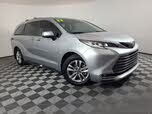
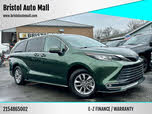
The latest Sienna embraced a modern SUV-inspired style. While the unmistakable sliding doors signaled its minivan roots, its bold front end and meticulously engineered sliding door hinges, which concealed the slider channel below the rear window, added to the clean design. Its rear doors also featured striking styling integrated into the fender well, giving the vehicle a confident stance. Wheels ranged from 17-inch on the base models to 18-inch and even 20-inch on higher trims, enhancing its assertive profile.
Inside, the cabin strategy avoided the conventional minivan vibe. The front cabin was decluttered and boasted ample storage solutions—convenient for any family hauler. Storage options included an under-console open storage area, substantial door pockets, and numerous cup holders (15 or 16 depending on the spare tire option). The second and third rows offered spacious, comfortable seating, with available second-row captain’s chairs with ottomans and a 60/40-split third-row bench that tucked away into the floor. The second row could slide up to 25 inches, simplifying access to the third row.
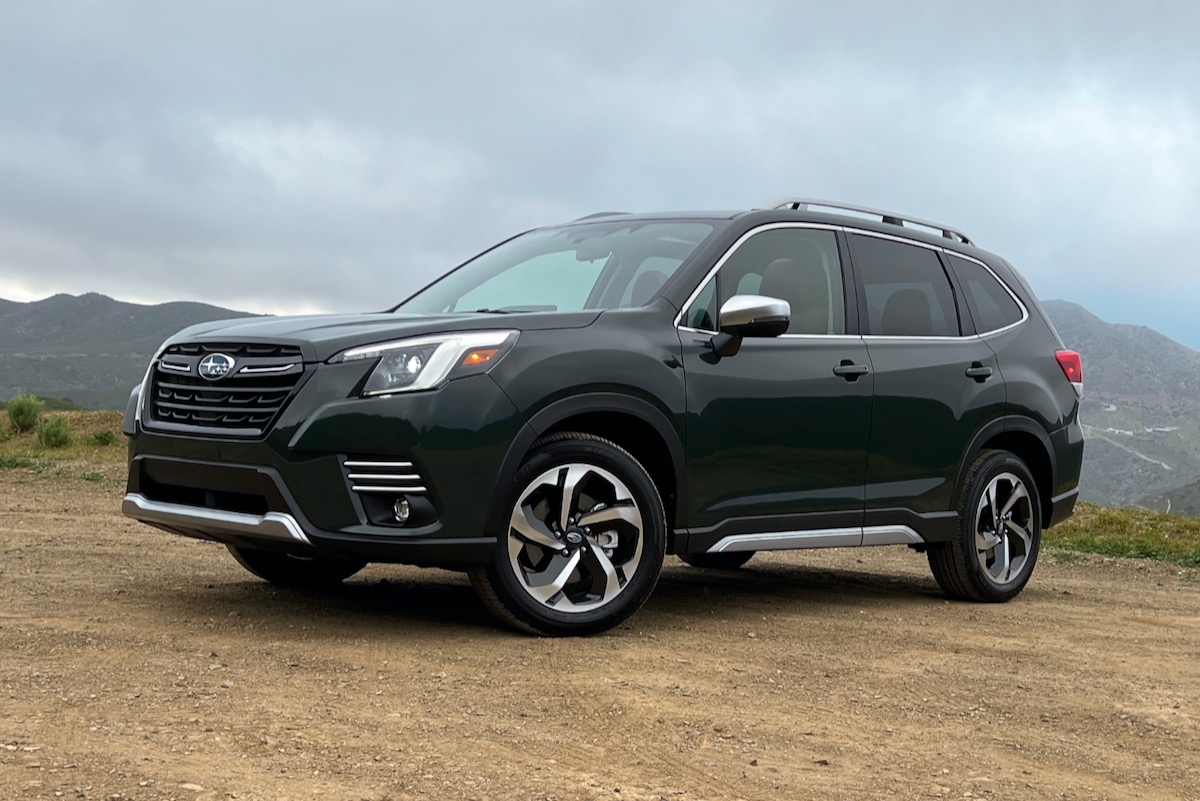
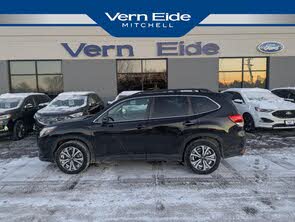
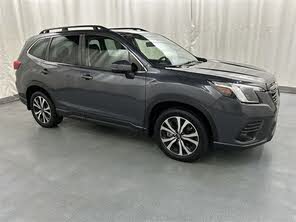
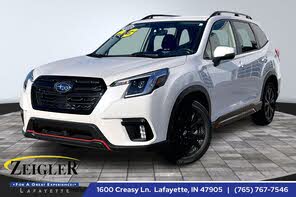
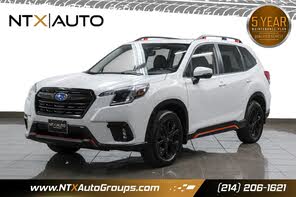
The 2023 Subaru Forester retained a familiar appearance, closely resembling its predecessors from the past two decades. Our test vehicle, painted Cascade Green Silica, reinforced this sense of uniformity. The new Forester came in six trims: Base, Premium, Sport, Wilderness, Limited, and Touring, with prices ranging from $26,395 to $36,495, excluding a $1,225 destination charge. Our Touring trim model totaled $37,720, including destination.
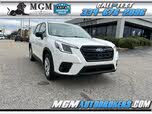
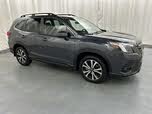
In terms of design, the Forester maintained a two-box SUV silhouette with elements akin to a smaller Subaru Ascent, featuring flared fenders, a narrow waist, an upswept beltline, and distinctive pincer-shaped front and rear lighting. However, aesthetics were not its strongest suit.
Among the Forester trims, Touring was the most visually refined, boasting 18-inch alloy wheels and upscale satin chrome exterior accents. Like other Foresters, it came equipped with robust roof rails capable of supporting up to 700 pounds of static weight, or 800 pounds on the Wilderness variant, making it ideal for rooftop tents. However, it’s important to remember that the dynamic-load rating was 176 pounds.
Inside, the Forester Touring featured exclusive Saddle Brown leather, visible stitching, and metallic accents, integrating traditional Subaru design elements such as analog gauges, an 8-inch touchscreen, and an information display at the top of the dashboard. While hard plastics were prevalent, they facilitated easier cabin cleaning.
Overall, the Forester's interior felt busier, attributed to the mix of gray and silver cladding outside and the traditional button- and knob-laden control layout inside. This classic approach may have been preferred by those who appreciated an easy-to-locate and user-friendly design. The Forester retained a sense of back-to-basics utility, combined with some upscale touches for higher trims.


The 2022 Sienna continued its hybrid-only configuration introduced in 2021. This strategic move aligned with Toyota's legacy as a leader in hybrid technology, which extended across models like Avalon, Camry, Corolla, Prius, Highlander, RAV4, and Venza, and the upcoming Tundra hybrid truck.
Under the hood, the Sienna housed a 2.5-liter four-cylinder engine paired with two electric motors, collectively generating 243 horsepower. While FWD was standard, buyers could opt for AWD on any trim. The AWD system incorporated a rear electric motor delivering 54 hp and 89 pound-feet of torque, simplifying the drivetrain mechanics.
The Sienna utilized an electronically controlled continuously variable transmission (CVT), offering seamless power delivery and enhanced fuel efficiency. Drivers could select from four driving modes (Normal, EV, Eco, and Sport) using a center console toggle, adding versatility to the driving experience.
Handling was impressive for a minivan, credited to the Toyota Next Generation Architecture (TNGA) platform that integrated front suspension, steering, and independent rear trailing arm suspension. This setup minimized body roll, providing a comfortable highway ride.
The standout feature was the Sienna Hybrid’s fuel economy. According to EPA estimates, FWD models achieved 36 mpg in the city, highway, and combined, while AWD variants were rated at 35 mpg in the same categories. The integration and placement of the 288-volt nickel-metal-hydride battery pack under the front seats ensured efficient space utilization and a balanced ride. The battery pack came with an extensive 10-year/150,000-mile warranty.
Every 2023 Subaru Forester model was powered by a 2.5-liter four-cylinder engine, producing 182 horsepower and 176 pound-feet of torque. This engine powered all four wheels via a CVT designed with eight programmed ratios to mimic the feel of a traditional automatic transmission. Additionally, the Subaru Intelligent Drive (SI-Drive) system featured a Sport mode for more responsive handling.
Apart from the Base trim, all Forester models included an X-Mode off-road traction management system enhanced with hill descent control. The Premium trim added Normal, Snow, and Dirt modes, while higher trims introduced settings for Deep Snow and Mud, augmenting its off-road capabilities.
The Forester Wilderness trim, designed for rugged terrain, incorporated several modifications for enhanced off-road performance. However, our testing focused on the more refined Touring trim. Despite severe weather—torrential rain, flooded roads, and muddy trails—the Forester excelled, showing its prowess in adverse conditions. During typical test routes through the Santa Monica Mountains and Ventura County, the engine's performance appeared adequate, slightly more lively than the Subaru Outback’s similar powertrain, attributed to the Forester's lighter weight. However, the engine's noise levels under acceleration might be a drawback for some.
Subaru's tuning ensured excellent driving dynamics with comfortable yet engaging handling. The Forester’s light and precise steering, effective brakes, and well-tuned suspension supported confident driving on varied terrains. It avoided the oft-experienced lateral and fore-aft motions of other SUVs, resulting in a composed ride.
Nonetheless, the Forester's fuel economy on our testing route fell short of the official 29 mpg combined rating, averaging 25.9 mpg (26 mpg for the Wilderness). A turbocharged engine could have improved performance, especially at higher elevations. Moreover, a hybrid variant could boost efficiency while providing additional power for adventurous drives.
The Sienna served as an ideal family workhorse, boasting the ability to convey a full 4x8 sheet of plywood with the tailgate closed. The flexible sliding second row facilitated cargo loading from both the rear and side doors. With the second row in default position, cargo space measurements were: 33.5 cubic feet behind the third row, 75.2 cubic feet behind the second row, and 101 cubic feet behind the first row. Additionally, the Sienna had a maximum towing capacity of 3,500 pounds.
The third-row bench, split 60/40, seamlessly stored away into the floor, prioritizing versatile cargo configurations. Each seating row had practical storage, including cupholders and bottle holders in all four side doors. For ultimate convenience, both side sliding doors and the rear tailgate were power-operated, activated by foot-motion sensors, proving invaluable for hands-free access while carrying groceries or children.
Functionality underscored the Forester's design, emphasizing practicality over style. In the Premium trim, features like a panoramic sunroof, 10-way power-adjustable driver’s seat, heated front seats, heated side mirrors, and windshield wiper de-icer system were standard. The higher trims offered upgraded upholstery, dual-zone automatic climate control, and additional seating adjustments.
The Forester’s superior outward visibility was attributed to its high seating position, expansive windows, thin windshield pillars, and sizable side mirrors, enhancing driving and parking ease. However, the panoramic sunroof lacked sufficient tint, causing solar heating issues, while the rear seats were less supportive for longer trips.
The Forester's cargo versatility was evident with easily accessible storage and rear door hooks for grocery bags. It provided 26.9 cubic feet of cargo capacity behind the rear seats (28.9 cubic feet without the panoramic sunroof). Folding the seats expanded the capacity to 69.1 cubic feet (74.2 cubic feet without the sunroof). Despite being average for compact SUVs, the space was practically laid out for everyday use.
The Sienna’s technology suite was robust. It featured a 9-inch touchscreen across all trims, incorporating Apple CarPlay, Android Auto, Amazon Alexa, SiriusXM, a USB media port, and six USB charging ports. However, it lacked wireless CarPlay and Android Auto—an oversight in today’s tech-laden market.
Additional tech highlights included a one-year trial of Safety Connect and Remote Connect services (for XLE and higher trims), a 10-year Service Connect trial, and a three-month AT&T WiFi Connect trial with 2GB of data. Bluetooth hands-free calling and audio streaming were standard across all trims. Higher trims featured Qi wireless charging, a 1500-watt inverter with a 120-volt AC outlet, and enhanced audio systems, culminating in a 12-speaker JBL system for upper trims.
The rear-seat entertainment system, available on XLE and above, offered an 11.6-inch 1080p widescreen, accompanied by a remote and two wireless headphones. The instrument panel's color multi-information display varied by trim, with Platinum models featuring a 10-inch color head-up display for safer driving. Upgrading to Limited and Platinum trims added a digital rearview mirror, enhancing the rear visibility when fully loaded.
On the surface, the Forester's technology seemed dated, yet it offered practical functionality. The Base trim received a 6.5-inch touchscreen infotainment system with high-resolution display, Bluetooth, Apple CarPlay, and Android Auto. Upgrading to Premium added satellite radio, HD Radio, and Starlink connected services, including remote engine start and Wi-Fi hotspot. Notably, a CD player remained standard, except in the Base trim.
An 8-inch display was optional, supporting upgrades such as navigation and a premium Harman Kardon audio system. Unfortunately, the Forester lacked a wireless smartphone charger.
The user interface prioritized physical controls, which some drivers might prefer over modern touch-centric systems. Climate controls were separate from the touchscreen, and the volume and tuning knobs were straightforward to use. Despite occasional reflections on the display, the simplicity and ease of use outweighed these minor drawbacks.
The voice-recognition system, however, was problematic, often misunderstanding commands and providing inaccurate results. Thus, drivers were better off utilizing Apple CarPlay or Android Auto for navigation and other functions.
The 2021 Toyota Sienna received top safety ratings, achieving both a Top Safety Pick+ from the IIHS and a five-star rating from the NHTSA. The 2022 model was expected to maintain these accolades.
Toyota Safety Sense 2.0 included a comprehensive suite of driver aids: adaptive cruise control, Lane Tracing Assist, forward collision warning with pedestrian detection, automatic emergency braking, lane departure warning, automatic high beams, and traffic sign recognition. Additionally, the Star Safety System offered stability and traction control, anti-lock brakes, and electronic brake-force distribution.
The Sienna featured 10 airbags and several LATCH connectors, with specific configurations for eight-passenger and seven-passenger models. A rear-seat reminder system was standard, adding a vital layer of safety for families. Tire-pressure monitoring and an inflator kit were standard, with an optional spare tire moved to the cargo space wall for easier access.
The 2023 Forester boasted Subaru's next-generation EyeSight technology, offering enhanced driving assistance and collision avoidance via updated software and wider-view cameras. EyeSight was designed to perform better than before, with the addition of Automatic Emergency Steering for trim levels with blind-spot monitoring.
Forester trims included various safety features: base models lacked blind-spot monitoring, while it was optional on Premium and standard on higher trims. Wilderness and Touring trims included Rear Automatic Braking (RAB), though it sometimes activated unnecessarily. The RAB Off button was inconveniently located on the infotainment screen and defaulted to “on” at each start-up.
The Touring trim featured the DriverFocus Distraction Mitigation System, monitoring driver attentiveness and offering gesture control for temperature settings. While this advanced tech performed well, its practicality was questionable in some cases.
Despite these features, the Forester received a Top Safety Pick rating from the IIHS, a downgrade from the previous year's Top Safety Pick+ due to "Acceptable" and "Marginal" ratings in specific new tests. The NHTSA awarded the Forester five-star crash-test ratings overall, with a four-star rollover rating.
CarGurus highlights

According to CarGurus experts, the overall rating for the 2022 Toyota Sienna is 8.7 out of 10, while the 2023 Subaru Forester scores 7.3 out of 10. Given these scores, we recommend the 2022 Toyota Sienna for its superior overall performance, fuel efficiency, and practical features tailored to meet the needs of growing families.
Choose the 2022 Toyota Sienna if:
- You need a versatile and spacious vehicle with exceptional cargo capacity and practical sliding doors.
- Superior fuel efficiency is a priority, thanks to the hybrid powertrain.
- You appreciate comprehensive tech features and a stellar safety record.



Choose the 2023 Subaru Forester if:
- Off-roading and adverse weather performance are essential for your lifestyle, especially with advanced X-Mode settings and high ground clearance.
- Visibility and ease of driving are top concerns, enhanced by Forester’s design and seating position.
- You value functional and straightforward technology with reliable Subaru safety features.




CarGurus highlights
According to CarGurus experts, the overall rating for the 2022 Toyota Sienna is 8.7 out of 10, while the 2023 Subaru Forester scores 7.3 out of 10. Given these scores, we recommend the 2022 Toyota Sienna for its superior overall performance, fuel efficiency, and practical features tailored to meet the needs of growing families.
Choose the 2022 Toyota Sienna if:
Shop Now- You need a versatile and spacious vehicle with exceptional cargo capacity and practical sliding doors.
- Superior fuel efficiency is a priority, thanks to the hybrid powertrain.
- You appreciate comprehensive tech features and a stellar safety record.


Choose the 2023 Subaru Forester if:
Shop Now- Off-roading and adverse weather performance are essential for your lifestyle, especially with advanced X-Mode settings and high ground clearance.
- Visibility and ease of driving are top concerns, enhanced by Forester’s design and seating position.
- You value functional and straightforward technology with reliable Subaru safety features.







By: CarGurus + AI
At CarGurus, our team of experienced automotive writers remain at the heart of our content operation, conducting hands-on car tests and writing insightful guides that are backed by years of industry experience. To complement this, we are harnessing AI to make our content offering more diverse and more helpful to shoppers than ever. To achieve this, our AI systems are based exclusively on CarGurus content, ratings and data, so that what we produce is both unique to CarGurus, and uniquely helpful to car shoppers.