2021 Mazda CX-30 vs 2021 Honda CR-V

Overview | |
MSRP$22,050 | MSRP$25,350 |
Listings444 | Listings1266 |
Ratings & Reviews | |
User Reviews | User Reviews |
Expert reviews7.5 out of 10 | Expert reviews7.8 out of 10 |
Pros
Cons
| Pros
Cons
|
2021 Mazda CX-30 Reviews SummaryBlurring the lines between mainstream and luxury brands, the new 2021 Mazda CX-30 2.5 Turbo pairs effortless acceleration and engaging driving dynamics with a premium design and impressive technologies. Despite its substantial boost in power, this small crossover SUV isn’t about hardcore performance. Rather, it’s about delivering equal parts confidence, capability, style, and satisfaction, and at a price that stops where the traditional luxury brands are just getting started. | |
2021 Honda CR-V Reviews SummaryEven in a grim year, Honda is selling a staggering number of CR-Vs. The CR-V is the best-selling Honda by far. It’s also the second best-selling compact SUV, just behind the Toyota RAV4. And it's the fifth best-selling vehicle in the U.S., and if you take out all the commercial sales of full-size pickups it’s one of the two best-selling vehicles year in and year out. So it’s hard to argue against the CR-V formula. Honda’s been at this almost as long as crossovers have been a thing, launching the CR-V in 1997—a year after the RAV4 debuted. The funny thing is, aside from sales volume, there’s only one thing the CR-V particularly excels at. Aesthetics are subjective, but it would be hard to argue the CR-V is the best looking vehicle in its class. It’s not the cheapest. It’s not the best equipped, especially at the middle to lower trim levels. It’s not the fastest, nor is it the quietest, or the most fuel efficient. It’s not even the most reliable, showing up nowhere in J.D. Power's Most Reliable list. So what makes it so appealing to American consumers? Let’s see if we can figure that out. | |
No video found | |
Popular Features & Specs | |
Engine2.5L 186 hp I4 | Engine1.5L 190 hp I4 |
Drive TrainFWD | Drive TrainFWD |
Seating Capacity5 | Seating Capacity5 |
Horsepower186 hp @ 6000 rpm | Horsepower190 hp @ 5600 rpm |
MPG City25 | MPG City28 |
MPG Highway33 | MPG Highway34 |
Engine | |
Engine Name2.5L 186 hp I4 | Engine Name1.5L 190 hp I4 |
Torque186 lb-ft @ 4000 rpm | Torque179 lb-ft @ 2000 rpm |
Horsepower186 hp @ 6000 rpm | Horsepower190 hp @ 5600 rpm |
DrivetrainFWD | DrivetrainFWD |
Fuel Economy | |
MPG City25 | MPG City28 |
MPG Highway33 | MPG Highway34 |
Interior | |
Seating Capacity5 | Seating Capacity5 |
Safety | |
Front Crash Overall5 | Front Crash Overall5 |
Side Crash Overall5 | Side Crash Overall5 |
Dimensions & Capacity | |
Cargo Space20.2 cu ft | Cargo Space39.2 cu ft |
Curb Weight3234 lbs | Curb Weight3337 lbs |
Height61.7 in | Height66.1 in |
Length173.0 in | Length182.1 in |
Width70.7 in | Width73.0 in |
Wheelbase104.4 in | Wheelbase104.8 in |
Maximum Payload983 lbs | Maximum Payload1358 lbs |
Number of doors4 | Number of doors4 |
Maximum Towing Capacity | Maximum Towing Capacity1500 lbs |
Overview | ||
MSRP | $22,050 | $25,350 |
Listings | ||
Ratings & Reviews | ||
User reviews | ||
Expert reviews | 7.5 out of 10Read full review | 7.8 out of 10Read full review |
Pros & cons | Pros
Cons
| Pros
Cons
|
Summary | Blurring the lines between mainstream and luxury brands, the new 2021 Mazda CX-30 2.5 Turbo pairs effortless acceleration and engaging driving dynamics with a premium design and impressive technologies. Despite its substantial boost in power, this small crossover SUV isn’t about hardcore performance. Rather, it’s about delivering equal parts confidence, capability, style, and satisfaction, and at a price that stops where the traditional luxury brands are just getting started. | Even in a grim year, Honda is selling a staggering number of CR-Vs. The CR-V is the best-selling Honda by far. It’s also the second best-selling compact SUV, just behind the Toyota RAV4. And it's the fifth best-selling vehicle in the U.S., and if you take out all the commercial sales of full-size pickups it’s one of the two best-selling vehicles year in and year out. So it’s hard to argue against the CR-V formula. Honda’s been at this almost as long as crossovers have been a thing, launching the CR-V in 1997—a year after the RAV4 debuted. The funny thing is, aside from sales volume, there’s only one thing the CR-V particularly excels at. Aesthetics are subjective, but it would be hard to argue the CR-V is the best looking vehicle in its class. It’s not the cheapest. It’s not the best equipped, especially at the middle to lower trim levels. It’s not the fastest, nor is it the quietest, or the most fuel efficient. It’s not even the most reliable, showing up nowhere in J.D. Power's Most Reliable list. So what makes it so appealing to American consumers? Let’s see if we can figure that out. |
Video | No video found | |
Popular Features & Specs | ||
Engine | 2.5L 186 hp I4 | 1.5L 190 hp I4 |
Drive Train | FWD | FWD |
Seating Capacity | 5 | 5 |
Horsepower | 186 hp @ 6000 rpm | 190 hp @ 5600 rpm |
MPG City | 25 | 28 |
MPG Highway | 33 | 34 |
Engine | ||
Engine Name | 2.5L 186 hp I4 | 1.5L 190 hp I4 |
Torque | 186 lb-ft @ 4000 rpm | 179 lb-ft @ 2000 rpm |
Horsepower | 186 hp @ 6000 rpm | 190 hp @ 5600 rpm |
Drivetrain | FWD | FWD |
Fuel Economy | ||
MPG City | 25 | 28 |
MPG Highway | 33 | 34 |
Interior | ||
Seating Capacity | 5 | 5 |
Safety | ||
Front Crash Overall | 5 | 5 |
Side Crash Overall | 5 | 5 |
Dimensions & Capacity | ||
Cargo Space | 20.2 cu ft | 39.2 cu ft |
Curb Weight | 3234 lbs | 3337 lbs |
Height | 61.7 in | 66.1 in |
Length | 173.0 in | 182.1 in |
Width | 70.7 in | 73.0 in |
Wheelbase | 104.4 in | 104.8 in |
Maximum Payload | 983 lbs | 1358 lbs |
Number of doors | 4 | 4 |
Maximum Towing Capacity | 1500 lbs | |
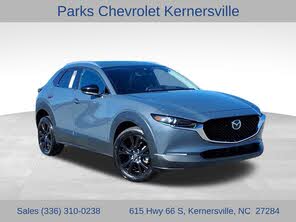
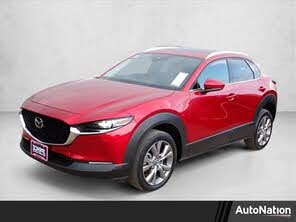
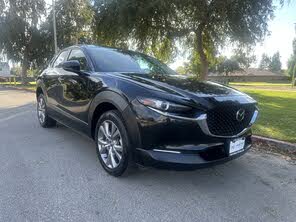
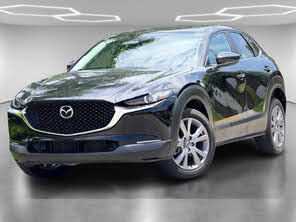
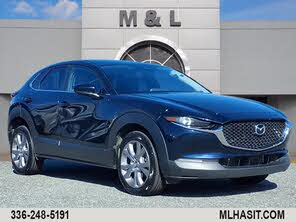
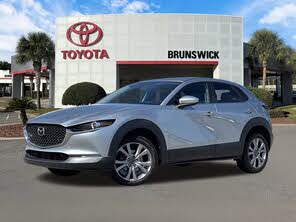
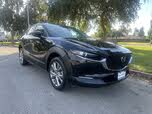
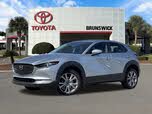
The 2021 Mazda CX-30 2.5 Turbo sported a distinctive, boldly designed look. It showcased shiny black 18-inch wheels, a shiny black grille, black side mirror housings, and thick matte black body cladding, creating an impression akin to an intense makeover by a black Sharpie. This abundant use of black elements provided the CX-30 with a stark, floating-over-the-wheels appearance, giving it an agile stance. The perception was so strong that it looked like the Mazda was perpetually cresting a hill at high speed.
Mazda's approach deliberately distanced the CX-30 from its Mazda3 hatchback sibling, despite sharing similar styling themes. The heightened stance of the CX-30 was both perceptual and real, making it evident as soon as one opened the door to slide into the driver's seat, rather than dropping down as one would in the Mazda3. Inside, the cabin mirrored the Mazda3’s, adorned with quality materials, complementary tones, and stitched chocolate brown surfaces, exuding an upscale, refined ambiance.
Modifications were minor, featuring a chrome accent around the engine start button and a frameless rearview mirror. Depending on the trim level, the upholstery ranged from black and Griege leatherette in lower trims to black or white leather in Premium and Premium Plus trims. Pricing was positioned between $31,000 and $35,000, with the Snowflake White Pearl Mica test vehicle costing $35,745, including destination charges.
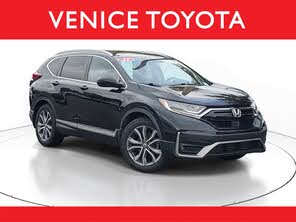
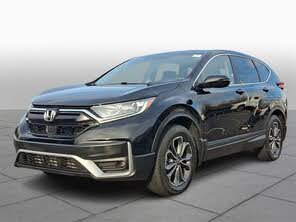
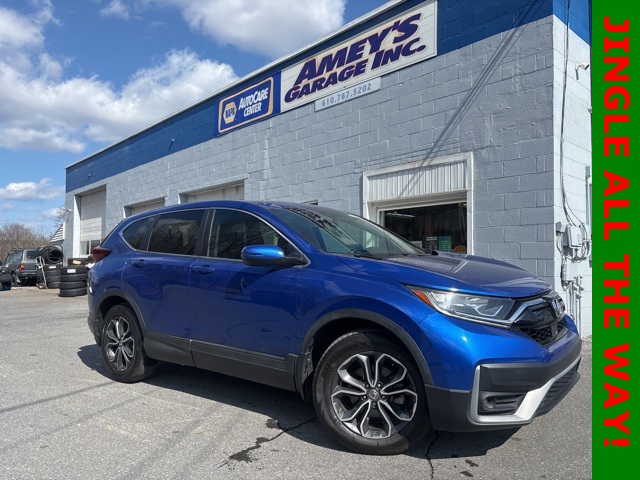
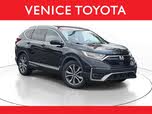
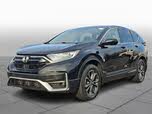
Contrastingly, the 2021 Honda CR-V held a more generic appearance, similar to many competitive crossovers. The styling across compact crossovers was nearly identical, with few distinguishing details aside from perhaps the grille and some chrome accents. Therefore, the CR-V wasn't a vehicle purchased for its exterior aesthetics.
Honda offered the CR-V in eight colors, though many were variations of gray, black, and white. More vibrant colors like Aegean Blue Metallic and Radiant Red Metallic were harder to find and mostly available in higher trims. The interior, available in black, gray, and ivory cloth or leather, reflected a more modern look with angular seat designs and headrests, especially noticeable in the higher trims.
The mid-tier trims of competitors like the Kia Sportage and Hyundai Tucson often provided more distinctive styling inside and out than the CR-V, which lacked uniqueness but remained a functional and practical choice.


Powering the 2021 Mazda CX-30 2.5 Turbo was a turbocharged 2.5-liter four-cylinder engine that delivered between 227 and 250 horsepower, contingent upon the octane rating of the fuel. Regular fuel yielded 227 hp, while premium fuel bumped it up to 250 hp. Torque figures were similarly impressive, ranging from 310 lb-ft at 2,000 rpm to 320 lb-ft at 2,500 rpm, ensuring consistent acceleration across varying engine speeds.
Paired with a six-speed automatic transmission and standard i-Activ all-wheel-drive (AWD), Mazda also tweaked the front suspension and G-Vectoring Control Plus technology to enhance handling. Fuel economy was rated at 25 mpg combined, but real-world driving yielded 24.1 mpg, culminating in a driving range of just over 305 miles.
Mazda’s approach didn’t prioritize the fastest acceleration times but instead focused on providing enjoyable and effortless power delivery, tuned to offer responsive acceleration in most situations. Under heavier acceleration, slight torque steer was present due to the high torque output, managed effectively by the GVC-Plus and i-Activ AWD systems that distributed power adeptly to the rear wheels when necessary.
Mazda's off-road mode, combined with 2.5 inches of additional ground clearance, enhanced the CX-30’s capability on rugged terrains, although its torsion-beam rear suspension occasionally exhibited more bounce over uneven surfaces. Nonetheless, the CX-30 was touted as a premium driving experience, though less engaging than the lower Mazda3 due to its added height and weight.
In contrast, the 2021 Honda CR-V, equipped uniformly across its trims with a 190-horsepower turbocharged four-cylinder engine, offered smooth, reliable acceleration rather than sportiness. It achieved 0-60 mph in about 7.8 seconds, comparable to its class but notably focused on providing a stable, predictable driving experience with its continuously variable transmission (CVT).
The CR-V’s CVT was designed for efficiency over excitement, contrasting with competitors like the Kia Sportage and Hyundai Tucson that offered more engaging driving experiences with their conventional transmissions. Available primarily in front-wheel drive (FWD), the CR-V also had all-wheel drive (AWD) as an optional feature.
With a MacPherson strut front suspension and multi-link rear suspension setup common in this class, the CR-V maintained decent handling and ride quality, albeit without the spirited driving dynamics found in some of its rivals.
The 2021 Mazda CX-30 2.5 Turbo excelled in driver comfort, featuring an eight-way power-adjustable seat, impressive long-distance support, and a driver-focused interior layout. Both front seats were heated, and Premium and Premium Plus trims included a heated steering wheel. However, the passenger seat lacked the range of adjustability of the driver’s seat, and ventilated seats were absent, slightly dimming its premium aspirations.
The cabin, although designed for the driver, felt spacious and high-quality, resembling larger SUVs. However, rear-seat comfort was compromised, with limited legroom making it suitable for short trips only. Nevertheless, rear passengers benefited from air conditioning vents for added comfort.
Storage options within the cabin were practical, although the placement of the wireless smartphone charger at the bottom of the center console forced a choice between storage and phone charging. Cargo volume stood at 20.2 cubic feet behind the second row, expanding to 45.2 cubic feet with the seats folded, slightly less than the Mazda3 hatchback.
The 2021 Honda CR-V, designed to provide generous space for five passengers, achieved its goal effectively. It featured a spacious 102.9 cubic feet of passenger volume, surpassing the Toyota RAV4 by four cubic feet. Cargo space was ample, offering 75.8 cubic feet with the rear seats folded, accommodating significant luggage.
Accessing the cargo area varied by trim, with lower trims requiring manual operation, while higher trims like the EX-L and Touring featured power tailgate options, the latter with a hands-free operation. Roof rails, absent in most trims, were standard only in the top Touring trim.
The 2021 Mazda CX-30 Turbo offered a non-touchscreen 8.8-inch display atop the dashboard, navigated via physical controls on the center console or steering wheel, and voice commands. Although innovative, this system required acclimation and could be distracting without a natural voice recognition system. Features like Apple CarPlay and Android Auto were standard, but switching between radio stations was cumbersome.
The CX-30 Turbo included three years of Mazda Connected Services, with a trial for the 4G LTE WiFi hotspot. Premium and Premium Plus trims added advanced features such as SiriusXM, navigation, and a 12-speaker Bose audio system, which provided impressive sound quality thanks to its early design integration.
Additionally, a head-up display (Active Driving Display) showed vital information, adding convenience and enhancing safety by allowing the driver to keep their eyes on the road.
In contrast, the base CR-V LX's technology was basic, with a small 5-inch screen. Higher trims included a 7-inch touchscreen with Apple CarPlay, Android Auto, and SMS text messaging functions. Audio systems ranged from a 180-watt system with six speakers in lower trims to a 300-watt system with a subwoofer in the Touring trim. Satellite navigation was exclusive to the Touring.
Charging ports were abundant in all trims but the base LX, with USB ports and a 12-volt outlet in the front and additional USB ports in the second row. The Touring trim also included a wireless phone charger up front.
The 2021 Mazda CX-30 Turbo earned top safety accolades, including a Top Safety Pick+ rating from the IIHS and high ratings from NHTSA, except for a four-star rollover rating. Mazda’s i-ActiveSense suite included advanced safety features, although it lacked high-speed lane-centering assistance.
Premium trim added adaptive front lighting, while Premium Plus included front and rear parking sensors, rear automatic braking, a surround-view camera, and Traffic Jam Assist. The latter provided lane-centering at speeds below 40 mph. The CX-30 Turbo also came with a mobile 9-1-1 automatic emergency notification system.
Similarly, the 2021 Honda CR-V received top safety ratings from IIHS and NHTSA, although it didn’t earn the highest Top Safety Pick+ rating due to lower headlight ratings and “Acceptable” LATCH system ease-of-use ratings.
Honda's edge was in making advanced safety features standard across trims. The Honda Sensing system included multi-angle rearview camera, forward collision warning, lane departure warning, automatic emergency braking, road departure mitigation, lane keeping assist, adaptive cruise control, and auto high-beams. Blind spot monitoring with rear cross-traffic alert was standard from the EX trim up.
CarGurus highlights

According to CarGurus experts, the overall rating for the 2021 Mazda CX-30 is 7.5 out of 10, while the 2021 Honda CR-V scores 7.8 out of 10. Given the higher rating, the Honda CR-V emerges as the recommended choice, offering more practicality, standard safety features, and a spacious interior, making it an excellent option for families and everyday use.
Choose the 2021 Mazda CX-30 if:
- You prioritize a sporty and distinctive design with upscale interior materials.
- You desire a responsive driving experience with advanced all-wheel drive and off-road capability.
- You seek premium features like a Bose audio system and head-up display in a compact SUV.



Choose the 2021 Honda CR-V if:
- You need a versatile and spacious vehicle with ample cargo capacity and passenger space.
- You prefer a vehicle loaded with standard advanced safety features across all trims.
- You value a practical and reliable driving experience suited for everyday use.







CarGurus highlights
According to CarGurus experts, the overall rating for the 2021 Mazda CX-30 is 7.5 out of 10, while the 2021 Honda CR-V scores 7.8 out of 10. Given the higher rating, the Honda CR-V emerges as the recommended choice, offering more practicality, standard safety features, and a spacious interior, making it an excellent option for families and everyday use.
Choose the 2021 Mazda CX-30 if:
Shop Now- You prioritize a sporty and distinctive design with upscale interior materials.
- You desire a responsive driving experience with advanced all-wheel drive and off-road capability.
- You seek premium features like a Bose audio system and head-up display in a compact SUV.








Choose the 2021 Honda CR-V if:
Shop Now- You need a versatile and spacious vehicle with ample cargo capacity and passenger space.
- You prefer a vehicle loaded with standard advanced safety features across all trims.
- You value a practical and reliable driving experience suited for everyday use.







By: CarGurus + AI
At CarGurus, our team of experienced automotive writers remain at the heart of our content operation, conducting hands-on car tests and writing insightful guides that are backed by years of industry experience. To complement this, we are harnessing AI to make our content offering more diverse and more helpful to shoppers than ever. To achieve this, our AI systems are based exclusively on CarGurus content, ratings and data, so that what we produce is both unique to CarGurus, and uniquely helpful to car shoppers.