2020 Mazda CX-30 vs 2021 Honda CR-V

Overview | |
MSRP$21,900 | MSRP$25,350 |
Listings186 | Listings1266 |
Ratings & Reviews | |
User Reviews | User Reviews |
Expert reviews7.7 out of 10 | Expert reviews7.8 out of 10 |
Pros
Cons
| Pros
Cons
|
2020 Mazda CX-30 Reviews SummaryBased on the Mazda3 platform, the 2020 Mazda CX-30 compact crossover offers two distinct advantages over the car on which it is based. The first is extra ground clearance for navigating snowstorms and light-difficulty trails. The second is easier entry and exit because the CX-30 sits higher off the ground. In exchange for these benefits, the CX-30 dilutes the brilliant design and driving dynamics for which the Mazda3 is revered. But it still looks and drives better than most of its competition. | |
2021 Honda CR-V Reviews SummaryEven in a grim year, Honda is selling a staggering number of CR-Vs. The CR-V is the best-selling Honda by far. It’s also the second best-selling compact SUV, just behind the Toyota RAV4. And it's the fifth best-selling vehicle in the U.S., and if you take out all the commercial sales of full-size pickups it’s one of the two best-selling vehicles year in and year out. So it’s hard to argue against the CR-V formula. Honda’s been at this almost as long as crossovers have been a thing, launching the CR-V in 1997—a year after the RAV4 debuted. The funny thing is, aside from sales volume, there’s only one thing the CR-V particularly excels at. Aesthetics are subjective, but it would be hard to argue the CR-V is the best looking vehicle in its class. It’s not the cheapest. It’s not the best equipped, especially at the middle to lower trim levels. It’s not the fastest, nor is it the quietest, or the most fuel efficient. It’s not even the most reliable, showing up nowhere in J.D. Power's Most Reliable list. So what makes it so appealing to American consumers? Let’s see if we can figure that out. | |
No video found | |
Popular Features & Specs | |
Engine2.5L 186 hp I4 | Engine1.5L 190 hp I4 |
Drive TrainFWD | Drive TrainFWD |
Seating Capacity5 | Seating Capacity5 |
Horsepower186 hp @ 6000 rpm | Horsepower190 hp @ 5600 rpm |
MPG City25 | MPG City28 |
MPG Highway33 | MPG Highway34 |
Engine | |
Engine Name2.5L 186 hp I4 | Engine Name1.5L 190 hp I4 |
Torque186 lb-ft @ 4000 rpm | Torque179 lb-ft @ 2000 rpm |
Horsepower186 hp @ 6000 rpm | Horsepower190 hp @ 5600 rpm |
DrivetrainFWD | DrivetrainFWD |
Fuel Economy | |
MPG City25 | MPG City28 |
MPG Highway33 | MPG Highway34 |
Interior | |
Seating Capacity5 | Seating Capacity5 |
Safety | |
Front Crash Overall5 | Front Crash Overall5 |
Side Crash Overall5 | Side Crash Overall5 |
Dimensions & Capacity | |
Cargo Space20.2 cu ft | Cargo Space39.2 cu ft |
Curb Weight3232 lbs | Curb Weight3337 lbs |
Height61.7 in | Height66.1 in |
Length173.0 in | Length182.1 in |
Width70.7 in | Width73.0 in |
Wheelbase104.5 in | Wheelbase104.8 in |
Maximum Payload957 lbs | Maximum Payload1358 lbs |
Number of doors4 | Number of doors4 |
Maximum Towing Capacity | Maximum Towing Capacity1500 lbs |
Overview | ||
MSRP | $21,900 | $25,350 |
Listings | ||
Ratings & Reviews | ||
User reviews | ||
Expert reviews | 7.7 out of 10Read full review | 7.8 out of 10Read full review |
Pros & cons | Pros
Cons
| Pros
Cons
|
Summary | Based on the Mazda3 platform, the 2020 Mazda CX-30 compact crossover offers two distinct advantages over the car on which it is based. The first is extra ground clearance for navigating snowstorms and light-difficulty trails. The second is easier entry and exit because the CX-30 sits higher off the ground. In exchange for these benefits, the CX-30 dilutes the brilliant design and driving dynamics for which the Mazda3 is revered. But it still looks and drives better than most of its competition. | Even in a grim year, Honda is selling a staggering number of CR-Vs. The CR-V is the best-selling Honda by far. It’s also the second best-selling compact SUV, just behind the Toyota RAV4. And it's the fifth best-selling vehicle in the U.S., and if you take out all the commercial sales of full-size pickups it’s one of the two best-selling vehicles year in and year out. So it’s hard to argue against the CR-V formula. Honda’s been at this almost as long as crossovers have been a thing, launching the CR-V in 1997—a year after the RAV4 debuted. The funny thing is, aside from sales volume, there’s only one thing the CR-V particularly excels at. Aesthetics are subjective, but it would be hard to argue the CR-V is the best looking vehicle in its class. It’s not the cheapest. It’s not the best equipped, especially at the middle to lower trim levels. It’s not the fastest, nor is it the quietest, or the most fuel efficient. It’s not even the most reliable, showing up nowhere in J.D. Power's Most Reliable list. So what makes it so appealing to American consumers? Let’s see if we can figure that out. |
Video | No video found | |
Popular Features & Specs | ||
Engine | 2.5L 186 hp I4 | 1.5L 190 hp I4 |
Drive Train | FWD | FWD |
Seating Capacity | 5 | 5 |
Horsepower | 186 hp @ 6000 rpm | 190 hp @ 5600 rpm |
MPG City | 25 | 28 |
MPG Highway | 33 | 34 |
Engine | ||
Engine Name | 2.5L 186 hp I4 | 1.5L 190 hp I4 |
Torque | 186 lb-ft @ 4000 rpm | 179 lb-ft @ 2000 rpm |
Horsepower | 186 hp @ 6000 rpm | 190 hp @ 5600 rpm |
Drivetrain | FWD | FWD |
Fuel Economy | ||
MPG City | 25 | 28 |
MPG Highway | 33 | 34 |
Interior | ||
Seating Capacity | 5 | 5 |
Safety | ||
Front Crash Overall | 5 | 5 |
Side Crash Overall | 5 | 5 |
Dimensions & Capacity | ||
Cargo Space | 20.2 cu ft | 39.2 cu ft |
Curb Weight | 3232 lbs | 3337 lbs |
Height | 61.7 in | 66.1 in |
Length | 173.0 in | 182.1 in |
Width | 70.7 in | 73.0 in |
Wheelbase | 104.5 in | 104.8 in |
Maximum Payload | 957 lbs | 1358 lbs |
Number of doors | 4 | 4 |
Maximum Towing Capacity | 1500 lbs | |
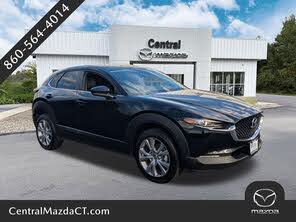
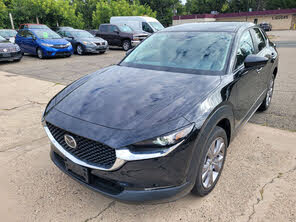
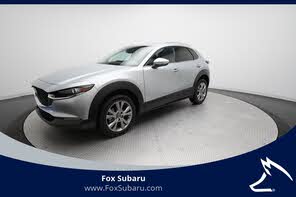
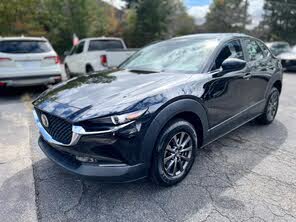
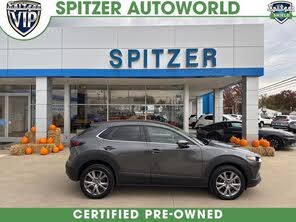
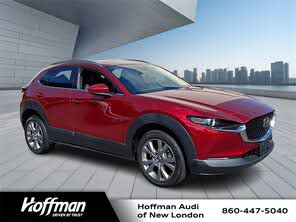
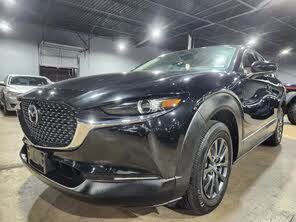
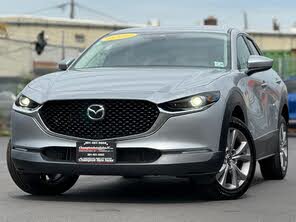
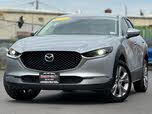
The 2020 Mazda CX-30 exhibited a dichotomy in its design language. Internally, Mazda had a brainstorming session regarding the thick gray plastic cladding enveloping the lower perimeter of the vehicle. Unfortunately, the decision to retain it was a misstep. Halving this cladding would have accentuated the CX-30's overall allure. As it was, the excessive cladding made even the 18-inch wheels appear disproportionately small and gave the SUV an awkward, lifted look reminiscent of a vehicle on a hydraulic lift awaiting service. Despite this, the CX-30's design shined through, especially in its luxurious interior, which rivaled those of premium brands above the cabin's midpoint. Below that, it was a different story, with hard plastics prevailing—a reasonable expectation given its price point.
Mazda CX-30 pricing started at $21,900. An additional $2,000 for Select trim was well spent, mainly due to features like dark-tinted rear privacy glass and 18-inch wheels, which complemented the design. Preferred trim came at a cost of $26,200, and Premium trim hit $28,200, with AWD being a $1,400 add-on. At the time, the destination charge was set at $1,100.
The test unit, a CX-30 Premium AWD, boasted extra-cost Soul Red Crystal paint, a navigation system, cargo mat, and a frameless auto-dimming rearview mirror, rounding the total to $32,120, including the destination charge. This configuration highlighted the CX-30’s visual and functional appeal while staying within a modest price range.
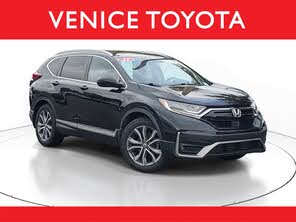
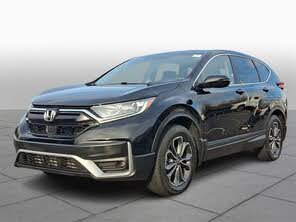
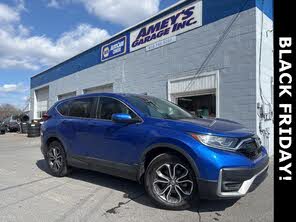
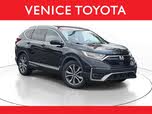
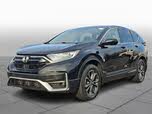
In contrast, the 2021 Honda CR-V presented a consistent and familiar face in the competitive crossover segment, blending seamlessly with its peers. Its design, while pleasing, echoed the comments of the 1950s when all cars looked the same. A keen eye could spot slight distinctions, such as the grille design and a few chromed accents, but these did not significantly set the CR-V apart. The color palette, though broad with eight choices, leaned heavily towards conservative shades; three variations of gray, alongside black and white dominated the range. Vibrant hues like Aegean Blue Metallic or Radiant Red Metallic were scarce on dealer lots, adding to the CR-V’s understated exterior presence.
Inside, the CR-V offered a modern, angular design with black, gray, and ivory color options depending on the trim level. Wood panels and chrome accents on higher trims lent an upscale feel. Competitors like the Kia Sportage and Hyundai Tucson, however, managed to outshine the CR-V with more distinct and adventurous styling choices. For prospective buyers in search of excitement in design, the CR-V was unlikely their first pick.


Mazda’s 2.5-liter 4-cylinder engine powered the 2020 CX-30, delivering 186 horsepower at 6,000 rpm and an equal measure of 186 pound-feet of torque at 4,000 rpm. While these figures placed the CX-30 on par with competitors, its heft at 3,408 pounds made it somewhat less sprightly, especially with the lack of a turbocharged engine. The 6-speed sport automatic transmission stood out with its adeptness at maximizing the engine's output. Paddle shifters in the Premium trim inferred sportiness, though the overall driving experience was more conservative.
AWD models came with a handy off-road traction assist system, and although the ground clearance measured 8 inches, it wasn’t suitable for more rigorous off-road adventures. It handled regular paths just fine but felt more sluggish compared to the sportier Mazda3. Increased ride height and weight contributed to reduced handling precision, though the steering and braking remained responsive, keeping driving enjoyable. The CX-30 averaged 23.9 mpg in real-world tests, slightly below the EPA’s estimated 27 mpg combined.
The 2021 Honda CR-V, on the other hand, wasn’t built for swift acceleration or tight cornering but for reliable and steady performance. Every CR-V, regardless of the trim, featured a 190-horsepower turbocharged four-cylinder engine. Road tests recorded a zero to 60 mph time of 7.8 seconds—noteworthy but not exceptional. The CVT, while efficient, didn’t enhance driver engagement the way traditional automatic transmissions do. Vehicles like the Kia Sportage and Hyundai Tucson, with their 8-speed automatics, offered a more pleasurable driving experience.
The CR-V’s ride relied on a common suspension setup with a MacPherson strut in the front and a multi-link system in the rear, ensuring predictable handling and decent ride quality. AWD was an option, unlike standard equipment in the Subaru Forester. Overall, the CR-V wasn’t about sporty performance but provided reliable and smooth operation in everyday driving scenarios.
One of the 2020 Mazda CX-30’s prime benefits was its elevated ride height, facilitating easier entry and exit. Inside, the interior boasted a premium feel above its midpoint, with plenty of soft-touch materials enhancing comfort. The driver’s seat in Preferred and Premium trims offered 8-way power adjustment and heating, though ventilated seats were notably absent despite the need for better cooling. The rear seat, however, was cramped with limited legroom, best suited for children or shorter adults.
Cargo space was another drawback, with only 20.2 cubic feet available behind the rear seat and 45.2 cubic feet with seats folded—figures comparable to a Mazda3 Hatchback. The reduced cargo space positioned the CX-30 lower in its class concerning utility.
Conversely, the 2021 Honda CR-V was designed with practicality as a priority. It offered a roomy 102.9 cubic feet of passenger space, surpassing the Toyota RAV4 by four cubic feet. Cargo capacity was equally impressive, with 75.8 cubic feet available when the rear seats were folded down, accommodating considerable amounts of luggage or gear.
Accessing the cargo area depended on the trim level. Lower trims like the LX required manual operation of the tailgate, while higher trims like the EX-L and Touring featured power tailgates, with the latter boasting a hands-free operation—a convenience, though somewhat finicky in practice. Roof rails, useful for additional cargo, were standard only on the top-tier Touring trim, while Subaru provided them on most trims.
The 2020 Mazda CX-30 emphasized essential technology without unnecessary frills, though its infotainment system had a steep learning curve. The 8.8-inch display, deliberately non-touchscreen, demanded learning various control methods via the center console, steering wheel, and voice commands. Standard features included Bluetooth, HD Radio, and Mazda Connected Services with a three-year trial. Apple CarPlay and Android Auto required selecting the Select trim, marking a significant upgrade decision.
Higher trims added features like satellite radio and a 12-speaker Bose sound system, with the Premium model offering a head-up display. Despite some user interface challenges, the tech package was robust once mastered.
The 2021 Honda CR-V’s base LX trim was Spartan with its 5-inch screen and limited connectivity. However, from the Special Edition trim upward, a 7-inch touchscreen became standard, incorporating Apple CarPlay, Android Auto, and SMS text messaging.
Audio systems varied, with the base trims having six-speaker setups, the EX-L upgrading to eight speakers, and the Touring featuring a 300-watt system with a subwoofer. The Touring was also the only trim with built-in navigation and wireless phone charging, presenting a clear tech hierarchy among trims.
The 2021 Honda CR-V excelled in safety too, earning both the NHTSA’s 5-star rating and the IIHS’sTop Safety Pick award, though it fell short of the Top Safety Pick+ due to its headlight evaluation and updated side crash test ratings. Honda's approach to safety was commendable, making its comprehensive Honda Sensing suite standard across all trims.
Features like a multi-angle rearview camera, forward collision warning, and road departure mitigation were standard. The only non-standard feature on the base LX was blind-spot monitoring, included from the EX trim onward.
CarGurus highlights

According to CarGurus experts, the overall rating for the 2020 Mazda CX-30 was 7.7 out of 10, while the 2021 Honda CR-V scored slightly better at 7.8 out of 10. Considering these ratings and the provided details, the recommendation leans towards the 2021 Honda CR-V for its superior interior space, comprehensive standard safety features, and practical utility. For those seeking a balance of style and functionality in a crossover, the CR-V emerged as the more well-rounded choice.
Choose the 2020 Mazda CX-30 if:
- You prioritize a premium-feeling interior and upscale materials in your vehicle.
- The driving dynamics, with sharp steering and responsive handling, are crucial to you.
- You seek a stylish, visually appealing SUV with essential safety features right from the base model.


Choose the 2021 Honda CR-V if:
- Interior space and cargo capacity are your top priorities for carrying passengers and gear.
- Advanced safety features are non-negotiable, and you prefer them as standard inclusions.
- You want reliable, smooth performance with a no-frills, practical approach to tech and convenience.







CarGurus highlights
According to CarGurus experts, the overall rating for the 2020 Mazda CX-30 was 7.7 out of 10, while the 2021 Honda CR-V scored slightly better at 7.8 out of 10. Considering these ratings and the provided details, the recommendation leans towards the 2021 Honda CR-V for its superior interior space, comprehensive standard safety features, and practical utility. For those seeking a balance of style and functionality in a crossover, the CR-V emerged as the more well-rounded choice.
Choose the 2020 Mazda CX-30 if:
Shop Now- You prioritize a premium-feeling interior and upscale materials in your vehicle.
- The driving dynamics, with sharp steering and responsive handling, are crucial to you.
- You seek a stylish, visually appealing SUV with essential safety features right from the base model.








Choose the 2021 Honda CR-V if:
Shop Now- Interior space and cargo capacity are your top priorities for carrying passengers and gear.
- Advanced safety features are non-negotiable, and you prefer them as standard inclusions.
- You want reliable, smooth performance with a no-frills, practical approach to tech and convenience.









By: CarGurus + AI
At CarGurus, our team of experienced automotive writers remain at the heart of our content operation, conducting hands-on car tests and writing insightful guides that are backed by years of industry experience. To complement this, we are harnessing AI to make our content offering more diverse and more helpful to shoppers than ever. To achieve this, our AI systems are based exclusively on CarGurus content, ratings and data, so that what we produce is both unique to CarGurus, and uniquely helpful to car shoppers.