2020 Ford Explorer vs 2021 Ford Edge
Overview | |
MSRP$32,765 | MSRP$32,750 |
Listings561 | Listings202 |
Ratings & Reviews | |
User Reviews | User Reviews |
Expert reviews7.2 out of 10 | Expert reviews7.2 out of 10 |
Pros
Cons
| Pros
Cons
|
2020 Ford Explorer Reviews SummaryFor nearly 30 years, the Ford Explorer has settled into the American lexicon like Cheerios. We've gobbled up millions of them, from the rock-crawling Eddie Bauers of the 1990s to the brand-new ST that can take down sports cars. The 2020 Explorer brings an all-new chassis, cranks up the technology, and introduces hybrid and high-performance powertrains in a space the size of a small living room. The Explorer's also getting very expensive while other automakers catch on to Ford's winning formula—for a lot less money. | |
2021 Ford Edge Reviews SummaryThe Ford Edge proves that trends run in cycles. Launched in the early 2000s, the original Edge was one of the first midsize crossover SUVs, sporting car-like styling that sharply contrasted the more traditional-looking Ford Explorer of the time. However, new-car buyers realized they liked the roominess of three-row SUVs like the Explorer more, and interest in the two-row Edge waned. Now, however, car shoppers are once again eyeing two-row midsize SUVs, this time as an alternative to sedans. The Edge is now part of a growing market segment that includes the Chevrolet Blazer, Honda Passport, Hyundai Santa Fe, Jeep Grand Cherokee, Nissan Murano, and Volkswagen Atlas Cross Sport. Yet while market dynamics have changed, the Edge hasn’t. The current second-generation Edge dates back to the 2015 model year, and even a substantial update undertaken for the 2019 model year is quickly receding in the rearview mirror. The Edge now sits between the much newer Explorer and Ford Escape in the automaker's SUV-heavy lineup. Aside from some new tech features, the 2021 Ford Edge doesn’t get many significant changes, so we can evaluate it based on our experience with previous model years. As with the 2020 model year, trim levels include SE, SEL, ST-Line, Titanium, and ST. | |
No video found | |
Popular Features & Specs | |
Engine2.3L 300 hp I4 | Engine2.0L 250 hp I4 |
DrivetrainRWD | DrivetrainFWD |
Seating Capacity7 | Seating Capacity5 |
Horsepower | Horsepower250 hp @ 5500 rpm |
MPG City21 | MPG City21 |
MPG Highway28 | MPG Highway29 |
Engine | |
Engine Name2.3L 300 hp I4 | Engine Name2.0L 250 hp I4 |
Torque | Torque280 lb-ft @ 3000 rpm |
Horsepower | Horsepower250 hp @ 5500 rpm |
DrivetrainRWD | DrivetrainFWD |
Fuel Economy | |
MPG City21 | MPG City21 |
MPG Highway28 | MPG Highway29 |
Interior | |
Seating Capacity7 | Seating Capacity5 |
Safety | |
Front Crash Overall5 | Front Crash Overall5 |
Side Crash Overall5 | Side Crash Overall5 |
Dimensions & Capacity | |
Cargo Space18.2 cu ft | Cargo Space39.2 cu ft |
Curb Weight4345 lbs | Curb Weight3960 lbs |
Height69.9 in | Height68.3 in |
Length198.8 in | Length188.8 in |
Width89.3 in | Width85.8 in |
Wheelbase119.1 in | Wheelbase112.2 in |
Maximum Payload1425 lbs | Maximum Payload1310 lbs |
Number of doors4 | Number of doors4 |
Maximum Towing Capacity5300 lbs | Maximum Towing Capacity1500 lbs |
Overview | ||
MSRP | $32,765 | $32,750 |
Listings | ||
Ratings & Reviews | ||
User reviews | ||
Expert reviews | 7.2 out of 10Read full review | 7.2 out of 10Read full review |
Pros & cons | Pros
Cons
| Pros
Cons
|
Summary | For nearly 30 years, the Ford Explorer has settled into the American lexicon like Cheerios. We've gobbled up millions of them, from the rock-crawling Eddie Bauers of the 1990s to the brand-new ST that can take down sports cars. The 2020 Explorer brings an all-new chassis, cranks up the technology, and introduces hybrid and high-performance powertrains in a space the size of a small living room. The Explorer's also getting very expensive while other automakers catch on to Ford's winning formula—for a lot less money. | The Ford Edge proves that trends run in cycles. Launched in the early 2000s, the original Edge was one of the first midsize crossover SUVs, sporting car-like styling that sharply contrasted the more traditional-looking Ford Explorer of the time. However, new-car buyers realized they liked the roominess of three-row SUVs like the Explorer more, and interest in the two-row Edge waned. Now, however, car shoppers are once again eyeing two-row midsize SUVs, this time as an alternative to sedans. The Edge is now part of a growing market segment that includes the Chevrolet Blazer, Honda Passport, Hyundai Santa Fe, Jeep Grand Cherokee, Nissan Murano, and Volkswagen Atlas Cross Sport. Yet while market dynamics have changed, the Edge hasn’t. The current second-generation Edge dates back to the 2015 model year, and even a substantial update undertaken for the 2019 model year is quickly receding in the rearview mirror. The Edge now sits between the much newer Explorer and Ford Escape in the automaker's SUV-heavy lineup. Aside from some new tech features, the 2021 Ford Edge doesn’t get many significant changes, so we can evaluate it based on our experience with previous model years. As with the 2020 model year, trim levels include SE, SEL, ST-Line, Titanium, and ST. |
Video | No video found | |
Popular Features & Specs | ||
Engine | 2.3L 300 hp I4 | 2.0L 250 hp I4 |
Drivetrain | RWD | FWD |
Seating Capacity | 7 | 5 |
Horsepower | 250 hp @ 5500 rpm | |
MPG City | 21 | 21 |
MPG Highway | 28 | 29 |
Engine | ||
Engine Name | 2.3L 300 hp I4 | 2.0L 250 hp I4 |
Torque | 280 lb-ft @ 3000 rpm | |
Horsepower | 250 hp @ 5500 rpm | |
Drivetrain | RWD | FWD |
Fuel Economy | ||
MPG City | 21 | 21 |
MPG Highway | 28 | 29 |
Interior | ||
Seating Capacity | 7 | 5 |
Safety | ||
Front Crash Overall | 5 | 5 |
Side Crash Overall | 5 | 5 |
Dimensions & Capacity | ||
Cargo Space | 18.2 cu ft | 39.2 cu ft |
Curb Weight | 4345 lbs | 3960 lbs |
Height | 69.9 in | 68.3 in |
Length | 198.8 in | 188.8 in |
Width | 89.3 in | 85.8 in |
Wheelbase | 119.1 in | 112.2 in |
Maximum Payload | 1425 lbs | 1310 lbs |
Number of doors | 4 | 4 |
Maximum Towing Capacity | 5300 lbs | 1500 lbs |
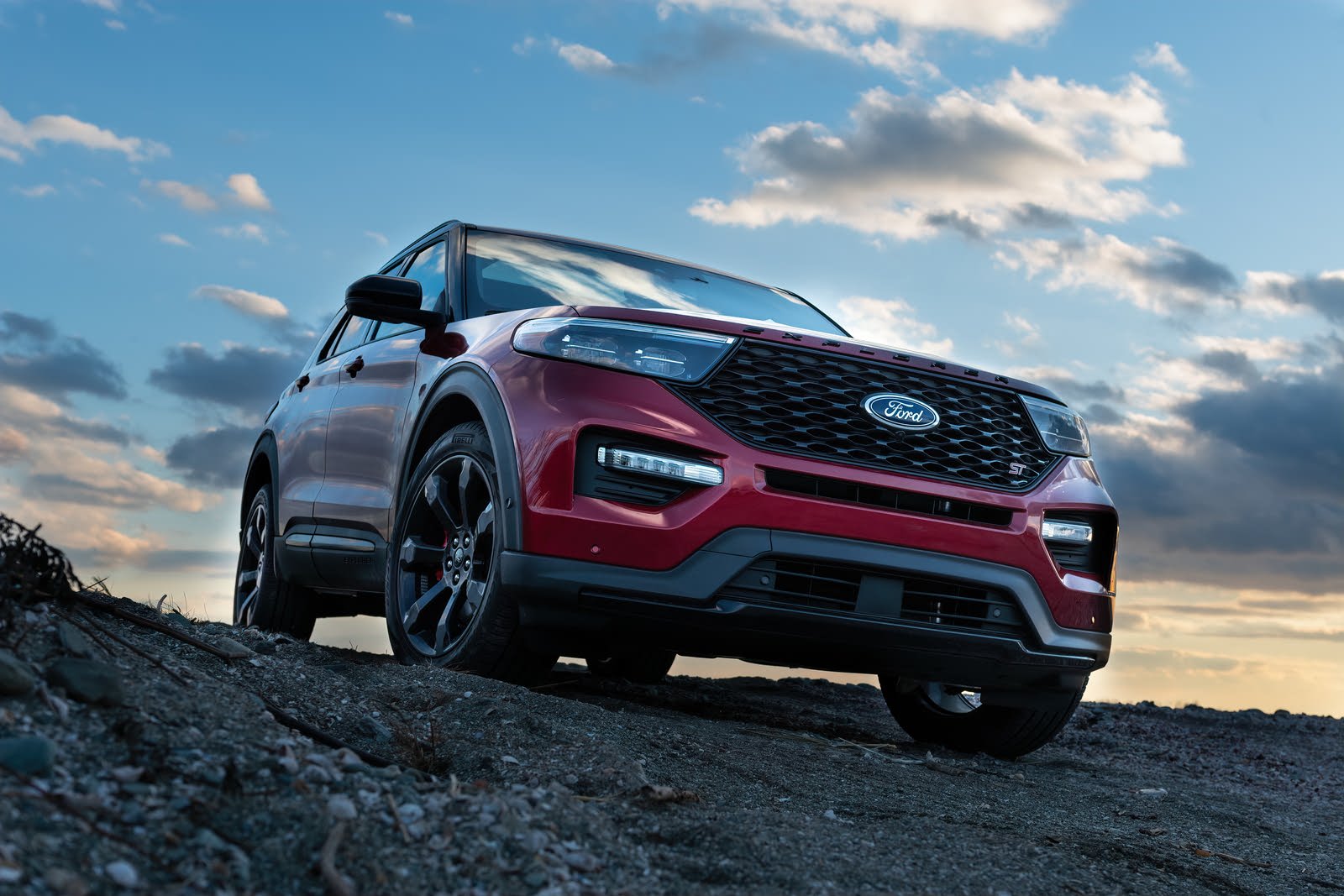
The 2020 Ford Explorer was a visual delight, elevating its aesthetics well beyond its predecessors. It managed to appear more handsome than some luxury competitors, such as the Land Rover Discovery, which had mimicked Ford’s styling cues from years prior. The 2020 model refined its upscale, utilitarian design by slimming down its body panels, particularly at the rear, and giving it a lower, more athletic stance. The wider headlights, oversized grille, and italicized "Explorer" lettering on the hood made for an iconic front façade. While the rear taillights might have been a bit underwhelming, the vehicle’s overall proportions were near-perfect. The ST version, with its black 21-inch rims, blacked-out trim, red brake calipers, striking Rapid Red paint, and quad exhaust pipes, was particularly eye-catching. Driving and being seen in it was an enjoyable experience.
However, the interior left much to be desired. Despite the high $60,000 price tag, the interior materials felt subpar. Leather seats felt like low-grade vinyl, and large parts of the door panels were made from rough, flimsy plastic, akin to municipal garbage cans. More hard plastic framed the air vents, center stack, and center console, complemented by questionable fake carbon-fiber trim. Although the top of the dashboard was padded, and aluminum speaker covers, along with white stitching, attempted to break the black monotony, it still felt far from luxurious. Buyers looking for luxury would have preferred the material quality found in less expensive alternatives like the Kia Telluride or the Toyota Highlander. This set a challenging precedent for the Explorer, making it seem too expensive for the comfort it offered.
The 2021 Ford Edge held onto much of its styling cues from the 2019 refresh, which aligned it with Ford's contemporary design language while maintaining its unique body shell. This blend gave the Edge a cleaner look compared to the showy designs of the Chevy Blazer and Hyundai Santa Fe. The Edge Titanium trims received extra chrome touches to denote their higher status, while the Edge ST trim sported a blacked-out grille, standard 20-inch wheels, and a body kit. The ST-Line offered these sporty aesthetics without the performance enhancements or added cost.
However, the Edge’s interior began to show signs of age. The design, although functional, was not as fresh as the exterior. Attempts to incorporate newer features, like a larger touchscreen, seemed awkwardly executed. While Titanium models came with leather upholstery, ST models boasted sporty front seats with added bolstering and a leather-wrapped steering wheel featuring contrast stitching.


Other engines included a 2.3-liter turbo inline-four with 300 hp and 310 lb-ft, offering commendable performance for an SUV, and a hybrid option that combined a 3.3-liter V6 with an electric motor for 318 hp. Despite its theoretical benefits, the hybrid didn't offer substantial fuel economy gains and thus was not highly recommended.
The Explorer’s towing capacities impressed as well. With the hybrid, it could tow 5,000 pounds, while the 4-cylinder engine managed 5,300 pounds, and the V6 AWD configuration could tow up to 5,600 pounds. Seven drive modes added versatility, handling everything from normal driving to off-road and towing scenarios.
The 2021 Ford Edge offered two engine options. Most models featured a 2.0-liter turbocharged EcoBoost four-cylinder engine, generating 250 horsepower and 275 pound-feet of torque, coupled with an eight-speed automatic transmission. This engine could be configured with either standard front-wheel drive (FWD) or optional all-wheel drive (AWD).
For performance enthusiasts, the Edge ST came with a twin-turbo 2.7-liter V6 engine, producing a robust 335 hp and 380 lb-ft of torque on 93-octane fuel. This model also included standard AWD, an eight-speed automatic transmission, and performance-specific suspension tuning. An available package added upgraded brakes and 21-inch wheels with summer tires for enhanced grip and stopping power.
The Edge ST faced skepticism due to its ST badge, traditionally associated with performance hatchbacks like the Focus ST and Fiesta ST. However, Ford asserted that the Edge ST aimed to compete with performance SUVs like the Porsche Macan. Though the comparison was ambitious, the Edge ST delivered a respectable driving experience, even if it didn't quite match the Porsche in finesse.
Towing capabilities were decent, with the FWD four-cylinder model capable of pulling 3,958 pounds, the AWD variant managing 4,122 pounds, and the V6-powered Edge ST topping out at 4,525 pounds. These figures fell short of the 5,000-pound tow ratings of competitors like the Honda Passport and Volkswagen Atlas Cross Sport.
Interior space was one of the 2020 Ford Explorer's strongest suits. During a Christmas road trip to Maine, the Explorer proved to be spacious and accommodating, with generous room for passengers and gear. The second row featured ample headroom and legroom, enhanced by air vents, USB ports, a practical center console, and a panoramic moonroof that contributed to a first-class experience. The third row, accessible via wide rear-door openings and easy-exit second-row captain's chairs, offered sufficient space for six-foot adults on short trips, despite the flat bench.
Cargo capacity saw slight reductions behind the third row, now offering 18 cubic feet compared to the previous 21. However, the trade-off was worth it for the added passenger space. Behind the second row, cargo space expanded to 48 cubic feet, and with all seats folded down, it reached an impressive 88 cubic feet—one of the largest in its class.
The Explorer avoided the touch-sensitive dashboard pitfalls of its predecessor, opting for physical knobs and switches for climate and stereo controls. However, the thick D-pillars and subpar 360-degree cameras did create blind spots, detracting from overall driver visibility. Nevertheless, driving the Explorer felt intuitive and straightforward.
The 2021 Ford Edge offered competitive interior space for a two-row midsize crossover. Rear-seat headroom was the best among its peers, and legroom in both rows was competitive, second only to the Hyundai Santa Fe. Standard dual-zone automatic climate control added to passenger comfort.
In terms of cargo space, the Edge provided 39.2 cubic feet with the rear seats in place and 73.4 cubic feet with them folded down, trailing only the Honda Passport and Volkswagen Atlas Cross Sport. Higher trims featured a foot-activated power liftgate for convenient access.
Despite its updated rotary shift knob aiming to free up center console space, the Edge's narrow console limited its effectiveness, offering only average space. The raised console design allowed for a storage nook below, but it was hard to reach and easy to forget about.
The 2020 Ford Explorer came equipped with an 8-inch touchscreen featuring Sync 3 infotainment, Apple CarPlay, Android Auto, and 4G WiFi as standard. Additional standard features included factory navigation (optional on base XLT), keyless entry, remote start, 3-zone climate control, and SiriusXM satellite radio. The nostalgic keyless entry keypad, allowing users to input a five-digit code, remained a useful feature.
The Co-Pilot360 Assist+ semi-automated driving system offered adaptive cruise control and steering assist but lacked the precision of competitors' systems, indicating that future software updates might be necessary for optimization.
For 2021, the Ford Edge received the latest Sync 4 infotainment system, present alongside standard wireless Apple CarPlay/Android Auto and an impressive 12-inch touchscreen display. It also featured Bluetooth, SiriusXM with 360L satellite radio, and a built-in 4G LTE WiFi hotspot. Edge ST models boasted a 12-speaker Bang & Olufsen audio system for enhanced sound quality.
While most competitors didn’t offer wireless Apple CarPlay and Android Auto, the Edge stood out by providing it as a standard feature. Additionally, two rear USB ports, including one USB-C, were added to meet modern connectivity needs.
Though yet to be driven in a Sync 4-equipped Edge, experiences with Sync 4 in other Ford models showed promising user-friendly features, including straightforward graphics and easy-to-navigate menus, enhancing the overall tech experience.
The 2020 Ford Explorer prioritized safety with the Ford Co-Pilot360 suite, which included standard forward emergency braking, blind-spot monitoring, auto high beams, and lane-keep assist. The Assist+ package added adaptive cruise control with steering assist and reverse braking, though the latter had issues with false activations, such as when reversing into a parking space.
NHTSA awarded the Edge a five-star overall safety rating, with five stars in frontal and side crash tests and four stars in rollover tests.
Standard safety features included under the Ford Co-Pilot360 banner were automatic high beams, blind-spot monitoring, lane-keep assist, forward-collision warning, automatic emergency braking (with pedestrian detection), post-collision braking, dynamic brake support, and rear parking sensors. Adaptive cruise control with stop-and-go and lane centering, along with Evasive Steering Assist, was standard on higher trims.
CarGurus highlights

According to CarGurus experts, the overall rating for the 2020 Ford Explorer is 7.2 out of 10, while the 2021 Ford Edge scores 7.2 out of 10. Given these identical scores, the choice between the 2020 Ford Explorer and the 2021 Ford Edge ultimately depends on your individual needs. If you require a spacious, versatile SUV with excellent performance and robust towing capabilities, the Explorer is the better choice. However, if you prioritize advanced tech features, stylish design, and exceptional safety ratings in a smaller package, the Edge makes a compelling case. Ultimately, both vehicles offer strong value, so your decision should hinge on which attributes align best with your lifestyle.
Choose the 2020 Ford Explorer if:
- You need a spacious, family-friendly SUV with one of the largest cargo areas in its class.
- You are looking for a robust performance SUV with a diverse engine lineup, especially if towing capacity is a concern.
- Advanced technology and user-friendly infotainment are high on your priority list, despite some minor imperfections.


Choose the 2021 Ford Edge if:
- You desire a stylish, two-row midsize crossover with ample rear-seat headroom and competitive legroom.
- Modern infotainment technology, particularly wireless Apple CarPlay and Android Auto, is essential to your driving experience.


CarGurus highlights
According to CarGurus experts, the overall rating for the 2020 Ford Explorer is 7.2 out of 10, while the 2021 Ford Edge scores 7.2 out of 10. Given these identical scores, the choice between the 2020 Ford Explorer and the 2021 Ford Edge ultimately depends on your individual needs. If you require a spacious, versatile SUV with excellent performance and robust towing capabilities, the Explorer is the better choice. However, if you prioritize advanced tech features, stylish design, and exceptional safety ratings in a smaller package, the Edge makes a compelling case. Ultimately, both vehicles offer strong value, so your decision should hinge on which attributes align best with your lifestyle.
Choose the 2020 Ford Explorer if:
Shop Now- You need a spacious, family-friendly SUV with one of the largest cargo areas in its class.
- You are looking for a robust performance SUV with a diverse engine lineup, especially if towing capacity is a concern.
- Advanced technology and user-friendly infotainment are high on your priority list, despite some minor imperfections.
Choose the 2021 Ford Edge if:
Shop Now- You desire a stylish, two-row midsize crossover with ample rear-seat headroom and competitive legroom.
- Modern infotainment technology, particularly wireless Apple CarPlay and Android Auto, is essential to your driving experience.

By: CarGurus + AI
At CarGurus, our team of experienced automotive writers remain at the heart of our content operation, conducting hands-on car tests and writing insightful guides that are backed by years of industry experience. To complement this, we are harnessing AI to make our content offering more diverse and more helpful to shoppers than ever. To achieve this, our AI systems are based exclusively on CarGurus content, ratings and data, so that what we produce is both unique to CarGurus, and uniquely helpful to car shoppers.

