2021 Nissan Rogue vs 2021 Ford Explorer

Overview | |
MSRP$32,925 | MSRP$26,050 |
Listings646 | Listings320 |
Ratings & Reviews | |
User Reviews | User Reviews |
Expert reviews7.5 out of 10 | Expert reviews9.0 out of 10 |
Pros
Cons
| Pros
Cons
|
2021 Ford Explorer Reviews SummaryThere was a time when everybody in America seemingly drove an Explorer. That may be an exaggeration, but not by much. In its first four years of production, Ford sold over a million examples. In 1998, Ford was selling its second-generation Explorer at a rate of nearly 440,000 per year. Whether your family purchased an Explorer or not, this was the nameplate that invented the midsize SUV segment. Fast forward to the 2021 model year and the Explorer is in its sixth generation. It's now a three-row SUV that clocks in at a maximum of 4,700 pounds, with a price tag north of $50,000 for the Explorer Platinum trim level. Long gone are the days when it was the only game in town. Almost every automaker has a competitor. So how does the Explorer shake out for 2021? | |
2021 Nissan Rogue Reviews SummaryTo characterize the all-new 2021 Nissan Rogue as vital to the automaker's success is an understatement. Not only is the compact crossover SUV the best-selling Nissan in America, but it's also one of the best-selling vehicles in America. Strip out pickup trucks, and the Rogue sits near the top of the U.S. sales chart with its primary competitors, the Honda CR-V and Toyota RAV4. Imagine the pressure on Nissan designers, engineers, and product planners as they prepared the current Rogue's replacement! The good news is that the new Rogue is a better SUV in every way but one. | |
No video found | |
Popular Features & Specs | |
Engine2.3L 300 hp I4 | Engine2.5L 181 hp I4 |
Drive TrainRWD | Drive TrainFWD |
Seating Capacity7 | Seating Capacity5 |
Horsepower | Horsepower181 hp @ 6000 rpm |
MPG City21 | MPG City27 |
MPG Highway28 | MPG Highway34 |
Engine | |
Engine Name2.3L 300 hp I4 | Engine Name2.5L 181 hp I4 |
Torque | Torque181 lb-ft @ 3600 rpm |
Horsepower | Horsepower181 hp @ 6000 rpm |
DrivetrainRWD | DrivetrainFWD |
Fuel Economy | |
MPG City21 | MPG City27 |
MPG Highway28 | MPG Highway34 |
Interior | |
Seating Capacity7 | Seating Capacity5 |
Safety | |
Front Crash Overall5 | Front Crash Overall3 |
Side Crash Overall5 | Side Crash Overall5 |
Dimensions & Capacity | |
Cargo Space18.2 cu ft | Cargo Space31.6 cu ft |
Curb Weight4345 lbs | Curb Weight3371 lbs |
Height69.9 in | Height66.5 in |
Length198.8 in | Length183.0 in |
Width89.3 in | Width72.4 in |
Wheelbase119.1 in | Wheelbase106.5 in |
Maximum Payload1425 lbs | Maximum Payload1115 lbs |
Number of doors4 | Number of doors4 |
Maximum Towing Capacity5300 lbs | Maximum Towing Capacity |
Overview | ||
MSRP | $32,925 | $26,050 |
Listings | ||
Ratings & Reviews | ||
User reviews | ||
Expert reviews | 7.5 out of 10Read full review | 9.0 out of 10Read full review |
Pros & cons | Pros
Cons
| Pros
Cons
|
Summary | There was a time when everybody in America seemingly drove an Explorer. That may be an exaggeration, but not by much. In its first four years of production, Ford sold over a million examples. In 1998, Ford was selling its second-generation Explorer at a rate of nearly 440,000 per year. Whether your family purchased an Explorer or not, this was the nameplate that invented the midsize SUV segment. Fast forward to the 2021 model year and the Explorer is in its sixth generation. It's now a three-row SUV that clocks in at a maximum of 4,700 pounds, with a price tag north of $50,000 for the Explorer Platinum trim level. Long gone are the days when it was the only game in town. Almost every automaker has a competitor. So how does the Explorer shake out for 2021? | To characterize the all-new 2021 Nissan Rogue as vital to the automaker's success is an understatement. Not only is the compact crossover SUV the best-selling Nissan in America, but it's also one of the best-selling vehicles in America. Strip out pickup trucks, and the Rogue sits near the top of the U.S. sales chart with its primary competitors, the Honda CR-V and Toyota RAV4. Imagine the pressure on Nissan designers, engineers, and product planners as they prepared the current Rogue's replacement! The good news is that the new Rogue is a better SUV in every way but one. |
Video | No video found | |
Popular Features & Specs | ||
Engine | 2.3L 300 hp I4 | 2.5L 181 hp I4 |
Drive Train | RWD | FWD |
Seating Capacity | 7 | 5 |
Horsepower | 181 hp @ 6000 rpm | |
MPG City | 21 | 27 |
MPG Highway | 28 | 34 |
Engine | ||
Engine Name | 2.3L 300 hp I4 | 2.5L 181 hp I4 |
Torque | 181 lb-ft @ 3600 rpm | |
Horsepower | 181 hp @ 6000 rpm | |
Drivetrain | RWD | FWD |
Fuel Economy | ||
MPG City | 21 | 27 |
MPG Highway | 28 | 34 |
Interior | ||
Seating Capacity | 7 | 5 |
Safety | ||
Front Crash Overall | 5 | 3 |
Side Crash Overall | 5 | 5 |
Dimensions & Capacity | ||
Cargo Space | 18.2 cu ft | 31.6 cu ft |
Curb Weight | 4345 lbs | 3371 lbs |
Height | 69.9 in | 66.5 in |
Length | 198.8 in | 183.0 in |
Width | 89.3 in | 72.4 in |
Wheelbase | 119.1 in | 106.5 in |
Maximum Payload | 1425 lbs | 1115 lbs |
Number of doors | 4 | 4 |
Maximum Towing Capacity | 5300 lbs | |
Ford had taken a familiar approach to its SUV lineup with the 2021 Ford Explorer, creating a cohesive family resemblance with models like the Escape, Edge, Explorer, and Expedition, all starting with "E." This was reminiscent of the 1950s strategy when automakers aimed for brand loyalty across different vehicle sizes and price points. The Explorer's exterior was sporty and sleek, with raked belt lines and assertive front-end styling. However, at a quick glance, it was sometimes hard to distinguish it from the Edge.
The Explorer came in six distinct trims: the base trim, XLT, Limited, Limited Hybrid, ST, and Platinum, with prices ranging from $32,925 to $52,730. Each trim offered different grille designs ranging from black, chrome-accented, or black with a red stripe, depending on the sportiness and luxury intended for the trim. Inside, the Explorer invariably came with three rows of seats, accommodating either six or seven passengers depending on whether second-row captain’s chairs or a bench seat were chosen. The base model featured cloth upholstery, and although even the entry-level seats were reasonably comfortable, the third row was not adult-friendly for long journeys.
The dashboard design was clean and functional, featuring an 8-inch LCD touchscreen as standard, ample physical buttons, and a rotary gearshift that saved space for additional storage. The XLT trim, being the most popular, offered upgrades like a power front passenger seat, improved finishes, and a 6.5-inch instrument panel screen, while higher trims like the Limited and above came with leather upholstery and higher-quality interior materials.
In contrast, the 2021 Nissan Rogue received a design overhaul, presenting a bold, rugged aesthetic that distanced itself from car-like looks. It featured dark gray cladding along its lower perimeter and assertively styled simulated skid plates and lower door protection. Clean LED lighting, a prominent V-Motion grille, and proper proportions gave it a contemporary look. Optional two-tone paint elevated its appeal further.
The Rogue was offered in four trims: S ($25,650), SV ($27,340), SL ($32,000), and the new Platinum ($35,430), with an additional $1,095 for destination charges. All-wheel drive was optional for $1,400, and there were premium option packages for the SV and SL trims. The interior of the Rogue SL test vehicle featured a bright Almond color leather, a panoramic sunroof, and plenty of soft-touch surfaces, adding to the perception of quality. Higher trims, especially the Platinum, offered semi-aniline quilted leather, contrast stitching, and ambient lighting for a luxurious feel.
The driving controls were logically arranged, and despite a throwback-style climate control display, the Rogue incorporated modern tech like wireless Apple CarPlay. The overall interior design and material quality improved vastly over the previous generation, with the Platinum trim standing out for its upscale attributes.


The 2021 Ford Explorer, even at its lightest, weighed 4,345 pounds. Its base engine was a 2.3-liter EcoBoost turbocharged four-cylinder, producing a robust 300 horsepower and 310 pound-feet of torque—impressive compared to competitors like the Kia Telluride's V6. Each Explorer came with a 10-speed automatic transmission, ensuring smooth and efficient gear shifts.
The Explorer's Limited Hybrid upped the game with a V6 hybrid powertrain delivering 310 hp and 331 lb-ft of torque. For higher trims, a 3.0-liter EcoBoost twin-turbo V6 was standard, offering 365 hp and 380 lb-ft of torque, with the sport-oriented ST trim boasting an even more thrilling 400 hp and 415 lb-ft of torque. Despite this, the Explorer was more focused on towing power than sheer performance, with a towing capacity ranging from 5,000 to 5,600 pounds, depending on the engine and trim configuration.
The 2021 Nissan Rogue, weighing nearly 3,500 pounds, was powered by a single engine option: a naturally aspirated 2.5-liter four-cylinder producing 181 horsepower and 181 pound-feet of torque. While this was sufficient for daily driving, it lacked the robust performance needed for more demanding conditions. The Rogue's continuously variable transmission (CVT) was well-executed, mimicking a traditional automatic and featuring paddle shifters for added control.
Despite its modest power, the Rogue offered all-wheel drive, 8.2 inches of ground clearance, and driving modes for Snow and Off-Road conditions, making it suitable for light adventuring. Nissan hinted at the possibility of future turbocharged versions but did not commit to an immediate release. Meanwhile, driving modes like Sport and Eco attempted to enhance driving dynamics and fuel efficiency, respectively. In practical driving scenarios, the front-wheel-drive Rogue SL managed 27.5 mpg, slightly below its EPA rating.
The Rogue's new architecture, consisting of 35% high-strength steel, resulted in improved ride and handling characteristics, enhanced by a strut front and multi-link rear suspension. Features like Brake-induced Intelligent Trace Control and Active Ride Control contributed to a smooth and predictable driving experience. Its new steering system, moving from the column to the rack and featuring a quicker ratio, offered markedly better feedback than the previous model.
The 2021 Ford Explorer's seating configuration varied by trim. The base model seated seven with a second-row bench, while higher trims had second-row captain’s chairs, reducing capacity to six. Second-row passengers enjoyed a generous 39 inches of legroom, slightly ahead of some competitors but trailing others like the Kia Telluride. With all seats used, the Explorer provided 21 cubic feet of cargo space, expandable to 81 cubic feet with the rear seats folded, which is competitive but not class-leading.
The 2021 Nissan Rogue aimed to enhance comfort with its Zero Gravity seat design, now improved over the previous generation. Cloth upholstery and manual adjustments were available in the base S trim, while higher trims like the SV offered eight-way power adjustments and leatherette upholstery. The SL trim featured leather seats, and the Platinum trim boasted quilted premium leather. Heated front seats, a heated steering wheel, and heated rear seats were available in upper trims, though ventilated seats were not offered.
Rear-seat passengers in the Rogue benefited from ample headroom and legroom, and doors that opened nearly 90 degrees for easy access. Child safety seats could be fitted across the rear bench thanks to newly positioned LATCH anchors. The Rogue also featured multiple storage solutions, including a roomy tray under the center console and ample door pockets.
The Rogue's cargo capacity ranged from 31.6 cubic feet in S and SV trims to 36.5 cubic feet in SL and Platinum trims, thanks to the Divide-N-Hide cargo management system. Total cargo capacity with the rear seats folded was 74.1 cubic feet, making it one of the more spacious options in the compact SUV segment. This was slightly less than the outgoing model but still generous.
The 2021 Ford Explorer came well-equipped even at the base trim, featuring an 8-inch touchscreen with AM/FM radio, SiriusXM, Apple CarPlay, Android Auto, a 4G WiFi hotspot, Ford’s Sync 3 infotainment system, and a six-speaker audio system. The Limited trim upgraded to a 12-speaker Bang & Olufsen system and HD radio. Higher trims offered a 10.1-inch touchscreen and up to 14 speakers.
The Explorer also provided multiple charging options, including two USB ports and five 12-volt power points throughout the cabin, with higher trims offering a 110-volt AC outlet.
Nissan's 2021 Rogue featured a competitive infotainment system. The base S trim included an 8-inch touchscreen, Bluetooth, SiriusXM, Apple CarPlay, and Android Auto, along with a six-month trial to Nissan Concierge Personal Assistant. Higher trims added features like NissanConnect Services, a WiFi hotspot, Amazon Alexa, and Google Assistant integration.
The SL Premium Package and Platinum trims offered a larger 9-inch touchscreen, navigation, wireless Apple CarPlay, and a Bose premium audio system. The Platinum trim further included advanced features like wireless smartphone charging, a 12.3-inch digital instrument cluster, and a 10.8-inch head-up display.
CarGurus highlights
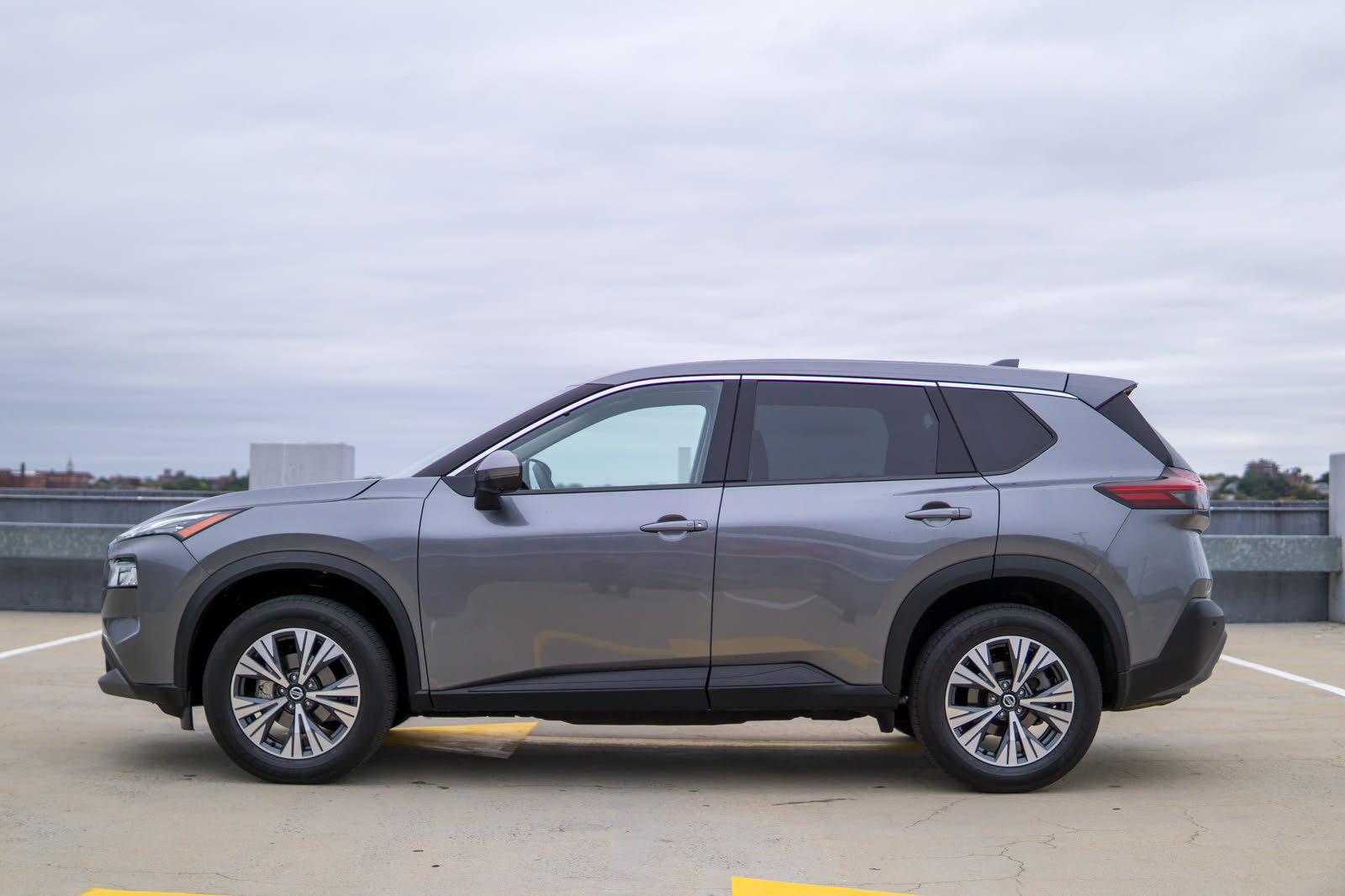
According to CarGurus experts, the overall rating for the 2021 Ford Explorer was 7.5 out of 10, while the 2021 Nissan Rogue scored 9.0 out of 10. Based on these ratings, the 2021 Nissan Rogue is the recommended choice. It excels in comfort, safety, and advanced technology, making it a standout option in the compact crossover SUV segment. While the Ford Explorer offers substantial towing capacity and powerful engine options, the Nissan Rogue's high-quality interior, comprehensive safety features, and excellent overall rating make it the superior vehicle in this comparison.
Choose the 2021 Nissan Rogue if:
- You value a refined and comfortable interior with advanced material quality and Zero Gravity seats.
- Comprehensive safety features and a more advanced ProPilot Assist system are important to you.
- You prioritize fuel efficiency and a user-friendly infotainment system with options for advanced technology upgrades.


Choose the 2021 Ford Explorer if:
- You need a robust towing capacity between 5,000 and 5,600 pounds.
- You prioritize a range of powerful engine options, including turbocharged and hybrid choices.
- You prefer a larger, three-row SUV with higher cargo capacity and more advanced tech in upper trims.


CarGurus highlights
According to CarGurus experts, the overall rating for the 2021 Ford Explorer was 7.5 out of 10, while the 2021 Nissan Rogue scored 9.0 out of 10. Based on these ratings, the 2021 Nissan Rogue is the recommended choice. It excels in comfort, safety, and advanced technology, making it a standout option in the compact crossover SUV segment. While the Ford Explorer offers substantial towing capacity and powerful engine options, the Nissan Rogue's high-quality interior, comprehensive safety features, and excellent overall rating make it the superior vehicle in this comparison.
Choose the 2021 Nissan Rogue if:
Shop Now- You value a refined and comfortable interior with advanced material quality and Zero Gravity seats.
- Comprehensive safety features and a more advanced ProPilot Assist system are important to you.
- You prioritize fuel efficiency and a user-friendly infotainment system with options for advanced technology upgrades.
Choose the 2021 Ford Explorer if:
Shop Now- You need a robust towing capacity between 5,000 and 5,600 pounds.
- You prioritize a range of powerful engine options, including turbocharged and hybrid choices.
- You prefer a larger, three-row SUV with higher cargo capacity and more advanced tech in upper trims.

By: CarGurus + AI
At CarGurus, our team of experienced automotive writers remain at the heart of our content operation, conducting hands-on car tests and writing insightful guides that are backed by years of industry experience. To complement this, we are harnessing AI to make our content offering more diverse and more helpful to shoppers than ever. To achieve this, our AI systems are based exclusively on CarGurus content, ratings and data, so that what we produce is both unique to CarGurus, and uniquely helpful to car shoppers.

