2021 Nissan Rogue Reviews, Pricing & Specs
Write a reviewPros
Stylish design
Great ride quality
Premium interior materials
Cons
Fairly pedestrian performance
Stereo is lacking
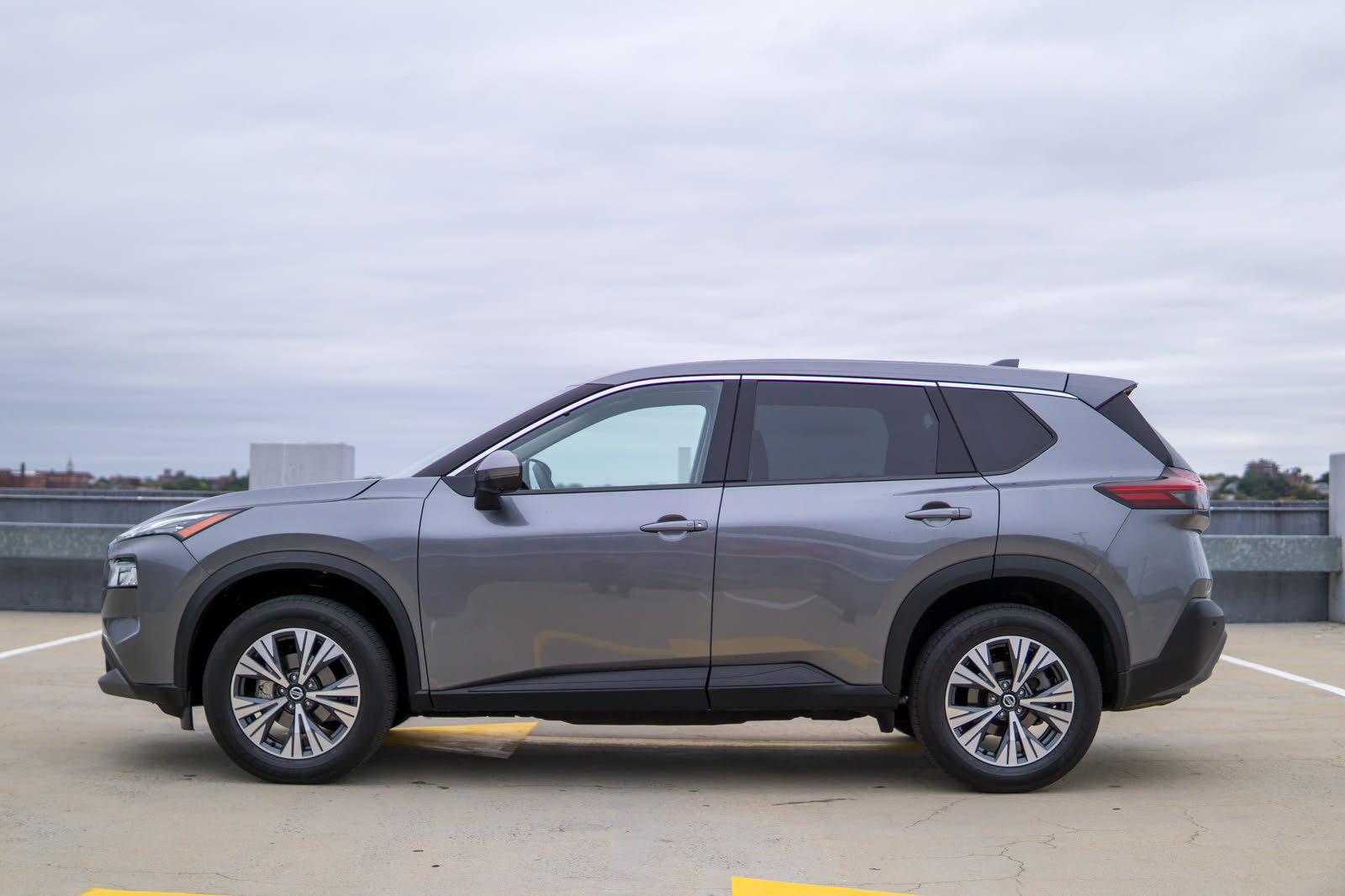
Redesigning a best-selling vehicle isn't easy, but with the 2021 Nissan Rogue, the automaker makes all of the right moves, except one.

Wearing handsome new styling with a more technical appearance, the 2021 Nissan Rogue looks more like an SUV than it does a car. Dark gray plastic cladding covers the Rogue's lower perimeter, and bold, simulated skid plates and lower door protection convey the right amount of ruggedness—perhaps too audaciously on the SUV's back bumper.
Clean LED lighting elements, a prominent V-Motion grille, and proper proportioning lend the new 2021 Rogue a modern aesthetic, and all trim levels include aluminum wheels sized up to 19 inches in diameter. Get the optional two-tone paint with a black roof treatment, and the SUV takes on a custom look.
Four versions of the new Rogue are available. The Rogue S ($25,650) serves as the entry point, the Rogue SV ($27,340) is typically the most popular trim level, the Rogue SL ($32,000) adds a little luxury to the equation, and the new-for 2021 Rogue Platinum ($35,430) decks the SUV out with semi-aniline quilted leather and other genuinely upscale amenities. Don't forget to add $1,095 in destination charges to each of the listed prices.
A handful of factory options are available. All-wheel drive costs $1,400, and Premium option packages are available for both the SV ($2,660) and SL ($1,320). Our test vehicle was a Rogue SL, and in addition to the Premium Package and extra-cost paint, it had a set of floor mats and a cargo area protection package. All in, the tested front-driver totaled $35,195, including destination charges.
Featuring an Almond color leather interior and a standard panoramic glass sunroof, our test vehicle's interior was light and bright, emphasizing its improved roominess. Abundant soft-touch surfaces, appealing simulated wood trim, and fabric-wrapped windshield pillars all lend a sense of quality to the cabin. Nissan also arranges the controls in a clean and logical fashion. For a legitimately luxurious look and feel, get Platinum trim for its quilted semi-aniline leather, contrast stitching, and ambient lighting.
One thing we noticed about the Rogue's interior is the appearance of the numbers on the climate control panel. They look like an old-school digital clock from the 1980s. Oh, and this SUV still offers a CD player, but don't infer that a Rogue is technologically outdated, because wireless Apple CarPlay is also on the menu.

Let's get this criticism out of the way now: the 2021 Nissan Rogue needs more power. As tested, it weighs nearly 3,500 pounds, and the only engine choice is a direct-injected 2.5-liter four-cylinder making 181 horsepower at 6,000 rpm and 181 pound-feet of torque at 3,600 rpm.
This output is adequate for typical daily-driver use, and the continuously variable transmission (CVT) does a decent job of leveraging the available torque. And as far as CVTs go, this is a good one because you barely notice it. Programmed ratios help it sound and feel more like a traditional automatic, and Nissan even provides paddle shifters on the steering wheel, though you won't be inclined to use them.
With that said, SUVs are made for adventuring. With available all-wheel drive (AWD), up to 8.2 inches of ground clearance, and new Snow and Off-Road driving modes, the 2021 Rogue is more adept at getting off the beaten path. And that can mean bringing people, pets, gear, and driving into mountains where a normally-aspirated 2.5-liter four-cylinder feels sapped of its energy.
We drove the new Rogue during a media program held by Nissan, and we asked whether turbocharging would be on the menu in the future. The non-committal response from Nissan suggested that a more powerful Rogue is likely on the way. We predict it will be available with the same variable-compression turbocharged 2.0-liter four-cylinder used in the Altima sedan and Infiniti QX50.
If you can't wait to see if a Rogue VC-Turbo becomes a reality, you can always change from the default Standard driving mode to Sport, making the SUV's driving dynamics feel more responsive. And if you were hoping for a Rogue Hybrid to reappear (Nissan also didn't say "No" about this possibility), in the meantime, you can try out the Eco drive mode.
As far as fuel economy is concerned, the tested Rogue SL with front-wheel drive (FWD) got 27.5 mpg on a driving loop with various roads and speeds, coming up 1.5 mpg short of the official EPA rating.
Drive the new 2021 Rogue, and it's easy to imagine how enjoyable a turbocharged engine could be. Nissan has done a beautiful job of tuning this SUV's ride and handling.
Based on a new, more robust architecture that is 35% composed of high-strength steel, the Rogue uses a strut front, multi-link rear suspension. Brake-induced Intelligent Trace Control and Active Ride Control systems fortify the suspension, adding an extra measure of ride and handling satisfaction. New for 2021, Vehicle Motion Control debuts to predictively anticipate ways to make the drive more enjoyable based on a driver's accelerator, steering, and braking inputs.
In combination with the test vehicle's 19-inch wheels and 235/55 all-season tires, these features make the Rogue feel predictable, smooth, and athletic, with less of the head toss that can afflict occupants of a typical SUV.
The real star of the show, though, is the Rogue's new steering. With the redesign, Nissan moves the electric assist from the steering column to the steering rack and quickens the ratio. These changes, plus added fine-tuning, result in dramatically improved steering feel over the previous-generation Rogue.

In the weightlessness of outer space, the human body adopts a neutral spine position that lessens stress on the bones and joints, reduces fatigue, and decreases muscle strain. Nissan attempts to replicate this with its Zero Gravity seat designs, and while their effectiveness varies depending on the vehicle, they certainly are comfortable.
Though the previous-generation Rogue had them, they felt somewhat small and undersized. Now, an improved set of Zero Gravity seats comes in the new 2021 Rogue, and the SUV is more comfortable as a result. With S trim, they're wrapped in cloth and include a manual driver's height adjuster. With SV trim, eight-way power adjustment is standard, and leatherette upholstery is an option. The SL has standard leather, and the Platinum gains a higher grade of soft and smooth premium leather.
Similar movement up the Rogue's trim level ladder adds the company's Quick Comfort heated front seats, a heated steering wheel, and heated rear seats. You'd think an automaker whose North American headquarters are located in summer-sweaty Nashville would also offer a ventilated seat option, but no.
Nissan does, however, install standard air conditioning. The SV adds dual-zone automatic climate control, while the SL and Platinum feature a triple-zone system that gives rear-seat occupants control over their temperature. Rear air conditioning vents are standard in all Rogues, and both the SL and Platinum have rear side window sunshades.
Rear-seat headroom and legroom are more generous than in the previous Rogue, and the rear doors now open to a nearly 90-degree angle, making it easy to load passengers as long as nobody is parked directly next to the SUV. The back seat is comfortable for both kids and adults, and with new LATCH anchors mounted in the center of the bench seat, the Rogue can accommodate up to three child safety seats. A standard rear-seat reminder system aims to prevent parents from accidentally leaving a child in the Rogue.
Nissan has also taken strides to reduce interior noise for a quieter driving experience. From aerodynamic improvements to the implementation of acoustic front glass and a thicker dashboard insulator, the changes are effective.
Storage is usefully sized and located. The Rogue's new electronic shifter frees up space under the center console for a storage tray, and the door-panel pockets easily accommodate 32-ounce water bottles. The center armrest features a split butterfly-style opening for easier access to the bin below it, which isn't particularly large.
Most versions of the Rogue offer a power rear liftgate, and with SL and Platinum trim, it's a hands-free design. Once it opens, you'll find 31.6 cubic feet of cargo capacity in the Rogue S and SV. The SL and Platinum have a standard Divide-N-Hide cargo management system, and these trims supply as much as 36.5 cubic feet of cargo space. Bins on either side of the cargo load floor accommodate one-gallon jugs of your favorite beverage.
While these cargo volume numbers are slightly less than the outgoing model, they remain generous for the compact crossover SUV segment. And, when you fold the Rogue's rear seat down, the maximum volume of 74.1 cubic feet is among the largest in the class.

Nissan offers a competitive infotainment package in the 2021 Rogue. With S trim, the system includes an 8-inch touchscreen display, Bluetooth, SiriusXM satellite radio, Apple CarPlay, and Android Auto. You also get a free six-month trial to Nissan Concierge Personal Assistant, after which a subscription is necessary to continue service.
To make using the system easier, Nissan includes knobs for both power/volume and station tuning, though they don't protrude much from the display panel's surface, which could make them harder to grasp and use. Glossy plastic finishes don't help in this regard. Menu shortcut buttons along the bottom of the display provide easy access to commonly used functions.
Move up from an S model to the SV or SL trim, and the Rogue adds NissanConnect Services, a WiFi hotspot, and both Amazon Alexa and Google Assistant integration. NissanConnect Services includes features such as remote engine starting, automatic collision notification, vehicle speed and boundary alerts, and a car finder function. After free trial periods, the various NissanConnect Services plans require a subscription fee.
Choose the SL Premium Package or the Rogue Platinum, and Nissan installs a larger 9-inch touchscreen display plus a door-to-door navigation system with real-time traffic, wireless Apple CarPlay, an upgraded voice recognition system, and a Bose premium audio system.
This infotainment setup came in the test vehicle, and aside from the stubby knobs and small shortcut buttons, it worked well. The voice recognition system produced mostly accurate results to a mix of naturally spoken and specific commands, and the Bose audio components delivered good sound for the vehicle segment.
If you're seeking even more technology in your 2021 Rogue, you'll want Platinum trim. It gets wireless smartphone charging, a 12.3-inch digital instrument cluster, and a 10.8-inch head-up display.

According to Nissan, safety is of paramount importance to people who buy small crossover SUVs. That makes sense, as they're often purchased by consumers who would otherwise shop for a family sedan.
With this in mind, Nissan equips every 2021 Rogue with a comprehensive collection of advanced driving assistance systems (ADAS). Bundled together under the Nissan Safety Shield 360 umbrella, they include all of the increasingly common safety features, from automatic emergency braking with pedestrian detection to lane-departure warning, but with a significant difference. Instead of including adaptive cruise control, Safety Shield 360 has a blind-spot warning system with rear cross-traffic alert.
Frankly, this is a better approach than what competitors frequently offer. Blind-spot warning systems are among the most effective ADAS available in modern vehicles, and they're often unavailable at the base trim level.
Additionally, Nissan equips the Rogue with ten airbags, a driver monitoring system, and a rear-seat reminder system that engages when you open a rear door before getting in and starting the vehicle. Nissan also claims to be the first to equip a mainstream compact SUV with rear pre-tensioning and load-limiting seatbelts. When you choose Platinum trim, you also get an airbag that deploys between the driver and front passenger to limit injury potential further.
Now, what about adaptive cruise control? That's standard starting with the Rogue SV, part of an improved ProPilot Assist driving aid that includes a lane-centering assistance function. Nissan says new radar and camera units improve ProPilot Assist's accuracy and smoothness. The stop-and-go operation in heavy traffic now resumes travel for up to 30 seconds after the SUV comes to a stop compared to three seconds in the previous-generation Rogue. The SV trim also adds a surround-view camera system for improved visibility.
With the SL Premium Package and the Rogue Platinum, Nissan offers an upgraded ProPilot Assist with Navi-link technology. It uses navigation map data and GPS coordinates to automatically adjust speed for curves, freeway junctions, and freeway exit ramps.
Overall, the new Rogue's ADAS works better than before. Technology ages fast, and the previous ProPilot Assist system was more an irritant than a help. This improved system certainly is more accurate and smoother, making it more likely you'll use it.
Simultaneously, though, it can still behave in unanticipated ways, and it issues a continuous stream of audible notifications as it acquires traffic targets ahead. Navi-link also slows the SUV too much in certain situations, aggravating motorists behind the Rogue.
Since the Rogue is brand new, crash-test results were unavailable as this review was written. However, the near doubling of the use of high-strength steel in the vehicle architecture, coupled with engineering that aims to better deflect crash energy away from the passenger compartment, bodes well for this Nissan's ability to protect you in a collision.

The Rogue goes up against stiff competition, from the CR-V and RAV4 to the Mazda CX-5 and Ford Escape. Competitively sized, priced, and equipped, the 2021 Nissan Rogue is a cost-effective choice in a compact crossover SUV. Since it has an average warranty, average free trial plans to connected services, and doesn't offer a free maintenance program, the Rogue makes the most financial sense with regard to its equipment and packaging. It offers more for less.
However, in comparison to the previous-generation Rogue, proving such value is not as important. That's because this redesigned 2021 Nissan Rogue is an excellent example of a modern compact crossover in its own right. All it needs is more power.

User reviews for 2021 Nissan Rogue
Write a review2021 Nissan Rogue Pricing
Trims & specs
Air Conditioning
Single front air conditioning zones
Airbags
Dual front airbags · Dual front knee airbags · Passenger airbag deactivation: occupant sensing deactivation · Front side airbags · Rear side curtain airbags
Audio System
Antenna Type: diversity · Voice recognition audio system · USB auxiliary audio input · IHeartRadio internet radio · Touch screen display radio · Satellite Radio: SiriusXM · Total Number of Speakers: 4
Brakes
ABS: 4-wheel · Braking assist: hill start assist · Electronic parking brake: auto off · Front brake diameter: 11.7 · Front brake width: 1.02 · Front brakes: ventilated disc · Rear brake diameter: 11.5 · Rear brake width: .63 · Rear brakes: ventilated disc
Comfort Features
Armrests: rear center folding with pass-thru · Floor Material: cargo area carpet · Shift knob trim: urethane · Steering wheel trim: urethane
Convenience Features
Assist handle: front · Cargo area power outlet: 12V · Cargo cover: hard · Center console: front console with armrest and storage · Cupholders: rear · Multi-function remote: keyless entry with panic alarm · One-touch windows: 1 · Power outlet(s): 12V front · Power steering: electric · Power windows: lockout button · Reading lights: rear · Steering wheel: tilt and telescopic · Steering wheel mounted controls: audio · Storage: cargo tie-down anchors and hooks · Vanity mirrors: dual illuminating
Driver Seat
Manual adjustments: 6
Drivetrain
Axle ratio: 5.69
Engine
Alternator: 120 amps
Exterior Features
Door handle color: black · Exhaust tip color: stainless-steel · Fender lip moldings: black · Front bumper color: body-color · Grille color: black with chrome accents · Mirror color: black · Rear bumper color: body-color · Rear spoiler: roofline spoiler · Rear spoiler color: body-color · Rear trunk/liftgate: liftgate · Rocker panel color: black · Window trim: chrome
Headrests
Front headrests: adjustable · Number of front headrests: 2 · Number of rear headrests: 3
In Car Entertainment
Connected in-car apps: Google POIs · Infotainment: NissanConnect · Infotainment screen size: 8 in.
Instrumentation
Fuel economy display: MPG · Instrument cluster screen size: 7 in. · Warnings and reminders: maintenance reminder
Lights
Daytime running lights: LED · Headlights: LED · Tail and brake lights: LED
Mirrors
Exterior mirrors: manual folding · Inside rearview mirror: manual day/night
Passenger Seat
Manual Adjustments: 4
Rear Seats
Type: 60-40 split bench
Safety
Automatic emergency braking: front · Camera system: rearview · Child seat anchors: LATCH system · Cross Traffic Alert: rear · Crumple zones: rear · Parking sensors: rear · Pre-Collision Warning System: audible warning · Pre-collision warning system: pedestrian detection · Rearview monitor: in dash
Seatbelts
Emergency locking retractors: front and rear · Front seatbelts: 3-point · Seatbelt force limiters: front · Seatbelt pretensioners: front · Seatbelt warning sensor: driver and passenger · Second row seatbelts: 3-point
Seats
Driver seat manual adjustments: height · Front seat type: bucket · Passenger seat manual adjustments: reclining · Rear headrests: adjustable · Rear seat folding: split · Rear seat manual adjustments: reclining · Upholstery: cloth
Security
Power door locks: anti-lockout
Spare Tire
Mount Location: inside · Size: temporary
Spare Wheel
Rim Type: steel
Steering
Steering ratio: 14.3 · Turns lock-to-lock: 2.5
Suspension
Front Arm Type: lower control arms · Front Shock Type: twin-tube gas shock absorbers · Front Spring Type: coil springs · Front Stabilizer Bar: diameter 24 mm · Front Suspension Classification: independent · Front Suspension Type: MacPherson struts · Rear Shock Type: twin-tube gas shock absorbers · Rear Spring Type: coil springs · Rear Stabilizer Bar: diameter 28 mm · Rear Suspension Classification: independent · Rear Suspension Type: multi-link
Telematics
Electronic messaging assistance: with read function · Phone: voice activated · Phone wireless data link: Bluetooth
Tires
Type: all season
Tires and Rims
Wheel type: aluminum alloy
Windows
Front wipers: variable intermittent · Liftgate window: fixed · Power windows: with safety reverse · Rear wiper: intermittent · Solar-tinted glass: front
Air Conditioning
Single front air conditioning zones
Airbags
Dual front airbags · Dual front knee airbags · Passenger airbag deactivation: occupant sensing deactivation · Front side airbags · Front side curtain airbags
Audio System
Antenna Type: diversity · Voice recognition audio system · USB auxiliary audio input · Pandora internet radio · Touch screen display radio · Satellite Radio: SiriusXM · Total Number of Speakers: 4
Brakes
ABS: 4-wheel · Braking assist: hill start assist · Electronic parking brake: auto off · Front brake diameter: 11.7 · Front brake width: 1.02 · Front brakes: ventilated disc · Rear brake diameter: 11.5 · Rear brake width: .63 · Rear brakes: ventilated disc
Comfort Features
Armrests: rear center with cupholders · Floor Material: carpet · Shift knob trim: urethane · Steering wheel trim: urethane
Convenience Features
Assist handle: rear · Cargo area power outlet: 12V · Cargo cover: hard · Center console: front console with armrest and storage · Cupholders: rear · Multi-function remote: keyless entry · One-touch windows: 1 · Power outlet(s): 12V front · Power steering: electric · Power windows: lockout button · Reading lights: front · Steering wheel: tilt and telescopic · Steering wheel mounted controls: cruise controls · Storage: front seatback · Vanity mirrors: dual illuminating
Driver Seat
Manual adjustments: 6
Drivetrain
4WD Type: on demand · Axle ratio: 5.69
Engine
Alternator: 120 amps
Exterior Features
Door handle color: black · Exhaust tip color: stainless-steel · Fender lip moldings: black · Front bumper color: body-color · Grille color: black with chrome accents · Mirror color: black · Rear bumper color: body-color · Rear spoiler: roofline spoiler · Rear spoiler color: body-color · Rear trunk/liftgate: liftgate · Rocker panel color: black · Window trim: chrome
Headrests
Front headrests: adjustable · Number of front headrests: 2 · Number of rear headrests: 3
In Car Entertainment
Connected in-car apps: Facebook · Infotainment: Android Auto ready · Infotainment screen size: 8 in.
Instrumentation
Fuel economy display: MPG · Instrument cluster screen size: 7 in. · Warnings and reminders: coolant temperature warning
Lights
Daytime running lights: LED · Headlights: LED · Tail and brake lights: LED
Mirrors
Exterior mirrors: manual folding · Inside rearview mirror: manual day/night
Passenger Seat
Manual Adjustments: 4
Rear Seats
Type: 60-40 split bench
Safety
Automatic emergency braking: front pedestrian · Camera system: rearview · Child seat anchors: LATCH system · Cross Traffic Alert: rear · Crumple zones: front · Parking sensors: rear · Pre-Collision Warning System: visual warning · Pre-collision warning system: pedestrian detection · Rearview monitor: in dash
Seatbelts
Emergency locking retractors: front and rear · Front seatbelts: 3-point · Seatbelt force limiters: front · Seatbelt pretensioners: front · Seatbelt warning sensor: driver and passenger · Second row seatbelts: 3-point
Seats
Driver seat manual adjustments: height · Front seat type: bucket · Passenger seat manual adjustments: reclining · Rear headrests: adjustable · Rear seat folding: split · Rear seat manual adjustments: reclining · Upholstery: cloth
Security
Power door locks: anti-lockout
Spare Tire
Mount Location: inside · Size: temporary
Spare Wheel
Rim Type: steel
Steering
Steering ratio: 14.3 · Turns lock-to-lock: 2.5
Suspension
Front Arm Type: lower control arms · Front Shock Type: twin-tube gas shock absorbers · Front Spring Type: coil springs · Front Stabilizer Bar: diameter 24 mm · Front Suspension Classification: independent · Front Suspension Type: MacPherson struts · Rear Shock Type: twin-tube gas shock absorbers · Rear Spring Type: coil springs · Rear Stabilizer Bar: diameter 28 mm · Rear Suspension Classification: independent · Rear Suspension Type: multi-link
Telematics
Electronic messaging assistance: with read function · Phone: voice activated · Phone wireless data link: Bluetooth
Tires
Type: all season
Tires and Rims
Wheel type: aluminum alloy
Windows
Front wipers: variable intermittent · Liftgate window: fixed · Power windows: with safety reverse · Rear wiper: with washer · Solar-tinted glass: front
Air Conditioning
Automatic climate control front air conditioning · Dual front air conditioning zones
Airbags
Dual front airbags · Dual front knee airbags · Passenger airbag deactivation: occupant sensing deactivation · Rear side airbags · Rear side curtain airbags
Audio System
Antenna Type: mast · Voice recognition audio system · Bluetooth auxiliary audio input · Pandora internet radio · AM/FM radio · Satellite Radio: SiriusXM · Total Number of Speakers: 6
Brakes
ABS: 4-wheel · Braking assist: hill start assist · Electronic parking brake: auto off · Front brake diameter: 11.7 · Front brake width: 1.02 · Front brakes: ventilated disc · Rear brake diameter: 11.5 · Rear brake width: .63 · Rear brakes: ventilated disc
Comfort Features
Armrests: rear center folding with pass-thru · Floor Material: cargo area carpet · Shift knob trim: urethane · Steering wheel trim: urethane
Convenience Features
Adaptive stop and go cruise control: semi-automatic · Assist handle: front · Autonomous lane guidance: lane centering · Cargo area power outlet: 12V · Cargo cover: hard · Center console: front console with armrest and storage · Cruise control: adaptive · Cupholders: rear · Multi-function remote: proximity entry system · One-touch windows: 1 · Power outlet(s): USB rear · Power steering: speed-proportional · Power windows: lockout button · Reading lights: rear · Steering wheel: tilt and telescopic · Steering wheel mounted controls: audio · Storage: dual level cargo area · Vanity mirrors: dual illuminating
Driver Seat
Adjustable lumbar support: power · Power adjustments: 8
Drivetrain
Axle ratio: 5.69
Engine
Alternator: 120 amps
Exterior Features
Door handle color: chrome · Exhaust tip color: stainless-steel · Fender lip moldings: black · Front bumper color: body-color · Grille color: black with chrome accents · Mirror color: body-color · Rear bumper color: body-color · Rear spoiler: roofline spoiler · Rear spoiler color: body-color · Rear trunk/liftgate: liftgate · Rocker panel color: black · Window trim: chrome
Headrests
Front headrests: adjustable · Number of front headrests: 2 · Number of rear headrests: 3
In Car Entertainment
Connected in-car apps: Google search · Infotainment: NissanConnect · Infotainment screen size: 8 in.
Instrumentation
Fuel economy display: range · Instrument cluster screen size: 7 in. · Warnings and reminders: low oil pressure
Lights
Daytime running lights: LED · Headlights: wiper activated · Tail and brake lights: LED
Mirrors
Exterior mirrors: integrated turn signals · Inside rearview mirror: manual day/night
Passenger Seat
Manual Adjustments: 4
Rear Seats
Type: 60-40 split bench
Safety
Automatic emergency braking: front pedestrian · Camera system: surround view · Child seat anchors: LATCH system · Cross Traffic Alert: rear · Crumple zones: front · Impact sensor: post-collision safety system · Parking sensors: rear · Pre-Collision Warning System: visual warning · Pre-collision warning system: pedestrian detection · Rearview monitor: in dash
Seatbelts
Emergency locking retractors: front and rear · Front seatbelts: 3-point · Seatbelt force limiters: front · Seatbelt pretensioners: front · Seatbelt warning sensor: driver and passenger · Second row seatbelts: 3-point
Seats
Driver seat power adjustments: reclining · Front seat type: bucket · Passenger seat manual adjustments: reclining · Rear headrests: adjustable · Rear seat folding: split · Rear seat manual adjustments: reclining · Upholstery: cloth
Security
Power door locks: anti-lockout
Spare Tire
Mount Location: inside · Size: temporary
Spare Wheel
Rim Type: steel
Steering
Steering ratio: 14.3 · Turns lock-to-lock: 2.5
Suspension
Front Arm Type: lower control arms · Front Shock Type: twin-tube gas shock absorbers · Front Spring Type: coil springs · Front Stabilizer Bar: diameter 24 mm · Front Suspension Classification: independent · Front Suspension Type: MacPherson struts · Rear Shock Type: twin-tube gas shock absorbers · Rear Spring Type: coil springs · Rear Stabilizer Bar: diameter 28 mm · Rear Suspension Classification: independent · Rear Suspension Type: multi-link
Telematics
Driver assistance app: roadside assistance · Electronic messaging assistance: with read function · Phone: voice activated · Phone wireless data link: Bluetooth · Smart device app compatibility: NissanConnect · Smart device app function: maintenance status · Wifi: hotspot
Tires
Type: all season
Tires and Rims
Wheel type: aluminum alloy
Windows
Front wipers: variable intermittent · Liftgate window: fixed · Power windows: with safety reverse · Rear wiper: with washer · Solar-tinted glass: front
Air Conditioning
Automatic climate control front air conditioning · Dual front air conditioning zones
Airbags
Dual front airbags · Dual front knee airbags · Passenger airbag deactivation: occupant sensing deactivation · Front side airbags · Front side curtain airbags
Audio System
Antenna Type: diversity · Voice recognition audio system · USB auxiliary audio input · Pandora internet radio · Touch screen display radio · Satellite Radio: SiriusXM · Total Number of Speakers: 6
Brakes
ABS: 4-wheel · Braking assist: hill start assist · Electronic parking brake: auto off · Front brake diameter: 11.7 · Front brake width: 1.02 · Front brakes: ventilated disc · Rear brake diameter: 11.5 · Rear brake width: .63 · Rear brakes: ventilated disc
Comfort Features
Armrests: rear center with cupholders · Floor Material: carpet · Shift knob trim: urethane · Steering wheel trim: urethane
Convenience Features
Adaptive stop and go cruise control: semi-automatic · Assist handle: rear · Autonomous lane guidance: lane centering · Cargo area power outlet: 12V · Cargo cover: hard · Center console: front console with armrest and storage · Cruise control: adaptive · Cupholders: front · Multi-function remote: trunk release · One-touch windows: 1 · Power outlet(s): 12V front · Power steering: electric · Power windows: lockout button · Reading lights: rear · Steering wheel: tilt and telescopic · Steering wheel mounted controls: audio · Storage: in-floor · Vanity mirrors: dual illuminating
Driver Seat
Adjustable lumbar support: power · Power adjustments: 8
Drivetrain
4WD Type: on demand · Axle ratio: 5.69
Engine
Alternator: 120 amps
Exterior Features
Door handle color: chrome · Exhaust tip color: stainless-steel · Fender lip moldings: black · Front bumper color: body-color · Grille color: black with chrome accents · Mirror color: body-color · Rear bumper color: body-color · Rear spoiler: roofline spoiler · Rear spoiler color: body-color · Rear trunk/liftgate: liftgate · Rocker panel color: black · Window trim: chrome
Headrests
Front headrests: adjustable · Number of front headrests: 2 · Number of rear headrests: 3
In Car Entertainment
Connected in-car apps: Google search · Infotainment: Android Auto ready · Infotainment screen size: 8 in.
Instrumentation
Fuel economy display: MPG · Instrument cluster screen size: 7 in. · Warnings and reminders: coolant temperature warning
Lights
Daytime running lights: LED · Headlights: auto delay off · Tail and brake lights: LED
Mirrors
Exterior mirrors: heated · Inside rearview mirror: manual day/night
Passenger Seat
Manual Adjustments: 4
Rear Seats
Type: 60-40 split bench
Safety
Automatic emergency braking: front · Camera system: surround view · Child seat anchors: LATCH system · Cross Traffic Alert: rear · Crumple zones: front · Impact sensor: alert system · Parking sensors: rear · Pre-Collision Warning System: visual warning · Pre-collision warning system: pedestrian detection · Rearview monitor: in dash
Seatbelts
Emergency locking retractors: front · Front seatbelts: 3-point · Seatbelt force limiters: front · Seatbelt pretensioners: front · Seatbelt warning sensor: driver and passenger · Second row seatbelts: 3-point
Seats
Driver seat power adjustments: reclining · Front seat type: bucket · Passenger seat manual adjustments: reclining · Rear headrests: adjustable · Rear seat folding: split · Rear seat manual adjustments: reclining · Upholstery: cloth
Security
Power door locks: anti-lockout
Spare Tire
Mount Location: inside · Size: temporary
Spare Wheel
Rim Type: steel
Steering
Steering ratio: 14.3 · Turns lock-to-lock: 2.5
Suspension
Front Arm Type: lower control arms · Front Shock Type: twin-tube gas shock absorbers · Front Spring Type: coil springs · Front Stabilizer Bar: diameter 24 mm · Front Suspension Classification: independent · Front Suspension Type: MacPherson struts · Rear Shock Type: twin-tube gas shock absorbers · Rear Spring Type: coil springs · Rear Stabilizer Bar: diameter 28 mm · Rear Suspension Classification: independent · Rear Suspension Type: multi-link
Telematics
Driver assistance app: roadside assistance · Electronic messaging assistance: with voice recognition · Phone: voice activated · Phone wireless data link: Bluetooth · Smart device app compatibility: NissanConnect · Smart device app function: lock operation · Wifi: hotspot
Tires
Type: all season
Tires and Rims
Wheel type: aluminum alloy
Windows
Front wipers: variable intermittent · Liftgate window: fixed · Power windows: with safety reverse · Rear wiper: intermittent · Solar-tinted glass: front
Air Conditioning
Automatic climate control front air conditioning · Dual front air conditioning zones · Automatic climate control rear air conditioning · Single rear air conditioning zones
Airbags
Dual front airbags · Dual front knee airbags · Passenger airbag deactivation: occupant sensing deactivation · Rear side airbags · Rear side curtain airbags
Audio System
Antenna Type: mast · Voice recognition audio system · Bluetooth auxiliary audio input · Pandora internet radio · AM/FM radio · Satellite Radio: SiriusXM · Total Number of Speakers: 6
Brakes
ABS: 4-wheel · Braking assist: hill start assist · Electronic parking brake: auto off · Front brake diameter: 11.7 · Front brake width: 1.02 · Front brakes: ventilated disc · Rear brake diameter: 11.5 · Rear brake width: .63 · Rear brakes: ventilated disc
Comfort Features
Armrests: rear center folding with pass-thru · Floor Material: cargo area carpet · Shift knob trim: leather · Steering wheel trim: leather
Convenience Features
Adaptive stop and go cruise control: semi-automatic · Assist handle: front · Autonomous lane guidance: lane centering · Cargo area power outlet: 12V · Cargo cover: hard · Center console: front console with armrest and storage · Cruise control: adaptive · Cupholders: front · Dimming rearview mirror: auto-dimming · Memorized settings: liftgate · Multi-function remote: proximity entry system · One-touch windows: 1 · Power outlet(s): USB-C front · Power steering: speed-proportional · Power windows: lockout button · Reading lights: front · Steering wheel: tilt and telescopic · Steering wheel mounted controls: phone · Storage: door pockets · Sunshade: side window · Universal garage door opener: Homelink · Vanity mirrors: dual illuminating
Driver Seat
Adjustable lumbar support: power · Power adjustments: 8
Drivetrain
Axle ratio: 5.69
Engine
Alternator: 120 amps
Exterior Features
Door handle color: chrome · Exhaust tip color: stainless-steel · Fender lip moldings: black · Front bumper color: body-color · Grille color: black with chrome accents · Mirror color: body-color · Rear bumper color: body-color · Rear spoiler: roofline spoiler · Rear spoiler color: body-color · Rear trunk/liftgate: power operated · Rocker panel color: black · Window trim: chrome
Headrests
Front headrests: adjustable · Number of front headrests: 2 · Number of rear headrests: 3
In Car Entertainment
Connected in-car apps: SiriusXM Stocks · Infotainment: Apply CarPlay ready · Infotainment screen size: 8 in.
Instrumentation
Fuel economy display: range · Instrument cluster screen size: 7 in. · Warnings and reminders: low fuel level
Lights
Daytime running lights: LED · Headlights: wiper activated · Tail and brake lights: LED
Mirrors
Exterior mirrors: power
Passenger Seat
Power adjustments: 4
Rear Seats
Type: 60-40 split bench
Roof
Moonroof: tilt/slide · Roof rails: chrome
Safety
Automatic emergency braking: rear · Camera system: surround view · Child seat anchors: LATCH system · Cross Traffic Alert: rear · Crumple zones: rear · Impact sensor: alert system · Parking sensors: rear · Pre-Collision Warning System: visual warning · Pre-collision warning system: pedestrian detection · Rearview monitor: in dash
Seatbelts
Emergency locking retractors: front · Front seatbelts: 3-point · Seatbelt force limiters: front · Seatbelt pretensioners: front · Seatbelt warning sensor: driver and passenger · Second row seatbelts: 3-point
Seats
Driver seat power adjustments: height · Front seat type: bucket · Passenger seat power adjustments: reclining · Rear headrests: adjustable · Rear seat folding: split · Rear seat manual adjustments: reclining · Upholstery: leather-trimmed
Security
Power door locks: anti-lockout
Spare Tire
Mount Location: inside · Size: temporary
Spare Wheel
Rim Type: steel
Steering
Steering ratio: 14.3 · Turns lock-to-lock: 2.5
Suspension
Front Arm Type: lower control arms · Front Shock Type: twin-tube gas shock absorbers · Front Spring Type: coil springs · Front Stabilizer Bar: diameter 24 mm · Front Suspension Classification: independent · Front Suspension Type: MacPherson struts · Rear Shock Type: twin-tube gas shock absorbers · Rear Spring Type: coil springs · Rear Stabilizer Bar: diameter 28 mm · Rear Suspension Classification: independent · Rear Suspension Type: multi-link
Telematics
Driver assistance app: roadside assistance · Electronic messaging assistance: with voice recognition · Phone: voice activated · Phone wireless data link: Bluetooth · Smart device app compatibility: NissanConnect · Smart device app function: maintenance status · Wifi: hotspot
Tires
Type: all season
Tires and Rims
Wheel type: aluminum alloy
Windows
Front wipers: variable intermittent · Liftgate window: fixed · Power windows: with safety reverse · Rear wiper: with washer · Solar-tinted glass: front
Air Conditioning
Automatic climate control front air conditioning · Dual front air conditioning zones · Automatic climate control rear air conditioning · Single rear air conditioning zones
Airbags
Dual front airbags · Dual front knee airbags · Passenger airbag deactivation: occupant sensing deactivation · Rear side airbags · Rear side curtain airbags
Audio System
Antenna Type: mast · Voice recognition audio system · Bluetooth auxiliary audio input · IHeartRadio internet radio · AM/FM radio · Satellite Radio: SiriusXM · Total Number of Speakers: 6
Brakes
ABS: 4-wheel · Braking assist: hill start assist · Electronic parking brake: auto off · Front brake diameter: 11.7 · Front brake width: 1.02 · Front brakes: ventilated disc · Rear brake diameter: 11.5 · Rear brake width: .63 · Rear brakes: ventilated disc
Comfort Features
Armrests: rear center folding with pass-thru · Floor Material: cargo area carpet · Shift knob trim: leather · Steering wheel trim: leather
Convenience Features
Adaptive stop and go cruise control: semi-automatic · Assist handle: front · Autonomous lane guidance: lane centering · Cargo area power outlet: 12V · Cargo cover: hard · Center console: front console with armrest and storage · Cruise control: adaptive · Cupholders: front · Dimming rearview mirror: auto-dimming · Memorized settings: 2 driver · Multi-function remote: trunk release · One-touch windows: 1 · Power outlet(s): 12V front · Power steering: speed-proportional · Power windows: lockout button · Reading lights: rear · Steering wheel: tilt and telescopic · Steering wheel mounted controls: audio · Storage: front seatback · Sunshade: side window · Universal garage door opener: Homelink · Vanity mirrors: dual illuminating
Driver Seat
Adjustable lumbar support: power · Power adjustments: 8
Drivetrain
4WD Type: on demand · Axle ratio: 5.69
Engine
Alternator: 120 amps
Exterior Features
Door handle color: chrome · Exhaust tip color: stainless-steel · Fender lip moldings: black · Front bumper color: body-color · Grille color: black with chrome accents · Mirror color: body-color · Rear bumper color: body-color · Rear spoiler: roofline spoiler · Rear spoiler color: body-color · Rear trunk/liftgate: sensor-activated · Rocker panel color: black · Window trim: chrome
Headrests
Front headrests: adjustable · Number of front headrests: 2 · Number of rear headrests: 3
In Car Entertainment
Connected in-car apps: Twitter · Infotainment: NissanConnect · Infotainment screen size: 8 in.
Instrumentation
Fuel economy display: MPG · Instrument cluster screen size: 7 in. · Warnings and reminders: coolant temperature warning
Lights
Daytime running lights: LED · Headlights: LED · Tail and brake lights: LED
Mirrors
Exterior mirrors: reverse gear tilt
Passenger Seat
Power adjustments: 4
Rear Seats
Type: 60-40 split bench
Roof
Moonroof: power panoramic · Roof rails: chrome
Safety
Automatic emergency braking: rear · Camera system: surround view · Child seat anchors: LATCH system · Cross Traffic Alert: rear · Crumple zones: front · Impact sensor: post-collision safety system · Parking sensors: rear · Pre-Collision Warning System: visual warning · Pre-collision warning system: pedestrian detection · Rearview monitor: in dash
Seatbelts
Emergency locking retractors: front · Front seatbelts: 3-point · Seatbelt force limiters: front · Seatbelt pretensioners: front · Seatbelt warning sensor: driver and passenger · Second row seatbelts: 3-point
Seats
Driver seat power adjustments: reclining · Front seat type: bucket · Passenger seat power adjustments: reclining · Rear headrests: adjustable · Rear seat folding: split · Rear seat manual adjustments: reclining · Upholstery: leather-trimmed
Security
Power door locks: anti-lockout
Spare Tire
Mount Location: inside · Size: temporary
Spare Wheel
Rim Type: steel
Steering
Steering ratio: 14.3 · Turns lock-to-lock: 2.5
Suspension
Front Arm Type: lower control arms · Front Shock Type: twin-tube gas shock absorbers · Front Spring Type: coil springs · Front Stabilizer Bar: diameter 24 mm · Front Suspension Classification: independent · Front Suspension Type: MacPherson struts · Rear Shock Type: twin-tube gas shock absorbers · Rear Spring Type: coil springs · Rear Stabilizer Bar: diameter 28 mm · Rear Suspension Classification: independent · Rear Suspension Type: multi-link
Telematics
Driver assistance app: roadside assistance · Electronic messaging assistance: with voice recognition · Phone: voice activated · Phone wireless data link: Bluetooth · Smart device app compatibility: NissanConnect · Smart device app function: lock operation · Wifi: hotspot
Tires
Type: all season
Tires and Rims
Wheel type: aluminum alloy
Windows
Front wipers: variable intermittent · Liftgate window: fixed · Power windows: with safety reverse · Rear wiper: intermittent · Solar-tinted glass: front
Air Conditioning
Automatic climate control front air conditioning · Dual front air conditioning zones · Automatic climate control rear air conditioning · Single rear air conditioning zones
Airbags
Dual front airbags · Dual front knee airbags · Passenger airbag deactivation: occupant sensing deactivation · Front side airbags · Front side curtain airbags
Audio System
Antenna Type: mast · Voice recognition audio system · USB auxiliary audio input · Pandora internet radio · Premium Brand: Bose · Touch screen display radio · Satellite Radio: SiriusXM · 2 subwoofers · Total Number of Speakers: 8
Brakes
ABS: 4-wheel · Braking assist: hill start assist · Electronic parking brake: auto off · Front brake diameter: 11.7 · Front brake width: 1.02 · Front brakes: ventilated disc · Rear brake diameter: 11.5 · Rear brake width: .63 · Rear brakes: ventilated disc
Comfort Features
Armrests: rear center folding with pass-thru · Floor Material: cargo area carpet · Shift knob trim: leather · Steering wheel trim: leather
Convenience Features
Adaptive stop and go cruise control: fully automated · Assist handle: rear · Autonomous lane guidance: lane centering · Cargo area power outlet: 12V · Cargo cover: hard · Center console: front console with armrest and storage · Cruise control: adaptive · Cupholders: front · Dimming rearview mirror: auto-dimming · Memorized settings: side mirrors · Multi-function remote: trunk release · One-touch windows: 1 · Power outlet(s): 12V front · Power steering: speed-proportional · Power windows: lockout button · Reading lights: rear · Steering wheel: tilt and telescopic · Steering wheel mounted controls: voice recognition controls · Storage: sunglasses holder · Sunshade: side window · Universal garage door opener: Homelink · Vanity mirrors: dual illuminating
Driver Seat
Adjustable lumbar support: power · Power adjustments: 8
Drivetrain
Axle ratio: 5.69
Engine
Alternator: 120 amps
Exterior Features
Door handle color: chrome · Exhaust tip color: stainless-steel · Fender lip moldings: black · Front bumper color: body-color · Grille color: black with chrome accents · Mirror color: body-color · Rear bumper color: body-color · Rear spoiler: roofline spoiler · Rear spoiler color: body-color · Rear trunk/liftgate: liftgate · Rocker panel color: black · Window trim: chrome
Headrests
Front headrests: adjustable · Number of front headrests: 2 · Number of rear headrests: 3
In Car Entertainment
Connected in-car apps: Google POIs · Infotainment: NissanConnect · Infotainment screen size: 9 in. · Smartphone integration: wireless Apple CarPlay
Instrumentation
Fuel economy display: MPG · Instrument cluster screen size: 12 in. · Warnings and reminders: low fuel level
Lights
Daytime running lights: LED · Headlights: Auto on/off · Tail and brake lights: LED
Mirrors
Exterior mirrors: manual folding
Passenger Seat
Power adjustments: 4
Rear Seats
Type: 60-40 split bench
Roof
Moonroof: sliding sunshade · Roof rails: chrome
Safety
Automatic emergency braking: front · Camera system: surround view · Child seat anchors: LATCH system · Cross Traffic Alert: rear · Crumple zones: rear · Impact sensor: post-collision safety system · Parking sensors: rear · Pre-Collision Warning System: audible warning · Pre-collision warning system: pedestrian detection · Rearview monitor: in dash · Traffic sign recognition: adaptive speed limiting
Seatbelts
Emergency locking retractors: front · Front seatbelts: 3-point · Seatbelt force limiters: front · Seatbelt pretensioners: front · Seatbelt warning sensor: driver and passenger · Second row seatbelts: 3-point
Seats
Driver seat power adjustments: height · Front seat type: bucket · Passenger seat power adjustments: reclining · Rear headrests: adjustable · Rear seat folding: split · Rear seat manual adjustments: reclining · Upholstery: leather-trimmed
Security
Power door locks: anti-lockout
Spare Tire
Mount Location: inside · Size: temporary
Spare Wheel
Rim Type: steel
Steering
Steering ratio: 14.3 · Turns lock-to-lock: 2.5
Suspension
Front Arm Type: lower control arms · Front Shock Type: twin-tube gas shock absorbers · Front Spring Type: coil springs · Front Stabilizer Bar: diameter 24 mm · Front Suspension Classification: independent · Front Suspension Type: MacPherson struts · Rear Shock Type: twin-tube gas shock absorbers · Rear Spring Type: coil springs · Rear Stabilizer Bar: diameter 28 mm · Rear Suspension Classification: independent · Rear Suspension Type: multi-link
Telematics
Driver assistance app: roadside assistance · Electronic messaging assistance: with read function · Navigation system: with voice recognition · Phone: voice activated · Phone wireless data link: Bluetooth · Smart device app compatibility: NissanConnect · Smart device app function: maintenance status · Wifi: hotspot
Tires
Type: all season
Tires and Rims
Wheel type: aluminum alloy
Windows
Front wipers: variable intermittent · Liftgate window: fixed · Power windows: with safety reverse · Rear wiper: intermittent · Solar-tinted glass: front
Air Conditioning
Automatic climate control front air conditioning · Dual front air conditioning zones · Automatic climate control rear air conditioning · Single rear air conditioning zones
Airbags
Dual front airbags · Dual front knee airbags · Passenger airbag deactivation: occupant sensing deactivation · Front side airbags · Front side curtain airbags
Audio System
Antenna Type: diversity · Voice recognition audio system · Bluetooth auxiliary audio input · IHeartRadio internet radio · Premium Brand: Bose · Touch screen display radio · Satellite Radio: SiriusXM · 2 subwoofers · Total Number of Speakers: 8
Brakes
ABS: 4-wheel · Braking assist: hill start assist · Electronic parking brake: auto off · Front brake diameter: 11.7 · Front brake width: 1.02 · Front brakes: ventilated disc · Rear brake diameter: 11.5 · Rear brake width: .63 · Rear brakes: ventilated disc
Comfort Features
Armrests: rear center with cupholders · Floor Material: cargo area carpet · Shift knob trim: leather · Steering wheel trim: leather
Convenience Features
Adaptive stop and go cruise control: fully automated · Assist handle: rear · Autonomous lane guidance: lane centering · Cargo area power outlet: 12V · Cargo cover: hard · Center console: front console with armrest and storage · Cruise control: adaptive · Cupholders: rear · Dimming rearview mirror: auto-dimming · Memorized settings: side mirrors · Multi-function remote: proximity entry system · One-touch windows: 1 · Power outlet(s): USB-C front · Power steering: electric · Power windows: lockout button · Reading lights: front · Steering wheel: tilt and telescopic · Steering wheel mounted controls: phone · Storage: dual level cargo area · Sunshade: side window · Universal garage door opener: Homelink · Vanity mirrors: dual illuminating
Driver Seat
Adjustable lumbar support: power · Power adjustments: 8
Drivetrain
4WD Type: on demand · Axle ratio: 5.69
Engine
Alternator: 120 amps
Exterior Features
Door handle color: chrome · Exhaust tip color: stainless-steel · Fender lip moldings: black · Front bumper color: body-color · Grille color: black with chrome accents · Mirror color: body-color · Rear bumper color: body-color · Rear spoiler: roofline spoiler · Rear spoiler color: body-color · Rear trunk/liftgate: liftgate · Rocker panel color: black · Window trim: chrome
Headrests
Front headrests: adjustable · Number of front headrests: 2 · Number of rear headrests: 3
In Car Entertainment
Connected in-car apps: SiriusXM Weather · Infotainment: Android Auto ready · Infotainment screen size: 9 in. · Smartphone integration: wireless Apple CarPlay
Instrumentation
Fuel economy display: MPG · Instrument cluster screen size: 12 in. · Warnings and reminders: low fuel level
Lights
Daytime running lights: LED · Headlights: Auto on/off · Tail and brake lights: LED
Mirrors
Exterior mirrors: integrated turn signals
Passenger Seat
Power adjustments: 4
Rear Seats
Type: 60-40 split bench
Roof
Moonroof: anti-trapping feature · Roof rails: chrome
Safety
Automatic emergency braking: front pedestrian · Camera system: surround view · Child seat anchors: LATCH system · Cross Traffic Alert: rear · Crumple zones: rear · Impact sensor: post-collision safety system · Parking sensors: rear · Pre-Collision Warning System: visual warning · Pre-collision warning system: pedestrian detection · Rearview monitor: in dash · Traffic sign recognition: adaptive speed limiting
Seatbelts
Emergency locking retractors: front · Front seatbelts: 3-point · Seatbelt force limiters: front · Seatbelt pretensioners: front · Seatbelt warning sensor: driver and passenger · Second row seatbelts: 3-point
Seats
Driver seat power adjustments: reclining · Front seat type: bucket · Passenger seat power adjustments: reclining · Rear headrests: adjustable · Rear seat folding: split · Rear seat manual adjustments: reclining · Upholstery: leather-trimmed
Security
Power door locks: anti-lockout
Spare Tire
Mount Location: inside · Size: temporary
Spare Wheel
Rim Type: steel
Steering
Steering ratio: 14.3 · Turns lock-to-lock: 2.5
Suspension
Front Arm Type: lower control arms · Front Shock Type: twin-tube gas shock absorbers · Front Spring Type: coil springs · Front Stabilizer Bar: diameter 24 mm · Front Suspension Classification: independent · Front Suspension Type: MacPherson struts · Rear Shock Type: twin-tube gas shock absorbers · Rear Spring Type: coil springs · Rear Stabilizer Bar: diameter 28 mm · Rear Suspension Classification: independent · Rear Suspension Type: multi-link
Telematics
Driver assistance app: roadside assistance · Electronic messaging assistance: with read function · Navigation system: with voice recognition · Phone: voice activated · Phone wireless data link: Bluetooth · Smart device app compatibility: NissanConnect · Smart device app function: send destination to vehicle · Wifi: hotspot
Tires
Type: all season
Tires and Rims
Wheel type: aluminum alloy
Windows
Front wipers: variable intermittent · Liftgate window: fixed · Power windows: with safety reverse · Rear wiper: intermittent · Solar-tinted glass: front

