2020 Lincoln Navigator vs 2021 Ford Edge

Overview | |
MSRP$76,185 | MSRP$32,750 |
Listings139 | Listings207 |
Ratings & Reviews | |
User Reviews | User Reviews |
Expert reviews8.2 out of 10 | Expert reviews7.2 out of 10 |
Pros
Cons
| Pros
Cons
|
2020 Lincoln Navigator Reviews SummaryFrom an impressive customer care program to a lineup of luxury vehicles focused on catering to and coddling its clients, Lincoln is carving a niche for itself in a space the automaker has referred to as “quiet luxury.” With the discontinuation of both the Continental and MKZ sedans after the 2020 model year, Lincoln will now rely on a lineup of four SUVs to continue its quest for success. Of those SUVs, the 2020 Lincoln Navigator is the flagship setting the course for the future. | |
2021 Ford Edge Reviews SummaryThe Ford Edge proves that trends run in cycles. Launched in the early 2000s, the original Edge was one of the first midsize crossover SUVs, sporting car-like styling that sharply contrasted the more traditional-looking Ford Explorer of the time. However, new-car buyers realized they liked the roominess of three-row SUVs like the Explorer more, and interest in the two-row Edge waned. Now, however, car shoppers are once again eyeing two-row midsize SUVs, this time as an alternative to sedans. The Edge is now part of a growing market segment that includes the Chevrolet Blazer, Honda Passport, Hyundai Santa Fe, Jeep Grand Cherokee, Nissan Murano, and Volkswagen Atlas Cross Sport. Yet while market dynamics have changed, the Edge hasn’t. The current second-generation Edge dates back to the 2015 model year, and even a substantial update undertaken for the 2019 model year is quickly receding in the rearview mirror. The Edge now sits between the much newer Explorer and Ford Escape in the automaker's SUV-heavy lineup. Aside from some new tech features, the 2021 Ford Edge doesn’t get many significant changes, so we can evaluate it based on our experience with previous model years. As with the 2020 model year, trim levels include SE, SEL, ST-Line, Titanium, and ST. | |
No video found | No video found |
Popular Features & Specs | |
Engine3.5L 450 hp V6 | Engine2.0L 250 hp I4 |
Drive Train4X2 | Drive TrainFWD |
Seating Capacity8 | Seating Capacity5 |
Horsepower450 hp @ 5500 rpm | Horsepower250 hp @ 5500 rpm |
MPG City16 | MPG City21 |
MPG Highway22 | MPG Highway29 |
Engine | |
Engine Name3.5L 450 hp V6 | Engine Name2.0L 250 hp I4 |
Torque510 lb-ft @ 3000 rpm | Torque280 lb-ft @ 3000 rpm |
Horsepower450 hp @ 5500 rpm | Horsepower250 hp @ 5500 rpm |
Drivetrain4X2 | DrivetrainFWD |
Fuel Economy | |
MPG City16 | MPG City21 |
MPG Highway22 | MPG Highway29 |
Interior | |
Leather SeatsStandard | Leather Seats |
Seating Capacity8 | Seating Capacity5 |
Key Features | |
Navigation SystemStandard | Navigation System |
Safety | |
Front Crash Overall5 | Front Crash Overall5 |
Side Crash Overall5 | Side Crash Overall5 |
Dimensions & Capacity | |
Cargo Space20.9 cu ft | Cargo Space39.2 cu ft |
Curb Weight5673 lbs | Curb Weight3960 lbs |
Height76.4 in | Height68.3 in |
Length210.0 in | Length188.8 in |
Width93.8 in | Width85.8 in |
Wheelbase122.5 in | Wheelbase112.2 in |
Maximum Payload1620 lbs | Maximum Payload1310 lbs |
Number of doors4 | Number of doors4 |
Maximum Towing Capacity8600 lbs | Maximum Towing Capacity1500 lbs |
Standard Towing Capacity6200 lbs | Standard Towing Capacity |
Overview | ||
MSRP | $76,185 | $32,750 |
Listings | ||
Ratings & Reviews | ||
User reviews | ||
Expert reviews | 8.2 out of 10Read full review | 7.2 out of 10Read full review |
Pros & cons | Pros
Cons
| Pros
Cons
|
Summary | From an impressive customer care program to a lineup of luxury vehicles focused on catering to and coddling its clients, Lincoln is carving a niche for itself in a space the automaker has referred to as “quiet luxury.” With the discontinuation of both the Continental and MKZ sedans after the 2020 model year, Lincoln will now rely on a lineup of four SUVs to continue its quest for success. Of those SUVs, the 2020 Lincoln Navigator is the flagship setting the course for the future. | The Ford Edge proves that trends run in cycles. Launched in the early 2000s, the original Edge was one of the first midsize crossover SUVs, sporting car-like styling that sharply contrasted the more traditional-looking Ford Explorer of the time. However, new-car buyers realized they liked the roominess of three-row SUVs like the Explorer more, and interest in the two-row Edge waned. Now, however, car shoppers are once again eyeing two-row midsize SUVs, this time as an alternative to sedans. The Edge is now part of a growing market segment that includes the Chevrolet Blazer, Honda Passport, Hyundai Santa Fe, Jeep Grand Cherokee, Nissan Murano, and Volkswagen Atlas Cross Sport. Yet while market dynamics have changed, the Edge hasn’t. The current second-generation Edge dates back to the 2015 model year, and even a substantial update undertaken for the 2019 model year is quickly receding in the rearview mirror. The Edge now sits between the much newer Explorer and Ford Escape in the automaker's SUV-heavy lineup. Aside from some new tech features, the 2021 Ford Edge doesn’t get many significant changes, so we can evaluate it based on our experience with previous model years. As with the 2020 model year, trim levels include SE, SEL, ST-Line, Titanium, and ST. |
Video | No video found | No video found |
Popular Features & Specs | ||
Engine | 3.5L 450 hp V6 | 2.0L 250 hp I4 |
Drive Train | 4X2 | FWD |
Seating Capacity | 8 | 5 |
Horsepower | 450 hp @ 5500 rpm | 250 hp @ 5500 rpm |
MPG City | 16 | 21 |
MPG Highway | 22 | 29 |
Engine | ||
Engine Name | 3.5L 450 hp V6 | 2.0L 250 hp I4 |
Torque | 510 lb-ft @ 3000 rpm | 280 lb-ft @ 3000 rpm |
Horsepower | 450 hp @ 5500 rpm | 250 hp @ 5500 rpm |
Drivetrain | 4X2 | FWD |
Fuel Economy | ||
MPG City | 16 | 21 |
MPG Highway | 22 | 29 |
Interior | ||
Leather Seats | Standard | |
Seating Capacity | 8 | 5 |
Key Features | ||
Navigation System | Standard | |
Safety | ||
Front Crash Overall | 5 | 5 |
Side Crash Overall | 5 | 5 |
Dimensions & Capacity | ||
Cargo Space | 20.9 cu ft | 39.2 cu ft |
Curb Weight | 5673 lbs | 3960 lbs |
Height | 76.4 in | 68.3 in |
Length | 210.0 in | 188.8 in |
Width | 93.8 in | 85.8 in |
Wheelbase | 122.5 in | 112.2 in |
Maximum Payload | 1620 lbs | 1310 lbs |
Number of doors | 4 | 4 |
Maximum Towing Capacity | 8600 lbs | 1500 lbs |
Standard Towing Capacity | 6200 lbs | |
The 2020 Lincoln Navigator stood out with its luxurious design, featuring chrome and brightwork that differentiated it from the Ford Expedition, on which it was based. The Navigator's unique front and rear styling, along with the Lincoln Embrace lighting system, added a touch of elegance. The lattice-type grille with an illuminated Lincoln star, fender vents, and full-width taillights were distinctive design elements. The Navigator Reserve Monochromatic Package, available in White, Ceramic Pearl, and Infinite Black, further enhanced its custom look with body-color grille and side mirror enhancements, and 22-inch black-painted wheels.
Inside, the Navigator offered a Dark Slate leather interior with 30-way Perfect Position front seats, a dashboard with mid-century modern styling cues, and a wide, two-tiered storage console. Digital instrumentation, a 10-inch infotainment touchscreen, and piano-key transmission controls set it apart from the Expedition. The panoramic glass roof and high-quality materials added to the luxurious feel, making the Navigator a convincingly luxurious flagship SUV.
The 2021 Ford Edge retained its refreshed look from the 2019 model year, integrating the current Ford design with the existing Edge body shell. The Edge Titanium models featured extra chrome, while the Edge ST trim had a blacked-out grille, standard 20-inch wheels, and a body kit. The Edge ST-Line offered the same exterior styling as the ST but without the performance upgrades and higher price tag.
Inside, the Edge's design showed its age, with awkward tweaks to accommodate new features like a larger touchscreen. Titanium models had leather upholstery, while ST models had sporty front seats with added bolstering and a leather-wrapped steering wheel with contrast stitching. Despite the dated interior, the Edge remained a cleaner-looking alternative to competitors like the Chevy Blazer and Hyundai Santa Fe.


The 2020 Lincoln Navigator featured a twin-turbocharged 3.5-liter V6 engine producing 450 horsepower and 510 lb-ft of torque, outperforming the Ford Expedition's most powerful version. A 10-speed automatic transmission transferred power to the rear wheels, with an optional four-wheel drive. Lincoln Drive Modes tailored the powertrain to specific driving situations, including Conserve, Normal, Excite, Slippery, Deep Conditions, and Slow Climb with the towing package. The Navigator's maximum towing capacity was 8,700 pounds with rear-wheel drive and 8,300 pounds with four-wheel drive, aided by Pro Trailer Backup Assist.
The Navigator's acceleration was strong, with a subtle yet aggressive engine note. However, fuel economy was a concern, averaging 16.4 mpg on the testing loop, with an EPA rating of 18 mpg in combined driving. The Navigator's 22-inch wheels and adaptive damping suspension struggled with impact harshness over imperfect pavement, especially in Excite mode. Despite its size, the Navigator's body motion control was excellent, lending it a hint of athleticism. Around town, the Navigator felt huge, but a tight turning radius, parking assist system, and numerous camera views improved maneuverability.
The 2021 Ford Edge offered a 2.0-liter turbocharged EcoBoost four-cylinder engine with 250 horsepower and 275 lb-ft of torque, paired with an eight-speed automatic transmission. It came with standard front-wheel drive or optional all-wheel drive. The Edge ST performance model featured an EcoBoost twin-turbo 2.7-liter V6 with 335 hp and 380 lb-ft of torque on 93-octane fuel, standard all-wheel drive, and model-specific suspension tuning. An option package added upgraded brakes and 21-inch wheels with summer tires.
The Edge ST aimed to compete with performance SUVs like the Porsche Macan, though it fell short of that benchmark. The Edge was refined for its aging platform, but the turbo-four engine in non-ST models felt sluggish. The Edge's maximum towing capacities were 3,958 pounds for the base FWD four-cylinder, 4,122 pounds for four-cylinder AWD models, and 4,525 pounds for the V6-powered Edge ST. While respectable, these numbers were lower than competitors like the Honda Passport and Volkswagen Atlas Cross Sport.
Entering the 2020 Lincoln Navigator required climbing up into the SUV, though available power running boards helped. Inside, passengers enjoyed ample room and comfort, with the test vehicle's 30-way Perfect Position front seats offering exceptional comfort. The second row could be configured with a three-person bench or two captain's chairs, with an optional large center console. Triple-zone climate control ensured comfort across all three rows, and the test vehicle had heated rear seat cushions.
The Navigator's third-row seat provided class-leading legroom and thigh support, making it comfortable for most passengers. Cargo volumes were also class-leading, with the standard-length model offering 19.3 cubic feet behind the third row, 57.5 cubic feet behind the second row, and a maximum of 103.3 cubic feet. The longer Navigator L increased these measurements to 34.3, 73.3, and 120.2 cubic feet, respectively.
The 2021 Ford Edge remained competitive on interior space, offering the most rear-seat headroom among two-row midsize crossovers. Legroom in both rows was second only to the Hyundai Santa Fe. Dual-zone automatic climate control was standard. Cargo space was 39.2 cubic feet with the rear seats in place and 73.4 cubic feet with the rear seats folded, trailing only the Honda Passport and Volkswagen Atlas Cross Sport. A foot-activated power liftgate was available on higher trims.
The Edge's rotary shift knob freed up space on the center console, but the narrow width limited its usefulness. The raised console provided a storage nook below, though its out-of-the-way location made it difficult to reach and easy to forget items placed there.
The 2020 Lincoln Navigator's Sync 3 infotainment system was its least impressive technology, taking time to load content. However, it offered Apple CarPlay, Android Auto, Lincoln Connect services with a 4G LTE WiFi hotspot, 911 Assist, a Lincoln Way smartphone and smartwatch app, and wireless device charging. "Phone As A Key" technology allowed the smartphone to function as the vehicle key. The voice recognition system worked reasonably well but was not as advanced as some competitors.
The Reserve's Luxury Package included a 20-speaker Revel Ultima audio system with three listening profiles: Stereo, Audience, and On Stage. Additional technologies included a surround-view camera system and a head-up display. The test vehicle did not have the optional Lincoln Play rear-seat entertainment system, which added dual 10-inch displays, wireless headphones, Slingbox access, Roku media streaming, and Apple and Android compatibility.
The 2021 Ford Edge featured the latest Sync 4 infotainment system with standard wireless Apple CarPlay/Android Auto and a 12-inch touchscreen. Bluetooth, SiriusXM with 360L satellite radio, and a built-in 4G LTE WiFi hotspot were standard. Edge ST models had a 12-speaker Bang & Olufsen audio system. The Edge also had four USB ports, including two rear USB ports added for the 2021 model year.
Sync 4's simple graphics and straightforward menu layouts were user-friendly, and the system's performance in other Ford models was positive. Not all competitors offered wireless Apple CarPlay and Android Auto, making the Edge's tech offerings competitive.
The 2020 Lincoln Navigator came with the standard Lincoln Co-Pilot360 collection of advanced driving assistance systems (ADAS), including forward-collision warning with pedestrian detection, automatic emergency braking, lane-departure warning with lane-keeping assistance, blind-spot warning with trailer coverage, rear cross-traffic warning, and automatic high-beam headlights. The Reserve trim added adaptive cruise control with stop-and-go capability.
The Navigator's adaptive cruise control operated smoothly, and the lane-keeping assistance system was subtle yet effective. The lane-departure warning system's steering wheel vibration was hard to detect due to road surface vibrations. The Navigator's nearly three-ton curb weight contributed to its safety, earning a five-star overall safety rating from the NHTSA. However, the RWD model had a three-star rollover resistance rating. The IIHS had not tested the 2020 model.
The 2021 Ford Edge was an IIHS "Top Safety Pick," scoring top ratings in all crash tests and front crash prevention tech in vehicle-to-vehicle situations. It received lower ratings for vehicle-to-pedestrian front crash prevention, LATCH child-seat anchor ease of use, and headlight performance. The NHTSA gave the Edge a five-star overall safety rating, with five stars in frontal and side crash tests and four stars in rollover tests.
The Edge's standard safety features under the Ford Co-Pilot360 banner included automatic high beams, blind-spot monitoring, lane-keep assist, forward-collision warning, automatic emergency braking with pedestrian detection, post-collision braking, dynamic brake support, and rear parking sensors. Adaptive cruise control with stop-and-go and lane centering, along with Evasive Steering Assist, was standard on all but the base SE trim.
CarGurus highlights
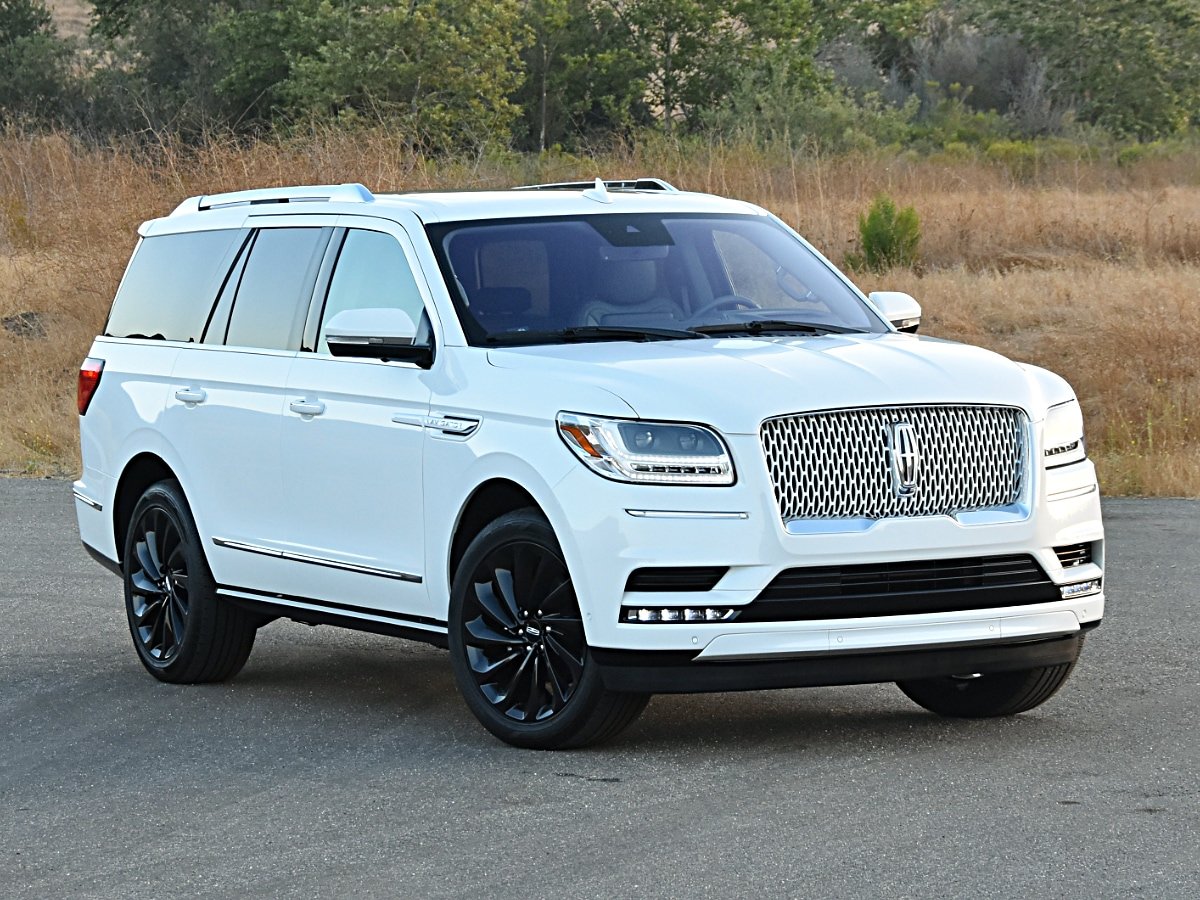
According to CarGurus experts, the overall rating for the 2020 Lincoln Navigator is 8.2 out of 10, while the 2021 Ford Edge scores 7.2 out of 10. Based on these ratings, the 2020 Lincoln Navigator is the recommended choice, offering superior luxury, performance, and comfort.
Choose the 2020 Lincoln Navigator if:
- You prioritize a luxurious and spacious interior with class-leading comfort and cargo space.
- You need a powerful engine with strong towing capabilities and advanced trailer assist technology.
- You value a high level of standard and optional safety features, along with a refined driving experience.


Choose the 2021 Ford Edge if:
- You want a midsize crossover with competitive interior space and headroom.
- You prefer the latest infotainment technology with wireless Apple CarPlay and Android Auto.
- You seek a vehicle with strong safety ratings and a comprehensive suite of standard safety features.


CarGurus highlights
According to CarGurus experts, the overall rating for the 2020 Lincoln Navigator is 8.2 out of 10, while the 2021 Ford Edge scores 7.2 out of 10. Based on these ratings, the 2020 Lincoln Navigator is the recommended choice, offering superior luxury, performance, and comfort.
Choose the 2020 Lincoln Navigator if:
Shop Now- You prioritize a luxurious and spacious interior with class-leading comfort and cargo space.
- You need a powerful engine with strong towing capabilities and advanced trailer assist technology.
- You value a high level of standard and optional safety features, along with a refined driving experience.
Choose the 2021 Ford Edge if:
Shop Now- You want a midsize crossover with competitive interior space and headroom.
- You prefer the latest infotainment technology with wireless Apple CarPlay and Android Auto.
- You seek a vehicle with strong safety ratings and a comprehensive suite of standard safety features.

By: CarGurus + AI
At CarGurus, our team of experienced automotive writers remain at the heart of our content operation, conducting hands-on car tests and writing insightful guides that are backed by years of industry experience. To complement this, we are harnessing AI to make our content offering more diverse and more helpful to shoppers than ever. To achieve this, our AI systems are based exclusively on CarGurus content, ratings and data, so that what we produce is both unique to CarGurus, and uniquely helpful to car shoppers.

