2020 Honda CR-V vs 2020 Ford Edge
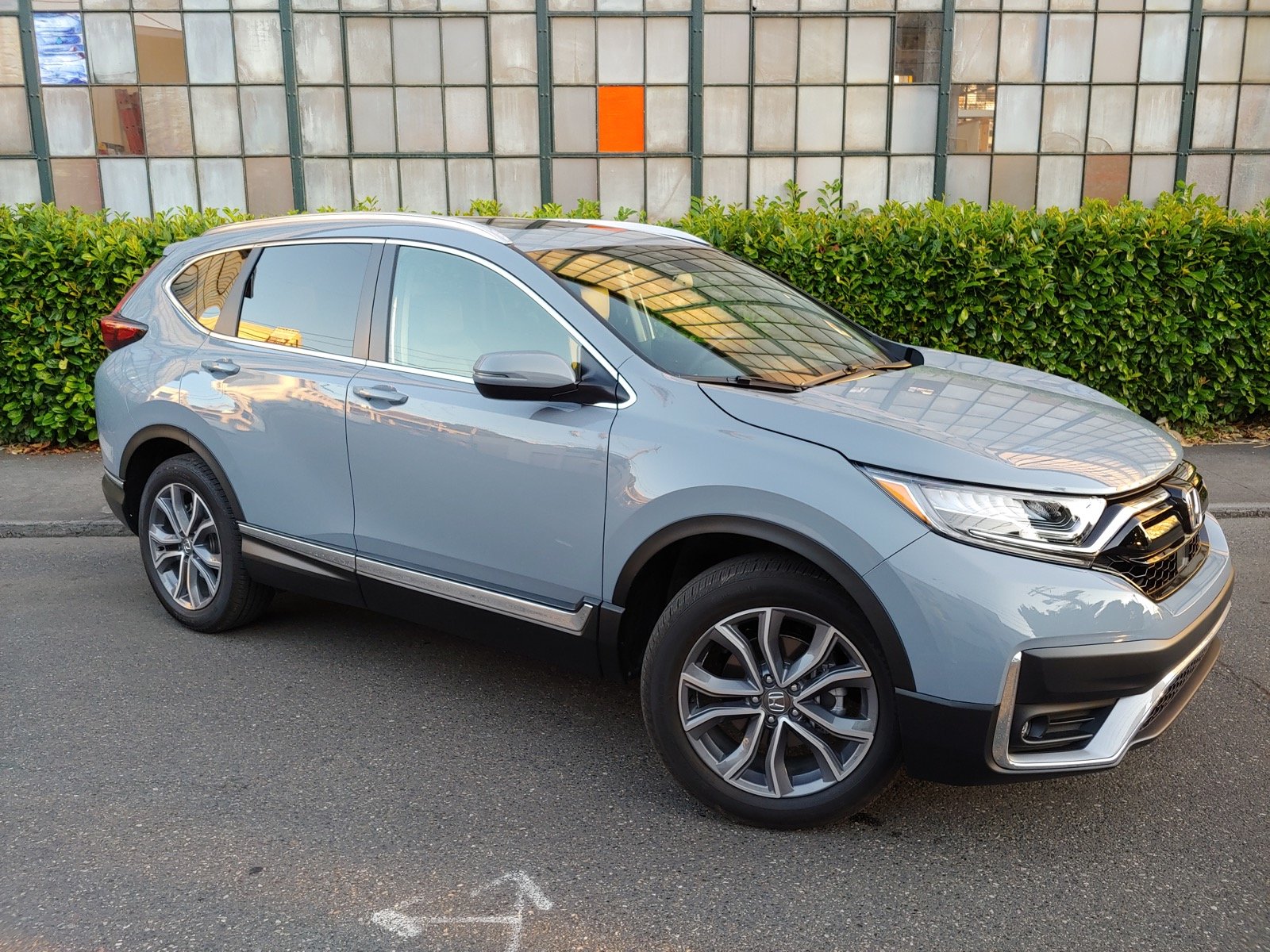
Overview | |
MSRP$31,100 | MSRP$25,150 |
Listings1077 | Listings1508 |
Ratings & Reviews | |
User Reviews | User Reviews |
Expert reviews8.0 out of 10 | Expert reviews7.5 out of 10 |
Pros
Cons
| Pros
Cons
|
2020 Ford Edge Reviews SummaryThe Ford Edge isn’t exactly memorable, which isn’t a bad thing. It isn’t a good thing either. Cars can be remembered for attractive design, fun driving dynamics, or being a solid value. They can also be remembered in a negative light for a polarizing design, poor build quality, or being unsafe to the point of scandal. But the 2020 Ford Edge is just... there. It is a midsize two-row SUV that doesn’t offend, but also doesn’t “wow.” But just as critically, the Edge is getting long in the tooth. In the SUV segment, constant iteration is necessary for survival, and the Edge is in need of a redesign. But in lieu of new blood, Ford has done well to keep the Edge fitted with the latest infotainment and safety technology. It also offers a performance variant, called the Edge ST. This is something that you won’t find in the Edge’s competitors, the Nissan Murano and Honda Passport. But is it enough to keep the Edge relevant against its more contemporary rivals? Read on to find out. | |
2020 Honda CR-V Reviews SummaryHonda’s compact SUV has been satisfying buyers for more than two decades, with more than five million CR-V’s sold. Such a legacy means the CR-V has long had its wrinkles smoothed out into a comfortable and capable crossover package that’s only downside may be its sheer inoffensiveness. This year’s model gets engine and safety upgrades, which improve fuel economy and help to make Honda’s bestseller an even better value. | |
No video found | No video found |
Popular Features & Specs | |
Engine2.0L 250 hp I4 | Engine1.5L 190 hp I4 |
Drive TrainFWD | Drive TrainFWD |
Seating Capacity5 | Seating Capacity5 |
Horsepower250 hp @ 5500 rpm | Horsepower190 hp @ 5600 rpm |
MPG City21 | MPG City28 |
MPG Highway29 | MPG Highway34 |
Engine | |
Engine Name2.0L 250 hp I4 | Engine Name1.5L 190 hp I4 |
Torque280 lb-ft @ 3000 rpm | Torque179 lb-ft @ 2000 rpm |
Horsepower250 hp @ 5500 rpm | Horsepower190 hp @ 5600 rpm |
DrivetrainFWD | DrivetrainFWD |
Fuel Economy | |
MPG City21 | MPG City28 |
MPG Highway29 | MPG Highway34 |
Interior | |
Seating Capacity5 | Seating Capacity5 |
Safety | |
Front Crash Overall5 | Front Crash Overall5 |
Side Crash Overall5 | Side Crash Overall5 |
Dimensions & Capacity | |
Cargo Space39.2 cu ft | Cargo Space39.2 cu ft |
Curb Weight4027 lbs | Curb Weight3337 lbs |
Height68.3 in | Height66.1 in |
Length188.8 in | Length182.1 in |
Width85.8 in | Width73.0 in |
Wheelbase112.2 in | Wheelbase104.8 in |
Maximum Payload1243 lbs | Maximum Payload1358 lbs |
Number of doors4 | Number of doors4 |
Maximum Towing Capacity1500 lbs | Maximum Towing Capacity1500 lbs |
Overview | ||
MSRP | $31,100 | $25,150 |
Listings | ||
Ratings & Reviews | ||
User reviews | ||
Expert reviews | 8.0 out of 10Read full review | 7.5 out of 10Read full review |
Pros & cons | Pros
Cons
| Pros
Cons
|
Summary | The Ford Edge isn’t exactly memorable, which isn’t a bad thing. It isn’t a good thing either. Cars can be remembered for attractive design, fun driving dynamics, or being a solid value. They can also be remembered in a negative light for a polarizing design, poor build quality, or being unsafe to the point of scandal. But the 2020 Ford Edge is just... there. It is a midsize two-row SUV that doesn’t offend, but also doesn’t “wow.” But just as critically, the Edge is getting long in the tooth. In the SUV segment, constant iteration is necessary for survival, and the Edge is in need of a redesign. But in lieu of new blood, Ford has done well to keep the Edge fitted with the latest infotainment and safety technology. It also offers a performance variant, called the Edge ST. This is something that you won’t find in the Edge’s competitors, the Nissan Murano and Honda Passport. But is it enough to keep the Edge relevant against its more contemporary rivals? Read on to find out. | Honda’s compact SUV has been satisfying buyers for more than two decades, with more than five million CR-V’s sold. Such a legacy means the CR-V has long had its wrinkles smoothed out into a comfortable and capable crossover package that’s only downside may be its sheer inoffensiveness. This year’s model gets engine and safety upgrades, which improve fuel economy and help to make Honda’s bestseller an even better value. |
Video | No video found | No video found |
Popular Features & Specs | ||
Engine | 2.0L 250 hp I4 | 1.5L 190 hp I4 |
Drive Train | FWD | FWD |
Seating Capacity | 5 | 5 |
Horsepower | 250 hp @ 5500 rpm | 190 hp @ 5600 rpm |
MPG City | 21 | 28 |
MPG Highway | 29 | 34 |
Engine | ||
Engine Name | 2.0L 250 hp I4 | 1.5L 190 hp I4 |
Torque | 280 lb-ft @ 3000 rpm | 179 lb-ft @ 2000 rpm |
Horsepower | 250 hp @ 5500 rpm | 190 hp @ 5600 rpm |
Drivetrain | FWD | FWD |
Fuel Economy | ||
MPG City | 21 | 28 |
MPG Highway | 29 | 34 |
Interior | ||
Seating Capacity | 5 | 5 |
Safety | ||
Front Crash Overall | 5 | 5 |
Side Crash Overall | 5 | 5 |
Dimensions & Capacity | ||
Cargo Space | 39.2 cu ft | 39.2 cu ft |
Curb Weight | 4027 lbs | 3337 lbs |
Height | 68.3 in | 66.1 in |
Length | 188.8 in | 182.1 in |
Width | 85.8 in | 73.0 in |
Wheelbase | 112.2 in | 104.8 in |
Maximum Payload | 1243 lbs | 1358 lbs |
Number of doors | 4 | 4 |
Maximum Towing Capacity | 1500 lbs | 1500 lbs |
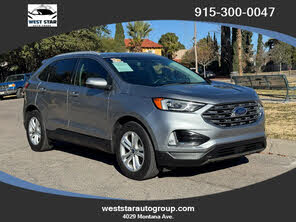
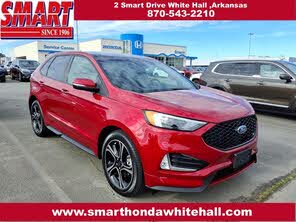
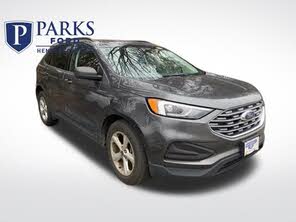
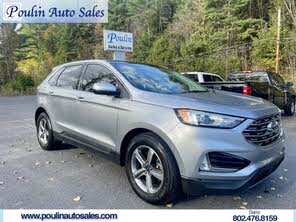
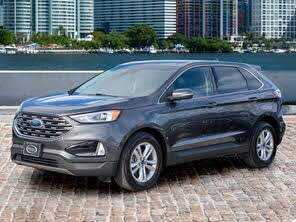
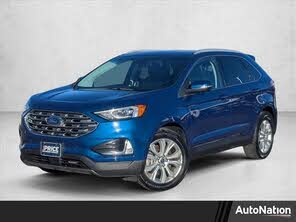
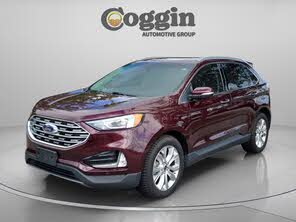
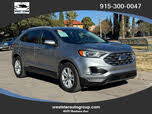
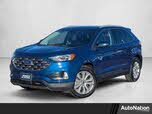
For the 2020 Ford Edge, Ford stuck to a familiar formula, offering a mix of space and a car-like ride based on the Ford Fusion sedan platform. The second generation, arriving in the 2015 model year, received a notable styling update in 2019, which carried over to 2020, ensuring the Edge still looked fresh. The 2019 facelift gave the Edge a contemporary touch, resembling a crossover version of the Fusion with angular headlights and a large trapezoidal grille. However, the interior showed signs of aging with the same overall layout since 2015 and subtle updates from 2019. Small, awkwardly arranged climate and radio controls marked the center console, while the rotary shifter was a modernistic solution that freed up space. The cabin had a mix of soft-touch materials and hard plastics, which slightly diminished the overall quality feel.
The Edge offered four trims: SE, SEL, Titanium, and ST, each with an impressive array of features. The SE trim came with a 10-way power-adjustable driver’s seat, satellite radio, WiFi hotspot, two USB ports, remote keyless entry, and Ford’s SYNC 3 infotainment system, including Apple CarPlay, Android Auto, Bluetooth, and Amazon Alexa. The SEL added LED fog lights, heated side mirrors, 18-inch aluminum wheels, synthetic leather upholstery, heated front seats and more. The Titanium trim featured 19-inch wheels, unique headlights, genuine leather upholstery, a 10-way power-adjustable passenger seat, and premium audio by Bang & Olufsen. Lastly, the ST trim was the performance variant, sporting a powerful engine, standard all-wheel drive (AWD), and sportier styling.
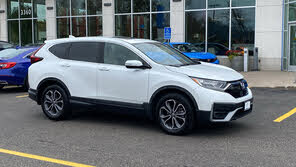
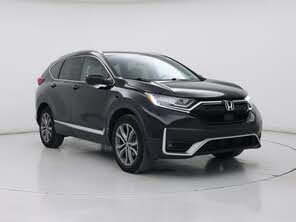
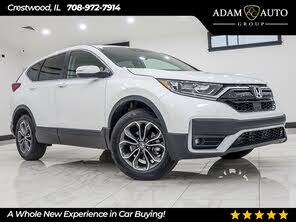
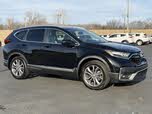
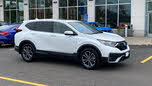
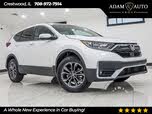
In contrast, the 2020 Honda CR-V flaunted its fifth-generation design, familiar and fun. Honda's approach was always to offer curvy and car-like lines, akin to their sedan lineup, and this design ethos made the CR-V more station wagon-like. Its external look set a paradigm for modern family transportation. Inside, however, opinions were mixed. The mishmash of textures and materials, such as wood-look trim and leather upholstery in pricier models, clashed with low-quality plastics, reminding drivers that an upgraded CR-V was still rooted in an economy car.
The CR-V offered four trims: LX, EX, EX-L, and Touring, all underpinned by simplicity, reflecting Honda's ethos. Prices began at $26,270 for the LX, with FWD standard and AWD as a $1,500 option on all trims. Noteworthy features included 17-inch alloy wheels standard on the LX, with larger wheels reserved for higher trims. Fabric seating was standard on the lower trims, with real leather available on higher models, while a retractable moonroof was added starting from the EX trim. The top-of-the-line Touring model featured roof rails and more upscale touches.


The 2020 Ford Edge's base engine was a 2.0-liter turbocharged four-cylinder making 250 horsepower and 275 pound-feet of torque, paired with an eight-speed automatic transmission. Available in both front-wheel and all-wheel drive, this engine excelled at low-end acceleration, suitable for city driving. However, it struggled slightly at higher speeds, though it remained adequate for highway merging. The Edge's suspension was tailored for American roads, adeptly absorbing potholes while providing a refined and engaging ride.
The Ford Edge ST was the performance variant with a 2.7-liter EcoBoost V6 engine delivering 335 horsepower and 380 pound-feet of torque, coupled with an eight-speed automatic transmission and standard AWD. The ST excelled at higher speeds, offering robust power, heavy steering, and excellent cornering capabilities. A Sport mode button further enhanced throttle response and transmission mapping, providing a dynamic driving experience.
Conversely, the 2020 Honda CR-V replaced its old base engine with a 1.5-liter turbocharged four-cylinder across all trims, previously exclusive to higher trims. This engine produced 190 horsepower and 179 pound-feet of torque, paired with a continuously variable automatic transmission (CVT). The engine was well-matched to the CR-V, providing quick acceleration, especially in Sport mode. Honda's engineers effectively mitigated the sluggishness typical of CVTs, ensuring a more conventional driving feel.
The CR-V's handling was akin to a small sedan, with a well-weighted steering feel, nimble handling, and minimal body roll. Its low curb weight of 3,337 pounds for the FWD LX model contributed to its lively performance and superior fuel economy. The FWD models achieved an EPA rating of 30 mpg combined, while the AWD versions managed 29 mpg combined. Additionally, the CR-V Hybrid was introduced for 2020, competing with hybrid versions of the RAV4 and Escape.
The 2020 Ford Edge boasted impressive interior space, with a layout designed for comfort and utility. The high seating position provided a commanding view of the road, while the array of cubbies and compartments ensured plenty of storage space. The second-row seats offered ample head- and legroom without compromising front-seat comfort. The cargo capacity was substantial, with 39.2 cubic feet of space behind the rear seats, expanding to 73.4 cubic feet with the 60/40 split rear seats folded down. This capacity was more than the Jeep Grand Cherokee and Nissan Murano, though slightly less than the Honda Passport. Higher trims like the SEL and Titanium also came with a hands-free foot-activated power liftgate.
The 2020 Honda CR-V demonstrated Honda's mastery in packaging, with a spacious cabin rivaling that of the Volkswagen Tiguan. It offered excellent head- and legroom for both front and rear passengers. Its thoughtful seating position maximized visibility and comfort. The cargo area was generous, matching the Tiguan’s volume despite being three inches shorter. The CR-V featured clever storage solutions, such as a deep center console inspired by the Odyssey minivan and a versatile two-position load floor, enabling a flat floor with seats folded for a total of 75.8 cubic feet of cargo space. Even the door pockets were designed for extra storage, making the CR-V practical and easy to live with.
The 2020 Ford Edge excelled in standard technology, with Ford's SYNC 3 infotainment system available in all trims. The 8-inch touchscreen interface was user-friendly, featuring icons for audio, phone, navigation (optional on SEL and ST, standard on Titanium), apps, and settings. The inclusion of Apple CarPlay and Android Auto integration negated the necessity for built-in navigation, although a voice-activated navigation system with real-time traffic updates was available. The Edge also offered two smart-charging USB ports and an optional dual rear-seat entertainment system.
In contrast, the 2020 Honda CR-V’s infotainment was a weak point. The base LX trim came with a 5-inch screen, offering minimal features like Bluetooth and Pandora compatibility. Higher trims got a 7-inch touchscreen, which seemed inadequate compared to competitors' larger screens. The system lacked hard buttons, relying on touchscreen commands, making it less intuitive. Apple CarPlay and Android Auto were only available on higher trims, and even then, they felt poorly integrated. The Touring trim introduced a wireless phone charger, but overall, the CR-V's infotainment lagged behind its peers.
The 2020 Ford Edge offered a comprehensive safety package, including front and side-impact airbags, AdvanceTrac traction control with Roll Stability Control, Curve Control, tire pressure monitoring, and a child seat anchoring system. The Ford Co-Pilot360 safety suite came standard, featuring automatic emergency braking with pedestrian detection, forward collision warning, lane departure warning, blind-spot monitoring with rear cross-traffic alert, and automatic high beams. The SEL trim and above could upgrade to Co-Pilot360 Assist+, adding adaptive cruise control and active lane centering for semi-autonomous driving capabilities. The Edge received a "Top Safety Pick" rating from the IIHS and a five-star overall rating from the NHTSA.
The 2020 Honda CR-V also came with robust safety features. The Honda Sensing suite was standard across all trims, offering forward-collision warning with automatic emergency braking, pedestrian detection, road-departure mitigation, adaptive cruise control with lane-keeping assist, and automatic high beams. EX trims and above added blind-spot monitoring and cross-traffic monitoring. The CR-V earned a five-star rating from the NHTSA and a Top Safety Pick designation from the IIHS, though lower trims received marginal headlight ratings. Additionally, a recall for a possible rear subframe failure affected some 2020 models.
CarGurus highlights

According to CarGurus experts, the overall rating for the 2020 Ford Edge is 8.0 out of 10, while the 2020 Honda CR-V scores 7.5 out of 10. Based on these ratings, if you prioritize a well-rounded driving experience, advanced technology, and impressive safety features, the 2020 Ford Edge emerges as the superior choice. It offers a balanced mix of performance, comfort, and modern amenities, making it a compelling option for those in the market for a midsize SUV.
Choose the 2020 Honda CR-V if:
- You value excellent fuel economy and a refined, car-like driving experience.
- You need a practical interior with versatile storage solutions and competitive cargo capacity.
- You want comprehensive safety features as standard across all trim levels, including adaptive cruise control and lane-keeping assist.



Choose the 2020 Ford Edge if:
- You prioritize a powerful and engaging performance, especially with the Edge ST variant.
- You prefer a user-friendly and well-integrated infotainment system with standard Apple CarPlay and Android Auto.
- You seek a spacious, comfortable interior with convenient storage solutions and substantial cargo capacity.


CarGurus highlights
According to CarGurus experts, the overall rating for the 2020 Ford Edge is 8.0 out of 10, while the 2020 Honda CR-V scores 7.5 out of 10. Based on these ratings, if you prioritize a well-rounded driving experience, advanced technology, and impressive safety features, the 2020 Ford Edge emerges as the superior choice. It offers a balanced mix of performance, comfort, and modern amenities, making it a compelling option for those in the market for a midsize SUV.
Choose the 2020 Honda CR-V if:
Shop Now- You value excellent fuel economy and a refined, car-like driving experience.
- You need a practical interior with versatile storage solutions and competitive cargo capacity.
- You want comprehensive safety features as standard across all trim levels, including adaptive cruise control and lane-keeping assist.





Choose the 2020 Ford Edge if:
Shop Now- You prioritize a powerful and engaging performance, especially with the Edge ST variant.
- You prefer a user-friendly and well-integrated infotainment system with standard Apple CarPlay and Android Auto.
- You seek a spacious, comfortable interior with convenient storage solutions and substantial cargo capacity.








By: CarGurus + AI
At CarGurus, our team of experienced automotive writers remain at the heart of our content operation, conducting hands-on car tests and writing insightful guides that are backed by years of industry experience. To complement this, we are harnessing AI to make our content offering more diverse and more helpful to shoppers than ever. To achieve this, our AI systems are based exclusively on CarGurus content, ratings and data, so that what we produce is both unique to CarGurus, and uniquely helpful to car shoppers.