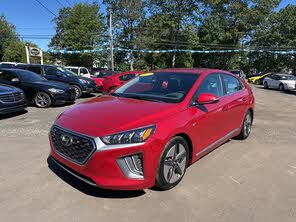
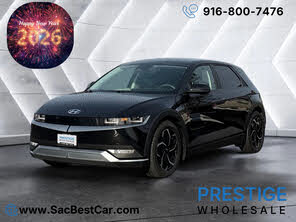
Hyundai Ioniq Hybrid vs Hyundai Ioniq 5


Overview | |
Years produced2017-2023 | Years produced2022-Present |
MSRP$22,400 | MSRP$42,600 |
Listings250 | Listings9451 |
Ratings & Reviews | |
User Reviews | User Reviews |
Expert reviews8.3 out of 10 | Expert reviews8.7 out of 10 |
Pros
Cons
| |
Reviews SummaryI love spikes in gas prices. Seriously. My Southern California neighborhood gets quiet because all the people with loud motorcycles and fast muscle cars and giant trucks with oversized mud tires stop driving like they’ve got something to prove. When gas prices begin to climb, they'd all be well-served by trading in their gas-guzzlers for a 2019 Hyundai Ioniq Hybrid. When it whirs about in electric vehicle mode, the Ioniq even sounds cool. My second-grader said so. | |
Reviews SummaryIt would appear to be the calendar, not the competition, that has the Ioniq 5 due for a mid-cycle refresh. We liked it when it burst onto the scene as an angular oddball in a sea of soft-lined sameness, and it has only improved over the last few years. Verdict: Hyundai makes minor but welcome changes and avoids tweaking the many things that were working well, successfully making a good thing better. | |
No video found | |
Popular Features & Specs | |
Engine1.6L 139 hp I4 Hybrid | Engine168 hp Electric |
Drive TrainFWD | Drive TrainRWD |
Seating Capacity5 | Seating Capacity5 |
EV Battery Capacity1.6 kWh | EV Battery Capacity63 kWh |
MPG City57 | MPG City131 |
MPG Highway59 | MPG Highway100 |
Battery Charge Time (120V) | Battery Charge Time (120V)54 hours |
Battery Charge Time (240V) | Battery Charge Time (240V)5.7 hours |
Engine | |
Engine Name1.6L 139 hp I4 Hybrid | Engine Name168 hp Electric |
Battery Charge Time (120V) | Battery Charge Time (120V)54 hours |
Battery Charge Time (240V) | Battery Charge Time (240V)5.7 hours |
DrivetrainFWD | DrivetrainRWD |
Fuel Economy | |
EV Battery Capacity1.6 kWh | EV Battery Capacity63 kWh |
MPG City57 | MPG City131 |
MPG Highway59 | MPG Highway100 |
Interior | |
Seating Capacity5 | Seating Capacity5 |
Key Features | |
Navigation System | Navigation SystemStandard |
Dimensions & Capacity | |
Cargo Space26.5 cu ft | Cargo Space26.3 cu ft |
Curb Weight2996 lbs | Curb Weight4144 lbs |
Height56.9 in | Height63.0 in |
Length176.0 in | Length183.3 in |
Width71.7 in | Width74.4 in |
Wheelbase106.3 in | Wheelbase118.1 in |
Maximum Payload939 lbs | Maximum Payload1081 lbs |
Number of doors4 | Number of doors4 |
Overview | ||
Years produced | 2017-2023 | 2022-Present |
MSRP | $22,400 | $42,600 |
Listings | ||
Ratings & Reviews | ||
User reviews | ||
Expert reviews | 8.3 out of 10Read full review | 8.7 out of 10Read full review |
Pros & cons | Pros
Cons
| |
Summary | I love spikes in gas prices. Seriously. My Southern California neighborhood gets quiet because all the people with loud motorcycles and fast muscle cars and giant trucks with oversized mud tires stop driving like they’ve got something to prove. When gas prices begin to climb, they'd all be well-served by trading in their gas-guzzlers for a 2019 Hyundai Ioniq Hybrid. When it whirs about in electric vehicle mode, the Ioniq even sounds cool. My second-grader said so. | It would appear to be the calendar, not the competition, that has the Ioniq 5 due for a mid-cycle refresh. We liked it when it burst onto the scene as an angular oddball in a sea of soft-lined sameness, and it has only improved over the last few years. Verdict: Hyundai makes minor but welcome changes and avoids tweaking the many things that were working well, successfully making a good thing better. |
Video | No video found | |
Popular Features & Specs | ||
Engine | 1.6L 139 hp I4 Hybrid | 168 hp Electric |
Drive Train | FWD | RWD |
Seating Capacity | 5 | 5 |
EV Battery Capacity | 1.6 kWh | 63 kWh |
MPG City | 57 | 131 |
MPG Highway | 59 | 100 |
Battery Charge Time (120V) | 54 hours | |
Battery Charge Time (240V) | 5.7 hours | |
Engine | ||
Engine Name | 1.6L 139 hp I4 Hybrid | 168 hp Electric |
Battery Charge Time (120V) | 54 hours | |
Battery Charge Time (240V) | 5.7 hours | |
Drivetrain | FWD | RWD |
Fuel Economy | ||
EV Battery Capacity | 1.6 kWh | 63 kWh |
MPG City | 57 | 131 |
MPG Highway | 59 | 100 |
Interior | ||
Seating Capacity | 5 | 5 |
Key Features | ||
Navigation System | Standard | |
Dimensions & Capacity | ||
Cargo Space | 26.5 cu ft | 26.3 cu ft |
Curb Weight | 2996 lbs | 4144 lbs |
Height | 56.9 in | 63.0 in |
Length | 176.0 in | 183.3 in |
Width | 71.7 in | 74.4 in |
Wheelbase | 106.3 in | 118.1 in |
Maximum Payload | 939 lbs | 1081 lbs |
Number of doors | 4 | 4 |











By: CarGurus + AI
At CarGurus, our team of experienced automotive writers remain at the heart of our content operation, conducting hands-on car tests and writing insightful guides that are backed by years of industry experience. To complement this, we are harnessing AI to make our content offering more diverse and more helpful to shoppers than ever. To achieve this, our AI systems are based exclusively on CarGurus content, ratings and data, so that what we produce is both unique to CarGurus, and uniquely helpful to car shoppers.