2020 Ford Explorer vs 2021 Hyundai Venue
Overview | |
MSRP$32,765 | MSRP$18,750 |
Listings3069 | Listings168 |
Ratings & Reviews | |
User Reviews | User Reviews |
Expert reviews7.2 out of 10 | Expert reviews7.3 out of 10 |
Pros
Cons
| Pros
Cons
|
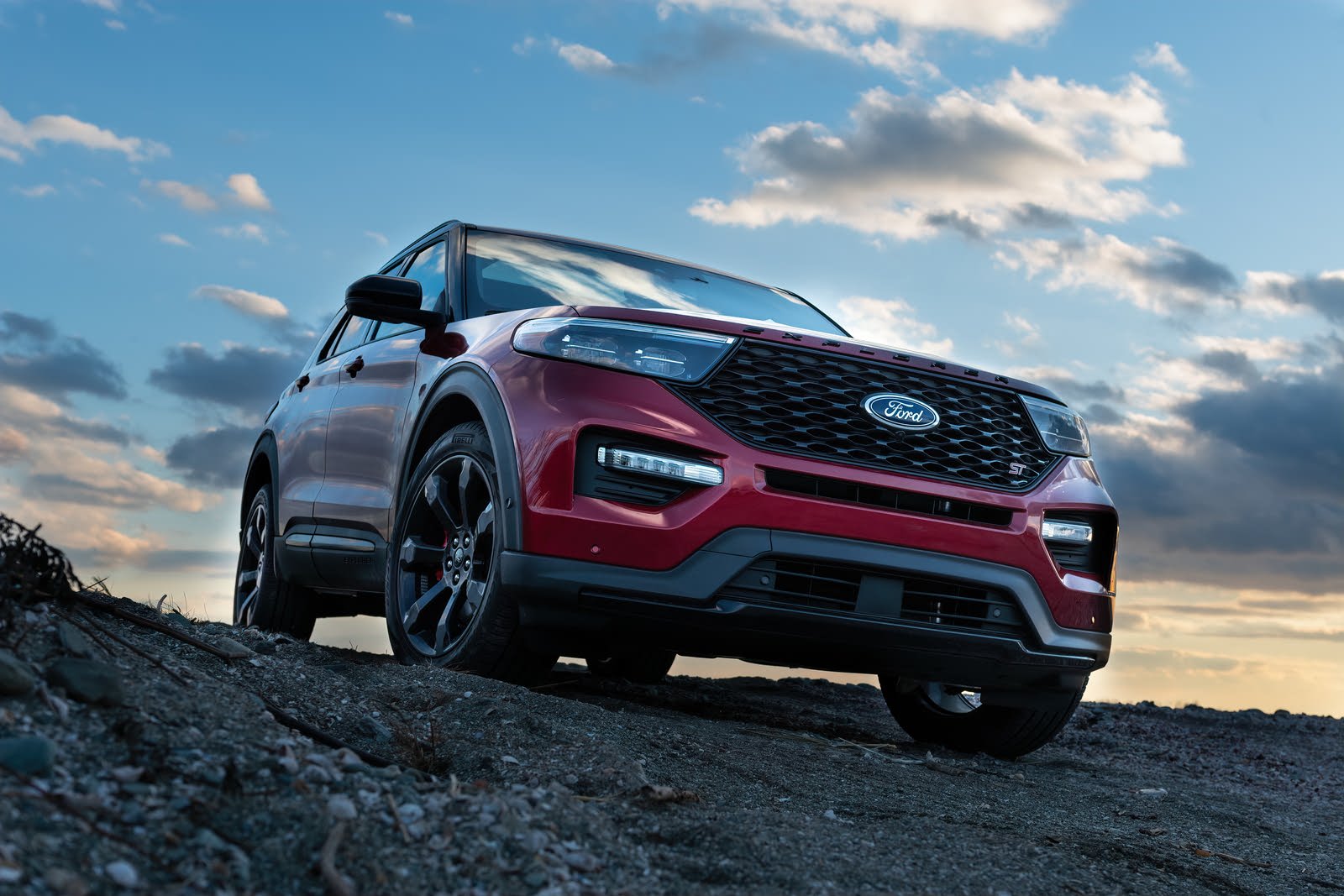
2020 Ford Explorer Reviews SummaryFor nearly 30 years, the Ford Explorer has settled into the American lexicon like Cheerios. We've gobbled up millions of them, from the rock-crawling Eddie Bauers of the 1990s to the brand-new ST that can take down sports cars. The 2020 Explorer brings an all-new chassis, cranks up the technology, and introduces hybrid and high-performance powertrains in a space the size of a small living room. The Explorer's also getting very expensive while other automakers catch on to Ford's winning formula—for a lot less money. | |
2021 Hyundai Venue Reviews SummaryThis is the future of basic transportation. Shoppers are shifting from sedans and hatchbacks to crossovers and SUVs, but the bigger the car, the bigger the price tag. Enter the Hyundai Venue. Roughly the same shape as a typical crossover, but impossibly small, the Venue offers the look and feel of a crossover while maintaining the footprint (and, very nearly, the price) of a hatchback. | |
Popular Features & Specs | |
Engine2.3L 300 hp I4 | Engine1.6L 121 hp I4 |
Drive TrainRWD | Drive TrainFWD |
Seating Capacity7 | Seating Capacity5 |
Horsepower | Horsepower121 hp @ 6300 rpm |
MPG City21 | MPG City30 |
MPG Highway28 | MPG Highway33 |
Engine | |
Engine Name2.3L 300 hp I4 | Engine Name1.6L 121 hp I4 |
Torque | Torque113 lb-ft @ 4500 rpm |
Horsepower | Horsepower121 hp @ 6300 rpm |
DrivetrainRWD | DrivetrainFWD |
Fuel Economy | |
MPG City21 | MPG City30 |
MPG Highway28 | MPG Highway33 |
Interior | |
Seating Capacity7 | Seating Capacity5 |
Safety | |
Front Crash Overall5 | Front Crash Overall4 |
Side Crash Overall5 | Side Crash Overall5 |
Dimensions & Capacity | |
Cargo Space18.2 cu ft | Cargo Space18.7 cu ft |
Curb Weight4345 lbs | Curb Weight2612 lbs |
Height69.9 in | Height61.6 in |
Length198.8 in | Length159.0 in |
Width89.3 in | Width69.7 in |
Wheelbase119.1 in | Wheelbase99.2 in |
Maximum Payload1425 lbs | Maximum Payload1158 lbs |
Number of doors4 | Number of doors4 |
Maximum Towing Capacity5300 lbs | Maximum Towing Capacity |
Overview | ||
MSRP | $32,765 | $18,750 |
Listings | ||
Ratings & Reviews | ||
User reviews | ||
Expert reviews | 7.2 out of 10Read full review | 7.3 out of 10Read full review |
Pros & cons | Pros
Cons
| Pros
Cons
|
Summary | For nearly 30 years, the Ford Explorer has settled into the American lexicon like Cheerios. We've gobbled up millions of them, from the rock-crawling Eddie Bauers of the 1990s to the brand-new ST that can take down sports cars. The 2020 Explorer brings an all-new chassis, cranks up the technology, and introduces hybrid and high-performance powertrains in a space the size of a small living room. The Explorer's also getting very expensive while other automakers catch on to Ford's winning formula—for a lot less money. | This is the future of basic transportation. Shoppers are shifting from sedans and hatchbacks to crossovers and SUVs, but the bigger the car, the bigger the price tag. Enter the Hyundai Venue. Roughly the same shape as a typical crossover, but impossibly small, the Venue offers the look and feel of a crossover while maintaining the footprint (and, very nearly, the price) of a hatchback. |
Video | ||
Popular Features & Specs | ||
Engine | 2.3L 300 hp I4 | 1.6L 121 hp I4 |
Drive Train | RWD | FWD |
Seating Capacity | 7 | 5 |
Horsepower | 121 hp @ 6300 rpm | |
MPG City | 21 | 30 |
MPG Highway | 28 | 33 |
Engine | ||
Engine Name | 2.3L 300 hp I4 | 1.6L 121 hp I4 |
Torque | 113 lb-ft @ 4500 rpm | |
Horsepower | 121 hp @ 6300 rpm | |
Drivetrain | RWD | FWD |
Fuel Economy | ||
MPG City | 21 | 30 |
MPG Highway | 28 | 33 |
Interior | ||
Seating Capacity | 7 | 5 |
Safety | ||
Front Crash Overall | 5 | 4 |
Side Crash Overall | 5 | 5 |
Dimensions & Capacity | ||
Cargo Space | 18.2 cu ft | 18.7 cu ft |
Curb Weight | 4345 lbs | 2612 lbs |
Height | 69.9 in | 61.6 in |
Length | 198.8 in | 159.0 in |
Width | 89.3 in | 69.7 in |
Wheelbase | 119.1 in | 99.2 in |
Maximum Payload | 1425 lbs | 1158 lbs |
Number of doors | 4 | 4 |
Maximum Towing Capacity | 5300 lbs | |
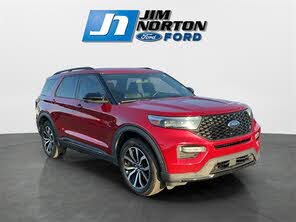
The 2020 Ford Explorer was a striking vehicle, boasting a more refined and athletic design compared to its predecessors. Its widened headlights, large grille, and distinctive "Explorer" lettering on the hood gave it a recognizable and handsome appearance. The ST version, with its black 21-inch rims and quad exhaust pipes, was particularly eye-catching. However, the interior left much to be desired, with materials that felt subpar for its price range. Despite its high cost, the Explorer's interior was criticized for its use of low-grade vinyl and hard plastics, making it less appealing compared to competitors like the Kia Telluride and Toyota Highlander.
In contrast, the 2021 Hyundai Venue was praised for its timeless and stylish design. Its upright stance, horizontal roofline, and steep tailgate gave it a unique look that defied its small size. The Venue's grille was well-proportioned, and its split headlights and patterned taillights added to its charm. The Denim trim, with its white roof and unique paint job, was particularly attractive. Inside, the Venue offered a modern look despite its budget-friendly materials. While plastic was prevalent, the cabin felt airy and bright, thanks to its large windows and thin A-pillars. The Venue's interior was functional and stylish, making it a strong contender in its segment.


The 2020 Ford Explorer offered a range of powerful engines, with the ST trim featuring a 3.0-liter twin-turbo V6 producing 400 horsepower and 415 pound-feet of torque. This engine, paired with a 10-speed automatic transmission, delivered smooth and addictive power. The Explorer's rear-wheel-drive chassis provided excellent weight distribution, enhancing its handling and ride quality. The Explorer also offered a 2.3-liter turbo inline-four engine with 300 horsepower and a hybrid option with a net 318 horsepower. Towing capacity varied, with the V6 AWD model capable of towing up to 5,600 pounds. The Explorer's seven drive modes allowed for versatile performance across different terrains.
The 2021 Hyundai Venue, on the other hand, was equipped with a 1.6-liter four-cylinder engine producing 121 horsepower and 113 pound-feet of torque. This engine, paired with a continuously variable automatic transmission, provided adequate performance for its size. The Venue's front-wheel-drive setup and lightweight design made it nimble in urban settings, though it lacked the power for more spirited driving. The Venue's performance was comparable to competitors like the Nissan Kicks and Ford EcoSport, but it did not offer the same level of excitement as the Explorer.
The 2020 Ford Explorer excelled in interior space, offering ample room for passengers and cargo. The second row felt luxurious with air vents, USB ports, and a panoramic moonroof. The third row was more spacious than previous models, accommodating six-foot-tall adults for short trips. Cargo space was generous, with 18 cubic feet behind the third row, 48 cubic feet behind the second row, and 88 cubic feet with all seats folded. The Explorer's physical controls were intuitive, though visibility was hindered by thick D-pillars and fuzzy cameras.
The 2021 Hyundai Venue provided decent front-seat space, with ample headroom and legroom. Storage options were limited but functional, with trays for small items and a compact center console. The back seat was tighter, suitable for short trips, and cargo space was limited to 18.7 cubic feet with the seats up and 31.9 cubic feet with them down. The Venue's cargo capacity lagged behind competitors, but its hatchback design offered some versatility.
The 2020 Ford Explorer came standard with an 8-inch touchscreen featuring Sync 3 infotainment, Apple CarPlay, Android Auto, and 4G WiFi. Higher trims offered a 10-inch vertical touchscreen and a 12-inch digital instrument cluster. While the interface was high-resolution and well-organized, it lacked customization options and felt unfinished. The Co-Pilot360 Assist+ system offered semi-automated driving features but was not as refined as competitors.
The 2021 Hyundai Venue impressed with its tech offerings, featuring an 8-inch touchscreen with high resolution and responsive swipe functionality. Physical buttons provided easy access to media and settings, and the interface was designed for simplicity. The Venue's infotainment system included Bluetooth, Apple CarPlay, and Android Auto, with future updates promising wireless CarPlay for the base model. The Venue's tech was user-friendly and well-integrated, making it a standout feature.
The 2020 Ford Explorer came with Ford Co-Pilot 360, which included forward emergency braking, blind-spot monitoring, auto high beams, and lane-keep assist. The Assist+ option added adaptive cruise control and reverse braking, though it was prone to false activations. The Explorer received an Acceptable rating in the IIHS small overlap test on the driver's side.
The 2021 Hyundai Venue offered a comprehensive suite of safety features, including automatic emergency braking, lane-keeping assist, and driver-attention warning. Higher trims added blind-spot monitoring and rear cross-traffic alert. The Venue's safety systems were well-integrated and unobtrusive. In crash tests, the Venue received four out of five stars from the NHTSA for front collision and rollover.
CarGurus highlights

According to CarGurus experts, the overall rating for the 2020 Ford Explorer is 7.2 out of 10, while the 2021 Hyundai Venue scores 7.3 out of 10. Based on these ratings, the Hyundai Venue is the recommended choice, offering a better balance of style, technology, and value for its price.
Choose the 2020 Ford Explorer if:
- You prioritize powerful engine options and towing capacity.
- You need ample interior space for passengers and cargo.
- You value a rear-wheel-drive chassis for better handling.






Choose the 2021 Hyundai Venue if:
- You want a stylish and modern design in a compact package.
- You seek a budget-friendly vehicle with excellent tech features.
- You prefer a nimble and efficient car for urban driving.



CarGurus highlights
According to CarGurus experts, the overall rating for the 2020 Ford Explorer is 7.2 out of 10, while the 2021 Hyundai Venue scores 7.3 out of 10. Based on these ratings, the Hyundai Venue is the recommended choice, offering a better balance of style, technology, and value for its price.
Choose the 2020 Ford Explorer if:
Shop Now- You prioritize powerful engine options and towing capacity.
- You need ample interior space for passengers and cargo.
- You value a rear-wheel-drive chassis for better handling.










Choose the 2021 Hyundai Venue if:
Shop Now- You want a stylish and modern design in a compact package.
- You seek a budget-friendly vehicle with excellent tech features.
- You prefer a nimble and efficient car for urban driving.











By: CarGurus + AI
At CarGurus, our team of experienced automotive writers remain at the heart of our content operation, conducting hands-on car tests and writing insightful guides that are backed by years of industry experience. To complement this, we are harnessing AI to make our content offering more diverse and more helpful to shoppers than ever. To achieve this, our AI systems are based exclusively on CarGurus content, ratings and data, so that what we produce is both unique to CarGurus, and uniquely helpful to car shoppers.