2020 Ford Explorer vs 2020 Land Rover Range Rover Sport

Overview | |
MSRP$32,765 | MSRP$68,650 |
Listings3084 | Listings391 |
Ratings & Reviews | |
User Reviews | User Reviews |
Expert reviews7.2 out of 10 | Expert reviews6.7 out of 10 |
Pros
Cons
| Pros
Cons
|
2020 Ford Explorer Reviews SummaryFor nearly 30 years, the Ford Explorer has settled into the American lexicon like Cheerios. We've gobbled up millions of them, from the rock-crawling Eddie Bauers of the 1990s to the brand-new ST that can take down sports cars. The 2020 Explorer brings an all-new chassis, cranks up the technology, and introduces hybrid and high-performance powertrains in a space the size of a small living room. The Explorer's also getting very expensive while other automakers catch on to Ford's winning formula—for a lot less money. | |
2020 Land Rover Range Rover Sport Reviews SummaryWhen you think of a plug-in hybrid electric vehicle (PHEV), the image of a dorky little hatchback car probably pops into your mind. The new 2020 Land Rover Range Rover Sport PHEV, however, is an entirely different kind of electrified vehicle. Land Rover says it retains all of its traditional land-roving capabilities while delivering greater efficiency. Based on our week-long test in this SUV’s natural habitat (the swanky suburbs of a big city), it does get remarkably good fuel economy. | |
Popular Features & Specs | |
Engine2.3L 300 hp I4 | Engine3.0L 355 hp I6 |
Drive TrainRWD | Drive TrainAWD |
Seating Capacity7 | Seating Capacity7 |
Horsepower | Horsepower355 hp @ 5500 rpm |
EV Battery Capacity | EV Battery Capacity0.2 kWh |
MPG City21 | MPG City19 |
MPG Highway28 | MPG Highway24 |
Engine | |
Engine Name2.3L 300 hp I4 | Engine Name3.0L 355 hp I6 |
Torque | Torque365 lb-ft @ 2000 rpm |
Horsepower | Horsepower355 hp @ 5500 rpm |
DrivetrainRWD | DrivetrainAWD |
Fuel Economy | |
EV Battery Capacity | EV Battery Capacity0.2 kWh |
MPG City21 | MPG City19 |
MPG Highway28 | MPG Highway24 |
Interior | |
Leather Seats | Leather SeatsStandard |
Seating Capacity7 | Seating Capacity7 |
Key Features | |
Navigation System | Navigation SystemStandard |
Safety | |
Front Crash Overall5 | Front Crash Overall |
Side Crash Overall5 | Side Crash Overall |
Dimensions & Capacity | |
Cargo Space18.2 cu ft | Cargo Space27.5 cu ft |
Curb Weight4345 lbs | Curb Weight4870 lbs |
Height69.9 in | Height71.0 in |
Length198.8 in | Length192.1 in |
Width89.3 in | Width87.4 in |
Wheelbase119.1 in | Wheelbase115.1 in |
Maximum Payload1425 lbs | Maximum Payload1850 lbs |
Number of doors4 | Number of doors4 |
Maximum Towing Capacity5300 lbs | Maximum Towing Capacity7716 lbs |
Overview | ||
MSRP | $32,765 | $68,650 |
Listings | ||
Ratings & Reviews | ||
User reviews | ||
Expert reviews | 7.2 out of 10Read full review | 6.7 out of 10Read full review |
Pros & cons | Pros
Cons
| Pros
Cons
|
Summary | For nearly 30 years, the Ford Explorer has settled into the American lexicon like Cheerios. We've gobbled up millions of them, from the rock-crawling Eddie Bauers of the 1990s to the brand-new ST that can take down sports cars. The 2020 Explorer brings an all-new chassis, cranks up the technology, and introduces hybrid and high-performance powertrains in a space the size of a small living room. The Explorer's also getting very expensive while other automakers catch on to Ford's winning formula—for a lot less money. | When you think of a plug-in hybrid electric vehicle (PHEV), the image of a dorky little hatchback car probably pops into your mind. The new 2020 Land Rover Range Rover Sport PHEV, however, is an entirely different kind of electrified vehicle. Land Rover says it retains all of its traditional land-roving capabilities while delivering greater efficiency. Based on our week-long test in this SUV’s natural habitat (the swanky suburbs of a big city), it does get remarkably good fuel economy. |
Video | ||
Popular Features & Specs | ||
Engine | 2.3L 300 hp I4 | 3.0L 355 hp I6 |
Drive Train | RWD | AWD |
Seating Capacity | 7 | 7 |
Horsepower | 355 hp @ 5500 rpm | |
EV Battery Capacity | 0.2 kWh | |
MPG City | 21 | 19 |
MPG Highway | 28 | 24 |
Engine | ||
Engine Name | 2.3L 300 hp I4 | 3.0L 355 hp I6 |
Torque | 365 lb-ft @ 2000 rpm | |
Horsepower | 355 hp @ 5500 rpm | |
Drivetrain | RWD | AWD |
Fuel Economy | ||
EV Battery Capacity | 0.2 kWh | |
MPG City | 21 | 19 |
MPG Highway | 28 | 24 |
Interior | ||
Leather Seats | Standard | |
Seating Capacity | 7 | 7 |
Key Features | ||
Navigation System | Standard | |
Safety | ||
Front Crash Overall | 5 | |
Side Crash Overall | 5 | |
Dimensions & Capacity | ||
Cargo Space | 18.2 cu ft | 27.5 cu ft |
Curb Weight | 4345 lbs | 4870 lbs |
Height | 69.9 in | 71.0 in |
Length | 198.8 in | 192.1 in |
Width | 89.3 in | 87.4 in |
Wheelbase | 119.1 in | 115.1 in |
Maximum Payload | 1425 lbs | 1850 lbs |
Number of doors | 4 | 4 |
Maximum Towing Capacity | 5300 lbs | 7716 lbs |
The 2020 Ford Explorer was a handsome vehicle, more so than the Land Rover Discovery, which had mimicked Ford's style years after the previous-generation Explorer debuted in 2011. The 2020 model refined its upscale, utilitarian design by slimming down the body panels, especially at the rear, giving it a lower and more athletic appearance. The widened headlights, extra-large grille, and italic "Explorer" lettering on the hood's edge created a prominent and recognizable face. The ST version, with black 21-inch rims, blacked-out trim, red brake calipers, rich Rapid Red paint, and quad exhaust pipes, was particularly striking.
However, the interior was a letdown. Despite the high price tag, the materials felt subpar. The leather resembled low-grade vinyl, and the door panels were covered in flimsy, rough-grained plastic. The center stack and console were framed with more hard plastic, and fake carbon-fiber trim intersected with coarse plastic. While the top of the dashboard was padded and the aluminum speaker covers and white stitching added some flair, the overall feel was not luxurious. The Explorer's interior did not justify its high cost, especially when compared to competitors like the Kia Telluride and Toyota Highlander, which offered better interiors at lower prices.
The 2020 Land Rover Range Rover Sport PHEV maintained a subtle exterior, with only a "P400e" badge on the tailgate differentiating it from other versions. The charging port was cleverly integrated into the grille, maintaining the vehicle's sleek design. This approach was appreciated, as it kept the vehicle's aesthetics intact while incorporating the hybrid powertrain, which added $4,750 to the price.
Starting at $79,000, the Range Rover Sport PHEV included HSE trim, with the non-hybrid SE trim available for less than $70,000. My test vehicle, with nearly $13,000 in options, totaled $93,200. The Firenze Red paint, black roof, and 21-inch aluminum wheels enhanced the SUV's inherent good looks, giving it a commanding presence. Inside, the cabin was filled with high-quality materials, reflecting the vehicle's price. However, the technology and functionality of these materials sometimes fell short, as detailed in the review.


The 2020 Ford Explorer offered a range of engines and a rear-wheel-drive (RWD) chassis, providing better weight distribution than the previous front-wheel-drive (FWD) platform. The ST trim, tuned by Ford Performance, featured a 3.0-liter twin-turbo V6 with 400 horsepower and 415 pound-feet of torque, paired with a 10-speed automatic transmission. The ST's ride quality was commendable, with precise steering and flat cornering, making it a nimble machine. The powertrain delivered smooth, addictive power, with the option of all-wheel drive (AWD) on all trims. The Explorer's towing capacity varied, with the hybrid powertrain towing 5,000 pounds, the 4-cylinder towing up to 5,300 pounds, and the V6 with AWD handling 5,600 pounds.
The 2020 Land Rover Range Rover Sport PHEV combined a turbocharged 2.0-liter 4-cylinder engine with a 141-hp electric motor and a 13-kWh battery, producing 398 horsepower and 472 pound-feet of torque. Despite Land Rover's claim of a 31-mile all-electric range, my test vehicle struggled to stay in EV mode, possibly due to climate control use or excessive acceleration. The SUV averaged 25.5 mpg over a 60-mile loop, a 6.5-mpg improvement over the previous model's supercharged V6. The Range Rover Sport PHEV offered quick acceleration, adaptive air suspension, and various driving modes, making it athletic on mountain roads and comfortable on highways. However, the regenerative brakes were grabby, and the steering-assist system could be overly aggressive.
The 2020 Ford Explorer provided ample space for passengers and cargo. On a road trip to Maine, the Explorer comfortably accommodated my parents and me, along with our camera gear. The second row featured air vents, USB ports, a center console, and a panoramic moonroof, making it feel like first class. The third row was spacious enough for six-foot-tall adults on short journeys. The cargo area measured 18 cubic feet behind the third row, 48 cubic feet behind the second row, and 88 cubic feet with all seats folded, making it one of the largest in its class. The Explorer's physical knobs and switches for climate and stereo controls were user-friendly, though the thick D-pillars and fuzzy 360-degree cameras were drawbacks.
The 2020 Land Rover Range Rover Sport PHEV had a compromised cargo area due to the battery beneath the raised cargo floor, reducing the space to 27.5 cubic feet. The cargo area was prone to items falling out when the tailgate was opened. Despite this, the Range Rover Sport PHEV comfortably seated five people. The front seats were heated, ventilated, and highly adjustable, though the narrow inboard armrests were uncomfortable. Rear-seat passengers enjoyed a tall riding position and good thigh support, with 4-zone automatic climate control enhancing comfort. The panoramic glass roof brightened the black-on-black interior, and gesture control operated the sunshade.
The 2020 Ford Explorer came standard with an 8-inch touchscreen, Sync 3 infotainment, Apple CarPlay, Android Auto, and 4G WiFi. Factory navigation was standard on all models except the base XLT. Keyless entry, remote start, 3-zone climate control, and SiriusXM satellite radio were also standard. The keyless entry keypad allowed for convenient access without carrying keys. My test car featured a 10-inch vertical touchscreen and a 12-inch digital instrument cluster, making navigation easier. However, the system lacked innovation, with updates only available through an external WiFi connection. The instrument panel had fun animations but limited customization options. The Co-Pilot360 Assist+ semi-automated driving system was not as effective as competitors' systems.
The 2020 Land Rover Range Rover Sport's InControl Touch Pro Duo infotainment system was complex and sometimes frustrating. Despite spending time setting it up, I occasionally struggled to access specific features. The system sometimes behaved unexpectedly, and the lack of haptic feedback from the touchscreen was a drawback. While the touchscreen technology managed the vehicle's complexity, it could be confusing and bemusing. Technophobes might find the Range Rover Sport challenging to drive.
The 2020 Ford Explorer came standard with Ford Co-Pilot 360, which included forward emergency braking, blind-spot monitoring, auto high beams, and lane-keep assist. The Assist+ option added adaptive cruise control with steering assist and reverse braking, though the latter activated falsely during my test. A passenger front knee airbag was standard. The Insurance Institute for Highway Safety (IIHS) rated the Explorer as Acceptable in the small overlap test on the driver's side.
The 2020 Land Rover Range Rover Sport featured advanced driver-assistance systems (ADAS), including a new steering-assist system. However, the vehicle's higher center of gravity and adaptive air suspension could cause head-toss on uneven pavement. The lane-keeping assist system was abrupt, leading me to turn off the lane-discipline features. Crash-test ratings were unavailable, but the Range Rover Sport's nearly 5,500-pound weight provided a sense of security in collisions.
CarGurus highlights
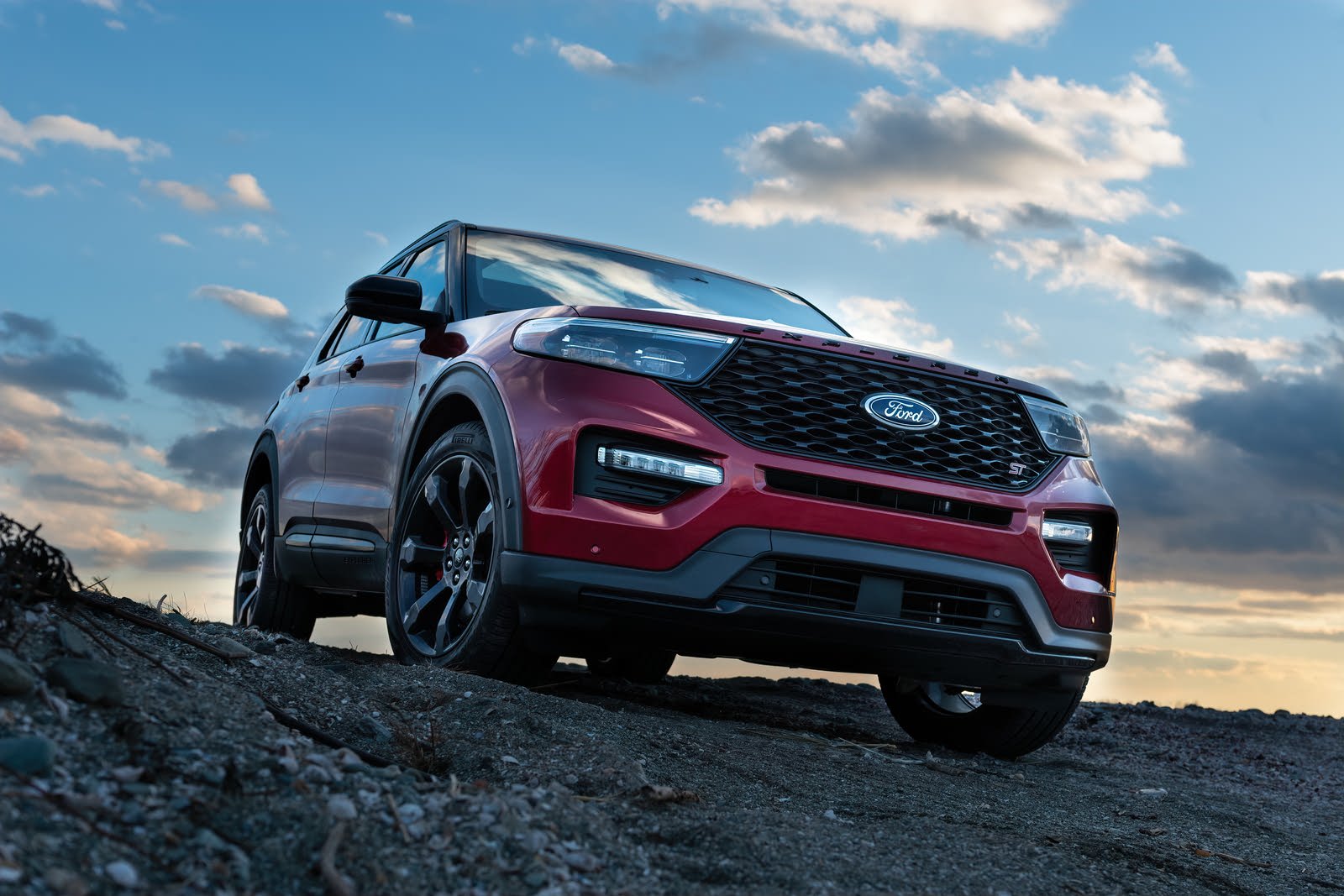
According to CarGurus experts, the overall rating for the 2020 Ford Explorer is 7.2 out of 10, while the 2020 Land Rover Range Rover Sport scores 6.7 out of 10. Based on these ratings, the 2020 Ford Explorer is the better choice, offering a more balanced combination of performance, space, and technology.
Choose the 2020 Ford Explorer if:
- You want a spacious interior with ample cargo capacity.
- You prefer a vehicle with a powerful and smooth powertrain.
- You value user-friendly physical controls for climate and stereo functions.







Choose the 2020 Land Rover Range Rover Sport if:
- You seek a luxurious interior with high-quality materials.
- You desire a vehicle with quick acceleration and adaptive air suspension.
- You appreciate advanced driver-assistance systems and off-roading capability.


CarGurus highlights
According to CarGurus experts, the overall rating for the 2020 Ford Explorer is 7.2 out of 10, while the 2020 Land Rover Range Rover Sport scores 6.7 out of 10. Based on these ratings, the 2020 Ford Explorer is the better choice, offering a more balanced combination of performance, space, and technology.
Choose the 2020 Ford Explorer if:
Shop Now- You want a spacious interior with ample cargo capacity.
- You prefer a vehicle with a powerful and smooth powertrain.
- You value user-friendly physical controls for climate and stereo functions.










Choose the 2020 Land Rover Range Rover Sport if:
Shop Now- You seek a luxurious interior with high-quality materials.
- You desire a vehicle with quick acceleration and adaptive air suspension.
- You appreciate advanced driver-assistance systems and off-roading capability.







By: CarGurus + AI
At CarGurus, our team of experienced automotive writers remain at the heart of our content operation, conducting hands-on car tests and writing insightful guides that are backed by years of industry experience. To complement this, we are harnessing AI to make our content offering more diverse and more helpful to shoppers than ever. To achieve this, our AI systems are based exclusively on CarGurus content, ratings and data, so that what we produce is both unique to CarGurus, and uniquely helpful to car shoppers.