2020 Ford Explorer vs 2020 Ford Edge
Overview | |
MSRP$32,765 | MSRP$31,100 |
Listings463 | Listings175 |
Ratings & Reviews | |
User Reviews | User Reviews |
Expert reviews7.2 out of 10 | Expert reviews8.0 out of 10 |
Pros
Cons
| Pros
Cons
|
2020 Ford Explorer Reviews SummaryFor nearly 30 years, the Ford Explorer has settled into the American lexicon like Cheerios. We've gobbled up millions of them, from the rock-crawling Eddie Bauers of the 1990s to the brand-new ST that can take down sports cars. The 2020 Explorer brings an all-new chassis, cranks up the technology, and introduces hybrid and high-performance powertrains in a space the size of a small living room. The Explorer's also getting very expensive while other automakers catch on to Ford's winning formula—for a lot less money. | |
2020 Ford Edge Reviews SummaryThe Ford Edge isn’t exactly memorable, which isn’t a bad thing. It isn’t a good thing either. Cars can be remembered for attractive design, fun driving dynamics, or being a solid value. They can also be remembered in a negative light for a polarizing design, poor build quality, or being unsafe to the point of scandal. But the 2020 Ford Edge is just... there. It is a midsize two-row SUV that doesn’t offend, but also doesn’t “wow.” But just as critically, the Edge is getting long in the tooth. In the SUV segment, constant iteration is necessary for survival, and the Edge is in need of a redesign. But in lieu of new blood, Ford has done well to keep the Edge fitted with the latest infotainment and safety technology. It also offers a performance variant, called the Edge ST. This is something that you won’t find in the Edge’s competitors, the Nissan Murano and Honda Passport. But is it enough to keep the Edge relevant against its more contemporary rivals? Read on to find out. | |
No video found | |
Popular Features & Specs | |
Engine2.3L 300 hp I4 | Engine2.0L 250 hp I4 |
Drive TrainRWD | Drive TrainFWD |
Seating Capacity7 | Seating Capacity5 |
Horsepower | Horsepower250 hp @ 5500 rpm |
MPG City21 | MPG City21 |
MPG Highway28 | MPG Highway29 |
Engine | |
Engine Name2.3L 300 hp I4 | Engine Name2.0L 250 hp I4 |
Torque | Torque280 lb-ft @ 3000 rpm |
Horsepower | Horsepower250 hp @ 5500 rpm |
DrivetrainRWD | DrivetrainFWD |
Fuel Economy | |
MPG City21 | MPG City21 |
MPG Highway28 | MPG Highway29 |
Interior | |
Seating Capacity7 | Seating Capacity5 |
Safety | |
Front Crash Overall5 | Front Crash Overall5 |
Side Crash Overall5 | Side Crash Overall5 |
Dimensions & Capacity | |
Cargo Space18.2 cu ft | Cargo Space39.2 cu ft |
Curb Weight4345 lbs | Curb Weight4027 lbs |
Height69.9 in | Height68.3 in |
Length198.8 in | Length188.8 in |
Width89.3 in | Width85.8 in |
Wheelbase119.1 in | Wheelbase112.2 in |
Maximum Payload1425 lbs | Maximum Payload1243 lbs |
Number of doors4 | Number of doors4 |
Maximum Towing Capacity5300 lbs | Maximum Towing Capacity1500 lbs |
Overview | ||
MSRP | $32,765 | $31,100 |
Listings | ||
Ratings & Reviews | ||
User reviews | ||
Expert reviews | 7.2 out of 10Read full review | 8.0 out of 10Read full review |
Pros & cons | Pros
Cons
| Pros
Cons
|
Summary | For nearly 30 years, the Ford Explorer has settled into the American lexicon like Cheerios. We've gobbled up millions of them, from the rock-crawling Eddie Bauers of the 1990s to the brand-new ST that can take down sports cars. The 2020 Explorer brings an all-new chassis, cranks up the technology, and introduces hybrid and high-performance powertrains in a space the size of a small living room. The Explorer's also getting very expensive while other automakers catch on to Ford's winning formula—for a lot less money. | The Ford Edge isn’t exactly memorable, which isn’t a bad thing. It isn’t a good thing either. Cars can be remembered for attractive design, fun driving dynamics, or being a solid value. They can also be remembered in a negative light for a polarizing design, poor build quality, or being unsafe to the point of scandal. But the 2020 Ford Edge is just... there. It is a midsize two-row SUV that doesn’t offend, but also doesn’t “wow.” But just as critically, the Edge is getting long in the tooth. In the SUV segment, constant iteration is necessary for survival, and the Edge is in need of a redesign. But in lieu of new blood, Ford has done well to keep the Edge fitted with the latest infotainment and safety technology. It also offers a performance variant, called the Edge ST. This is something that you won’t find in the Edge’s competitors, the Nissan Murano and Honda Passport. But is it enough to keep the Edge relevant against its more contemporary rivals? Read on to find out. |
Video | No video found | |
Popular Features & Specs | ||
Engine | 2.3L 300 hp I4 | 2.0L 250 hp I4 |
Drive Train | RWD | FWD |
Seating Capacity | 7 | 5 |
Horsepower | 250 hp @ 5500 rpm | |
MPG City | 21 | 21 |
MPG Highway | 28 | 29 |
Engine | ||
Engine Name | 2.3L 300 hp I4 | 2.0L 250 hp I4 |
Torque | 280 lb-ft @ 3000 rpm | |
Horsepower | 250 hp @ 5500 rpm | |
Drivetrain | RWD | FWD |
Fuel Economy | ||
MPG City | 21 | 21 |
MPG Highway | 28 | 29 |
Interior | ||
Seating Capacity | 7 | 5 |
Safety | ||
Front Crash Overall | 5 | 5 |
Side Crash Overall | 5 | 5 |
Dimensions & Capacity | ||
Cargo Space | 18.2 cu ft | 39.2 cu ft |
Curb Weight | 4345 lbs | 4027 lbs |
Height | 69.9 in | 68.3 in |
Length | 198.8 in | 188.8 in |
Width | 89.3 in | 85.8 in |
Wheelbase | 119.1 in | 112.2 in |
Maximum Payload | 1425 lbs | 1243 lbs |
Number of doors | 4 | 4 |
Maximum Towing Capacity | 5300 lbs | 1500 lbs |
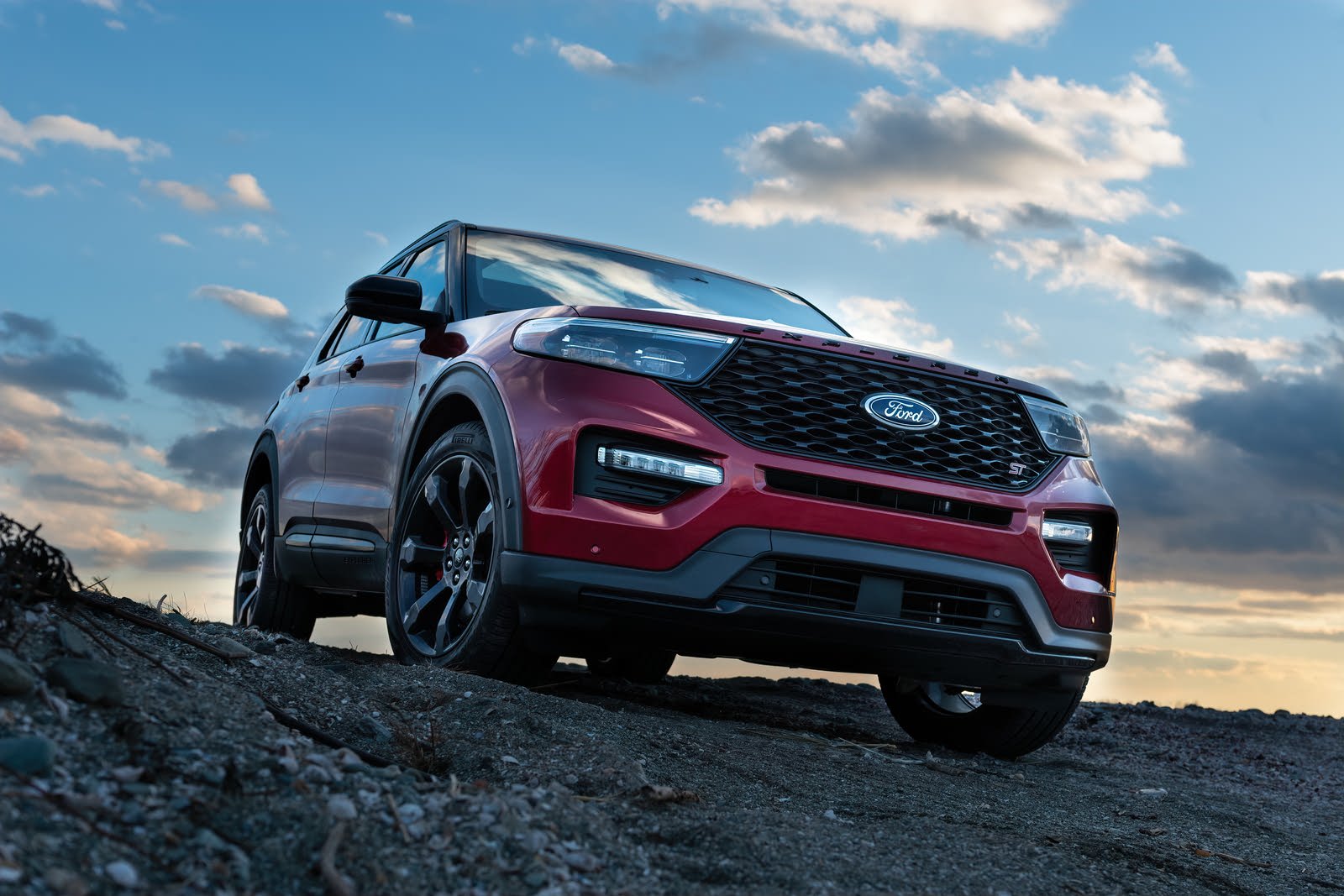
The 2020 Ford Explorer had a particularly handsome design that outshined even competitors like the Land Rover Discovery. The latest model refined its upscale, utilitarian design by trimming down the body panels, particularly at the rear, giving it a lower and more athletic look. The widened headlights, large grille, and prominent "Explorer" lettering on the hood provided a recognizable and strong front face. The ST version, equipped with black 21-inch rims, blacked-out trim, red brake calipers, rich Rapid Red paint, and quad exhaust pipes, looked positively striking and drew a lot of attention.
However, the Explorer's interior did not meet the same high standards. Despite the vehicle's high price, which ranged up to $60,000, the interior materials felt subpar. The so-called leather resembled low-grade vinyl, and many surfaces, such as door panels and the frames around air vents, were made of hard, rough-grained plastic. While the dashboard had a padded top and the switchgear felt solid, the overall feel was disappointing. The Kia Telluride offered a better interior quality at a significantly lower price. When compared to similarly priced competitors like Mercedes, Audi, and Lexus, the Explorer's interior fell short.
The 2020 Ford Edge, in contrast, had a fresh design that was more in line with the styling updates received in 2019. The exterior maintained a close resemblance to the Ford Fusion sedan, featuring angular headlights and a large, trapezoidal grille. The interior, although still showing its age from the second generation introduced in 2015, had good cabin quality with plenty of soft-touch materials and solid fit-and-finish. However, the heavy use of hard plastics in the center console and center stack detracted from its overall feel.
The Edge's various trims, from SE to SEL to Titanium and ST, brought various interior upgrades. Higher trims featured synthetic and genuine leather upholstery, heated and power-adjustable seats, and advanced audio systems. The cabin quality and design of the Edge made it a pleasant space, though not necessarily luxurious.


Performance was a strong suit for the 2020 Ford Explorer. Ford made a significant investment in a rear-wheel-drive (RWD) chassis, providing a more balanced weight distribution. The ST trim, tuned by Ford Performance, featured a 3.0-liter twin-turbo V6 engine capable of 400 horsepower and 415 pound-feet of torque. This setup enabled a nimble and flat cornering experience with superb brake feel and precise handling. The 10-speed automatic transmission, despite an occasional downshifting jerk, delivered smooth and uninterrupted power. The ST’s performance was unmatched by any non-luxury SUV in its price range, though it came at the cost of fuel efficiency, averaging 18 mpg during the test.
The Explorer also offered a 2.3-liter turbo inline-four engine with 300 horsepower and 310 pound-feet of torque, which provided robust performance for its class. A hybrid model combined a 3.3-liter V6 with an electric motor to produce a total of 318 horsepower, though its fuel-efficiency benefits were marginal. The Explorer's various engines allowed for towing capacities up to 5,600 pounds with AWD, making it a versatile performer.
The 2020 Ford Edge started with a 2.0-liter turbocharged four-cylinder engine producing 250 horsepower and 275 pound-feet of torque. This engine provided solid performance for everyday driving, though it struggled at higher speeds. The Edge’s suspension was well-tuned for American roads, absorbing potholes without being overly soft.
For those seeking more performance, the Edge ST offered a 2.7-liter EcoBoost V6 engine with 335 horsepower and 380 pound-feet of torque. The ST’s acceleration was strong once the turbo lag was overcome, and it featured heavy steering and excellent cornering, enhancing its sporty feel. The eight-speed automatic transmission worked well with this engine, and the Sport mode added an extra layer of driving excitement.
The 2020 Ford Explorer provided a spacious and comfortable interior, ideal for long road trips. During a holiday journey to Maine, the spacious second row with USB ports, air vents, and a panoramic moonroof made for a pleasant ride. The third row, although flat and not suitable for long journeys, could accommodate six-foot-tall adults for short trips. The Explorer offered 18 cubic feet of cargo space behind the third row, 48 cubic feet behind the second row, and 88 cubic feet with all seats folded, making it one of the largest in its class.
The Explorer’s simple and intuitive dashboard featured physical knobs and switches for climate and stereo controls, though some adjustments required using the touchscreen. The thick D-pillars and fuzzy 360-degree cameras created unnecessary blind spots but otherwise, driving the Explorer was straightforward and user-friendly.
The 2020 Ford Edge impressed with its cabin layout, providing a commanding view of the road without feeling overly upright. The seats were surrounded by plenty of storage compartments, making it ideal for commuting and road trips. The second row offered ample head- and legroom without needing to adjust the front seats. Though it lacked a third row, the provided space was generous and comfortable.
The Edge offered 39.2 cubic feet of cargo space behind the rear seats, expandable to 73.4 cubic feet with the rear seats folded. This cargo capacity was more than that of competitors like the Jeep Grand Cherokee and Nissan Murano but slightly less than the Honda Passport. The SEL and Titanium trims added the convenience of a hands-free foot-activated power rear liftgate.
The 2020 Ford Explorer came with an 8-inch touchscreen featuring Sync 3 infotainment, Apple CarPlay, Android Auto, and 4G WiFi as standard. Factory navigation was included on all but the base XLT model. Other standard features included keyless entry, remote start, 3-zone climate control, and SiriusXM satellite radio. Ford’s decades-old keyless entry keypad remained a practical feature alongside modern tech like FordPass Connect.
Higher trims like the ST and Platinum offered a 10-inch vertical touchscreen and a 12-inch digital instrument cluster through the Premium Technology Package. Although the touchscreen provided clear and organized navigation, the digital instrument panel lacked customization options. Co-Pilot360 Assist+, available on all trim levels, offered semi-automated driving but did not track lanes as well as competitors' systems.
The 2020 Ford Edge provided an impressive array of standard technology across all trims. The Sync 3 infotainment system included an 8-inch touchscreen with intuitive controls and Apple CarPlay and Android Auto integration. Optional voice-activated navigation with SiriusXM Traffic and Travel Link was available on higher trims.
The Edge also came with smart-charging USB ports, and higher trims offered a semi-digital instrument panel with dual screens. A rear-seat entertainment system with screens in the front headrests was also available, enhancing the Edge’s tech offerings.
The 2020 Ford Explorer came standard with Ford Co-Pilot 360, offering forward emergency braking, blind-spot monitoring, auto high beams, and lane-keep assist. The Assist+ option added adaptive cruise control with steering assist and reverse braking, though the latter had issues with false activations. A passenger front knee airbag was standard. The IIHS rated the Explorer as "Acceptable" in the small overlap test on the driver's side but had not completed all tests at the time of review.
The 2020 Ford Edge’s safety features included a full array of airbags, AdvanceTrac traction control with Roll Stability Control and Curve Control, a tire pressure monitoring system, and a child seat anchoring system. The standard Ford Co-Pilot360 safety system provided robust driver assistance technologies like automatic emergency braking with pedestrian detection, forward collision warning, lane departure warning, automatic high beams, and blind-spot monitoring with rear cross-traffic alert.
Upgrading to the SEL trim gave access to Co-Pilot360 Assist+, adding adaptive cruise control with stop-and-go functionality and active lane centering. The 2020 Edge received a "Top Safety Pick" rating from the IIHS and a five-star overall safety rating from the NHTSA, though it had mixed headlight ratings.
CarGurus highlights

According to CarGurus experts, the overall rating for the 2020 Ford Explorer is 7.2 out of 10, while the 2020 Ford Edge scores 8.0 out of 10. Given these ratings, the Ford Edge stands as the better choice overall. It offers excellent technology features, a comfortable and spacious cabin, and strong safety ratings, making it a more well-rounded and appealing option compared to the Explorer.
Choose the 2020 Ford Explorer if:
- You need a spacious three-row SUV with ample cargo capacity, making it ideal for long family trips.
- You prioritize powerful engine options and superior on-road performance, especially with the ST trim.
- You appreciate a wide range of advanced safety features and semi-automated driving technology.


Choose the 2020 Ford Edge if:
- You prefer a two-row SUV with a comfortable and spacious interior for both front and rear passengers.
- You value impressive technology features like Sync 3, Apple CarPlay, and an intuitive infotainment system.
- You want a vehicle with strong safety ratings and advanced driver assistance systems at a lower price point.


CarGurus highlights
According to CarGurus experts, the overall rating for the 2020 Ford Explorer is 7.2 out of 10, while the 2020 Ford Edge scores 8.0 out of 10. Given these ratings, the Ford Edge stands as the better choice overall. It offers excellent technology features, a comfortable and spacious cabin, and strong safety ratings, making it a more well-rounded and appealing option compared to the Explorer.
Choose the 2020 Ford Explorer if:
Shop Now- You need a spacious three-row SUV with ample cargo capacity, making it ideal for long family trips.
- You prioritize powerful engine options and superior on-road performance, especially with the ST trim.
- You appreciate a wide range of advanced safety features and semi-automated driving technology.
Choose the 2020 Ford Edge if:
Shop Now- You prefer a two-row SUV with a comfortable and spacious interior for both front and rear passengers.
- You value impressive technology features like Sync 3, Apple CarPlay, and an intuitive infotainment system.
- You want a vehicle with strong safety ratings and advanced driver assistance systems at a lower price point.

By: CarGurus + AI
At CarGurus, our team of experienced automotive writers remain at the heart of our content operation, conducting hands-on car tests and writing insightful guides that are backed by years of industry experience. To complement this, we are harnessing AI to make our content offering more diverse and more helpful to shoppers than ever. To achieve this, our AI systems are based exclusively on CarGurus content, ratings and data, so that what we produce is both unique to CarGurus, and uniquely helpful to car shoppers.

