2020 Ford Escape vs 2021 Nissan Rogue

Overview | |
MSRP$24,885 | MSRP$26,050 |
Listings1823 | Listings2402 |
Ratings & Reviews | |
User Reviews | User Reviews |
Expert reviews8.0 out of 10 | Expert reviews9.0 out of 10 |
Pros
Cons
| Pros
Cons
|
2020 Ford Escape Reviews SummaryIn case you didn’t hear, Ford came out with an electric crossover, calling it the Mustang Mach-E. Ford could have called it something else, but the marketing department decided to leverage the famous Mustang name to capture headlines and, hopefully, shoppers. What should not be overlooked is the fact Ford chose to make its first-ever standalone electric vehicle a crossover. This choice is a testament to how far the sport utility vehicle has come. Paired with Ford's decision to phase out sedans and hatchbacks, it's clear the company is putting all of its eggs into its trucks, SUVs, and crossovers. Suffice it to say, there is just a bit of pressure on the redesigned 2020 Ford Escape. While the Escape has been around since 2000, it came into its own in 2013 when the “One Ford” philosophy was adopted, meaning that vehicles would be sold in multiple markets around the globe. As a result, the U.S. got Europe’s Ford Kuga, rebranded as the Escape—a high-tech, handsome, and surprisingly athletic small SUV. So, with all this mind, the new Escape needs to not only be an improvement over the previous generation to compete against the rest of the compact crossover segment, it also needs to win over would-be sedan and hatchback customers. Can the 2020 Escape rise to the occasion? | |
2021 Nissan Rogue Reviews SummaryTo characterize the all-new 2021 Nissan Rogue as vital to the automaker's success is an understatement. Not only is the compact crossover SUV the best-selling Nissan in America, but it's also one of the best-selling vehicles in America. Strip out pickup trucks, and the Rogue sits near the top of the U.S. sales chart with its primary competitors, the Honda CR-V and Toyota RAV4. Imagine the pressure on Nissan designers, engineers, and product planners as they prepared the current Rogue's replacement! The good news is that the new Rogue is a better SUV in every way but one. | |
Popular Features & Specs | |
Engine1.5L 181 hp I3 | Engine2.5L 181 hp I4 |
Drive TrainFWD | Drive TrainFWD |
Seating Capacity5 | Seating Capacity5 |
Horsepower | Horsepower181 hp @ 6000 rpm |
MPG City27 | MPG City27 |
MPG Highway33 | MPG Highway35 |
Engine | |
Engine Name1.5L 181 hp I3 | Engine Name2.5L 181 hp I4 |
Torque | Torque181 lb-ft @ 3600 rpm |
Horsepower | Horsepower181 hp @ 6000 rpm |
DrivetrainFWD | DrivetrainFWD |
Fuel Economy | |
MPG City27 | MPG City27 |
MPG Highway33 | MPG Highway35 |
Interior | |
Seating Capacity5 | Seating Capacity5 |
Safety | |
Front Crash Overall5 | Front Crash Overall3 |
Side Crash Overall5 | Side Crash Overall5 |
Dimensions & Capacity | |
Cargo Space37.5 cu ft | Cargo Space31.6 cu ft |
Curb Weight3299 lbs | Curb Weight3371 lbs |
Height66.1 in | Height66.5 in |
Length180.5 in | Length183.0 in |
Width85.6 in | Width72.4 in |
Wheelbase106.7 in | Wheelbase106.5 in |
Maximum Payload | Maximum Payload1115 lbs |
Number of doors4 | Number of doors4 |
Overview | ||
MSRP | $24,885 | $26,050 |
Listings | ||
Ratings & Reviews | ||
User reviews | ||
Expert reviews | 8.0 out of 10Read full review | 9.0 out of 10Read full review |
Pros & cons | Pros
Cons
| Pros
Cons
|
Summary | In case you didn’t hear, Ford came out with an electric crossover, calling it the Mustang Mach-E. Ford could have called it something else, but the marketing department decided to leverage the famous Mustang name to capture headlines and, hopefully, shoppers. What should not be overlooked is the fact Ford chose to make its first-ever standalone electric vehicle a crossover. This choice is a testament to how far the sport utility vehicle has come. Paired with Ford's decision to phase out sedans and hatchbacks, it's clear the company is putting all of its eggs into its trucks, SUVs, and crossovers. Suffice it to say, there is just a bit of pressure on the redesigned 2020 Ford Escape. While the Escape has been around since 2000, it came into its own in 2013 when the “One Ford” philosophy was adopted, meaning that vehicles would be sold in multiple markets around the globe. As a result, the U.S. got Europe’s Ford Kuga, rebranded as the Escape—a high-tech, handsome, and surprisingly athletic small SUV. So, with all this mind, the new Escape needs to not only be an improvement over the previous generation to compete against the rest of the compact crossover segment, it also needs to win over would-be sedan and hatchback customers. Can the 2020 Escape rise to the occasion? | To characterize the all-new 2021 Nissan Rogue as vital to the automaker's success is an understatement. Not only is the compact crossover SUV the best-selling Nissan in America, but it's also one of the best-selling vehicles in America. Strip out pickup trucks, and the Rogue sits near the top of the U.S. sales chart with its primary competitors, the Honda CR-V and Toyota RAV4. Imagine the pressure on Nissan designers, engineers, and product planners as they prepared the current Rogue's replacement! The good news is that the new Rogue is a better SUV in every way but one. |
Video | ||
Popular Features & Specs | ||
Engine | 1.5L 181 hp I3 | 2.5L 181 hp I4 |
Drive Train | FWD | FWD |
Seating Capacity | 5 | 5 |
Horsepower | 181 hp @ 6000 rpm | |
MPG City | 27 | 27 |
MPG Highway | 33 | 35 |
Engine | ||
Engine Name | 1.5L 181 hp I3 | 2.5L 181 hp I4 |
Torque | 181 lb-ft @ 3600 rpm | |
Horsepower | 181 hp @ 6000 rpm | |
Drivetrain | FWD | FWD |
Fuel Economy | ||
MPG City | 27 | 27 |
MPG Highway | 33 | 35 |
Interior | ||
Seating Capacity | 5 | 5 |
Safety | ||
Front Crash Overall | 5 | 3 |
Side Crash Overall | 5 | 5 |
Dimensions & Capacity | ||
Cargo Space | 37.5 cu ft | 31.6 cu ft |
Curb Weight | 3299 lbs | 3371 lbs |
Height | 66.1 in | 66.5 in |
Length | 180.5 in | 183.0 in |
Width | 85.6 in | 72.4 in |
Wheelbase | 106.7 in | 106.5 in |
Maximum Payload | 1115 lbs | |
Number of doors | 4 | 4 |
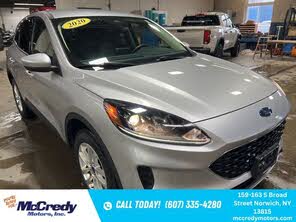
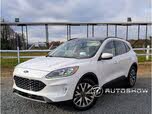
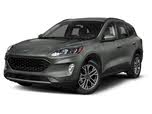
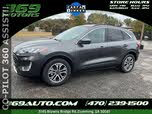
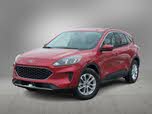
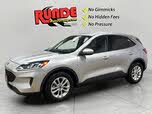
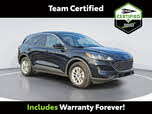
The 2020 Ford Escape impressed with its attractive compact crossover design. Sporting a large grille similar to that of the outgoing Fiesta and Focus hatchbacks, and headlights inspired by the Ford GT supercar, the Escape had an aesthetic appeal that few could ignore. Despite its curvaceous design coming at the cost of rear cargo space—a point we'll delve into later—the Escape remained one of the most eye-catching small SUVs on the market, perhaps only behind the Mazda CX-5 and Jeep Cherokee.
The interior of the Escape marries modernity with functionality. The cabin showcased a forward-looking design with essential controls intuitively placed. Our test model was outfitted with a fully digital instrument panel and a floating infotainment screen, part of a seamless, contemporary design.
The Escape was available in five trims: S, SE, SE Sport, SEL, and Titanium. The base S trim came with 17-inch steel wheels covered in plastic, a 4.2-inch instrument panel screen, three 12-volt power outlets, manually adjustable front seats, and the Sync infotainment system with a 4.2-inch center screen. The S trim also included FordPass Connect with WiFi for up to ten devices and remote vehicle controls via a mobile device. Standard safety features included a full suite of driver-assistance aids.
By moving up to the SE trim, customers received 17-inch painted aluminum wheels, tinted side and rear windows, a chrome grille surround, and body-color door handles. The interior upgrades included automatic climate control, heated front seats, satellite radio, a 10-way power driver’s seat, and an upgraded 8-inch Sync 3 infotainment system with Apple CarPlay and Android Auto.
The SE Sport model added black-painted wheels and sporty design touches like a black grille surround and black mirror caps. Inside, it featured a 12.3-inch fully digital instrument panel and a leather-wrapped steering wheel and came standard with a hybrid drivetrain.
Climbing to the SEL trim added fog lamps, black roof racks, 18-inch machined aluminum wheels, and a hands-free power liftgate. Interior upgrades included memory settings for the power driver’s seat, synthetic upholstery, sport bucket seats, and a heated steering wheel.
Our Titanium test model offered unique 19-inch wheels, LED fog lamps, acoustic-laminated glass, a dual-panel moonroof, and a plush two-tone leather interior. Highlights included a premium B&O audio system, leather seating, and a 6-way power front passenger seat.
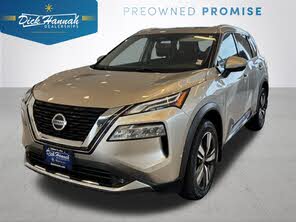
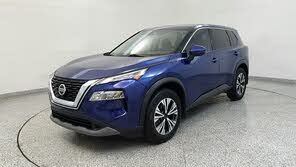
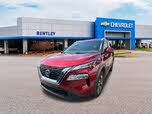
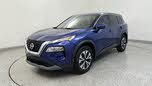
Conversely, the 2021 Nissan Rogue displayed a fresh, rugged SUV look with dark gray plastic cladding around its perimeter and bold skid plates. The LED lighting elements, V-Motion grille, and proportional dimensions gave the Rogue a modern aesthetic. The optional two-tone paint with a black roof added a custom look that appealed to many consumers.
Four trims were available: S, SV, SL, and the new Platinum. Each trim offered aluminum wheels up to 19 inches in size. The Rogue S was the entry-level trim at $25,650, followed by the popular SV at $27,340, the more luxurious SL at $32,000, and the top-tier Platinum at $35,430. It’s important to note that prices required an additional $1,095 in destination charges.
Our test vehicle was the SL trim equipped with the Premium Package, additional cost paint, floor mats, and a cargo area protection package, bringing the total to $35,195.
Inside, the Rogue SL impressed with its Almond colored leather interior and standard panoramic glass sunroof, highlighting its improved roominess. The cabin featured abundant soft-touch materials, simulated wood trim, and fabric-covered windshield pillars for added quality. Controls were logically arranged, and the optional Platinum trim further enhanced the interior experience with quilted semi-aniline leather, contrast stitching, and ambient lighting.
However, the Rogue's climate control panel resembled an old-school digital clock from the 1980s. Despite still offering a CD player, the Rogue included modern tech such as wireless Apple CarPlay.


The 2020 Ford Escape stood out with its diverse engine options. It offered four choices, bucking the trend among small SUVs, including a 3-cylinder engine producing 180 horsepower and 177 pound-feet of torque. This engine was standard in the S, SE, and SEL trims.
Other options included a turbocharged 2.0-liter 4-cylinder engine, making 250 horsepower and 275 pound-feet of torque, available on the SEL and standard on the Titanium. The hybrid drivetrain featured a 2.5-liter 4-cylinder engine paired with electric power for a total of 198 horsepower, standard on the SE Sport and available on the Titanium.
The plug-in hybrid version was optional for the SE, SEL, and Titanium, offering multiple configurations. The conventional engines utilized an 8-speed automatic transmission, while the hybrid variants employed a CVT. The 3-cylinder and non-plug-in hybrid engines offered both FWD and AWD, whereas the turbo engine and plug-in hybrid were exclusively AWD.
Our Escape Titanium had the most powerful engine, but the transmission occasionally lagged on downshifts. Nevertheless, this setup provided ample power for city driving and shone on highways, particularly when overtaking. The Escape boasted direct steering, a sporty feel, and potent brakes, making it a fun drive despite being a small SUV.
Fuel economy figures were impressive across the board. The standard hybrid got 44 mpg city, 37 highway, and 41 combined, while the SE Sport managed 43/37/40. The 1.5-liter turbocharged engine returned 27/33/30 combined, dropping slightly to 26/31/26 with AWD. Our 2.0-liter turbo AWD received 23/31/26 in fuel economy.
In contrast, the 2021 Nissan Rogue needed more power. It offered a single direct-injected 2.5-liter 4-cylinder engine producing 181 horsepower at 6,000 rpm and 181 pound-feet of torque at 3,600 rpm. Weighing nearly 3,500 pounds, this output was merely adequate for daily driving. The CVT performed well, simulating traditional gear shifts and offering paddle shifters, though they were hardly used.
The Rogue offered available AWD and up to 8.2 inches of ground clearance with new Snow and Off-Road driving modes for better adventuring. Although the power felt lacking, Nissan hinted at future potential, possibly incorporating the VC-Turbo engine used in the Altima and Infiniti QX50.
The Rogue's driving dynamics improved with various enhancements. Based on a robust architecture with 35% high-strength steel, it featured a strut front and multi-link rear suspension. Intelligent Trace Control and Active Ride Control systems further refined the ride. New for 2021, the Vehicle Motion Control system anticipated driver inputs for a more enjoyable drive.
An upgraded steering system, with quicker ratio and better tuning, improved steering feel dramatically. The Rogue felt smooth, athletic, and predictable, making the driving experience satisfying despite the underwhelming power.
The 2020 Ford Escape prioritized passenger space over cargo capacity, likely due to its sleeker design. It offered 37.5 cubic feet of cargo space behind the second row, reduced to 34.4 cubic feet in the hybrid models. With the backseat folded down, the Escape provided 65.4 cubic feet or 60.8 cubic feet in upper-level trims.
Comparatively, the previous model had 68 cubic feet, and rivals like the Honda CR-V, Subaru Forester, and Volkswagen Tiguan offered around 75 cubic feet. The Escape's design seemed a step back in terms of cargo space. However, Ford likely settled into its niche, similar to competitors focusing on style and performance rather than sheer function.
The Escape emphasized passenger comfort, offering ample headroom and decent legroom in the second row. The front seats provided commanding views and good visibility. Practical storage solutions included deep water-bottle holders and multiple trays and compartments.
The 2021 Nissan Rogue aimed to provide a more comfortable experience with improved Zero Gravity seats, featuring better support and materials across trims. Ranging from cloth in the S trim to premium leather in the Platinum, the seating options added to the comfort.
Heated front seats, steering wheel, and rear seats were available from the SV trim upwards. Although ventilated seats weren't an option, all trims featured air conditioning. The SV and SL trims offered dual-zone automatic climate control, while the SL and Platinum provided a triple-zone system with rear-seat temperature controls and sunshades.
The rear seats of the Rogue offered generous headroom and legroom, with nearly 90-degree opening rear doors for easier loading, and could accommodate three child safety seats with new LATCH anchors. A rear-seat reminder system was standard to prevent leaving children behind.
Nissan reduced interior noise with aerodynamic improvements and acoustic glass, resulting in a quieter cabin. The new electronic shifter allowed space under the center console for a storage tray, and door-panel pockets easily held 32-ounce water bottles. The center armrest featured a split butterfly-style opening for easier access.
Most Rogue trims offered a power rear liftgate, and the SL and Platinum trims featured a hands-free design. The Rogue provided 31.6 cubic feet of cargo space in the S and SV trims, while the SL and Platinum included a Divide-N-Hide system for up to 36.5 cubic feet. Despite being slightly less than the outgoing model, the Rogue's cargo space was competitive, and it expanded to 74.1 cubic feet with the rear seats folded down.
In-car technology has become a necessity, and the 2020 Ford Escape reflected this trend. However, the base Escape disappointed with its small 4.2-inch audio-control screen. The SE trim, recommended by CarGurus, upgraded to an 8-inch Sync 3 screen offering Android Auto and Apple CarPlay, enhancing the in-car experience.
The Sync 3 system allowed multitasking between the car display and the phone, adding convenience. The Titanium trim featured a head-up display (HUD) via a flip-up screen rather than windscreen projection, which limited visibility for taller drivers and reduced its effectiveness.
The 2021 Nissan Rogue offered a competitive infotainment package starting with an 8-inch touchscreen on the base S trim, including Bluetooth, SiriusXM satellite radio, Apple CarPlay, and Android Auto. There was also a six-month free trial for Nissan Concierge Personal Assistant.
Nissan provided knobs for volume and tuning on the infotainment system, though their flat surface made them harder to use. Shortcut buttons at the bottom of the display helped access common functions easily.
Upgrading to the SV or SL trims added NissanConnect Services, a WiFi hotspot, and Alexa and Google Assistant integration, along with remote engine starting, automatic collision notification, speed and boundary alerts, and a car finder function. Higher trims could access additional features via a subscription.
The SL Premium Package and Rogue Platinum offered a larger 9-inch touchscreen, door-to-door navigation with real-time traffic, wireless Apple CarPlay, upgraded voice recognition, and a Bose premium audio system, enhancing the tech experience.
Platinum trim also included wireless smartphone charging, a 12.3-inch digital instrument cluster, and a 10.8-inch head-up display, offering top-tier tech features.
The 2020 Ford Escape came standard with a comprehensive safety suite, including front and side-impact airbags, a reversing camera, traction control, and a tire-pressure-monitoring system (TPMS). It also included Ford Co-Pilot360, featuring advanced safety systems like forward-collision warning, lane-keeping assist, adaptive cruise control, automatic high beams, blind-spot monitoring, rear cross-traffic alert, and a driver drowsiness monitor. Although not tested by NHTSA, it received the best overall score of Good from IIHS.
The 2021 Nissan Rogue prioritized safety with the Safety Shield 360 suite, including automatic emergency braking with pedestrian detection, lane-departure warning, and a blind-spot warning system with rear cross-traffic alert. Ten airbags, a driver monitoring system, and a standard rear-seat reminder system enhanced safety. Nissan also introduced rear pre-tensioning and load-limiting seatbelts, a first in the segment.
The Rogue SV trim added ProPilot Assist with adaptive cruise control and lane-centering assistance. The SL Premium Package and Platinum trim upgraded to ProPilot Assist with Navi-link technology, using navigation data to adjust speed for curves and freeway exits automatically.
Crash-test results were unavailable for the new Rogue, but its reinforced architecture with high-strength steel promised improved crash protection.
CarGurus highlights
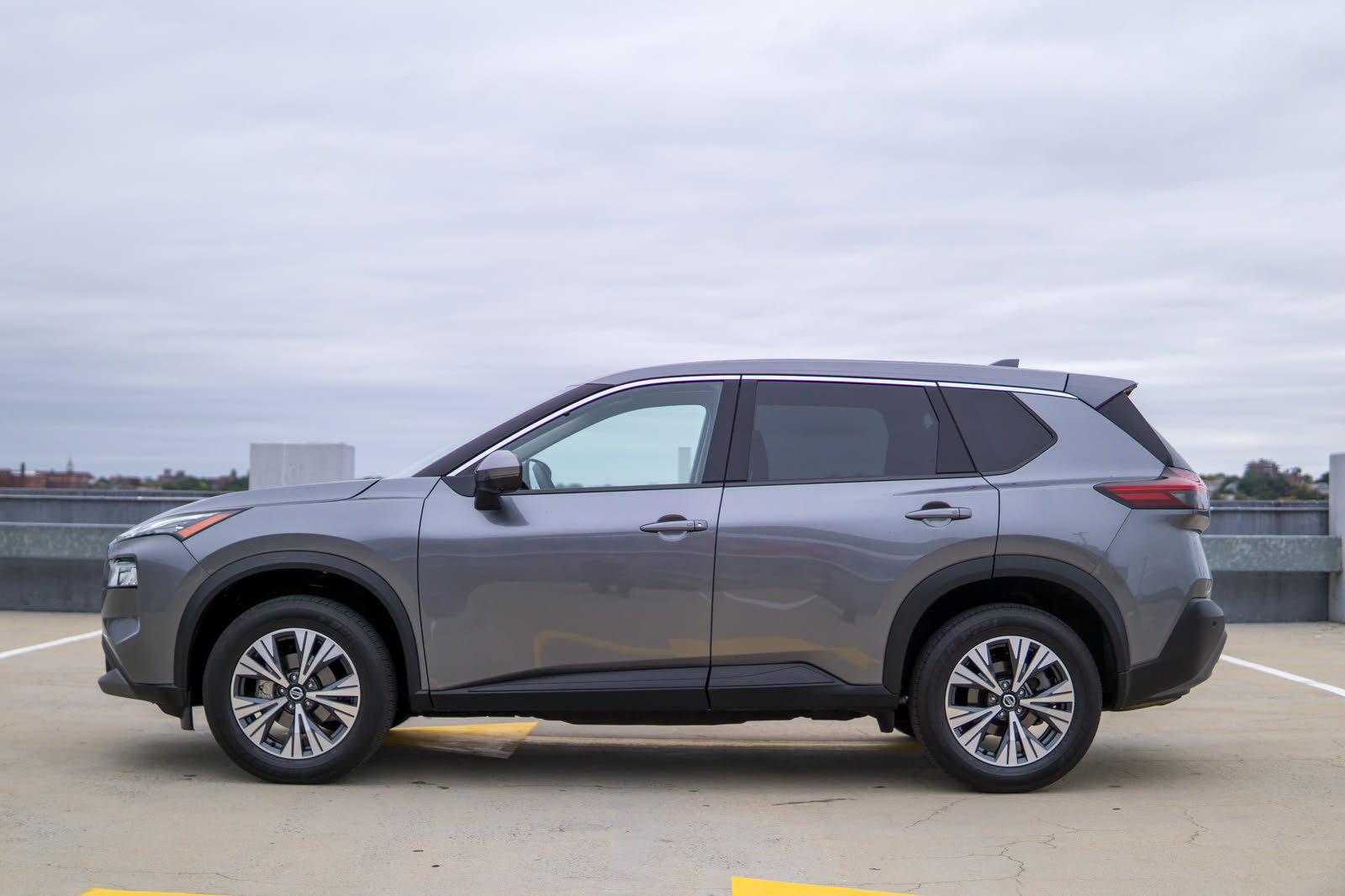
According to CarGurus experts, the overall rating for the 2020 Ford Escape is 8.0 out of 10, while the 2021 Nissan Rogue scores 9.0 out of 10. Based on these ratings, the 2021 Nissan Rogue earns our recommendation. With its advanced comfort features, competitive cargo space, and impressive safety and technology packages, the Rogue edges out the Escape as the superior choice for the discerning consumer.
Choose the 2020 Ford Escape if:
- You prefer multiple engine choices, including hybrid options, for personalized performance and fuel efficiency.
- Advanced technology features, such as a fully digital instrument panel and Sync 3 infotainment, are a priority.
- Safety features, including Ford Co-Pilot360, are crucial for your peace of mind.


Choose the 2021 Nissan Rogue if:
- Comfort is paramount, and you value features like Zero Gravity seats, advanced climate control, and reduced cabin noise.
- Modern design and advanced technological options, including ProPilot Assist and a high-tech infotainment system, enhance your driving experience.
- An SUV with competitive cargo space, practical storage solutions, and a focus on safety features like Safety Shield 360 fits your needs.





CarGurus highlights
According to CarGurus experts, the overall rating for the 2020 Ford Escape is 8.0 out of 10, while the 2021 Nissan Rogue scores 9.0 out of 10. Based on these ratings, the 2021 Nissan Rogue earns our recommendation. With its advanced comfort features, competitive cargo space, and impressive safety and technology packages, the Rogue edges out the Escape as the superior choice for the discerning consumer.
Choose the 2020 Ford Escape if:
Shop Now- You prefer multiple engine choices, including hybrid options, for personalized performance and fuel efficiency.
- Advanced technology features, such as a fully digital instrument panel and Sync 3 infotainment, are a priority.
- Safety features, including Ford Co-Pilot360, are crucial for your peace of mind.
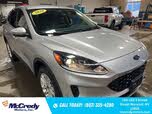
Choose the 2021 Nissan Rogue if:
Shop Now- Comfort is paramount, and you value features like Zero Gravity seats, advanced climate control, and reduced cabin noise.
- Modern design and advanced technological options, including ProPilot Assist and a high-tech infotainment system, enhance your driving experience.
- An SUV with competitive cargo space, practical storage solutions, and a focus on safety features like Safety Shield 360 fits your needs.





By: CarGurus + AI
At CarGurus, our team of experienced automotive writers remain at the heart of our content operation, conducting hands-on car tests and writing insightful guides that are backed by years of industry experience. To complement this, we are harnessing AI to make our content offering more diverse and more helpful to shoppers than ever. To achieve this, our AI systems are based exclusively on CarGurus content, ratings and data, so that what we produce is both unique to CarGurus, and uniquely helpful to car shoppers.