2021 Subaru Forester vs 2021 Ford Escape
Overview | |
MSRP$24,795 | MSRP$25,555 |
Listings194 | Listings371 |
Ratings & Reviews | |
User Reviews | User Reviews |
Expert reviews7.5 out of 10 | Expert reviews6.7 out of 10 |
Pros
Cons
| Pros
Cons
|
2021 Subaru Forester Reviews SummaryThe Subaru Forester was one of the original compact crossover SUVs. Along with the Ford Escape, Honda CR-V, and Toyota RAV4, it helped introduce a vehicular genre that is now displacing traditional sedans from American driveways. That means the Forester has more competition than ever. What was once a small market segment has swelled with the addition of compact SUVs like the Hyundai Tucson, Kia Sportage, Mazda CX-5, Nissan Rogue, Volkswagen Tiguan, and the modern version of the Jeep Cherokee. To keep pace with the competition, the Forester has packed on technology—and pounds. While the first-generation Forester (affectionately nicknamed “toaster” by fans because of its boxy shape) was genuinely compact, the current version has the footprint of a midsize SUV from two decades ago. This version was introduced for the 2019 model year, so it doesn’t change much for 2021. The only news is the addition of three standard safety features—steering-responsive LED headlights, automatic high beams, and a rear seatbelt reminder—standard fog lights and keyless access with push-button start for the Premium trim level, and additional equipment reshuffling on other trim levels. The 2021 Subaru Forester is available in five trim levels—Base, Premium, Sport, Limited, and Touring—all with standard all-wheel drive (AWD). Our test car was the mid-range Sport model. | |
2021 Ford Escape Reviews SummaryThe Ford Escape is the Blue Oval’s compact crossover SUV, and one of the most important models in the automaker’s lineup. It competes in one of the most popular market segments of the moment, against popular vehicles like the Honda CR-V, Hyundai Tucson, Kia Sportage, Nissan Rogue, and Subaru Forester. Ford also views the Escape as the de facto choice for a large slice of its customers. After the automaker eliminated sedans and hatchbacks from its United States lineup, the Escape was left as the most logical choice for keeping existing Fusion and Focus owners in the Ford fold. So in a 2020 model year redesign, Ford gave the Escape more car-like styling, and emphasized fuel efficiency. Following that redesign, the 2021 Escape is largely unchanged. The only differences are new appearance packages and exterior colors, an available tow package, and slightly improved fuel economy for the base powertrain. The trim-level lineup of S, SE, SEL, and Titanium carries over as well. So while we didn’t get a chance to drive a 2021 Escape, we can evaluate it based on our experience with the 2020 model. | |
No video found | |
Popular Features & Specs | |
Engine2.5L 182 hp H4 | Engine1.5L 181 hp I3 |
Drive TrainAWD | Drive TrainFWD |
Seating Capacity5 | Seating Capacity5 |
Horsepower182 hp @ 5800 rpm | Horsepower |
MPG City26 | MPG City28 |
MPG Highway33 | MPG Highway34 |
Engine | |
Engine Name2.5L 182 hp H4 | Engine Name1.5L 181 hp I3 |
Torque178 lb-ft @ 4400 rpm | Torque |
Horsepower182 hp @ 5800 rpm | Horsepower |
DrivetrainAWD | DrivetrainFWD |
Fuel Economy | |
MPG City26 | MPG City28 |
MPG Highway33 | MPG Highway34 |
Interior | |
Seating Capacity5 | Seating Capacity5 |
Safety | |
Front Crash Overall5 | Front Crash Overall5 |
Side Crash Overall5 | Side Crash Overall5 |
Dimensions & Capacity | |
Cargo Space31.1 cu ft | Cargo Space37.5 cu ft |
Curb Weight3453 lbs | Curb Weight3302 lbs |
Height67.5 in | Height66.1 in |
Length182.1 in | Length180.5 in |
Width80.9 in | Width85.6 in |
Wheelbase105.1 in | Wheelbase106.7 in |
Maximum Payload1438 lbs | Maximum Payload |
Number of doors4 | Number of doors4 |
Maximum Towing Capacity1500 lbs | Maximum Towing Capacity |
Overview | ||
MSRP | $24,795 | $25,555 |
Listings | ||
Ratings & Reviews | ||
User reviews | ||
Expert reviews | 7.5 out of 10Read full review | 6.7 out of 10Read full review |
Pros & cons | Pros
Cons
| Pros
Cons
|
Summary | The Subaru Forester was one of the original compact crossover SUVs. Along with the Ford Escape, Honda CR-V, and Toyota RAV4, it helped introduce a vehicular genre that is now displacing traditional sedans from American driveways. That means the Forester has more competition than ever. What was once a small market segment has swelled with the addition of compact SUVs like the Hyundai Tucson, Kia Sportage, Mazda CX-5, Nissan Rogue, Volkswagen Tiguan, and the modern version of the Jeep Cherokee. To keep pace with the competition, the Forester has packed on technology—and pounds. While the first-generation Forester (affectionately nicknamed “toaster” by fans because of its boxy shape) was genuinely compact, the current version has the footprint of a midsize SUV from two decades ago. This version was introduced for the 2019 model year, so it doesn’t change much for 2021. The only news is the addition of three standard safety features—steering-responsive LED headlights, automatic high beams, and a rear seatbelt reminder—standard fog lights and keyless access with push-button start for the Premium trim level, and additional equipment reshuffling on other trim levels. The 2021 Subaru Forester is available in five trim levels—Base, Premium, Sport, Limited, and Touring—all with standard all-wheel drive (AWD). Our test car was the mid-range Sport model. | The Ford Escape is the Blue Oval’s compact crossover SUV, and one of the most important models in the automaker’s lineup. It competes in one of the most popular market segments of the moment, against popular vehicles like the Honda CR-V, Hyundai Tucson, Kia Sportage, Nissan Rogue, and Subaru Forester. Ford also views the Escape as the de facto choice for a large slice of its customers. After the automaker eliminated sedans and hatchbacks from its United States lineup, the Escape was left as the most logical choice for keeping existing Fusion and Focus owners in the Ford fold. So in a 2020 model year redesign, Ford gave the Escape more car-like styling, and emphasized fuel efficiency. Following that redesign, the 2021 Escape is largely unchanged. The only differences are new appearance packages and exterior colors, an available tow package, and slightly improved fuel economy for the base powertrain. The trim-level lineup of S, SE, SEL, and Titanium carries over as well. So while we didn’t get a chance to drive a 2021 Escape, we can evaluate it based on our experience with the 2020 model. |
Video | No video found | |
Popular Features & Specs | ||
Engine | 2.5L 182 hp H4 | 1.5L 181 hp I3 |
Drive Train | AWD | FWD |
Seating Capacity | 5 | 5 |
Horsepower | 182 hp @ 5800 rpm | |
MPG City | 26 | 28 |
MPG Highway | 33 | 34 |
Engine | ||
Engine Name | 2.5L 182 hp H4 | 1.5L 181 hp I3 |
Torque | 178 lb-ft @ 4400 rpm | |
Horsepower | 182 hp @ 5800 rpm | |
Drivetrain | AWD | FWD |
Fuel Economy | ||
MPG City | 26 | 28 |
MPG Highway | 33 | 34 |
Interior | ||
Seating Capacity | 5 | 5 |
Safety | ||
Front Crash Overall | 5 | 5 |
Side Crash Overall | 5 | 5 |
Dimensions & Capacity | ||
Cargo Space | 31.1 cu ft | 37.5 cu ft |
Curb Weight | 3453 lbs | 3302 lbs |
Height | 67.5 in | 66.1 in |
Length | 182.1 in | 180.5 in |
Width | 80.9 in | 85.6 in |
Wheelbase | 105.1 in | 106.7 in |
Maximum Payload | 1438 lbs | |
Number of doors | 4 | 4 |
Maximum Towing Capacity | 1500 lbs | |
The 2021 Subaru Forester, despite its redesign in 2019, had an exterior styling that appeared dated mainly because it retained many elements from its previous generation. The only significant visual change was the distinct cross-shaped taillights on the fifth-generation model. Subaru seemed to follow the principle of not altering what wasn't broken, considering the boxy, upright shape of the Forester aligned well with consumer preferences for SUV styling. While the base trim with its 17-inch steel wheels appeared plain, the model still exuded a clean, unpretentious look that contrasted favorably with many other compact crossovers.
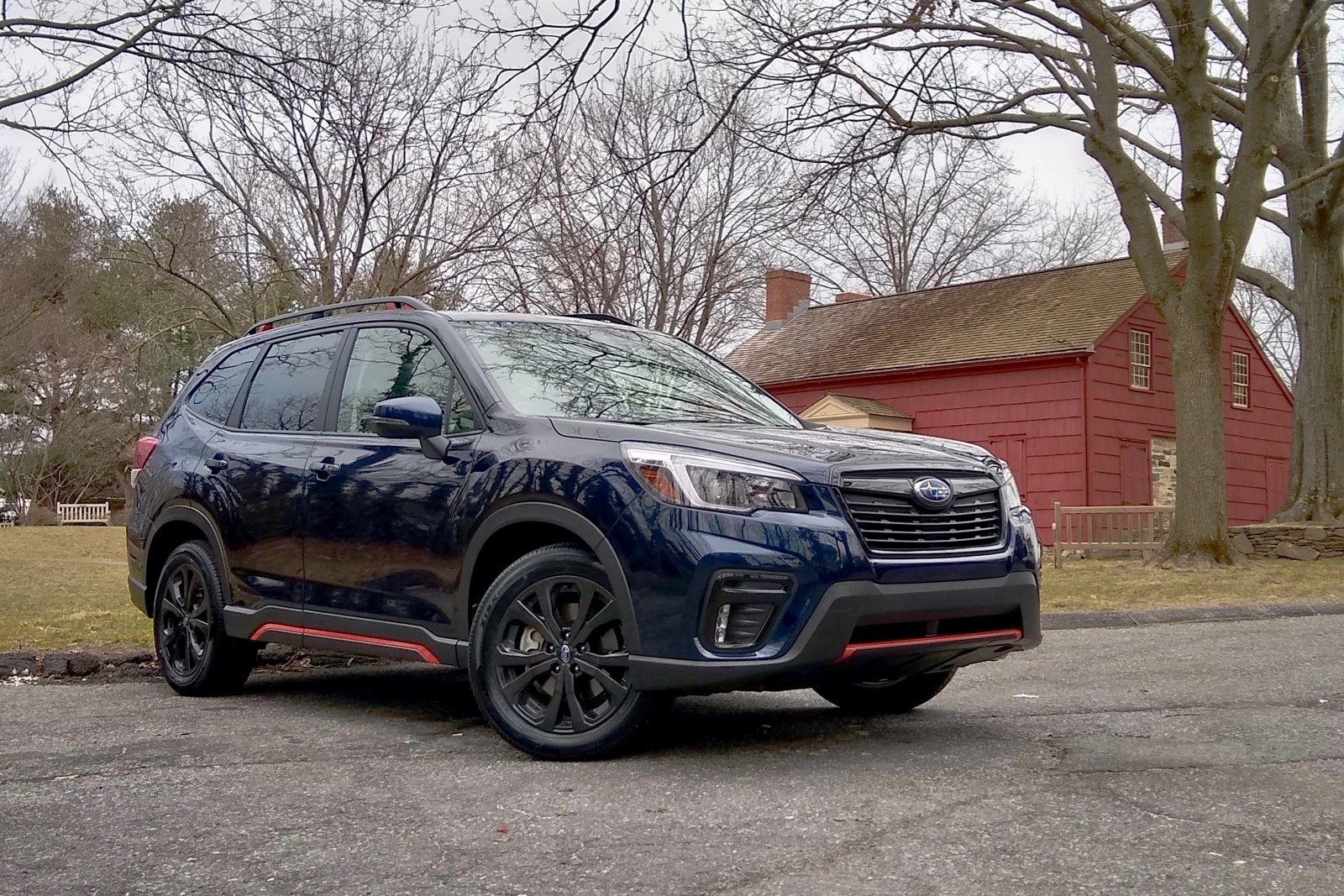
Sport models, like the one tested, featured orange striping along the lower body and roof rails, a rear spoiler, and black 18-inch alloy wheels, which made a notable enhancement to the vehicle's aesthetic, especially when paired with a complementary color like the Dark Blue Pearl on our test car. This model rode on the Subaru Global Platform, shared with other models such as the Impreza, Crosstrek, Legacy, Outback, and the larger Ascent crossover, emphasizing its consistent design ethos.
Inside, the Forester shared the brand's no-nonsense interior design, featuring practical materials designed for durability rather than aesthetics. The Sport trim added orange accents and cross-stitching, giving a splash of color. Depending on the trim, seats were available in cloth (Base, Premium, Sport) or leather (Limited, Touring), with an All-Weather Package adding thoughtful conveniences like heated front seats, heated exterior mirrors, and a windshield de-icer.
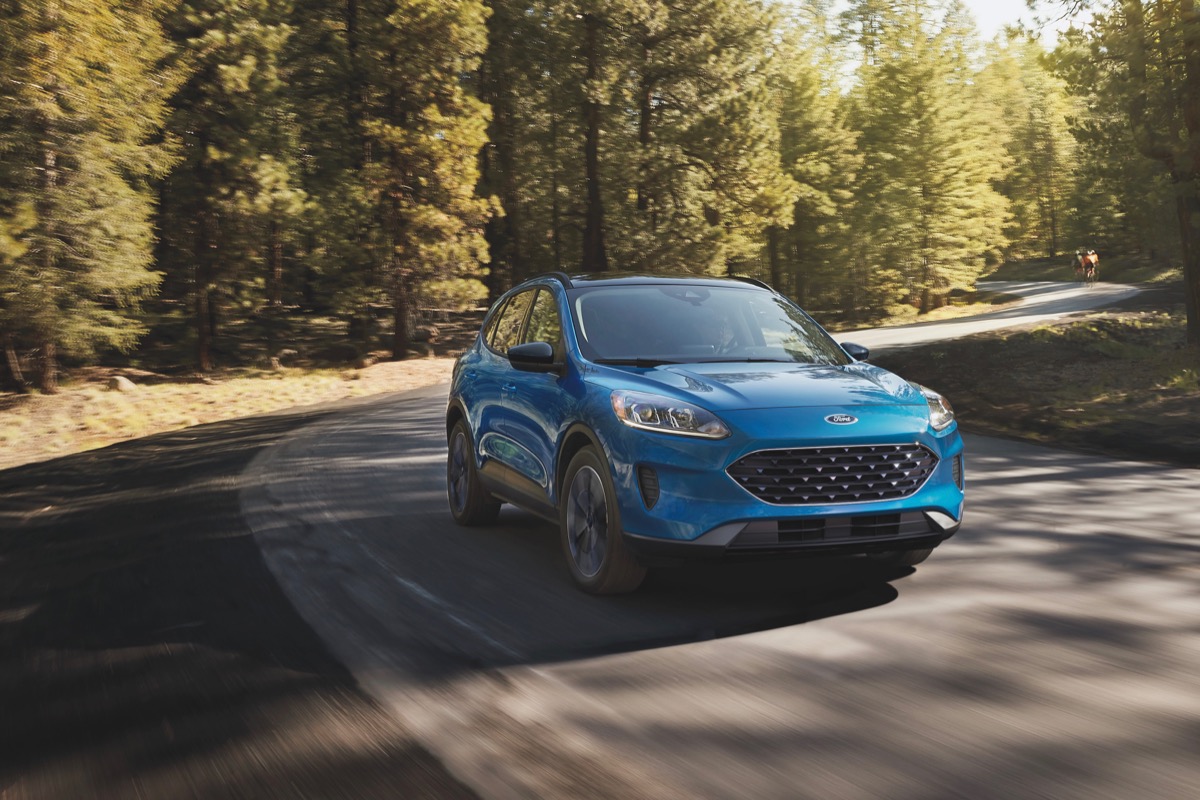
The 2021 Ford Escape, redesigned in its fourth generation, blended SUV and hatchback characteristics. Its curved front and sleek roofline made it resemble a larger Focus, but with the typical tall ride height of an SUV. This design gave it a less truck-like appearance compared to rivals like the Honda CR-V, Subaru Forester, or Toyota RAV4, though it risked seeming generic next to more distinct competitors like the Hyundai Tucson or Kia Sportage.
For 2021, Ford introduced new appearance packages for three of its four trim levels: SE Sport Appearance Package, SEL Stealth AWD Package, and Titanium Elite Package, adding 19-inch wheels and upgraded interior trims.
The interior design, however, lacked cohesion, with mismatched elements like an angular instrument cluster that clashed with the exterior's sleekness. Despite offering amenities such as a leather-wrapped steering wheel and ActiveX upholstery with Miko Suede inserts on higher trims, the Escape’s materials felt subpar, with even the top Titanium trim lacking standard leather seats.




The Forester came equipped with a single powertrain option – a 2.5-liter four-cylinder engine producing 182 horsepower and 176 pound-feet of torque, mated to a CVT with a manual mode and paddle shifters on certain trims. The engine’s boxer configuration provided a lower center of gravity, a Subaru hallmark. However, while the Forester's power was sufficient for everyday needs, it lacked the punch needed for rapid acceleration or highway merging, and significant wind noise was noticeable at higher speeds.
The Forester’s suspension was tuned for comfort, absorbing bumps well but resulting in significant body roll in corners and excessive bounce on uneven roads. While the ride was smooth, the body movement detracted from overall comfort. Subaru’s AWD system was standard and more sophisticated than many competitors', featuring X-Mode for different surfaces, and Dual X-Mode on Sport trims for “Snow/Dirt” and “Snow/Mud” terrains.
The Forester's off-road capability was decent with its 8.7 inches of ground clearance, but for extreme off-roading, options like the Jeep Cherokee Trailhawk or Ford Bronco Sport would be better suited.
The 2021 Escape offered a variety of powertrains: a base 1.5-liter turbocharged three-cylinder with 181 horsepower and 191 pound-feet of torque paired with an eight-speed automatic transmission, either with FWD or optional AWD. A more powerful 2.0-liter turbocharged four-cylinder engine with 250 horsepower and 280 pound-feet of torque, limited to AWD, was available. Additionally, hybrid and plug-in hybrid versions featured a 2.5-liter engine with electric assist, providing a system output of 200 horsepower, with the plug-in hybrid capable of significant electric-only travel.
The 1.5-liter engine, despite being a three-cylinder, performed adequately, and transitions in the hybrid models were smooth. However, chassis tuning was subpar across all models, leading to a sloppy suspension and lackluster steering that made driving a chore. The towing capacity reached a maximum of 3,500 pounds with the 2.0-liter engine, but figures for hybrids were unspecified.
The Forester accommodated five passengers with ample headroom and legroom, especially notable with its flat roofline, enhancing the sense of space and visibility. The boxy shape allowed 35.4 cubic feet of cargo space with the rear seats up and 76.1 cubic feet with them folded down, surpassing competitors like the Honda CR-V and Hyundai Tucson in maximum capacity. However, it lacked a sliding second-row bench for flexible space management.
The Forester’s interior storage included well-sized cupholders and a reasonably spacious center console. Yet, the phone-storage cubby was inadequately sized, and Subaru did not offer wireless charging. The power-adjustable driver’s seat was only available from the Premium trim onwards. Controls for audio and climate were user-friendly, though the numerous buttons on the steering wheel caused some confusion.
Despite its car-like styling, the Escape was competitive in terms of interior space for compact SUVs. Its first and second-row headroom and legroom were among the best, with a sliding rear seat maximizing either passenger comfort or cargo space, providing up to 40.7 inches of rear legroom in non-hybrid models.
In terms of cargo capacity, the Escape offered 33.5 cubic feet with the rear seats up for gasoline models, increasing to 37.5 cubic feet with the seats slid forward. Folding the seats provided up to 65.4 cubic feet for gasoline models. However, hybrid models sacrificed some space due to the battery placement, offering less cargo volume compared to gasoline variants and many rivals like the Subaru Forester or Nissan Rogue.
The Subaru Forester came with the Starlink infotainment system, featuring a 6.5-inch touchscreen standard on base models, along with Apple CarPlay, Android Auto, Bluetooth, SiriusXM satellite radio, USB ports, and a CD player. Higher trims like the Sport added an 8-inch touchscreen and Harman Kardon audio system, while navigation and additional rear USB ports were available in the Limited and Touring trims.
Despite the screen being slow to boot, the infotainment system's intuitive design with physical shortcut buttons made for an easy user experience. The additional small screens in the dashboard and instrument cluster provided secondary information, which seemed redundant.
The Ford Escape utilized the older Sync 3 infotainment system, with the base Escape S featuring a 4.2-inch touchscreen, Apple CarPlay, Android Auto, and a 4G LTE WiFi hotspot. Upgrading to the SE trim brought an 8-inch touchscreen with enhanced functionality and SiriusXM radio. The top Titanium trim added a 12.3-inch digital instrument cluster and a premium 10-speaker Bang & Olufsen sound system.
While Sync 3 was known for its ease of use, the lack of newer tech like wireless Apple CarPlay and Android Auto, found in Sync 4, was a drawback compared to competitors with more modern tech offerings.
Subaru excelled in safety with the Forester, earning the highest “Top Safety Pick+” from the IIHS, with top ratings in crash tests and front-crash prevention tech, along with a “Good” rating for headlights. The NHTSA awarded the Forester a five-star overall rating, reflecting its strong performance in various safety tests.
Standard safety features in the Forester included the EyeSight driver-assist suite with adaptive cruise control, automatic emergency braking, lane-departure warning, and lead-vehicle start alert. Optional features extended to blind-spot monitoring, rear-cross traffic alert, lane-keep assist, and reverse automatic braking. Subaru’s unique DriverFocus system monitored driver attention levels, adding an extra layer of safety.
The 2021 Escape earned a “Top Safety Pick” rating from IIHS, with favorable scores in crash tests and for LATCH child seat anchors. The NHTSA also gave the Escape a five-star overall rating.
Standard safety features came under the Ford Co-Pilot360 suite, including automatic high beams, blind-spot monitoring, lane-keep assist, forward collision warning, and automatic emergency braking. The optional Co-Pilot360 Assist+ package added adaptive cruise control, traffic-sign recognition, park assist, and Evasive Steering Assist for emergency maneuvers.
CarGurus highlights
According to CarGurus experts, the overall rating for the 2021 Subaru Forester was 7.5 out of 10, while the 2021 Ford Escape scored 6.7 out of 10. Based on these ratings, we recommend the 2021 Subaru Forester as the superior choice. Its excellent safety credentials, standard AWD, and greater cargo space with the seats folded provide compelling advantages over the 2021 Ford Escape. Moreover, the Forester’s balance of rugged SUV utility and reliable everyday performance positions it as the better option for a wide range of consumers.
Choose the 2021 Subaru Forester if:
- You prioritize safety, as the Forester had top-notch crash ratings and extensive safety features.
- Robust AWD performance is essential, with sophisticated terrain management systems as standard.
- You need ample cargo space with the rear seats folded, surpassing many competitors.


Choose the 2021 Ford Escape if:
- You prefer a variety of powertrain options, including hybrid and plug-in hybrid choices.
- You require a versatile sliding rear seat that maximizes rear legroom or cargo space.
- You value an intuitive infotainment system albeit lacking some newer tech features.


CarGurus highlights
According to CarGurus experts, the overall rating for the 2021 Subaru Forester was 7.5 out of 10, while the 2021 Ford Escape scored 6.7 out of 10. Based on these ratings, we recommend the 2021 Subaru Forester as the superior choice. Its excellent safety credentials, standard AWD, and greater cargo space with the seats folded provide compelling advantages over the 2021 Ford Escape. Moreover, the Forester’s balance of rugged SUV utility and reliable everyday performance positions it as the better option for a wide range of consumers.
Choose the 2021 Subaru Forester if:
Shop Now- You prioritize safety, as the Forester had top-notch crash ratings and extensive safety features.
- Robust AWD performance is essential, with sophisticated terrain management systems as standard.
- You need ample cargo space with the rear seats folded, surpassing many competitors.
Choose the 2021 Ford Escape if:
Shop Now- You prefer a variety of powertrain options, including hybrid and plug-in hybrid choices.
- You require a versatile sliding rear seat that maximizes rear legroom or cargo space.
- You value an intuitive infotainment system albeit lacking some newer tech features.

By: CarGurus + AI
At CarGurus, our team of experienced automotive writers remain at the heart of our content operation, conducting hands-on car tests and writing insightful guides that are backed by years of industry experience. To complement this, we are harnessing AI to make our content offering more diverse and more helpful to shoppers than ever. To achieve this, our AI systems are based exclusively on CarGurus content, ratings and data, so that what we produce is both unique to CarGurus, and uniquely helpful to car shoppers.

