2021 Toyota Sequoia vs 2021 Ford Explorer

Overview | |
MSRP$32,925 | MSRP$50,400 |
Listings642 | Listings19 |
Ratings & Reviews | |
User Reviews | User Reviews |
Expert reviews7.5 out of 10 | Expert reviews7.0 out of 10 |
Pros
Cons
| Pros
Cons
|
2021 Ford Explorer Reviews SummaryThere was a time when everybody in America seemingly drove an Explorer. That may be an exaggeration, but not by much. In its first four years of production, Ford sold over a million examples. In 1998, Ford was selling its second-generation Explorer at a rate of nearly 440,000 per year. Whether your family purchased an Explorer or not, this was the nameplate that invented the midsize SUV segment. Fast forward to the 2021 model year and the Explorer is in its sixth generation. It's now a three-row SUV that clocks in at a maximum of 4,700 pounds, with a price tag north of $50,000 for the Explorer Platinum trim level. Long gone are the days when it was the only game in town. Almost every automaker has a competitor. So how does the Explorer shake out for 2021? | |
2021 Toyota Sequoia Reviews SummaryLook around on the road today, and you are bound to see SUVs of all shapes and sizes. From three-row family haulers to subcompact runabouts. There is an SUV for nearly every need and every budget. The 2021 Toyota Sequoia might feel like it's from an earlier wave of the SUV craze, and that’s because it is. Born out of the 1990s SUV-excess-fest, the Sequoia has evolved into a niche vehicle for those who need serious space and truck-like capability. The current generation of the Sequoia has been around for almost 15 years, and while Toyota has updated it in several ways, there’s no avoiding its age. Even with modern tech and safety features, this is still an aging beast. Can such a dated vehicle still be relevant in the modern car market? And is age really that important to buyers who are looking for tons of space and standard V8 power? Read on to find out. | |
No video found | No video found |
Popular Features & Specs | |
Engine2.3L 300 hp I4 | Engine5.7L 381 hp V8 |
Drive TrainRWD | Drive Train4X2 |
Seating Capacity7 | Seating Capacity8 |
Horsepower | Horsepower381 hp @ 5600 rpm |
MPG City21 | MPG City13 |
MPG Highway28 | MPG Highway17 |
Engine | |
Engine Name2.3L 300 hp I4 | Engine Name5.7L 381 hp V8 |
Torque | Torque401 lb-ft @ 3600 rpm |
Horsepower | Horsepower381 hp @ 5600 rpm |
DrivetrainRWD | Drivetrain4X2 |
Fuel Economy | |
MPG City21 | MPG City13 |
MPG Highway28 | MPG Highway17 |
Interior | |
Seating Capacity7 | Seating Capacity8 |
Key Features | |
Sunroof/Moonroof | Sunroof/MoonroofStandard |
Safety | |
Front Crash Overall5 | Front Crash Overall |
Side Crash Overall5 | Side Crash Overall |
Dimensions & Capacity | |
Cargo Space18.2 cu ft | Cargo Space18.9 cu ft |
Curb Weight4345 lbs | Curb Weight5730 lbs |
Height69.9 in | Height77.0 in |
Length198.8 in | Length205.1 in |
Width89.3 in | Width79.9 in |
Wheelbase119.1 in | Wheelbase122.0 in |
Maximum Payload1425 lbs | Maximum Payload1405 lbs |
Number of doors4 | Number of doors4 |
Maximum Towing Capacity5300 lbs | Maximum Towing Capacity7400 lbs |
Standard Towing Capacity | Standard Towing Capacity7400 lbs |
Overview | ||
MSRP | $32,925 | $50,400 |
Listings | ||
Ratings & Reviews | ||
User reviews | ||
Expert reviews | 7.5 out of 10Read full review | 7.0 out of 10Read full review |
Pros & cons | Pros
Cons
| Pros
Cons
|
Summary | There was a time when everybody in America seemingly drove an Explorer. That may be an exaggeration, but not by much. In its first four years of production, Ford sold over a million examples. In 1998, Ford was selling its second-generation Explorer at a rate of nearly 440,000 per year. Whether your family purchased an Explorer or not, this was the nameplate that invented the midsize SUV segment. Fast forward to the 2021 model year and the Explorer is in its sixth generation. It's now a three-row SUV that clocks in at a maximum of 4,700 pounds, with a price tag north of $50,000 for the Explorer Platinum trim level. Long gone are the days when it was the only game in town. Almost every automaker has a competitor. So how does the Explorer shake out for 2021? | Look around on the road today, and you are bound to see SUVs of all shapes and sizes. From three-row family haulers to subcompact runabouts. There is an SUV for nearly every need and every budget. The 2021 Toyota Sequoia might feel like it's from an earlier wave of the SUV craze, and that’s because it is. Born out of the 1990s SUV-excess-fest, the Sequoia has evolved into a niche vehicle for those who need serious space and truck-like capability. The current generation of the Sequoia has been around for almost 15 years, and while Toyota has updated it in several ways, there’s no avoiding its age. Even with modern tech and safety features, this is still an aging beast. Can such a dated vehicle still be relevant in the modern car market? And is age really that important to buyers who are looking for tons of space and standard V8 power? Read on to find out. |
Video | No video found | No video found |
Popular Features & Specs | ||
Engine | 2.3L 300 hp I4 | 5.7L 381 hp V8 |
Drive Train | RWD | 4X2 |
Seating Capacity | 7 | 8 |
Horsepower | 381 hp @ 5600 rpm | |
MPG City | 21 | 13 |
MPG Highway | 28 | 17 |
Engine | ||
Engine Name | 2.3L 300 hp I4 | 5.7L 381 hp V8 |
Torque | 401 lb-ft @ 3600 rpm | |
Horsepower | 381 hp @ 5600 rpm | |
Drivetrain | RWD | 4X2 |
Fuel Economy | ||
MPG City | 21 | 13 |
MPG Highway | 28 | 17 |
Interior | ||
Seating Capacity | 7 | 8 |
Key Features | ||
Sunroof/Moonroof | Standard | |
Safety | ||
Front Crash Overall | 5 | |
Side Crash Overall | 5 | |
Dimensions & Capacity | ||
Cargo Space | 18.2 cu ft | 18.9 cu ft |
Curb Weight | 4345 lbs | 5730 lbs |
Height | 69.9 in | 77.0 in |
Length | 198.8 in | 205.1 in |
Width | 89.3 in | 79.9 in |
Wheelbase | 119.1 in | 122.0 in |
Maximum Payload | 1425 lbs | 1405 lbs |
Number of doors | 4 | 4 |
Maximum Towing Capacity | 5300 lbs | 7400 lbs |
Standard Towing Capacity | 7400 lbs | |
The 2021 Ford Explorer was a testament to Ford's consistent design philosophy, offering a family resemblance across its SUV lineup. With its sporty, raked belt lines and distinctive visages, the Explorer stood out among other brands' SUVs. The vehicle's exterior varied with trim levels, featuring different grille designs and chrome accents. Inside, the Explorer provided three rows of seating as standard, with the base model offering cloth upholstery. The dashboard was clean and user-friendly, dominated by an 8-inch LCD touchscreen and large knobs for audio and climate controls. The Explorer's interior space was practical, with a rotary gearshift freeing up storage space. The XLT trim was the most popular, offering enhanced features like a power front passenger seat and nicer finishes, while higher trims provided leather upholstery.
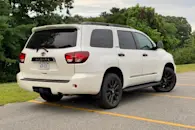
The 2021 Toyota Sequoia, despite its age, maintained a commanding presence with its large silhouette. The vehicle's design updates in 2018, including new headlights and grille, were subtle but aimed to keep it modern. Inside, the Sequoia's massive center dash design was reminiscent of the mid-2000s, with a standard 7-inch touchscreen that appeared small against the expansive dash. The cabin offered ample space, particularly in the second row, with comfortable and supportive seats. The Sequoia's trims ranged from the entry-level SR5 to the range-topping Platinum, each offering various features and packages. The Nightshade Special Edition added unique styling elements, while the TRD Pro was tailored for off-road use. The Sequoia's interior was practical, with deep door pockets and a massive center console, though newer SUVs offered better space utilization.









The 2021 Ford Explorer, at its lightest, weighed 4,345 pounds and featured a base 2.3-liter EcoBoost turbocharged four-cylinder engine, delivering 300 horsepower and 310 pound-feet of torque. This engine outperformed competitors like the Kia Telluride's V6. All Explorer trims were equipped with a 10-speed automatic transmission. The Limited Hybrid trim offered a V6 hybrid drivetrain with 310 hp and 331 lb-ft of torque. Higher trims featured a 3.0-liter EcoBoost twin-turbo V6, delivering 365 hp and 380 lb-ft of torque, while the sport-oriented Explorer ST offered 400 hp and 415 lb-ft of torque. The Explorer's towing capacity ranged from 5,000 to 5,600 pounds, depending on the trim and engine, making it suitable for towing moderate loads.
The 2021 Toyota Sequoia came standard with a 5.7-liter V8 engine, producing 381 horsepower and 401 pound-feet of torque. A six-speed automatic transmission routed power through standard rear-wheel drive or available four-wheel drive. Despite its weight of up to 6,000 pounds, the Sequoia offered stout acceleration. The vehicle's driving dynamics were truck-like, with a soft suspension and strong brakes. The Sequoia's towing capacity was 7,400 pounds, which was less than competitors like the Ford Expedition and Chevrolet Tahoe but still more capable than most SUVs.
The 2021 Ford Explorer offered seating for seven in the base model, with captain's chairs in higher trims reducing capacity to six. The Explorer provided 39 inches of legroom for second-row passengers, which was competitive within its segment. With the third row deployed, the Explorer offered 21 cubic feet of cargo space, and 81 cubic feet with the rear seats folded, which was less than some competitors.
The 2021 Toyota Sequoia's cabin was one of its main selling points, offering nearly 19 cubic feet of cargo space behind the third row and over 66 cubic feet with the third row folded. With all rear seats folded, the Sequoia provided 120 cubic feet of cargo space, which was competitive with other full-size SUVs. The Sequoia featured a power-retractable rear window, a practical feature for accessing the cargo area. The interior offered ample storage with deep door pockets and a large center console, though newer SUVs offered better space utilization.
The 2021 Ford Explorer came with an 8-inch touchscreen as standard, offering features like Apple CarPlay, Android Auto, a 4G WiFi hotspot, and Ford's Sync 3 infotainment system. Higher trims offered a 10.1-inch touchscreen and a Bang & Olufsen audio system with up to 14 speakers. The Explorer provided multiple USB ports and power outlets, with a wireless charging pad available from the Limited trim up.
The 2021 Toyota Sequoia featured a 7-inch touchscreen infotainment system with Apple CarPlay, Android Auto, Amazon Alexa, and a WiFi hotspot. The system was user-friendly, with large hard buttons for easy navigation. The Sequoia's digital trip computer was small but functional. Despite its dated technology, the Sequoia offered modern smartphone connectivity and simplicity.
The 2021 Ford Explorer was rated as a Top Safety Pick+ by the IIHS, with top scores in crash tests. The Explorer offered the Ford Co-Pilot360 suite of safety features, including blind-spot monitoring, lane keeping assist, and automatic emergency braking. Higher trims offered additional features like adaptive cruise control and evasive steering assist.
The 2021 Toyota Sequoia came with the Toyota Safety Sense-P suite, including forward-collision warning, adaptive cruise control, and blind-spot monitoring. The Sequoia lacked some advanced features like lane-keeping assist but offered a comprehensive list of standard safety features. It scored four out of five stars in the NHTSA's rollover test.
CarGurus highlights

According to CarGurus experts, the overall rating for the 2021 Ford Explorer is 7.5 out of 10, while the 2021 Toyota Sequoia scores 7.0 out of 10. Based on these ratings, the Ford Explorer is the recommended choice, offering a more modern design, advanced technology, and a higher safety rating.
Choose the 2021 Toyota Sequoia if:
- You require a spacious interior with ample cargo capacity for large loads.
- You value a powerful V8 engine with strong towing capabilities.
- You appreciate a simple, user-friendly infotainment system with essential connectivity.


Choose the 2021 Ford Explorer if:
- You prioritize a modern infotainment system with advanced connectivity features.
- You need a vehicle with a higher safety rating and comprehensive safety features.
- You prefer a more fuel-efficient engine with a range of powertrain options.


CarGurus highlights
According to CarGurus experts, the overall rating for the 2021 Ford Explorer is 7.5 out of 10, while the 2021 Toyota Sequoia scores 7.0 out of 10. Based on these ratings, the Ford Explorer is the recommended choice, offering a more modern design, advanced technology, and a higher safety rating.
Choose the 2021 Toyota Sequoia if:
Shop Now- You require a spacious interior with ample cargo capacity for large loads.
- You value a powerful V8 engine with strong towing capabilities.
- You appreciate a simple, user-friendly infotainment system with essential connectivity.
Choose the 2021 Ford Explorer if:
Shop Now- You prioritize a modern infotainment system with advanced connectivity features.
- You need a vehicle with a higher safety rating and comprehensive safety features.
- You prefer a more fuel-efficient engine with a range of powertrain options.

By: CarGurus + AI
At CarGurus, our team of experienced automotive writers remain at the heart of our content operation, conducting hands-on car tests and writing insightful guides that are backed by years of industry experience. To complement this, we are harnessing AI to make our content offering more diverse and more helpful to shoppers than ever. To achieve this, our AI systems are based exclusively on CarGurus content, ratings and data, so that what we produce is both unique to CarGurus, and uniquely helpful to car shoppers.

