2020 Ford Explorer vs 2021 Lincoln Aviator
Overview | |
MSRP$32,765 | MSRP$50,660 |
Listings521 | Listings139 |
Ratings & Reviews | |
User Reviews | User Reviews |
Expert reviews7.2 out of 10 | Expert reviews7.8 out of 10 |
Pros
Cons
| Pros
Cons
|
2020 Ford Explorer Reviews SummaryFor nearly 30 years, the Ford Explorer has settled into the American lexicon like Cheerios. We've gobbled up millions of them, from the rock-crawling Eddie Bauers of the 1990s to the brand-new ST that can take down sports cars. The 2020 Explorer brings an all-new chassis, cranks up the technology, and introduces hybrid and high-performance powertrains in a space the size of a small living room. The Explorer's also getting very expensive while other automakers catch on to Ford's winning formula—for a lot less money. | |
2021 Lincoln Aviator Reviews SummaryOnly a few years ago, Lincoln was in a confusing space. Confusing because many of its cars overlapped with the nicest trims of vehicles from parent company Ford. It was also confusing because of the alphanumeric vehicle names. But Lincoln has ended both of those trends. First, Lincoln has returned to real names for its vehicles, such as the Corsair and Nautilus (Cadillac, are you listening?!). But what’s in a name? This rebranding would be moot without a compelling product. In this respect, the American luxury brand has delivered, highlighted by the 2021 Lincoln Aviator. This three-row midsize SUV boasts modern technology, potent drivetrain options, and creature comforts that you might sooner find in a high-end German luxury sedan. But this newfound quality comes with a steeper price tag. So is it worth consideration against the likes of the Audi Q7 and RX 350L? Read on to find out. | |
No video found | |
Popular Features & Specs | |
Engine2.3L 300 hp I4 | Engine3.0L 400 hp V6 |
Drive TrainRWD | Drive TrainRWD |
Seating Capacity7 | Seating Capacity7 |
MPG City21 | MPG City18 |
MPG Highway28 | MPG Highway26 |
Engine | |
Engine Name2.3L 300 hp I4 | Engine Name3.0L 400 hp V6 |
DrivetrainRWD | DrivetrainRWD |
Fuel Economy | |
MPG City21 | MPG City18 |
MPG Highway28 | MPG Highway26 |
Interior | |
Seating Capacity7 | Seating Capacity7 |
Safety | |
Front Crash Overall5 | Front Crash Overall5 |
Side Crash Overall5 | Side Crash Overall5 |
Dimensions & Capacity | |
Cargo Space18.2 cu ft | Cargo Space18.3 cu ft |
Curb Weight4345 lbs | Curb Weight4745 lbs |
Height69.9 in | Height69.6 in |
Length198.8 in | Length199.3 in |
Width89.3 in | Width89.9 in |
Wheelbase119.1 in | Wheelbase119.1 in |
Maximum Payload1425 lbs | Maximum Payload1615 lbs |
Number of doors4 | Number of doors4 |
Maximum Towing Capacity5300 lbs | Maximum Towing Capacity |
Overview | ||
MSRP | $32,765 | $50,660 |
Listings | ||
Ratings & Reviews | ||
User reviews | ||
Expert reviews | 7.2 out of 10Read full review | 7.8 out of 10Read full review |
Pros & cons | Pros
Cons
| Pros
Cons
|
Summary | For nearly 30 years, the Ford Explorer has settled into the American lexicon like Cheerios. We've gobbled up millions of them, from the rock-crawling Eddie Bauers of the 1990s to the brand-new ST that can take down sports cars. The 2020 Explorer brings an all-new chassis, cranks up the technology, and introduces hybrid and high-performance powertrains in a space the size of a small living room. The Explorer's also getting very expensive while other automakers catch on to Ford's winning formula—for a lot less money. | Only a few years ago, Lincoln was in a confusing space. Confusing because many of its cars overlapped with the nicest trims of vehicles from parent company Ford. It was also confusing because of the alphanumeric vehicle names. But Lincoln has ended both of those trends. First, Lincoln has returned to real names for its vehicles, such as the Corsair and Nautilus (Cadillac, are you listening?!). But what’s in a name? This rebranding would be moot without a compelling product. In this respect, the American luxury brand has delivered, highlighted by the 2021 Lincoln Aviator. This three-row midsize SUV boasts modern technology, potent drivetrain options, and creature comforts that you might sooner find in a high-end German luxury sedan. But this newfound quality comes with a steeper price tag. So is it worth consideration against the likes of the Audi Q7 and RX 350L? Read on to find out. |
Video | No video found | |
Popular Features & Specs | ||
Engine | 2.3L 300 hp I4 | 3.0L 400 hp V6 |
Drive Train | RWD | RWD |
Seating Capacity | 7 | 7 |
MPG City | 21 | 18 |
MPG Highway | 28 | 26 |
Engine | ||
Engine Name | 2.3L 300 hp I4 | 3.0L 400 hp V6 |
Drivetrain | RWD | RWD |
Fuel Economy | ||
MPG City | 21 | 18 |
MPG Highway | 28 | 26 |
Interior | ||
Seating Capacity | 7 | 7 |
Safety | ||
Front Crash Overall | 5 | 5 |
Side Crash Overall | 5 | 5 |
Dimensions & Capacity | ||
Cargo Space | 18.2 cu ft | 18.3 cu ft |
Curb Weight | 4345 lbs | 4745 lbs |
Height | 69.9 in | 69.6 in |
Length | 198.8 in | 199.3 in |
Width | 89.3 in | 89.9 in |
Wheelbase | 119.1 in | 119.1 in |
Maximum Payload | 1425 lbs | 1615 lbs |
Number of doors | 4 | 4 |
Maximum Towing Capacity | 5300 lbs | |
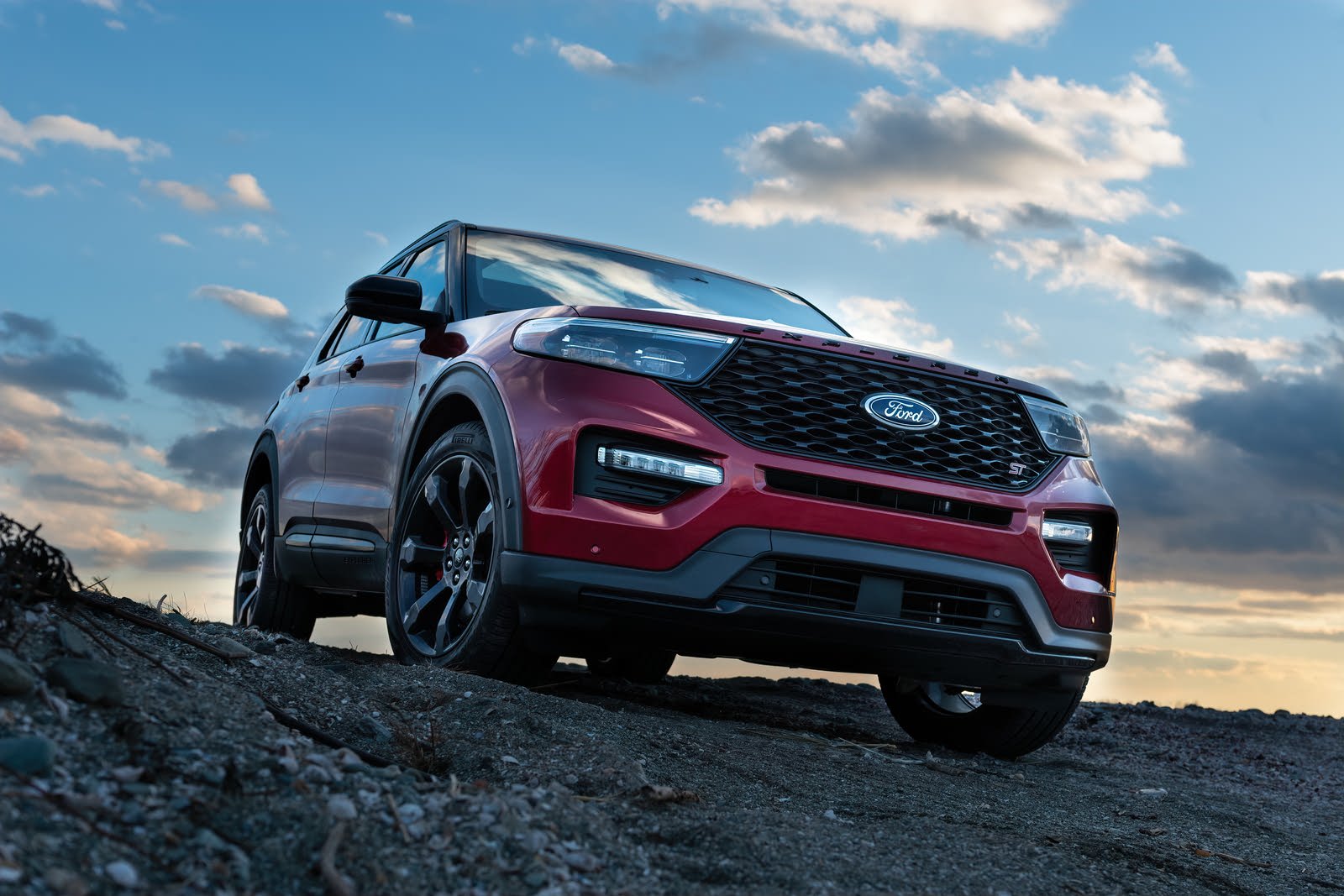
The 2020 Ford Explorer was a striking vehicle, boasting a more refined and athletic design compared to its predecessors. Its widened headlights, extra-large grille, and italic "Explorer" lettering on the hood gave it a prominent and recognizable face. The ST version, with its black 21-inch rims, blacked-out trim, red brake calipers, and quad exhaust pipes, was particularly eye-catching. However, the interior left much to be desired. Despite the high price tag, the materials felt subpar, with low-grade vinyl and rough-grained plastic dominating the cabin. The all-black interior of the ST trim, although broken up by some aluminum speaker covers and white stitching, felt monotonous and lacked the luxury expected at this price point.
The 2021 Lincoln Aviator, on the other hand, nailed the styling with its crisp lines and chrome accents, making it one of the sharpest-looking cars in its class. The interior was a significant step up from its Ford counterpart, offering a cabin defined by comfort and warmth. Soft-touch materials, a standard 10.1-inch touchscreen, and a piano button shifter added to the luxurious feel. The Aviator's cabin was not only stylish but also functional, with features like soothing chimes for alerts and a well-laid-out button shifter contributing to an air of class and sophistication.


The 2020 Ford Explorer offered a range of engines, with the standout being the 3.0-liter twin-turbo V6 in the ST trim, producing 400 horsepower and 415 pound-feet of torque. This engine, paired with a 10-speed automatic transmission, delivered smooth and addictive power. The rear-wheel-drive chassis provided a balanced and nimble driving experience, especially in the ST trim, where the suspension and steering were finely tuned. The Explorer also offered a 2.3-liter turbo inline-four engine with 300 hp and 310 lb-ft, and a gas-electric hybrid option with a net 318 hp. Towing capacity varied from 5,000 to 5,600 pounds, depending on the engine and drivetrain.
The 2021 Lincoln Aviator also featured a 3.0-liter twin-turbo V6, producing 400 hp and 415 lb-ft of torque, available in both rear-wheel and all-wheel drive. The Grand Touring and Grand Touring Black Label trims added a plug-in hybrid configuration, boosting output to 494 hp and 630 lb-ft of torque. This hybrid powertrain provided brisk acceleration and a smooth swell of power, although the Aviator's heft was noticeable in corners. The drive mode selector offered options like "Excite" and "Conserve," enhancing the driving experience. The Aviator was well-suited for highways and suburban driving but struggled in tight city spaces.
The 2020 Ford Explorer excelled in interior space, offering ample room for passengers and cargo. The second row felt like first class, with air vents, USB ports, and a panoramic moonroof. The third row was more spacious than previous models, accommodating six-foot-tall adults for short journeys. Cargo space measured 18 cubic feet behind the third row, 48 cubic feet behind the second row, and 88 cubic feet with all seats folded. The Explorer's physical knobs and switches made it user-friendly, although the thick D-pillars and fuzzy 360-degree cameras were drawbacks.
The 2021 Lincoln Aviator provided 18.3 cubic feet of cargo space behind the third row, expanding to 41.8 cubic feet with the third row folded, and 77.7 cubic feet with all rear seats down. The second row, especially in the Grand Touring trim, was the highlight, featuring captain's chairs, a center console, and a digital control panel. The use of power-button door releases was a potential issue, but overall, the Aviator's interior was spacious and luxurious.
The 2020 Ford Explorer came standard with an 8-inch touchscreen, Sync 3 infotainment, Apple CarPlay, Android Auto, and 4G WiFi. Higher trims offered a 10-inch vertical touchscreen and a 12-inch digital instrument cluster. While the infotainment system was user-friendly, it lacked innovation, and the digital instrument panel felt unfinished. The Co-Pilot360 Assist+ system provided semi-automated driving features but was not as refined as competitors' systems.
The 2021 Lincoln Aviator featured a 10.1-inch touchscreen with the Sync 3 infotainment system, offering a more natural landscape layout. The system was intuitive, with large icons for Apple CarPlay and Android Auto. The Aviator also had a fully digital instrument panel and an optional head-up display with crisp graphics. The technology in the Aviator was well-executed and user-friendly, enhancing the overall driving experience.
The 2020 Ford Explorer came with Ford Co-Pilot 360, which included forward emergency braking, blind-spot monitoring, auto high beams, and lane-keep assist. The Assist+ option added adaptive cruise control and reverse braking, although the latter was prone to false activations. The Explorer had not been fully tested by the NHTSA but scored Acceptable in the IIHS small overlap test on the driver's side.
The 2021 Lincoln Aviator was well-equipped with standard safety features, including automatic emergency braking, lane departure warning, automatic high beams, blind-spot monitoring, and front-and-rear parking sensors. The Co-Pilot 360 Plus package added reverse automatic braking, self-parking functionality, and adaptive cruise control. The Aviator earned top marks from both the NHTSA and IIHS, including a Top Safety Pick accolade.
CarGurus highlights

According to CarGurus experts, the overall rating for the 2020 Ford Explorer is 7.2 out of 10, while the 2021 Lincoln Aviator scores 7.8 out of 10. Based on these ratings, the 2021 Lincoln Aviator is the better choice, offering a more luxurious interior, advanced technology, and superior safety features.
Choose the 2020 Ford Explorer if:
- You prioritize a powerful and nimble driving experience.
- You need ample interior space for passengers and cargo.
- You prefer physical knobs and switches for ease of use.


Choose the 2021 Lincoln Aviator if:
- You seek a luxurious and comfortable interior with high-quality materials.
- You want advanced technology and intuitive infotainment.
- You value top-tier safety ratings and comprehensive driver assistance features.


CarGurus highlights
According to CarGurus experts, the overall rating for the 2020 Ford Explorer is 7.2 out of 10, while the 2021 Lincoln Aviator scores 7.8 out of 10. Based on these ratings, the 2021 Lincoln Aviator is the better choice, offering a more luxurious interior, advanced technology, and superior safety features.
Choose the 2020 Ford Explorer if:
Shop Now- You prioritize a powerful and nimble driving experience.
- You need ample interior space for passengers and cargo.
- You prefer physical knobs and switches for ease of use.
Choose the 2021 Lincoln Aviator if:
Shop Now- You seek a luxurious and comfortable interior with high-quality materials.
- You want advanced technology and intuitive infotainment.
- You value top-tier safety ratings and comprehensive driver assistance features.

By: CarGurus + AI
At CarGurus, our team of experienced automotive writers remain at the heart of our content operation, conducting hands-on car tests and writing insightful guides that are backed by years of industry experience. To complement this, we are harnessing AI to make our content offering more diverse and more helpful to shoppers than ever. To achieve this, our AI systems are based exclusively on CarGurus content, ratings and data, so that what we produce is both unique to CarGurus, and uniquely helpful to car shoppers.

