2020 Ford Explorer vs 2021 Toyota Sequoia

Overview | |
MSRP$32,765 | MSRP$50,400 |
Listings533 | Listings20 |
Ratings & Reviews | |
User Reviews | User Reviews |
Expert reviews7.2 out of 10 | Expert reviews7.0 out of 10 |
Pros
Cons
| Pros
Cons
|
2020 Ford Explorer Reviews SummaryFor nearly 30 years, the Ford Explorer has settled into the American lexicon like Cheerios. We've gobbled up millions of them, from the rock-crawling Eddie Bauers of the 1990s to the brand-new ST that can take down sports cars. The 2020 Explorer brings an all-new chassis, cranks up the technology, and introduces hybrid and high-performance powertrains in a space the size of a small living room. The Explorer's also getting very expensive while other automakers catch on to Ford's winning formula—for a lot less money. | |
2021 Toyota Sequoia Reviews SummaryLook around on the road today, and you are bound to see SUVs of all shapes and sizes. From three-row family haulers to subcompact runabouts. There is an SUV for nearly every need and every budget. The 2021 Toyota Sequoia might feel like it's from an earlier wave of the SUV craze, and that’s because it is. Born out of the 1990s SUV-excess-fest, the Sequoia has evolved into a niche vehicle for those who need serious space and truck-like capability. The current generation of the Sequoia has been around for almost 15 years, and while Toyota has updated it in several ways, there’s no avoiding its age. Even with modern tech and safety features, this is still an aging beast. Can such a dated vehicle still be relevant in the modern car market? And is age really that important to buyers who are looking for tons of space and standard V8 power? Read on to find out. | |
No video found | |
Popular Features & Specs | |
Engine2.3L 300 hp I4 | Engine5.7L 381 hp V8 |
Drive TrainRWD | Drive Train4X2 |
Seating Capacity7 | Seating Capacity8 |
Horsepower | Horsepower381 hp @ 5600 rpm |
MPG City21 | MPG City13 |
MPG Highway28 | MPG Highway17 |
Engine | |
Engine Name2.3L 300 hp I4 | Engine Name5.7L 381 hp V8 |
Torque | Torque401 lb-ft @ 3600 rpm |
Horsepower | Horsepower381 hp @ 5600 rpm |
DrivetrainRWD | Drivetrain4X2 |
Fuel Economy | |
MPG City21 | MPG City13 |
MPG Highway28 | MPG Highway17 |
Interior | |
Seating Capacity7 | Seating Capacity8 |
Key Features | |
Sunroof/Moonroof | Sunroof/MoonroofStandard |
Safety | |
Front Crash Overall5 | Front Crash Overall |
Side Crash Overall5 | Side Crash Overall |
Dimensions & Capacity | |
Cargo Space18.2 cu ft | Cargo Space18.9 cu ft |
Curb Weight4345 lbs | Curb Weight5730 lbs |
Height69.9 in | Height77.0 in |
Length198.8 in | Length205.1 in |
Width89.3 in | Width79.9 in |
Wheelbase119.1 in | Wheelbase122.0 in |
Maximum Payload1425 lbs | Maximum Payload1405 lbs |
Number of doors4 | Number of doors4 |
Maximum Towing Capacity5300 lbs | Maximum Towing Capacity7400 lbs |
Standard Towing Capacity | Standard Towing Capacity7400 lbs |
Overview | ||
MSRP | $32,765 | $50,400 |
Listings | ||
Ratings & Reviews | ||
User reviews | ||
Expert reviews | 7.2 out of 10Read full review | 7.0 out of 10Read full review |
Pros & cons | Pros
Cons
| Pros
Cons
|
Summary | For nearly 30 years, the Ford Explorer has settled into the American lexicon like Cheerios. We've gobbled up millions of them, from the rock-crawling Eddie Bauers of the 1990s to the brand-new ST that can take down sports cars. The 2020 Explorer brings an all-new chassis, cranks up the technology, and introduces hybrid and high-performance powertrains in a space the size of a small living room. The Explorer's also getting very expensive while other automakers catch on to Ford's winning formula—for a lot less money. | Look around on the road today, and you are bound to see SUVs of all shapes and sizes. From three-row family haulers to subcompact runabouts. There is an SUV for nearly every need and every budget. The 2021 Toyota Sequoia might feel like it's from an earlier wave of the SUV craze, and that’s because it is. Born out of the 1990s SUV-excess-fest, the Sequoia has evolved into a niche vehicle for those who need serious space and truck-like capability. The current generation of the Sequoia has been around for almost 15 years, and while Toyota has updated it in several ways, there’s no avoiding its age. Even with modern tech and safety features, this is still an aging beast. Can such a dated vehicle still be relevant in the modern car market? And is age really that important to buyers who are looking for tons of space and standard V8 power? Read on to find out. |
Video | No video found | |
Popular Features & Specs | ||
Engine | 2.3L 300 hp I4 | 5.7L 381 hp V8 |
Drive Train | RWD | 4X2 |
Seating Capacity | 7 | 8 |
Horsepower | 381 hp @ 5600 rpm | |
MPG City | 21 | 13 |
MPG Highway | 28 | 17 |
Engine | ||
Engine Name | 2.3L 300 hp I4 | 5.7L 381 hp V8 |
Torque | 401 lb-ft @ 3600 rpm | |
Horsepower | 381 hp @ 5600 rpm | |
Drivetrain | RWD | 4X2 |
Fuel Economy | ||
MPG City | 21 | 13 |
MPG Highway | 28 | 17 |
Interior | ||
Seating Capacity | 7 | 8 |
Key Features | ||
Sunroof/Moonroof | Standard | |
Safety | ||
Front Crash Overall | 5 | |
Side Crash Overall | 5 | |
Dimensions & Capacity | ||
Cargo Space | 18.2 cu ft | 18.9 cu ft |
Curb Weight | 4345 lbs | 5730 lbs |
Height | 69.9 in | 77.0 in |
Length | 198.8 in | 205.1 in |
Width | 89.3 in | 79.9 in |
Wheelbase | 119.1 in | 122.0 in |
Maximum Payload | 1425 lbs | 1405 lbs |
Number of doors | 4 | 4 |
Maximum Towing Capacity | 5300 lbs | 7400 lbs |
Standard Towing Capacity | 7400 lbs | |
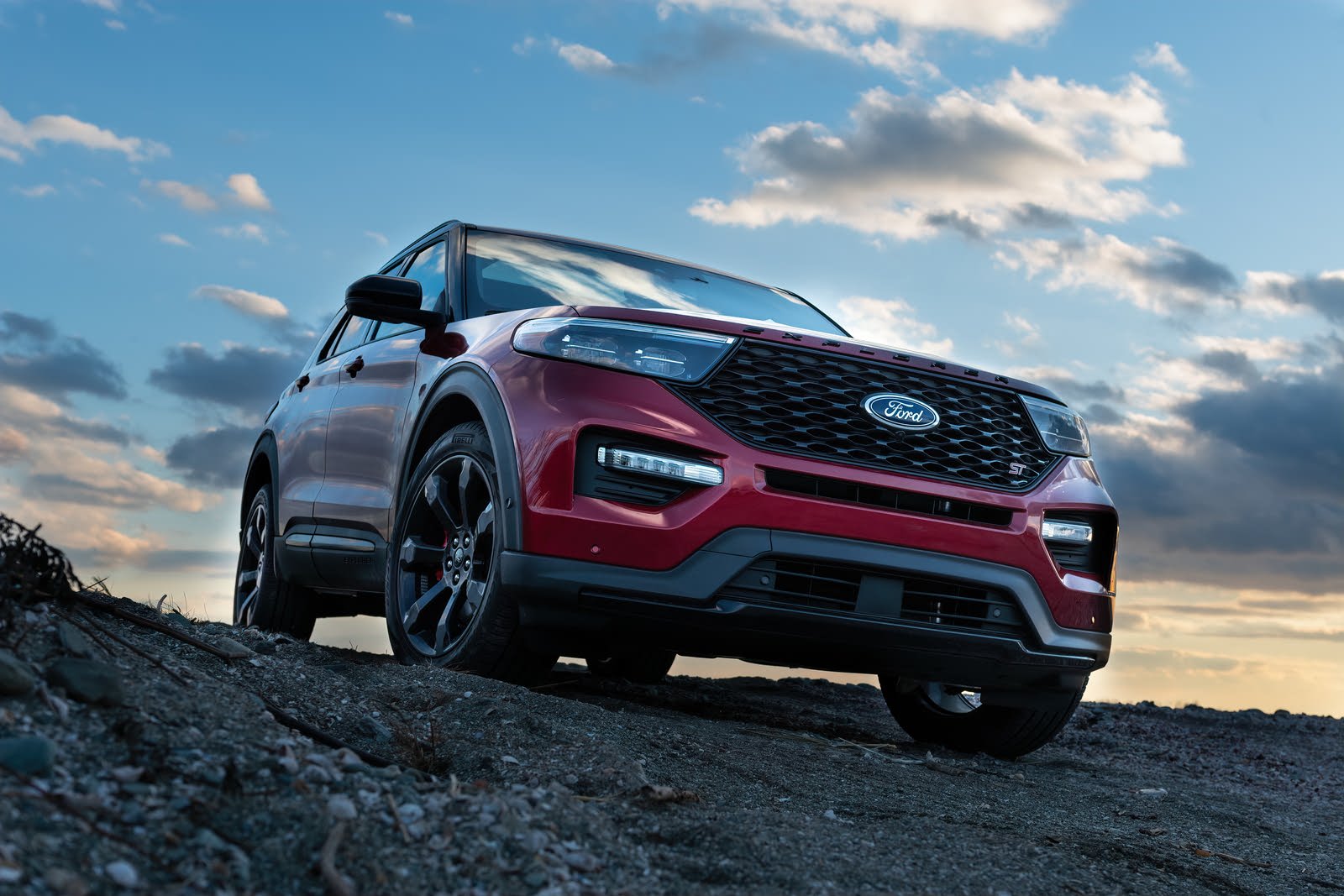
The 2020 Ford Explorer was a striking vehicle, boasting a more refined and athletic design compared to its predecessors. Its widened headlights, large grille, and distinctive "Explorer" lettering on the hood gave it a recognizable and bold presence. The ST version, with its blacked-out trim and sporty features, was particularly eye-catching. However, the interior left much to be desired, with materials that felt subpar for its price range. Despite its high cost, the Explorer's interior did not match the luxury of similarly priced competitors, making it feel overpriced for what it offered.
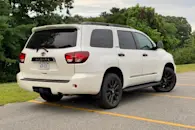
In contrast, the 2021 Toyota Sequoia, though dated in design, offered a robust and imposing silhouette. The subtle updates from 2018, including the grille and headlights, were not enough to modernize its appearance fully. Inside, the Sequoia's design felt reminiscent of the mid-2000s, with a massive center dash and a small touchscreen that seemed out of place. Despite its age, the Sequoia provided a comfortable and spacious cabin, especially in the second row, where passengers enjoyed ample headroom and legroom. The seats were supportive, making long journeys more pleasant.









The 2020 Ford Explorer offered a range of powerful engines, with the standout being the 3.0-liter twin-turbo V6 in the ST trim, delivering 400 horsepower and 415 pound-feet of torque. This engine, paired with a 10-speed automatic transmission, provided smooth and addictive power delivery. The Explorer's rear-wheel-drive chassis contributed to its nimble handling and flat cornering, making it a joy to drive. The Explorer also offered a 2.3-liter turbo inline-four engine with 300 horsepower and a hybrid option with a net 318 horsepower. Towing capacities varied, with the V6 AWD capable of towing up to 5,600 pounds.
The 2021 Toyota Sequoia came standard with a 5.7-liter V8 engine, producing 381 horsepower and 401 pound-feet of torque. This engine, paired with a six-speed automatic transmission, provided strong acceleration despite the Sequoia's hefty weight. The Sequoia's driving dynamics were reminiscent of a truck, with a soft suspension and strong brakes. It could tow up to 7,400 pounds, which was less than some competitors but still respectable. The Sequoia's driving experience was characterized by its robust V8 and truck-like feel, appealing to those who preferred a more traditional SUV experience.
The 2020 Ford Explorer excelled in providing ample interior space, with 18 cubic feet of cargo space behind the third row, 48 cubic feet behind the second row, and 88 cubic feet with all seats folded. The second row felt luxurious with air vents, USB ports, and a panoramic moonroof. The third row was more spacious than previous models, accommodating six-foot-tall adults for short trips. However, the Explorer's thick D-pillars and fuzzy 360-degree cameras created blind spots, detracting from its otherwise intuitive driving experience.
The 2021 Toyota Sequoia offered a cavernous interior, with nearly 19 cubic feet of cargo space behind the third row, over 66 cubic feet with the third row folded, and an impressive 120 cubic feet with all rear seats down. The Sequoia's power-retractable rear window was a unique feature, allowing easy access to the cargo area. While the front-row space could have been better utilized, the Sequoia provided deep in-door pockets and a massive center console, offering plenty of storage options. Despite its age, the Sequoia's interior was practical and spacious.
The 2020 Ford Explorer came equipped with an 8-inch touchscreen featuring Sync 3 infotainment, Apple CarPlay, Android Auto, and 4G WiFi. Higher trims offered a 10-inch vertical touchscreen and a 12-inch digital instrument cluster. While the interface was well-organized, it lacked innovation, and system updates required an external WiFi connection. The Co-Pilot360 Assist+ system offered semi-automated driving features but was not as refined as competitors' systems.
The 2021 Toyota Sequoia featured a 7-inch touchscreen infotainment system with Apple CarPlay, Android Auto, Amazon Alexa, and a WiFi hotspot. Our test model had a larger 9-inch screen, which still felt small on the large dash. The older infotainment system was straightforward to use, with hard buttons for easy navigation. The digital trip computer was small but functional, offering a simple and user-friendly experience.
The 2020 Ford Explorer came standard with Ford Co-Pilot 360, which included forward emergency braking, blind-spot monitoring, auto high beams, and lane-keep assist. The Assist+ option added adaptive cruise control with steering assist and reverse braking. The Explorer had not been fully tested by the NHTSA, but the IIHS rated it Acceptable in the small overlap test on the driver's side.
The 2021 Toyota Sequoia was equipped with the Toyota Safety Sense-P suite, offering forward-collision warning, automatic emergency braking, pedestrian detection, adaptive cruise control, lane-departure warning, and automatic high beams. It also included blind-spot monitoring, rear cross-traffic alert, and front-and-rear parking sensors. The Sequoia scored four out of five stars in the NHTSA's rollover test but had not been rated in other crash tests.
CarGurus highlights
According to CarGurus experts, the overall rating for the 2020 Ford Explorer is 7.2 out of 10, while the 2021 Toyota Sequoia scores 7.0 out of 10. Based on these ratings, the 2020 Ford Explorer is the recommended choice, offering a more modern design, powerful engine options, and a spacious interior.
Choose the 2020 Ford Explorer if:
- You prioritize a modern and athletic exterior design.
- You seek a powerful engine lineup with nimble handling.
- You value spacious interior accommodations and cargo capacity.


Choose the 2021 Toyota Sequoia if:
- You need a large, practical SUV with ample cargo space.
- You appreciate a traditional SUV driving experience with a robust V8 engine.
- You prefer straightforward and user-friendly technology.


CarGurus highlights
According to CarGurus experts, the overall rating for the 2020 Ford Explorer is 7.2 out of 10, while the 2021 Toyota Sequoia scores 7.0 out of 10. Based on these ratings, the 2020 Ford Explorer is the recommended choice, offering a more modern design, powerful engine options, and a spacious interior.
Choose the 2020 Ford Explorer if:
Shop Now- You prioritize a modern and athletic exterior design.
- You seek a powerful engine lineup with nimble handling.
- You value spacious interior accommodations and cargo capacity.
Choose the 2021 Toyota Sequoia if:
Shop Now- You need a large, practical SUV with ample cargo space.
- You appreciate a traditional SUV driving experience with a robust V8 engine.
- You prefer straightforward and user-friendly technology.

By: CarGurus + AI
At CarGurus, our team of experienced automotive writers remain at the heart of our content operation, conducting hands-on car tests and writing insightful guides that are backed by years of industry experience. To complement this, we are harnessing AI to make our content offering more diverse and more helpful to shoppers than ever. To achieve this, our AI systems are based exclusively on CarGurus content, ratings and data, so that what we produce is both unique to CarGurus, and uniquely helpful to car shoppers.

