2020 Ford Explorer vs 2021 Chevrolet Traverse
Overview | |
MSRP$32,765 | MSRP$29,800 |
Listings556 | Listings235 |
Ratings & Reviews | |
User Reviews | User Reviews |
Expert reviews7.2 out of 10 | Expert reviews6.7 out of 10 |
Pros
Cons
| Pros
Cons
|
2020 Ford Explorer Reviews SummaryFor nearly 30 years, the Ford Explorer has settled into the American lexicon like Cheerios. We've gobbled up millions of them, from the rock-crawling Eddie Bauers of the 1990s to the brand-new ST that can take down sports cars. The 2020 Explorer brings an all-new chassis, cranks up the technology, and introduces hybrid and high-performance powertrains in a space the size of a small living room. The Explorer's also getting very expensive while other automakers catch on to Ford's winning formula—for a lot less money. | |
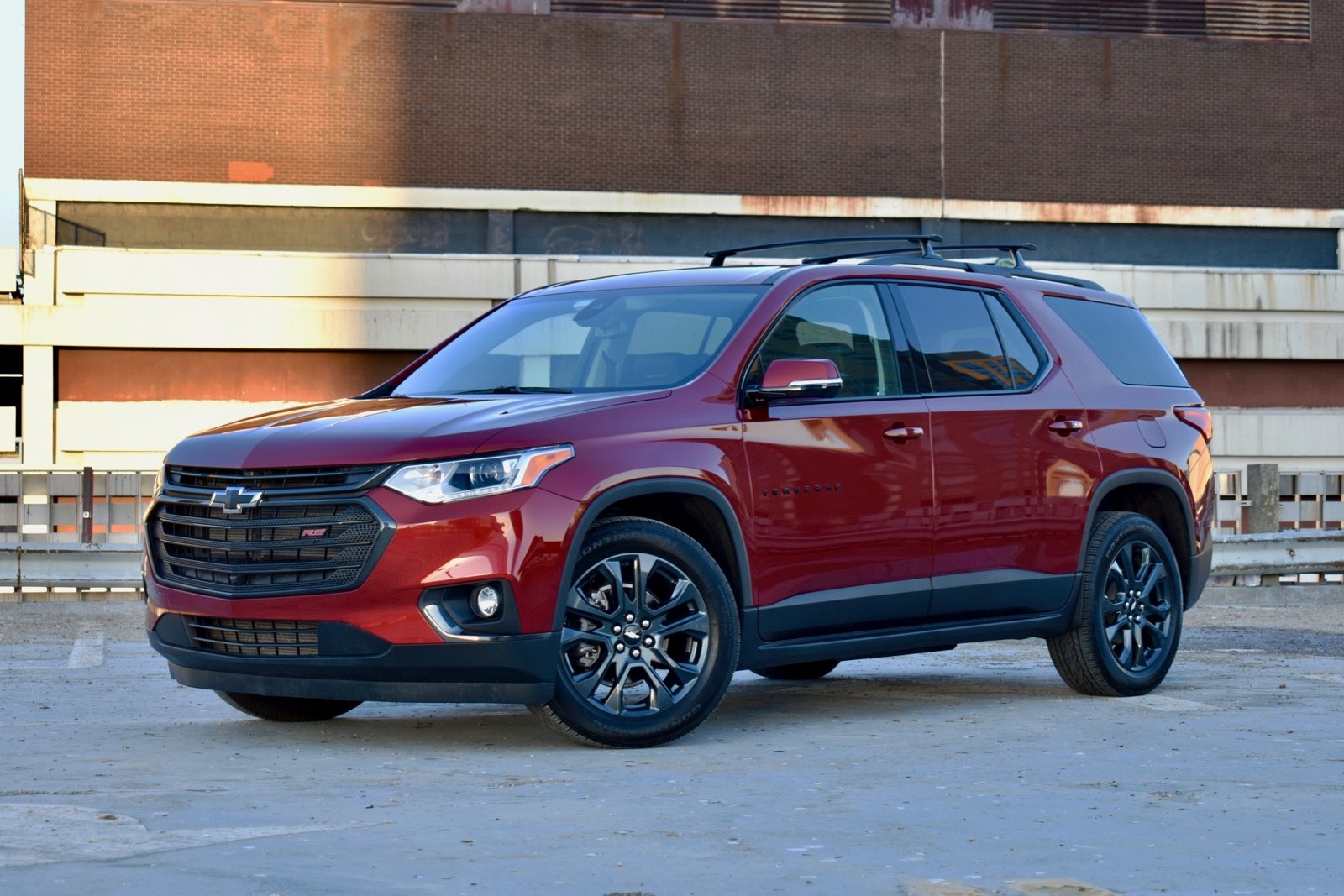
2021 Chevrolet Traverse Reviews SummaryLike a geological core sample, you can chart the evolution of the American family car by looking at the Chevrolet lineup. Go back a few decades and you have tail-finned and wood-paneled station wagons, then Lumina APV “Dustbuster” minivans. Today, you have the 2021 Chevrolet Traverse. The Traverse is a three-row crossover of the type that has largely eliminated the minivan from showrooms. As the new default choice for larger families, the three-row crossover has spawned a competitive market segment, encompassing the Ford Explorer, Honda Pilot, Hyundai Palisade, Kia Telluride, Mazda CX-9, Nissan Pathfinder, Subaru Ascent, Toyota Highlander, and Volkswagen Atlas. So buyers aren’t exactly lacking in choices here. The current-generation Traverse dates back to the 2018 model year, so it’s not the newest vehicle in the segment, but still fairly fresh. Chevy had some updates planned for the 2021 model year—including minor styling changes and wireless Apple CarPlay/Android Auto connectivity—but they’ve been pushed to 2022. However, these changes don’t appear significant enough to justify waiting around for the 2022 Traverse, which is scheduled to reach dealerships later this year. For 2021, the Traverse is available in L, LS, LT Cloth, LT Leather, RS, Premier, and High Country trim levels, with standard front-wheel drive (FWD) or optional all-wheel drive (AWD). Our test car was an AWD Traverse RS model. | |
No video found | |
Popular Features & Specs | |
Engine2.3L 300 hp I4 | Engine3.6L 310 hp V6 |
DrivetrainRWD | DrivetrainFWD |
Seating Capacity7 | Seating Capacity8 |
Horsepower | Horsepower310 hp @ 6800 rpm |
MPG City21 | MPG City18 |
MPG Highway28 | MPG Highway27 |
Engine | |
Engine Name2.3L 300 hp I4 | Engine Name3.6L 310 hp V6 |
Torque | Torque266 lb-ft @ 2800 rpm |
Horsepower | Horsepower310 hp @ 6800 rpm |
DrivetrainRWD | DrivetrainFWD |
Fuel Economy | |
MPG City21 | MPG City18 |
MPG Highway28 | MPG Highway27 |
Interior | |
Seating Capacity7 | Seating Capacity8 |
Safety | |
Front Crash Overall5 | Front Crash Overall4 |
Side Crash Overall5 | Side Crash Overall5 |
Dimensions & Capacity | |
Cargo Space18.2 cu ft | Cargo Space23.0 cu ft |
Curb Weight4345 lbs | Curb Weight4362 lbs |
Height69.9 in | Height70.7 in |
Length198.8 in | Length204.3 in |
Width89.3 in | Width78.6 in |
Wheelbase119.1 in | Wheelbase120.9 in |
Maximum Payload1425 lbs | Maximum Payload1798 lbs |
Number of doors4 | Number of doors4 |
Maximum Towing Capacity5300 lbs | Maximum Towing Capacity |
Overview | ||
MSRP | $32,765 | $29,800 |
Listings | ||
Ratings & Reviews | ||
User reviews | ||
Expert reviews | 7.2 out of 10Read full review | 6.7 out of 10Read full review |
Pros & cons | Pros
Cons
| Pros
Cons
|
Summary | For nearly 30 years, the Ford Explorer has settled into the American lexicon like Cheerios. We've gobbled up millions of them, from the rock-crawling Eddie Bauers of the 1990s to the brand-new ST that can take down sports cars. The 2020 Explorer brings an all-new chassis, cranks up the technology, and introduces hybrid and high-performance powertrains in a space the size of a small living room. The Explorer's also getting very expensive while other automakers catch on to Ford's winning formula—for a lot less money. | Like a geological core sample, you can chart the evolution of the American family car by looking at the Chevrolet lineup. Go back a few decades and you have tail-finned and wood-paneled station wagons, then Lumina APV “Dustbuster” minivans. Today, you have the 2021 Chevrolet Traverse. The Traverse is a three-row crossover of the type that has largely eliminated the minivan from showrooms. As the new default choice for larger families, the three-row crossover has spawned a competitive market segment, encompassing the Ford Explorer, Honda Pilot, Hyundai Palisade, Kia Telluride, Mazda CX-9, Nissan Pathfinder, Subaru Ascent, Toyota Highlander, and Volkswagen Atlas. So buyers aren’t exactly lacking in choices here. The current-generation Traverse dates back to the 2018 model year, so it’s not the newest vehicle in the segment, but still fairly fresh. Chevy had some updates planned for the 2021 model year—including minor styling changes and wireless Apple CarPlay/Android Auto connectivity—but they’ve been pushed to 2022. However, these changes don’t appear significant enough to justify waiting around for the 2022 Traverse, which is scheduled to reach dealerships later this year. For 2021, the Traverse is available in L, LS, LT Cloth, LT Leather, RS, Premier, and High Country trim levels, with standard front-wheel drive (FWD) or optional all-wheel drive (AWD). Our test car was an AWD Traverse RS model. |
Video | No video found | |
Popular Features & Specs | ||
Engine | 2.3L 300 hp I4 | 3.6L 310 hp V6 |
Drivetrain | RWD | FWD |
Seating Capacity | 7 | 8 |
Horsepower | 310 hp @ 6800 rpm | |
MPG City | 21 | 18 |
MPG Highway | 28 | 27 |
Engine | ||
Engine Name | 2.3L 300 hp I4 | 3.6L 310 hp V6 |
Torque | 266 lb-ft @ 2800 rpm | |
Horsepower | 310 hp @ 6800 rpm | |
Drivetrain | RWD | FWD |
Fuel Economy | ||
MPG City | 21 | 18 |
MPG Highway | 28 | 27 |
Interior | ||
Seating Capacity | 7 | 8 |
Safety | ||
Front Crash Overall | 5 | 4 |
Side Crash Overall | 5 | 5 |
Dimensions & Capacity | ||
Cargo Space | 18.2 cu ft | 23.0 cu ft |
Curb Weight | 4345 lbs | 4362 lbs |
Height | 69.9 in | 70.7 in |
Length | 198.8 in | 204.3 in |
Width | 89.3 in | 78.6 in |
Wheelbase | 119.1 in | 120.9 in |
Maximum Payload | 1425 lbs | 1798 lbs |
Number of doors | 4 | 4 |
Maximum Towing Capacity | 5300 lbs | |
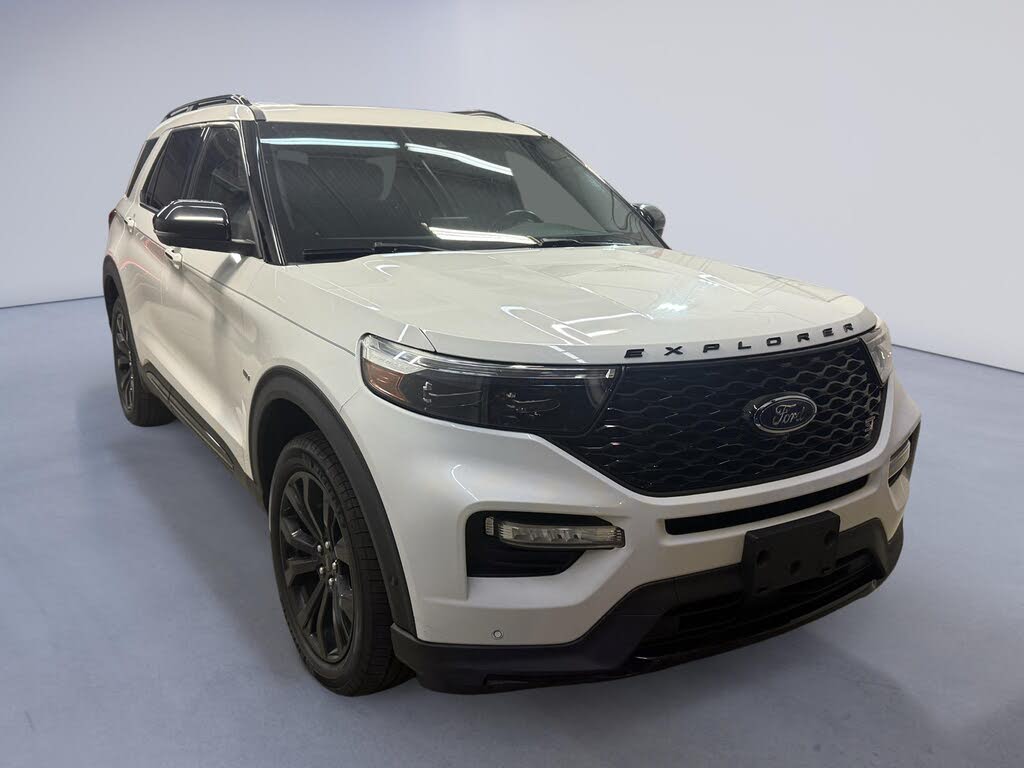
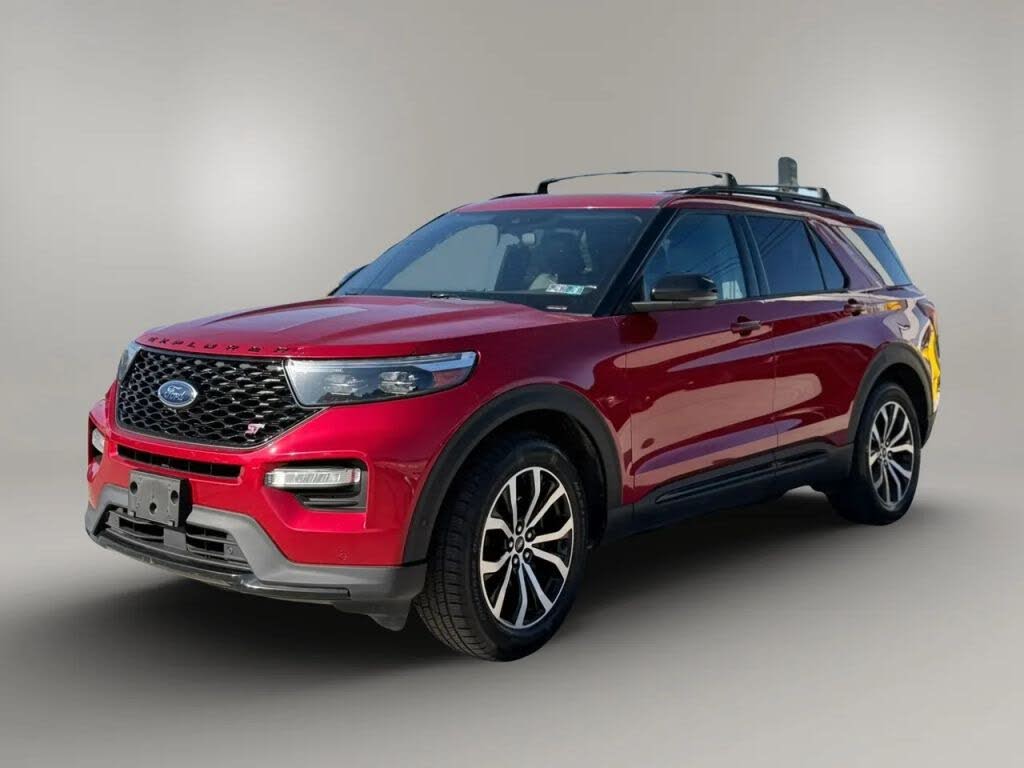
In 2020, the Ford Explorer stood out with its strikingly handsome design. Often compared to the Land Rover Discovery, the Explorer refined an upscale and utilitarian look, making it a scorcher despite its bulky 3-row structure. The body panels saw a reduction in excess material, particularly at the rear, giving this SUV a leaner and more athletic appearance. Ford paid special attention to the front, where widened headlights, a mammoth grille, and italic "Explorer" lettering on the hood's edge gave it a prominent face. The ST model, featuring black 21-inch rims, blacked-out trim, red brake calipers, vibrant Rapid Red paint, and quad exhaust pipes, especially turned heads. Ownership pride was palpable.
The interior, however, presented a different story. Priced at $60,000 in high trims, the materials felt subpar. Ford labeled low-grade vinyl as leather, and copious amounts of coarse, rough-textured plastic adorned door panels and the center console. Even fake carbon-fiber trim made an appearance. With a comfort level comparative to the Kia Telluride, which cost significantly less, the interior texture and material choices set the Explorer for disappointment. The padded dashboard, aluminum speaker covers, and white stitching offered minor relief, but overall, the interior fell short of what one might expect at that price point.
Comparatively, the 2021 Chevrolet Traverse opted for a more standardized SUV aesthetic but made creative use of trim-level details to distinguish itself. While the Explorer and Kia Telluride had slightly more charisma, the Traverse struck a balance with its tall roof, beefy wheel arches, and a commanding grille. Especially in the RS model, blacked-out trim brought elegance, while the High Country model added distinguishable chrome touches. The Traverse even offered appearance packages like Redline, Sport, and Midnight to spice things up.
Where the Traverse lacked radical interior design changes, it compensated with practical features. Unlike the Ford, Chevy offered a more restrained, cohesive interior. A highlight was the optional Dual SkyScape sunroof. Materials in the RS felt solid for GM's reputation, though the $50,000 price tag still put it below luxury levels. Just like the Explorer's ST trim, functional but unspectacular.


The 2020 Ford Explorer offered a range of powerful engines, starting with the impressive 3.0-liter twin-turbo V6 that delivered 400 horsepower and 415 pound-feet of torque in the ST trim. This engine, previewed by Ford Performance engineers, lent crisp handling and superb ride quality. Even though it lacked adaptive dampers, the Explorer ST turned corners with remarkable precision and maintained a flat stance. Brake performance was equally impressive. The 10-speed automatic transmission supported the powertrain well, despite occasional jerky downshifts. Sport mode, instead of erratically revving the engine, maintained balanced power delivery and a composed transmission state, setting it apart among non-luxury SUVs.
The standard engine for the majority of Explorer models was the 2.3-liter turbo inline-four, generating a robust 300 horsepower and 310 pound-feet of torque. Additionally, the gas-electric hybrid option in the Limited trim combined a 3.3-liter V6 with an electric motor for a net 318 horsepower. Despite its high rating, this hybrid didn’t provide significant fuel economy benefits, rendering it a questionable choice. The turbo V6 engines, particularly in ST and Platinum trims with AWD, were less fuel-efficient, averaging 18 mpg. Towing capacities varied, with the standard 4-cylinder engine capable of 5,300 pounds and the AWD V6 pulling up to 5,600 pounds, making it suitable for heavier loads.
The 2021 Chevrolet Traverse came with a single engine option: a 3.6-liter V6 producing 310 horsepower and 266 pound-feet of torque. Although not as potent off the line as some might expect, the Traverse’s V6 provided adequate power for highway merging and overtaking maneuvers. The nine-speed automatic transmission generally performed well but occasionally faltered with rough shifts.
The Traverse excelled on highways, blending quietness—thanks to active noise cancellation—and a smooth, absorbing suspension. This combination provided a harmonious ride quality. However, on twisty roads, the Traverse’s lack of agility showed compared to other three-row crossovers. Its AWD system required manual activation and had torque vectoring capabilities, which, though impressive on paper, lacked tangible impact on handling. Towing capacity matched the Explorer hybrid’s at 5,000 pounds, adequate but not exceptional in the segment.
The 2020 Ford Explorer excelled in passenger comfort and cargo versatility. On a long road trip with my parents, the second-row amenities created a first-class experience thanks to ample USB ports, multiple air vents, a center console, and an expansive panoramic moonroof. The reconfiguration provided extra headroom, particularly in the third row, allowing six-foot-tall adults to fit comfortably for short journeys. The second-row captain’s chairs could spring forward at the push of a button for easy access to the third row. However, the cargo area behind the third row was slightly reduced to 18 cubic feet from the previous year's 21 cubic feet. Overall cargo space was generous at 48 cubic feet with the second row down and 88 cubic feet with all seats folded. Despite some issues with visibility from thick D-pillars and subpar 360-degree cameras, the Explorer offered a relatively stress-free and intuitive driving experience.
The 2021 Chevrolet Traverse offered flexible seating configurations for seven or eight passengers. Interior headroom and legroom were commendable but not segment-leading. Heated front seats came standard on the RS trim, with ventilated front seats and heated outboard rear seats available on higher trims.
Where the Traverse truly shined was in cargo capacity. With 23 cubic feet behind the third row, 57.8 cubic feet behind the second row, and a generous 98.2 cubic feet with all rear seats folded, the Traverse outclassed many of its competitors. A power liftgate was available from the LT Cloth trim level upwards, with a gesture-activated liftgate on Premier and High Country trims. A power 60/40 split-folding third row came standard on RS and higher trims.
For interior storage, the Traverse was somewhat limited compared to its ample cargo space. Although it had fewer nooks and crannies for smaller items, it maintained practicality, especially compared to alternatives like minivans, which offer more ease for loading and unloading passengers and cargo.
The 2020 Ford Explorer came standard with an 8-inch touchscreen featuring Sync 3 infotainment, Apple CarPlay, Android Auto, 4G WiFi, keyless entry, remote start, and 3-zone climate control. Higher trims, such as the ST and Platinum, could upgrade to a 10-inch vertical touchscreen and a 12-inch digital instrument cluster. While this larger screen enhanced map visibility and organization, it lacked significant innovation. Co-Pilot360 Assist+ bundled semi-automated driving capabilities, which required substantial refinement. Adaptive cruise control, while fancy with its different lead car animations, could benefit from usability improvements.
The 2021 Chevrolet Traverse also packed a robust technology suite. Its standard 7-inch touchscreen came with Apple CarPlay/Android Auto, and Bluetooth compatibility, while higher trims featured an 8-inch touchscreen, navigation, 4G-LTE WiFi hotspot, and a Bose 10-speaker audio system. Despite the Ford's larger screens, Chevy’s straightforward interface proved efficient with large, user-friendly icons and maintained analog audio and climate controls.
The Traverse also offered a rearview camera mirror and an HD surround-view camera system. These features significantly enhanced visibility and maneuverability. Standard across all trims were two USB ports per row, whereas wireless charging was reserved for Premier and High Country models.
The 2020 Ford Explorer came equipped with Ford Co-Pilot 360, which included forward emergency braking, blind-spot monitoring, auto high beams, and lane-keep assist. The Co-Pilot360 Assist+ added adaptive cruise control with steering assist and reverse braking, which, although helpful, had occasional false positives. A passenger front knee airbag was also standard. The Explorer received an 'Acceptable' rating from the IIHS in the small overlap test on the driver’s side.
The 2021 Chevrolet Traverse earned top "Good" scores in all crash tests from the IIHS and the highest "Superior" rating for front-crash prevention. However, it received varied headlight ratings and an "Acceptable" for LATCH ease of use. The NHTSA rated it five stars overall, with four stars for frontal and rollover crash tests and five stars for side impacts.
Chevy’s standard driver-assist technology lagged behind competitors. Features like adaptive cruise control were only available on the top High Country trim, whereas other vehicles offered these as standard. Automatic emergency braking, forward-collision warning, lane-keep assist, lane-departure warning, automatic high beams, blind-spot monitoring, and rear cross-traffic alert were additional options but not standard features.
CarGurus highlights
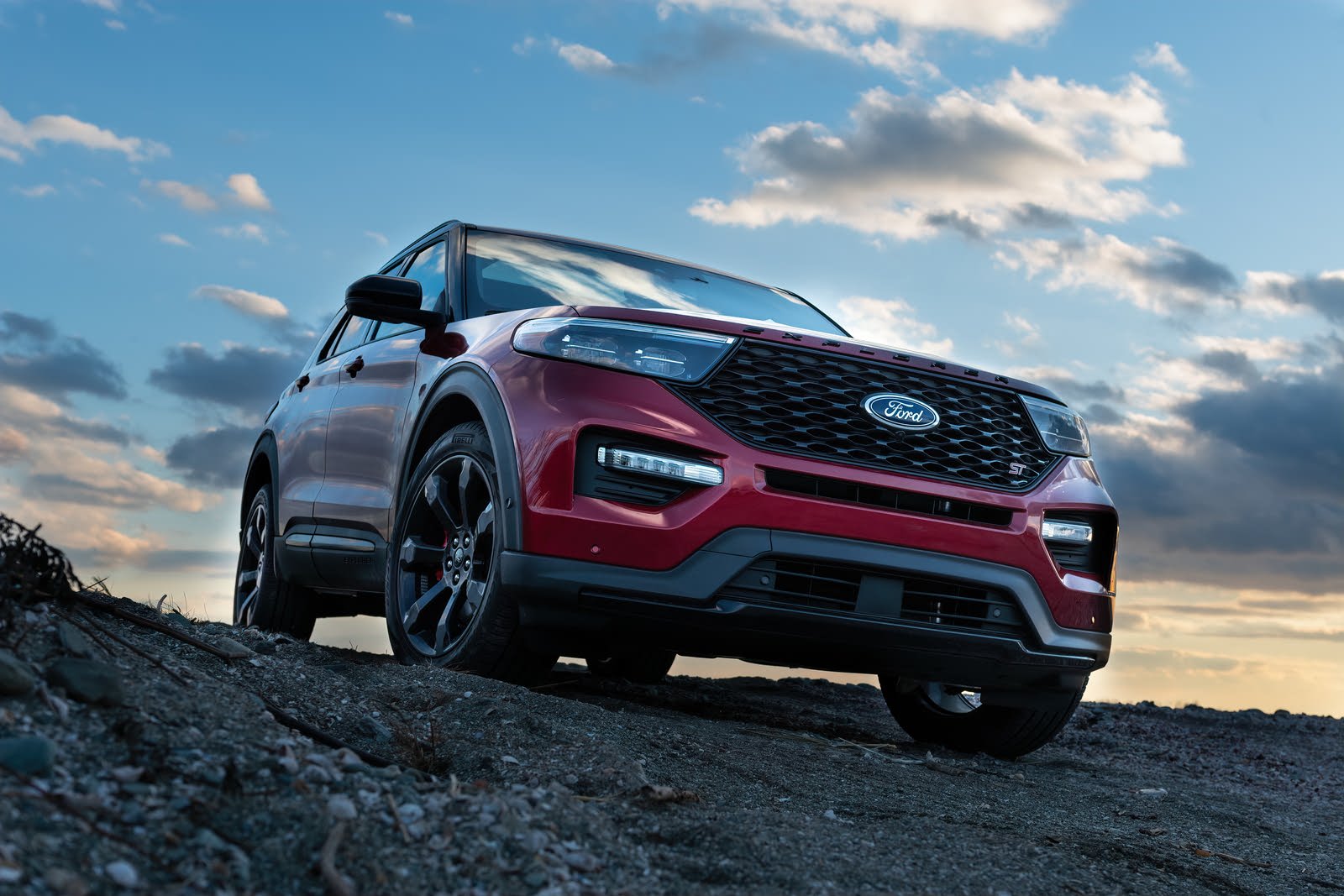
According to CarGurus experts, the overall rating for the 2020 Ford Explorer is 7.2 out of 10, while the 2021 Chevrolet Traverse scores 6.7 out of 10. Although both vehicles have their strengths, the Ford Explorer takes the lead with its more powerful engine lineup, more comprehensive safety features, and better driving dynamics. The Traverse, although commendable for its cargo space and road manners, ultimately falls short in overall refinement and advanced tech features. Therefore, the Ford Explorer emerges as the preferable choice based on these aspects.
Choose the 2020 Ford Explorer if:
- You prioritize powerful engine options and responsive handling.
- You value flexible and spacious interior configurations for passengers.
- Standard advanced safety features and robust infotainment options are essential.





Choose the 2021 Chevrolet Traverse if:
- Cargo capacity and standard usability are your top priorities.
- You want a balanced blend of functionality and quietly comfortable highway driving.
- Simplicity and efficient basic tech features matter more than having the latest in-car tech advancements.


CarGurus highlights
According to CarGurus experts, the overall rating for the 2020 Ford Explorer is 7.2 out of 10, while the 2021 Chevrolet Traverse scores 6.7 out of 10. Although both vehicles have their strengths, the Ford Explorer takes the lead with its more powerful engine lineup, more comprehensive safety features, and better driving dynamics. The Traverse, although commendable for its cargo space and road manners, ultimately falls short in overall refinement and advanced tech features. Therefore, the Ford Explorer emerges as the preferable choice based on these aspects.
Choose the 2020 Ford Explorer if:
Shop Now- You prioritize powerful engine options and responsive handling.
- You value flexible and spacious interior configurations for passengers.
- Standard advanced safety features and robust infotainment options are essential.
Choose the 2021 Chevrolet Traverse if:
Shop Now- Cargo capacity and standard usability are your top priorities.
- You want a balanced blend of functionality and quietly comfortable highway driving.
- Simplicity and efficient basic tech features matter more than having the latest in-car tech advancements.

By: CarGurus + AI
At CarGurus, our team of experienced automotive writers remain at the heart of our content operation, conducting hands-on car tests and writing insightful guides that are backed by years of industry experience. To complement this, we are harnessing AI to make our content offering more diverse and more helpful to shoppers than ever. To achieve this, our AI systems are based exclusively on CarGurus content, ratings and data, so that what we produce is both unique to CarGurus, and uniquely helpful to car shoppers.

