2023 Volkswagen ID.4 vs 2023 Nissan Ariya
Overview | |
MSRP$43,190 | MSRP$38,995 |
Listings546 | Listings659 |
Ratings & Reviews | |
User Reviews | User Reviews |
Expert reviews8.5 out of 10 | Expert reviews7.8 out of 10 |
Pros
Cons
| Pros
Cons
|
2023 Nissan Ariya Reviews SummaryBy 2023, it should be clear that electric vehicles are here to stay. Companies that got started early on EVs have a head start, and when considering the current era of electric mobility, no major automaker got out of the starting blocks faster than Nissan. The 2010 Nissan Leaf invited the masses to experience quiet, efficient motoring—but in the decade-plus since its debut, it has been caught by more impressive competition. The all-new 2023 Nissan Ariya aims to retake market share in the electric vehicle space. With front- and all-wheel-drive powertrain options, slick design, immersive technology, and a competitive price tag, the Ariya looks capable of putting Nissan back into the EV conversation. We tested a single-motor Ariya in the fall of 2022 and have since evaluated the dual-motor e-4ORCE model for this updated review. | |
2023 Volkswagen ID.4 Reviews SummaryThe Volkswagen ID.4 is still relatively new to the marketplace (it debuted for the 2021 model year) but VW is already making some important updates to keep it competitive and fulfill goals set when this compact electric SUV first launched. The 2023 Volkswagen ID.4 adds a new base model and a smaller 62-kilowatt-hour battery pack alongside the carryover 82-kWh to increase affordability. VW will also begin sourcing cars for its United States dealerships from the same Chattanooga, Tennessee, factory that builds the gasoline-powered Atlas and Atlas Cross Sport. The automaker has been discussing this since the ID.4 was unveiled, but at first cars for the U.S. came from Zwickau, Germany. The 2023 ID.4 retains single-motor rear-wheel drive (RWD) and dual-motor all-wheel drive (AWD) powertrain options, but gets revised exterior and interior styling, some software changes, and a few more standard tech features and driver aids. The new-for-2023 base model is dubbed ID.4 Standard, slotting below the ID.4 S, ID.4 Pro, ID.4 Pro S, and ID.4 Pro S Plus trim levels (the Pro S Plus replaces the Gradient appearance package from previous model years). We recently spent a day driving a Pro S AWD model from Nashville to Chattanooga, along with a shorter drive in an ID.4 Standard model. | |
No video found | |
Popular Features & Specs | |
Engine214 hp Electric | Engine201 hp Electric |
Drive TrainFWD | Drive TrainRWD |
Seating Capacity5 | Seating Capacity5 |
EV Battery Capacity63 kWh | EV Battery Capacity62 kWh |
MPG City109 | MPG City115 |
MPG Highway94 | MPG Highway99 |
Battery Charge Time (240V)10.5 hours | Battery Charge Time (240V) |
Engine | |
Engine Name214 hp Electric | Engine Name201 hp Electric |
Battery Charge Time (240V)10.5 hours | Battery Charge Time (240V) |
DrivetrainFWD | DrivetrainRWD |
Fuel Economy | |
EV Battery Capacity63 kWh | EV Battery Capacity62 kWh |
MPG City109 | MPG City115 |
MPG Highway94 | MPG Highway99 |
Interior | |
Seating Capacity5 | Seating Capacity5 |
Key Features | |
Navigation SystemStandard | Navigation SystemStandard |
Safety | |
Front Crash Overall4 | Front Crash Overall5 |
Side Crash Overall5 | Side Crash Overall5 |
Dimensions & Capacity | |
Cargo Space22.8 cu ft | Cargo Space30.3 cu ft |
Curb Weight4323 lbs | Curb Weight4317 lbs |
Height65.4 in | Height64.5 in |
Length182.9 in | Length180.5 in |
Width85.5 in | Width83.0 in |
Wheelbase109.3 in | Wheelbase108.9 in |
Maximum Payload | Maximum Payload959 lbs |
Number of doors4 | Number of doors4 |
Overview | ||
MSRP | $43,190 | $38,995 |
Listings | ||
Ratings & Reviews | ||
User reviews | ||
Expert reviews | 8.5 out of 10Read full review | 7.8 out of 10Read full review |
Pros & cons | Pros
Cons
| Pros
Cons
|
Summary | By 2023, it should be clear that electric vehicles are here to stay. Companies that got started early on EVs have a head start, and when considering the current era of electric mobility, no major automaker got out of the starting blocks faster than Nissan. The 2010 Nissan Leaf invited the masses to experience quiet, efficient motoring—but in the decade-plus since its debut, it has been caught by more impressive competition. The all-new 2023 Nissan Ariya aims to retake market share in the electric vehicle space. With front- and all-wheel-drive powertrain options, slick design, immersive technology, and a competitive price tag, the Ariya looks capable of putting Nissan back into the EV conversation. We tested a single-motor Ariya in the fall of 2022 and have since evaluated the dual-motor e-4ORCE model for this updated review. | The Volkswagen ID.4 is still relatively new to the marketplace (it debuted for the 2021 model year) but VW is already making some important updates to keep it competitive and fulfill goals set when this compact electric SUV first launched. The 2023 Volkswagen ID.4 adds a new base model and a smaller 62-kilowatt-hour battery pack alongside the carryover 82-kWh to increase affordability. VW will also begin sourcing cars for its United States dealerships from the same Chattanooga, Tennessee, factory that builds the gasoline-powered Atlas and Atlas Cross Sport. The automaker has been discussing this since the ID.4 was unveiled, but at first cars for the U.S. came from Zwickau, Germany. The 2023 ID.4 retains single-motor rear-wheel drive (RWD) and dual-motor all-wheel drive (AWD) powertrain options, but gets revised exterior and interior styling, some software changes, and a few more standard tech features and driver aids. The new-for-2023 base model is dubbed ID.4 Standard, slotting below the ID.4 S, ID.4 Pro, ID.4 Pro S, and ID.4 Pro S Plus trim levels (the Pro S Plus replaces the Gradient appearance package from previous model years). We recently spent a day driving a Pro S AWD model from Nashville to Chattanooga, along with a shorter drive in an ID.4 Standard model. |
Video | No video found | |
Popular Features & Specs | ||
Engine | 214 hp Electric | 201 hp Electric |
Drive Train | FWD | RWD |
Seating Capacity | 5 | 5 |
EV Battery Capacity | 63 kWh | 62 kWh |
MPG City | 109 | 115 |
MPG Highway | 94 | 99 |
Battery Charge Time (240V) | 10.5 hours | |
Engine | ||
Engine Name | 214 hp Electric | 201 hp Electric |
Battery Charge Time (240V) | 10.5 hours | |
Drivetrain | FWD | RWD |
Fuel Economy | ||
EV Battery Capacity | 63 kWh | 62 kWh |
MPG City | 109 | 115 |
MPG Highway | 94 | 99 |
Interior | ||
Seating Capacity | 5 | 5 |
Key Features | ||
Navigation System | Standard | Standard |
Safety | ||
Front Crash Overall | 4 | 5 |
Side Crash Overall | 5 | 5 |
Dimensions & Capacity | ||
Cargo Space | 22.8 cu ft | 30.3 cu ft |
Curb Weight | 4323 lbs | 4317 lbs |
Height | 65.4 in | 64.5 in |
Length | 182.9 in | 180.5 in |
Width | 85.5 in | 83.0 in |
Wheelbase | 109.3 in | 108.9 in |
Maximum Payload | 959 lbs | |
Number of doors | 4 | 4 |
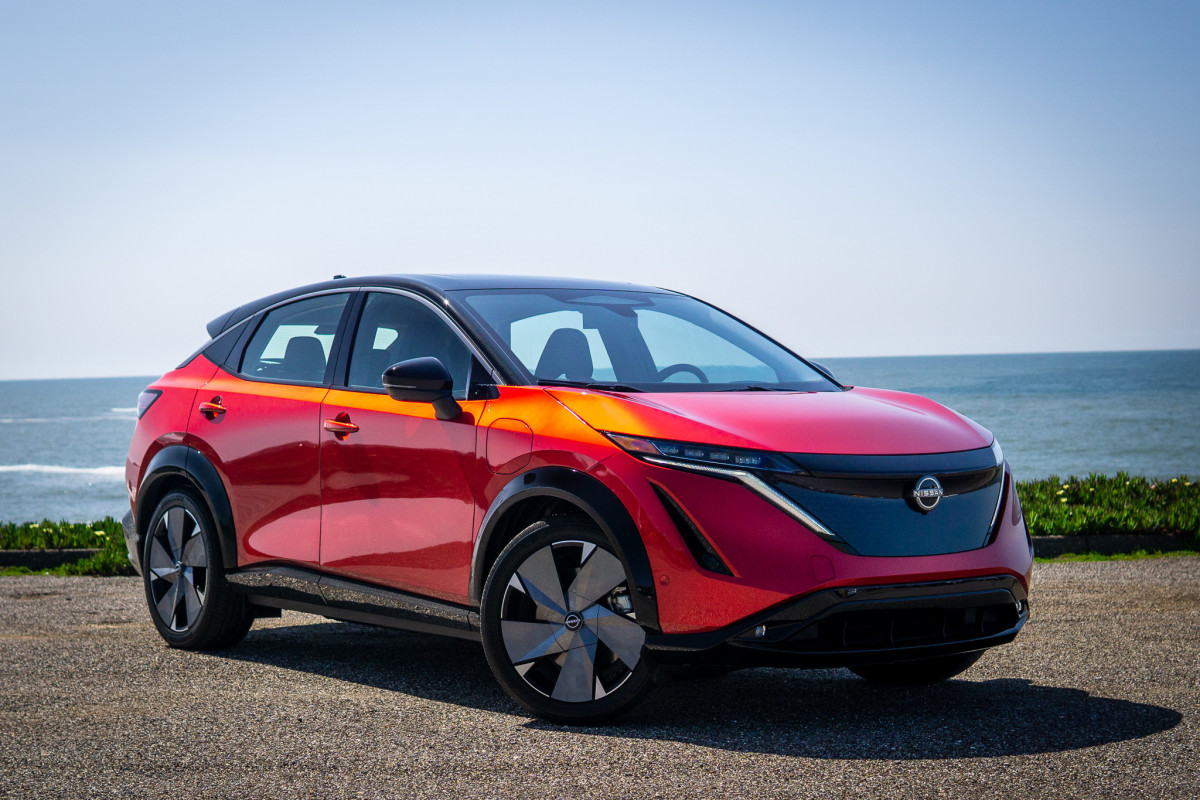
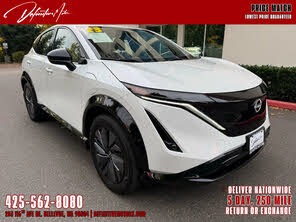
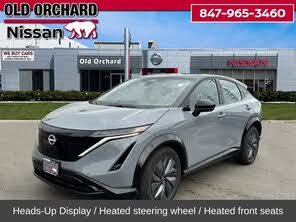
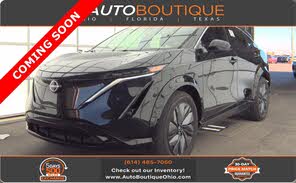
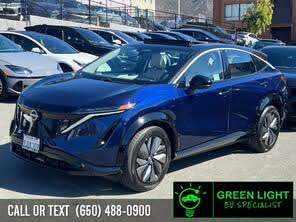
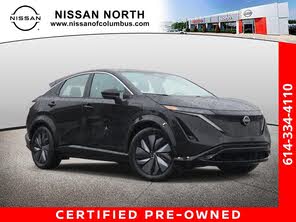
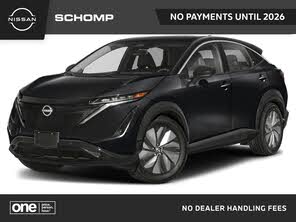
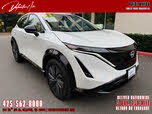
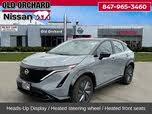
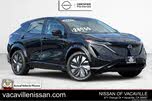
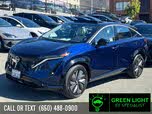
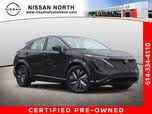
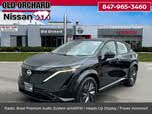
The 2023 Nissan Ariya showcased a distinctive and modern design, unlike many conventional SUVs. Nissan decided to forgo creases and sharp angles, opting instead for an “oval” silhouette that was especially noticeable from the side. Both the front and rear ends of the Ariya sloped away smoothly but swiftly from the roof’s apex, creating a sleek and aerodynamic profile. Thin LED headlights complemented by diagonal arrays of LED running lights and turn signals added to the vehicle's contemporary aesthetic. The front "grille," essentially a black space adopting Nissan’s “V-Motion” design language, featured an illuminated Nissan emblem at its center. The rear design was reminiscent of the 2023 Lexus NX with a thin, full-width taillight and "NISSAN" lettering positioned above the license plate bracket.
Inside, the Ariya was a testament to meticulous craftsmanship. The use of hard plastic was minimal, and the dashboard boasted a simplistic beauty. Dual 12-inch monitors (one concave, one convex) provided all necessary information, and the illuminated haptic buttons below the infotainment touchscreen enhanced its modern appeal. The interior lighting, hidden within Japanese Kumiko-inspired housings, likely added a wonderful ambiance, especially noted during nighttime driving although untested. Without a transmission tunnel, the Ariya’s cabin felt exceptionally open and spacious. Trim levels included Engage, Engage+, Venture+, Evolve+, Empower+, Premiere, and Platinum+, with both FWD and AWD options available. Test drives of the Premier FWD and Platinum+ AWD trims revealed eight-way power adjustment for the driver’s seat and four-way for the front passenger, displaying no discomfort despite limited adjustment options. The only notable complaint was the differing heights of the center and door armrests, making it uncomfortable for drivers with a broad reach.
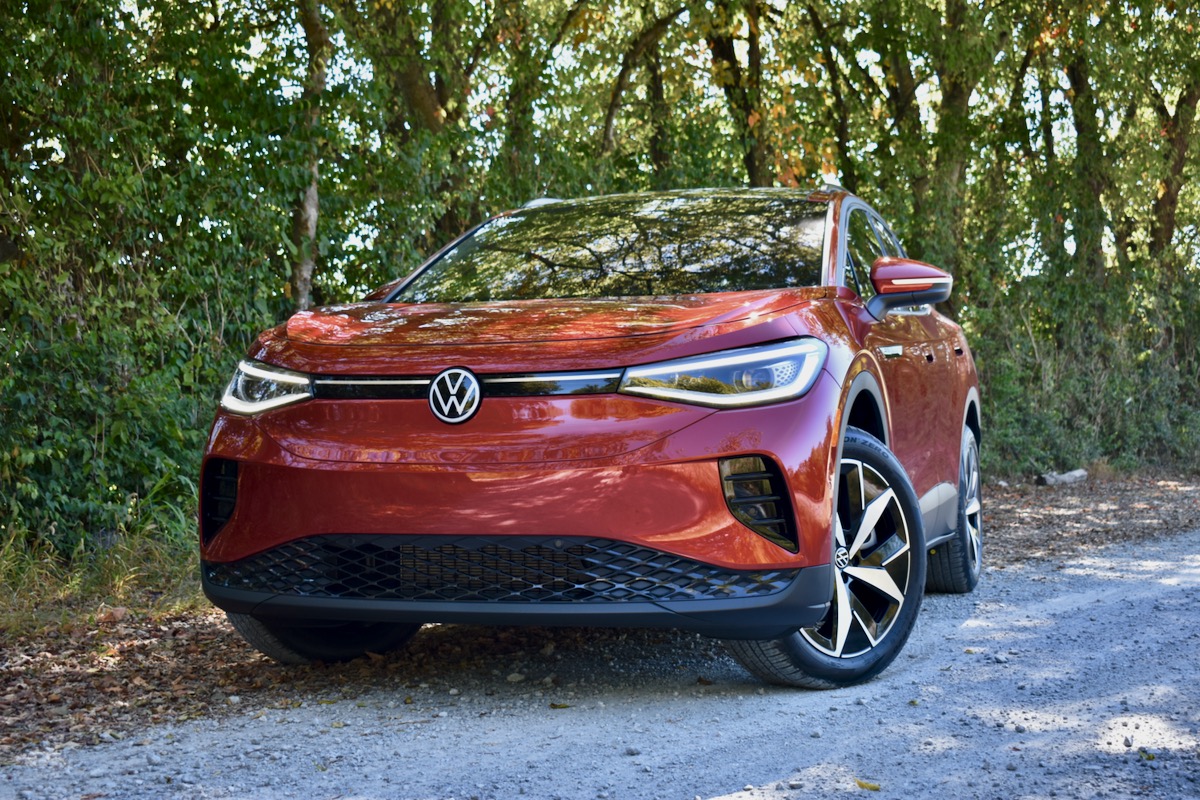
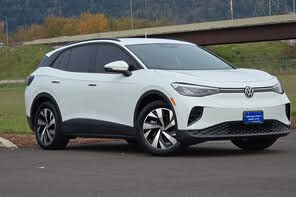
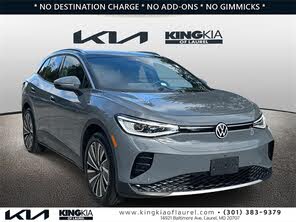
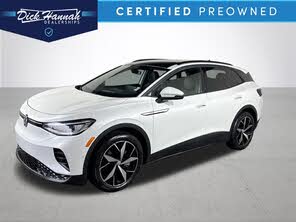
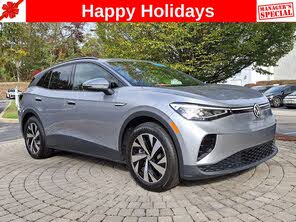
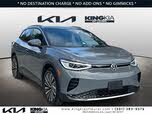
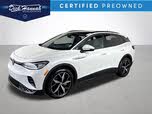
In contrast, the 2023 Volkswagen ID.4 underwent subtle styling changes for the model year. The front bumper now featured gloss black trim, and the rear bumper had a more squared-off design aimed at improving aerodynamics. New wheel designs and colors were introduced, and the rear VW logo was illuminated. Although distinguishable from VW’s gasoline models, the ID.4 didn’t look very much like an SUV, lacking the upright profile and increased ground clearance typical of traditional SUVs. This could have been a potential drawback for buyers favoring those aspects in their SUVs. The vehicle was based on VW’s MEB platform, which was engineered specifically for EVs, akin to the MQB platform used for a variety of VW’s gasoline models.
The ID.4’s interior favored a minimalist design, reflecting a feeling of high quality associated with recent VW gasoline-car interiors. Despite the base ID.4 Standard model featuring manual driver’s seat adjustments, it didn't feel like a substantial downgrade from the higher-level Pro S, even while retaining features like leatherette upholstery with partially recycled fibers for the seat and door-panel inserts.
Ultimately, both the Ariya and ID.4 had their unique strengths in terms of look and feel – with the Ariya aiming for a more futuristic and luxurious ambiance, while the ID.4 focused on minimalism and refinement.


The 2023 Nissan Ariya offered a variety of trims, leading to some confusion. The base Engage FWD trim featured a 63-kWh battery with a 160-kW AC synchronous single motor delivering 214 horsepower to the front wheels. The Engage AWD maintained the standard-range battery but added an extra motor. The Engage+ AWD and other “+” designated trims came with an 87-kWh extended range battery.
Moving up, the Venture+ FWD offered the extended-range battery and a more powerful 178-kW motor producing 238 horsepower. Other trims like the Evolve+ (available in FWD or AWD), the Empower+ FWD, the limited-edition Premiere FWD, and the top-tier Platinum+ AWD offered varied features and performance. The dual-motor powertrain in AWD models upped the stakes with 389 horsepower and 442 lb-ft of torque, allowing it to accelerate from 0-60 mph in just 4.8 seconds. Moreover, the vehicle boasted an advanced torque-split tuning mechanism that enhanced grip during turns and reduced nose dive under hard braking. With multiple driving modes – Eco, Standard, and Sport – the Ariya adapted well to different driving conditions. During testing, the FWD Ariya averaged roughly 3.5 miles per kWh, equating to about 304 miles of total range, while the AWD Ariya delivered around 3.0 miles per kWh, translating to approximately 260 miles of range.
The 2023 Volkswagen ID.4, on the other hand, had its standard 62-kWh battery pack available only on the base Standard and S models with RWD. The Pro, Pro S, and Pro S Plus trims used the larger 82-kWh pack with options for either RWD or AWD. The single-motor RWD models achieved an output of 201 horsepower and 229 lb-ft of torque, while the dual-motor AWD versions increased the output to 295 horsepower and 339 lb-ft of torque. This setup allowed the ID.4 to accelerate from 0-60 mph in 5.7 seconds. During testing, the 62-kWh ID.4 Standard felt quite spritely, although further driving time would be needed for a comprehensive comparison with the larger-battery RWD version.
Though the ID.4 showed good acceleration, matching some of VW’s sportier models, it didn’t handle twists and turns as well due to noticeable body roll. Nonetheless, it offered a comfortable and refined driving experience, perfect for racking up miles. The regenerative braking system, however, did not support one-pedal driving, opting for a more conventional approach to coasting and braking.
The 2023 Nissan Ariya benefited immensely from its EV-specific architecture, offering a spacious and airy cabin. Front and rear passengers enjoyed ample legroom, though the big sunroof did slightly impinge on rear headroom. The absence of a transmission tunnel added to the sense of open space, almost turning the interior into a mobile living room. However, the airy design came at the cost of cargo space, which measured in at 59 cubic feet – comparable to the Hyundai Ioniq 5 and Ford Mustang Mach-E but significantly less than some gasoline-powered rivals like the Nissan Rogue or Hyundai Tucson.
The Ariya included some neat interior features such as a powered bin under the center stack capable of holding numerous items and a power-adjustable center console that allowed easy adjustments for drivers of various sizes. While the haptic buttons on the center console took some getting used to, especially in pre-production models, they worked smoothly in the final versions.
The 2023 Volkswagen ID.4 excelled in interior space, providing more room for both front and rear-seat passengers compared to other EVs like the Chevrolet Bolt EV or Nissan Leaf, while also boasting superior headroom over the 2023 Kia Niro EV. With 30.3 cubic feet of cargo space with the rear seats up and 64.2 cubic feet when the rear seats were down, the ID.4 offered more storage capacity than many entry-level EVs. Nevertheless, when compared to gasoline crossovers such as the Honda CR-V or Toyota RAV4, it lagged slightly in overall cargo volume.
The ID.4 addressed SUV buyer expectations with a towing capacity of 2,200 pounds for RWD models and 2,700 pounds for AWD versions, providing some degree of towing capability. Interior updates included a conventional lid for the center console, a designated phone spot, and three-zone climate control with rear-seat controls and heated outboard rear seats to improve overall functionality.
In terms of technology, the 2023 Nissan Ariya came well-equipped, aiming to inform, connect, protect, and assist its users. The vehicle featured dual 12-inch displays – one for driver information, and the other for general infotainment. The connection between these screens was beautifully executed, offering crisp and bright visuals. Wireless Apple CarPlay was standard across all trims, while Android Auto required a wired connection. Additionally, most trims came with a head-up display. Integration with Alexa allowed drivers to control smart home devices directly from their vehicle and vice versa.
The infotainment system in the Ariya stood out for its full-featured software, providing a range of features coupled with an intuitive and modern interface, making it a significant improvement over older Nissan models.
For 2023, the Volkswagen ID.4 upgraded its formerly optional 12.0-inch touchscreen to be standard across all models, replacing the previous 10.0-inch screen on lower trims. Software updates aimed at improving responsiveness were also implemented, with wireless Apple CarPlay and Android Auto remaining standard. The ID.Cockpit digital instrument cluster provided sharp graphics and versatile display options, including smartphone-like icons or a traditional automotive split-screen view. Natural-language voice recognition made navigating the system easier, despite the less intuitive haptic touchpads on the dashboard and steering wheel, which could be distracting to use.
The ID.Light system added an innovative yet easily overlooked feature – ambient lighting that doubled as an AI assistant, changing colors based on driving conditions and providing directional cues for navigation.
The 2023 Nissan Ariya emphasized advanced safety with ProPilot Assist 2.0 featured on the Empower+ and Platinum+ trims. This updated system utilized HD map data and a driver-monitoring camera to deliver hands-free driving capabilities on marked highways. The addition of lane-change assist enhanced the system further. Standard safety features for all Ariyas included automatic emergency braking, blind-spot monitoring, a driver-attention monitor, and traffic-sign recognition.
Neither NHTSA nor IIHS had crash-tested the 2023 Ariya by the time of review, but this delay was not necessarily concerning as such data typically requires some time post-release.
Conversely, the 2023 Volkswagen ID.4 had received a five-star overall safety rating from NHTSA, with top marks in frontal and side crash tests, although it fell slightly short with four stars in rollover tests. While IIHS ratings for the 2023 model were pending, the 2022 model earned the highest “Top Safety Pick+” accolade, with top marks in crashworthiness and front crash prevention. However, its standard headlights received an “Average” rating, while the Pro S model’s headlights were rated “Good.”
Standard driver-assist features for the ID.4 included forward collision warning, automatic emergency braking with pedestrian and cyclist detection, blind-spot monitoring, rear park distance control, automatic high beams, traffic-sign recognition, and VW’s Travel Assist 2.0, which merged adaptive cruise control with automated lane centering. Additional 2023 features included Park Assist Plus automated parking, an automated lane-change feature, and a 360-degree camera system.
CarGurus highlights
According to CarGurus experts, the overall rating for the 2023 Nissan Ariya is 8.5 out of 10, while the 2023 Volkswagen ID.4 scores 7.8 out of 10. Based on these ratings, the Nissan Ariya emerges as the superior choice. Its modern design, advanced technology features, and sophisticated driver-assistance systems place it ahead of the Volkswagen ID.4. While the ID.4 offers notable interior space and practicality, the Ariya’s overall package makes it a more compelling option in the 2023 electric vehicle market.
Choose the 2023 Volkswagen ID.4 if:
- You need more interior space and cargo capacity compared to other entry-level EVs.
- You want a versatile powertrain with both RWD and AWD options and notable towing capacity.
- You prioritize safety with high NHTSA ratings and a comprehensive suite of standard driver-assist features.




Choose the 2023 Nissan Ariya if:
- You prioritize a futuristic and luxurious design, both inside and out.
- You seek advanced driver-assistance features with ProPilot Assist 2.0 for hands-free highway driving.
- You want a spacious and open cabin with high-tech conveniences like dual 12-inch displays and Alexa integration.



CarGurus highlights
According to CarGurus experts, the overall rating for the 2023 Nissan Ariya is 8.5 out of 10, while the 2023 Volkswagen ID.4 scores 7.8 out of 10. Based on these ratings, the Nissan Ariya emerges as the superior choice. Its modern design, advanced technology features, and sophisticated driver-assistance systems place it ahead of the Volkswagen ID.4. While the ID.4 offers notable interior space and practicality, the Ariya’s overall package makes it a more compelling option in the 2023 electric vehicle market.
Choose the 2023 Volkswagen ID.4 if:
Shop Now- You need more interior space and cargo capacity compared to other entry-level EVs.
- You want a versatile powertrain with both RWD and AWD options and notable towing capacity.
- You prioritize safety with high NHTSA ratings and a comprehensive suite of standard driver-assist features.




Choose the 2023 Nissan Ariya if:
Shop Now- You prioritize a futuristic and luxurious design, both inside and out.
- You seek advanced driver-assistance features with ProPilot Assist 2.0 for hands-free highway driving.
- You want a spacious and open cabin with high-tech conveniences like dual 12-inch displays and Alexa integration.





By: CarGurus + AI
At CarGurus, our team of experienced automotive writers remain at the heart of our content operation, conducting hands-on car tests and writing insightful guides that are backed by years of industry experience. To complement this, we are harnessing AI to make our content offering more diverse and more helpful to shoppers than ever. To achieve this, our AI systems are based exclusively on CarGurus content, ratings and data, so that what we produce is both unique to CarGurus, and uniquely helpful to car shoppers.