2021 Toyota RAV4 Hybrid vs 2021 Volvo XC90

Overview | |
MSRP$49,000 | MSRP$28,900 |
Listings329 | Listings882 |
Ratings & Reviews | |
User Reviews | User Reviews |
Expert reviews7.7 out of 10 | Expert reviews8.5 out of 10 |
Pros
Cons
| Pros
Cons
|
2021 Volvo XC90 Reviews SummaryVolvo may be known for sensible station wagons, but the XC90 SUV is the Swedish automaker’s de facto flagship. The current generation debuted design features, technology, and powertrains that have since found their way into most other Volvo models. Several years into the current-generation model’s lifecycle, the XC90 is no longer a trendsetter, but remains Volvo’s contender in the competitive midsize luxury SUV segment, with the automaker’s typical emphasis on safety features. The current-generation XC90 launched for the 2016 model year, so most competitors—including the Audi Q7, Acura MDX, BMW X5, and Mercedes-Benz GLE-Class—have been updated or redesigned since then. The Cadillac XT6 and Lincoln Aviator didn’t even exist when this generation of XC90 launched. A redesigned version is expected to arrive soon, so changes to the 2021 XC90 are minimal. All 2021 Volvo models are now limited to 112 mph for safety reasons and get Care Key, which lets owners limit the top speed before loaning the car out to a friend or family member. The XC90 also gets a handful of newly standard tech features, and some small cosmetic changes. Volvo offers the XC90 in three trim levels—Momentum, R-Design, and Inscription—with three powertrain options: T5 and T6 gasoline engines, and the T8 plug-in hybrid. Our test car was a range-topping T8 Recharge Inscription, combining the top Inscription trim level with the plug-in hybrid powertrain, which has the highest output of the three. | |
2021 Toyota RAV4 Hybrid Reviews SummaryA 2021 Toyota RAV4 Hybrid pays for itself in a little more than three years. We’ll show you the math later in this review, but based on national averages, it goes from being more expensive to buy to saving you money after about 40 months of ownership. Toyota sells the 2021 RAV4 Hybrid in LE, XLE, XLE Premium, XSE, and Limited trim levels. Pricing runs from $28,650 to $37,180, plus a $1,175 destination charge that can vary depending on your region. The XLE Premium trim is new for the 2021 model year and adds a super chrome wheel finish, a power sunroof, SofTex leatherette upholstery, dual-zone automatic climate control, and more. | |
No video found | No video found |
Popular Features & Specs | |
Engine2.0L 250 hp I4 | Engine2.5L 219 hp I4 Hybrid |
Drive TrainFWD | Drive TrainAWD |
Seating Capacity7 | Seating Capacity5 |
Horsepower250 hp @ 5500 rpm | Horsepower |
EV Battery Capacity | EV Battery Capacity1.6 kWh |
MPG City21 | MPG City41 |
MPG Highway30 | MPG Highway38 |
Engine | |
Engine Name2.0L 250 hp I4 | Engine Name2.5L 219 hp I4 Hybrid |
Torque258 lb-ft @ 1500 rpm | Torque |
Horsepower250 hp @ 5500 rpm | Horsepower |
DrivetrainFWD | DrivetrainAWD |
Fuel Economy | |
EV Battery Capacity | EV Battery Capacity1.6 kWh |
MPG City21 | MPG City41 |
MPG Highway30 | MPG Highway38 |
Interior | |
Seating Capacity7 | Seating Capacity5 |
Key Features | |
Sunroof/MoonroofStandard | Sunroof/Moonroof |
Safety | |
Front Crash Overall5 | Front Crash Overall4 |
Side Crash Overall5 | Side Crash Overall5 |
Dimensions & Capacity | |
Cargo Space10.7 cu ft | Cargo Space37.6 cu ft |
Curb Weight4374 lbs | Curb Weight3690 lbs |
Height69.9 in | Height67.0 in |
Length195.0 in | Length180.9 in |
Width84.3 in | Width73.0 in |
Wheelbase117.5 in | Wheelbase105.9 in |
Maximum Payload1631 lbs | Maximum Payload1230 lbs |
Number of doors4 | Number of doors4 |
Maximum Towing Capacity4000 lbs | Maximum Towing Capacity1750 lbs |
Overview | ||
MSRP | $49,000 | $28,900 |
Listings | ||
Ratings & Reviews | ||
User reviews | ||
Expert reviews | 7.7 out of 10Read full review | 8.5 out of 10Read full review |
Pros & cons | Pros
Cons
| Pros
Cons
|
Summary | Volvo may be known for sensible station wagons, but the XC90 SUV is the Swedish automaker’s de facto flagship. The current generation debuted design features, technology, and powertrains that have since found their way into most other Volvo models. Several years into the current-generation model’s lifecycle, the XC90 is no longer a trendsetter, but remains Volvo’s contender in the competitive midsize luxury SUV segment, with the automaker’s typical emphasis on safety features. The current-generation XC90 launched for the 2016 model year, so most competitors—including the Audi Q7, Acura MDX, BMW X5, and Mercedes-Benz GLE-Class—have been updated or redesigned since then. The Cadillac XT6 and Lincoln Aviator didn’t even exist when this generation of XC90 launched. A redesigned version is expected to arrive soon, so changes to the 2021 XC90 are minimal. All 2021 Volvo models are now limited to 112 mph for safety reasons and get Care Key, which lets owners limit the top speed before loaning the car out to a friend or family member. The XC90 also gets a handful of newly standard tech features, and some small cosmetic changes. Volvo offers the XC90 in three trim levels—Momentum, R-Design, and Inscription—with three powertrain options: T5 and T6 gasoline engines, and the T8 plug-in hybrid. Our test car was a range-topping T8 Recharge Inscription, combining the top Inscription trim level with the plug-in hybrid powertrain, which has the highest output of the three. | A 2021 Toyota RAV4 Hybrid pays for itself in a little more than three years. We’ll show you the math later in this review, but based on national averages, it goes from being more expensive to buy to saving you money after about 40 months of ownership. Toyota sells the 2021 RAV4 Hybrid in LE, XLE, XLE Premium, XSE, and Limited trim levels. Pricing runs from $28,650 to $37,180, plus a $1,175 destination charge that can vary depending on your region. The XLE Premium trim is new for the 2021 model year and adds a super chrome wheel finish, a power sunroof, SofTex leatherette upholstery, dual-zone automatic climate control, and more. |
Video | No video found | No video found |
Popular Features & Specs | ||
Engine | 2.0L 250 hp I4 | 2.5L 219 hp I4 Hybrid |
Drive Train | FWD | AWD |
Seating Capacity | 7 | 5 |
Horsepower | 250 hp @ 5500 rpm | |
EV Battery Capacity | 1.6 kWh | |
MPG City | 21 | 41 |
MPG Highway | 30 | 38 |
Engine | ||
Engine Name | 2.0L 250 hp I4 | 2.5L 219 hp I4 Hybrid |
Torque | 258 lb-ft @ 1500 rpm | |
Horsepower | 250 hp @ 5500 rpm | |
Drivetrain | FWD | AWD |
Fuel Economy | ||
EV Battery Capacity | 1.6 kWh | |
MPG City | 21 | 41 |
MPG Highway | 30 | 38 |
Interior | ||
Seating Capacity | 7 | 5 |
Key Features | ||
Sunroof/Moonroof | Standard | |
Safety | ||
Front Crash Overall | 5 | 4 |
Side Crash Overall | 5 | 5 |
Dimensions & Capacity | ||
Cargo Space | 10.7 cu ft | 37.6 cu ft |
Curb Weight | 4374 lbs | 3690 lbs |
Height | 69.9 in | 67.0 in |
Length | 195.0 in | 180.9 in |
Width | 84.3 in | 73.0 in |
Wheelbase | 117.5 in | 105.9 in |
Maximum Payload | 1631 lbs | 1230 lbs |
Number of doors | 4 | 4 |
Maximum Towing Capacity | 4000 lbs | 1750 lbs |
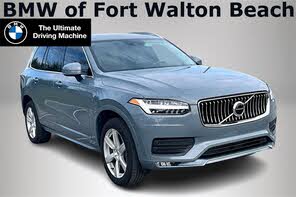
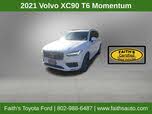
The 2021 Volvo XC90 saw a significant transformation from its previous iterations. Debuting with a refreshed image back in 2016, this model redefined Volvo’s typically conservative design language into something with more character. Despite retaining its traditional styling—like the boxy profile and rectangular grille—the XC90 introduced more refined lines and additional chrome trimming. Its LED headlights, adorned with “Thor’s Hammer” daytime running lights, were distinctive and aligned seamlessly with the overall design.
The XC90's varied trim levels added layers to its aesthetic appeal. The Inscription model was the most flamboyant, thanks to its extra chrome trim and (optional) 21-inch alloy wheels. Meanwhile, the R-Design trim targeted a sportier look and introduced a new gloss-black grille for 2021. The base Momentum model remained simpler, featuring new-design 19-inch wheels.
Underneath the polished exterior, the XC90 leveraged the Scalable Product Architecture (SPA) platform, shared with other Volvo “90” and "60" series models, giving it sturdy underpinnings.
Inside, the XC90 embraced “Swedish minimalism,” using high-quality, naturally-finished materials and thoughtfully arranged interiors devoid of unnecessary glitz. The test vehicle featured unique touches like the Orrefors crystal shifter and an option for wool upholstery, offering an unmatched level of sophistication.
In contrast, the 2021 Toyota RAV4 Hybrid Limited presented a different facet of SUV design. At a price point reaching $42,083 with almost every available option, it exhibited a higher-end package uncommon for RAV4 standards. The vehicle’s exterior didn't initially signal this high trim level, as its 18-inch wheels felt undersized and bland.
The RAV4 Hybrid’s interior, however, was attractive and practical. The blend of quality materials and some lower-end hard plastics were apparent. Notably, a rattle from the license plate vibrating on the tailgate revealed some oversight in build quality.
Ultimately, the RAV4 Hybrid’s tough-but-cute demeanor could have been sharpened with additional aesthetic enhancements, especially for a Limited trim, but inside, it remained functional and fairly high-quality for its segment.


The 2021 Volvo XC90 offered three distinct powertrains, each revolving around a 2.0-liter four-cylinder engine paired with an eight-speed automatic transmission. The T5 variant, with a turbocharged engine, delivered 250 hp and 258 lb-ft of torque. The T6 model, combining turbocharging and supercharging, pushed up the output to 316 hp and 295 lb-ft of torque. The T8 Twin Engine plug-in hybrid—rebranded as the Recharge—took the T6’s engine and added electric assist, bumping the total output to 400 hp and 472 lb-ft of torque.
The T5 came with front-wheel drive as standard, with AWD as an option. In contrast, AWD was standard on both the T6 and T8. While the T8 presented an impressive 400 hp, the reliance on a small 2.0-liter engine for much of this power meant it couldn’t match the flexibility offered by larger six-cylinder or V8 engines of rival brands. The XC90’s drive modes—Pure (all-electric), Hybrid, and Power—provided varied experiences, with Pure mode proving largely unutilized beyond low speeds.
Despite its lack of sportiness, the XC90 excelled in ride quality, thanks to optional air suspension, and maintained passenger comfort while delivering a quiet, almost serene cabin environment. The 5,000-pound maximum towing capacity (4,000 pounds for the FWD T5) was respectable, albeit slightly tempered by more capable competitors like the Lincoln Aviator.
The 2021 Toyota RAV4 Hybrid matched a 2.5-liter four-cylinder gas engine with front and rear electric motors and a lithium-ion battery. This setup delivered 219 hp—more potent than the RAV4’s standard engine but less powerful than the plug-in hybrid RAV4 Prime. With several driving modes including Eco, Normal, Sport, Trail, and EV, the RAV4 Hybrid offered a versatile driving experience.
Though heavier than the standard RAV4 by about 200 pounds, the RAV4 Hybrid’s electric motor provided immediate torque, enabling spirited acceleration. The EPA-rated 40 mpg in combined driving was nearly met during tests with an average of 39.7 mpg.
The continuously variable transmission (CVT) operated smoothly without the droning often associated with such systems, and the regenerative braking was impressively refined. Cornering was efficient, though the Michelin Primacy all-season tires struggled under aggressive driving.
With a well-handled ride and an available sport-tuned suspension in the XSE trim, the RAV4 Hybrid delivered a competent and comfortable daily driving experience. Its 8.1 inches of ground clearance and Trail driving mode facilitated moderate off-road capabilities.
The 2021 Volvo XC90 featured a choice between six or seven seats, reflecting whether second-row captain’s chairs or a bench seat was selected. Provided dimensions for headroom and legroom in all three rows were about average, making the third row a tight squeeze for adults. The seats, particularly in the second and third rows, were noted for their hardness and lack of support. An immense power moonroof and four-zone climate control contributed to a spacious and comfortable cabin ambiance despite storage space limitations.
Cargo capacities were another story: 11.2 cubic feet with all seats in place, extending to 64.1 cubic feet with the second and third rows folded. These figures placed the XC90 T8 Recharge towards the lower end of the spectrum in its class. A hands-free power tailgate was a convenient addition.
The 2021 Toyota RAV4 Hybrid excelled in interior comfort and practicality. The driver’s seat was power-adjustable in eight ways, while both front seats featured heating and ventilation. Despite lacking height adjustment for the front passenger seat, comfort levels remained commendable. Rear-seat legroom was plentiful, although the cushion lay a bit low. Heated rear seats and air conditioning vents further bolstered rear passenger comfort.
In terms of storage, the RAV4 Hybrid offered 37.5 cubic feet behind the rear seat, expanding to 69.8 cubic feet with seats folded. This rendered it more pragmatic than the XC90 in cargo space, although the prominence of the subwoofer in the cargo area was noted as a minor inconvenience.
Volvo’s Sensus infotainment system in the 2021 XC90 emphasized simplicity and efficiency. Standard features included a 9-inch touchscreen, a 12.3-inch digital instrument cluster, Apple CarPlay/Android Auto compatibility, and a built-in WiFi hotspot. With two front USB-A ports and two rear USB-C ports, connectivity options were robust. The portrait-oriented touchscreen facilitated intuitive use, although the amount of text and typeface complexity posed some readability issues. The wireless charging pad fitted most phones poorly and only the rear had USB-C ports, presenting slight usability concerns for some drivers.
For the 2021 Toyota RAV4 Hybrid, a variety of infotainment configurations were available, including 7-inch or 8-inch touchscreens. Standard features across the board included Apple CarPlay, Android Auto, Amazon Alexa compatibility, and SiriusXM satellite radio. Advanced packages brought an 11-speaker JBL premium audio system, dynamic navigation, and a comprehensive suite of connected services.
The test model’s infotainment screen, mounted prominently atop the dashboard, came with shortcut buttons and ensured easy access to various functions. Its voice recognition was generally effective, though some limitations were observed, such as the inability to adjust climate settings.
Safety was a hallmark for both models. The 2021 Volvo XC90 secured the highest “Top Safety Pick+” rating from the IIHS for non-hybrid models and a five-star overall safety rating from the NHTSA. Standard safety features were aplenty, including lane-keep assist, driver-attention monitor, traffic-sign recognition, blind-spot monitoring, rear cross-traffic alert, and Pilot Assist driver aid. Despite its proficiency, some limitations were observed in Pilot Assist’s lane-centering capabilities on curvy roads.
The 2021 Toyota RAV4 Hybrid came with Toyota Safety Sense 2.0, offering a broad array of advanced driving assistance features. Adaptive cruise control, forward-collision warning, automatic emergency braking, lane-departure warning, lane-keep assist, and road-sign recognition were part of the standard offering. The Hybrid Limited trim additionally offered rear automatic braking.
In safety performance, the RAV4 Hybrid earned a five-star overall rating from the NHTSA and high marks from the IIHS, except for some criticism of its headlights.
CarGurus highlights
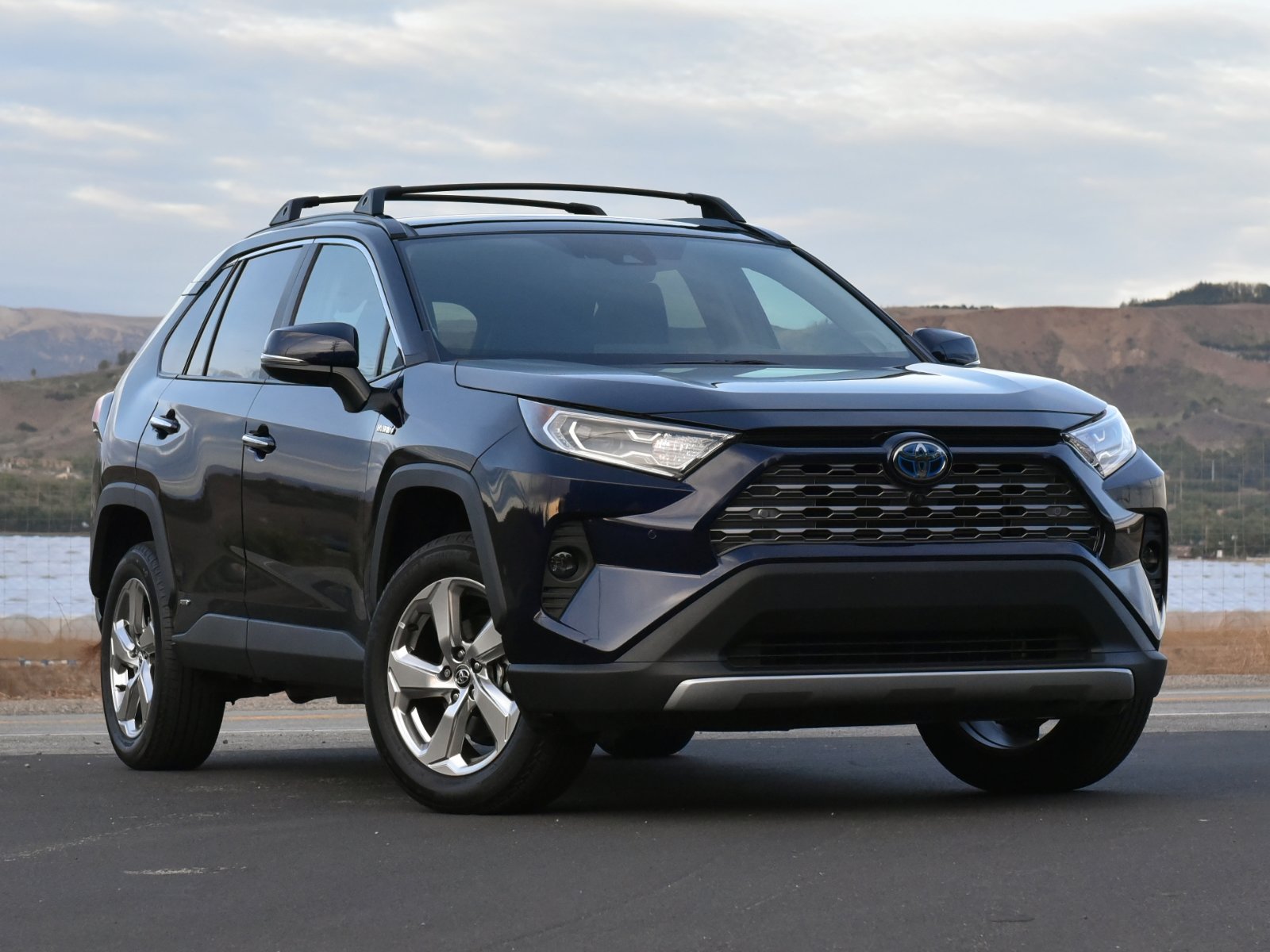
According to CarGurus experts, the overall rating for the 2021 Volvo XC90 was 7.7 out of 10, while the 2021 Toyota RAV4 Hybrid scored 8.5 out of 10. Based on these scores, the 2021 Toyota RAV4 Hybrid emerged as the better choice overall. It offered a more fuel-efficient, practical, and well-rounded driving experience, particularly excelling in areas like cargo capacity, technology, and safety. While the Volvo XC90 boasted a more luxurious interior and advanced safety features, the RAV4 Hybrid presented a compelling mix of efficiency, comfort, and practicality, making it the well-rounded winner in this comparison.
Choose the 2021 Toyota RAV4 Hybrid if:
- You seek excellent fuel efficiency and eco-friendly driving options.
- You need generous cargo space and practical interior storage solutions.
- You prefer modern infotainment systems and robust, standard safety features.


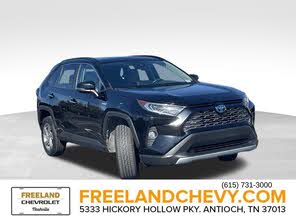


Choose the 2021 Volvo XC90 if:
- You value sophisticated, minimalist design with high-quality interior materials.
- You prioritize advanced safety features and top ratings in crash tests.
- You desire a luxury SUV with multiple powertrain options, including a plug-in hybrid.




CarGurus highlights
According to CarGurus experts, the overall rating for the 2021 Volvo XC90 was 7.7 out of 10, while the 2021 Toyota RAV4 Hybrid scored 8.5 out of 10. Based on these scores, the 2021 Toyota RAV4 Hybrid emerged as the better choice overall. It offered a more fuel-efficient, practical, and well-rounded driving experience, particularly excelling in areas like cargo capacity, technology, and safety. While the Volvo XC90 boasted a more luxurious interior and advanced safety features, the RAV4 Hybrid presented a compelling mix of efficiency, comfort, and practicality, making it the well-rounded winner in this comparison.
Choose the 2021 Toyota RAV4 Hybrid if:
Shop Now- You seek excellent fuel efficiency and eco-friendly driving options.
- You need generous cargo space and practical interior storage solutions.
- You prefer modern infotainment systems and robust, standard safety features.





Choose the 2021 Volvo XC90 if:
Shop Now- You value sophisticated, minimalist design with high-quality interior materials.
- You prioritize advanced safety features and top ratings in crash tests.
- You desire a luxury SUV with multiple powertrain options, including a plug-in hybrid.





By: CarGurus + AI
At CarGurus, our team of experienced automotive writers remain at the heart of our content operation, conducting hands-on car tests and writing insightful guides that are backed by years of industry experience. To complement this, we are harnessing AI to make our content offering more diverse and more helpful to shoppers than ever. To achieve this, our AI systems are based exclusively on CarGurus content, ratings and data, so that what we produce is both unique to CarGurus, and uniquely helpful to car shoppers.