2021 Subaru Forester vs 2021 Toyota RAV4

Overview | |
MSRP$26,350 | MSRP$24,795 |
Listings241 | Listings194 |
Ratings & Reviews | |
User Reviews | User Reviews |
Expert reviews7.3 out of 10 | Expert reviews7.5 out of 10 |
Pros
Cons
| Pros
Cons
|
2021 Toyota RAV4 Reviews SummarySince its launch in 1997, the Toyota RAV4 has ridden a wave of crossover SUV popularity to become one of Toyota’s bestselling models. Introduced for the 2019 model year, the current-generation RAV4 tries to offer the rugged style of a traditional SUV, but underneath it’s still a car-based crossover pitched against the likes of the Ford Escape, Honda CR-V, Hyundai Tucson, Kia Sportage, Nissan Rogue, Subaru Forester, and Volkswagen Tiguan. Because it’s only in its third model year, this fifth-generation RAV4 doesn’t get many updates for 2021. The biggest news is the addition of the RAV4 Prime plug-in hybrid to the lineup, but that model actually went on sale last year. The only other changes are a new XLE Premium trim level for the RAV4 Hybrid, and a new front stainless steel front skid plate for the gasoline RAV4 TRD Off-Road model. Toyota offers compact SUV buyers more choices than most competitors. The RAV4 LE, XLE, XLE Premium, and Limited trim levels are available with hybrid and non-hybrid powertrains. Toyota also offers the gasoline-only RAV4 Adventure and TRD Off-Road trim levels, plus the RAV4 Hybrid XSE. The RAV4 Prime is also available in two trim levels—SE and XSE. We’ve covered the RAV4 Hybrid and RAV4 Prime in separate reviews, so this review will focus on the gasoline RAV4. Our test car was a RAV4 TRD Off-Road, which joined the lineup for the 2020 model year and is the first RAV4 model tuned by Toyota Racing Development, the automaker’s North American performance division. | |
2021 Subaru Forester Reviews SummaryThe Subaru Forester was one of the original compact crossover SUVs. Along with the Ford Escape, Honda CR-V, and Toyota RAV4, it helped introduce a vehicular genre that is now displacing traditional sedans from American driveways. That means the Forester has more competition than ever. What was once a small market segment has swelled with the addition of compact SUVs like the Hyundai Tucson, Kia Sportage, Mazda CX-5, Nissan Rogue, Volkswagen Tiguan, and the modern version of the Jeep Cherokee. To keep pace with the competition, the Forester has packed on technology—and pounds. While the first-generation Forester (affectionately nicknamed “toaster” by fans because of its boxy shape) was genuinely compact, the current version has the footprint of a midsize SUV from two decades ago. This version was introduced for the 2019 model year, so it doesn’t change much for 2021. The only news is the addition of three standard safety features—steering-responsive LED headlights, automatic high beams, and a rear seatbelt reminder—standard fog lights and keyless access with push-button start for the Premium trim level, and additional equipment reshuffling on other trim levels. The 2021 Subaru Forester is available in five trim levels—Base, Premium, Sport, Limited, and Touring—all with standard all-wheel drive (AWD). Our test car was the mid-range Sport model. | |
No video found | |
Popular Features & Specs | |
Engine2.5L 203 hp I4 | Engine2.5L 182 hp H4 |
Drive TrainFWD | Drive TrainAWD |
Seating Capacity5 | Seating Capacity5 |
Horsepower | Horsepower182 hp @ 5800 rpm |
MPG City28 | MPG City26 |
MPG Highway35 | MPG Highway33 |
Engine | |
Engine Name2.5L 203 hp I4 | Engine Name2.5L 182 hp H4 |
Torque | Torque178 lb-ft @ 4400 rpm |
Horsepower | Horsepower182 hp @ 5800 rpm |
DrivetrainFWD | DrivetrainAWD |
Fuel Economy | |
MPG City28 | MPG City26 |
MPG Highway35 | MPG Highway33 |
Interior | |
Seating Capacity5 | Seating Capacity5 |
Safety | |
Front Crash Overall4 | Front Crash Overall5 |
Side Crash Overall5 | Side Crash Overall5 |
Dimensions & Capacity | |
Cargo Space37.5 cu ft | Cargo Space31.1 cu ft |
Curb Weight3370 lbs | Curb Weight3453 lbs |
Height67.0 in | Height67.5 in |
Length180.9 in | Length182.1 in |
Width73.0 in | Width80.9 in |
Wheelbase105.9 in | Wheelbase105.1 in |
Maximum Payload1240 lbs | Maximum Payload1438 lbs |
Number of doors4 | Number of doors4 |
Maximum Towing Capacity1500 lbs | Maximum Towing Capacity1500 lbs |
Overview | ||
MSRP | $26,350 | $24,795 |
Listings | ||
Ratings & Reviews | ||
User reviews | ||
Expert reviews | 7.3 out of 10Read full review | 7.5 out of 10Read full review |
Pros & cons | Pros
Cons
| Pros
Cons
|
Summary | Since its launch in 1997, the Toyota RAV4 has ridden a wave of crossover SUV popularity to become one of Toyota’s bestselling models. Introduced for the 2019 model year, the current-generation RAV4 tries to offer the rugged style of a traditional SUV, but underneath it’s still a car-based crossover pitched against the likes of the Ford Escape, Honda CR-V, Hyundai Tucson, Kia Sportage, Nissan Rogue, Subaru Forester, and Volkswagen Tiguan. Because it’s only in its third model year, this fifth-generation RAV4 doesn’t get many updates for 2021. The biggest news is the addition of the RAV4 Prime plug-in hybrid to the lineup, but that model actually went on sale last year. The only other changes are a new XLE Premium trim level for the RAV4 Hybrid, and a new front stainless steel front skid plate for the gasoline RAV4 TRD Off-Road model. Toyota offers compact SUV buyers more choices than most competitors. The RAV4 LE, XLE, XLE Premium, and Limited trim levels are available with hybrid and non-hybrid powertrains. Toyota also offers the gasoline-only RAV4 Adventure and TRD Off-Road trim levels, plus the RAV4 Hybrid XSE. The RAV4 Prime is also available in two trim levels—SE and XSE. We’ve covered the RAV4 Hybrid and RAV4 Prime in separate reviews, so this review will focus on the gasoline RAV4. Our test car was a RAV4 TRD Off-Road, which joined the lineup for the 2020 model year and is the first RAV4 model tuned by Toyota Racing Development, the automaker’s North American performance division. | The Subaru Forester was one of the original compact crossover SUVs. Along with the Ford Escape, Honda CR-V, and Toyota RAV4, it helped introduce a vehicular genre that is now displacing traditional sedans from American driveways. That means the Forester has more competition than ever. What was once a small market segment has swelled with the addition of compact SUVs like the Hyundai Tucson, Kia Sportage, Mazda CX-5, Nissan Rogue, Volkswagen Tiguan, and the modern version of the Jeep Cherokee. To keep pace with the competition, the Forester has packed on technology—and pounds. While the first-generation Forester (affectionately nicknamed “toaster” by fans because of its boxy shape) was genuinely compact, the current version has the footprint of a midsize SUV from two decades ago. This version was introduced for the 2019 model year, so it doesn’t change much for 2021. The only news is the addition of three standard safety features—steering-responsive LED headlights, automatic high beams, and a rear seatbelt reminder—standard fog lights and keyless access with push-button start for the Premium trim level, and additional equipment reshuffling on other trim levels. The 2021 Subaru Forester is available in five trim levels—Base, Premium, Sport, Limited, and Touring—all with standard all-wheel drive (AWD). Our test car was the mid-range Sport model. |
Video | No video found | |
Popular Features & Specs | ||
Engine | 2.5L 203 hp I4 | 2.5L 182 hp H4 |
Drive Train | FWD | AWD |
Seating Capacity | 5 | 5 |
Horsepower | 182 hp @ 5800 rpm | |
MPG City | 28 | 26 |
MPG Highway | 35 | 33 |
Engine | ||
Engine Name | 2.5L 203 hp I4 | 2.5L 182 hp H4 |
Torque | 178 lb-ft @ 4400 rpm | |
Horsepower | 182 hp @ 5800 rpm | |
Drivetrain | FWD | AWD |
Fuel Economy | ||
MPG City | 28 | 26 |
MPG Highway | 35 | 33 |
Interior | ||
Seating Capacity | 5 | 5 |
Safety | ||
Front Crash Overall | 4 | 5 |
Side Crash Overall | 5 | 5 |
Dimensions & Capacity | ||
Cargo Space | 37.5 cu ft | 31.1 cu ft |
Curb Weight | 3370 lbs | 3453 lbs |
Height | 67.0 in | 67.5 in |
Length | 180.9 in | 182.1 in |
Width | 73.0 in | 80.9 in |
Wheelbase | 105.9 in | 105.1 in |
Maximum Payload | 1240 lbs | 1438 lbs |
Number of doors | 4 | 4 |
Maximum Towing Capacity | 1500 lbs | 1500 lbs |
The 2021 Toyota RAV4 adopted a rugged exterior design that aimed to channel the aesthetic of a traditional SUV. Its boxy fender flares, chiseled taillights, and scowling front end stood in stark contrast to the more approachable look of previous RAV4 generations and most compact crossovers available at the time. The aggressive styling helped the RAV4 stand out in its category and contributed to the perception that it was more than just an ordinary vehicle. However, beneath the eye-catching exterior, the RAV4 was built on the Toyota New Global Architecture (TNGA) platform, which was a well-engineered foundation shared with other Toyota models like the Camry and Sienna. This combination meant that while the RAV4 looked tough, its mechanical underpinnings were more akin to a conventional family car.
The interior of the RAV4 also featured rugged styling elements, with large rubberized knobs and door handles that added a functional touch. While the material quality was decent on lower trims, it didn’t elevate significantly with the higher trims, leading to a somewhat underwhelming feel for the price. The TRD Off-Road model, for instance, had SofTex upholstery, which was a lighter and more durable alternative to leather, though real leather was not available, even on the range-topping Limited trim.
By contrast, the 2021 Subaru Forester continued with a design that felt more familiar and utilitarian. Despite being redesigned in 2019, it retained much of the styling from the previous generation. The primary change was distinctive cross-shaped taillights. Subaru likely followed the philosophy of not fixing what wasn't broken, as the Forester’s boxy, upright shape catered well to SUV shoppers' preferences. The base trim appeared plain with its 17-inch steel wheels but maintained a clean and unpretentious look compared to the more aggressively styled compact crossovers in the market.
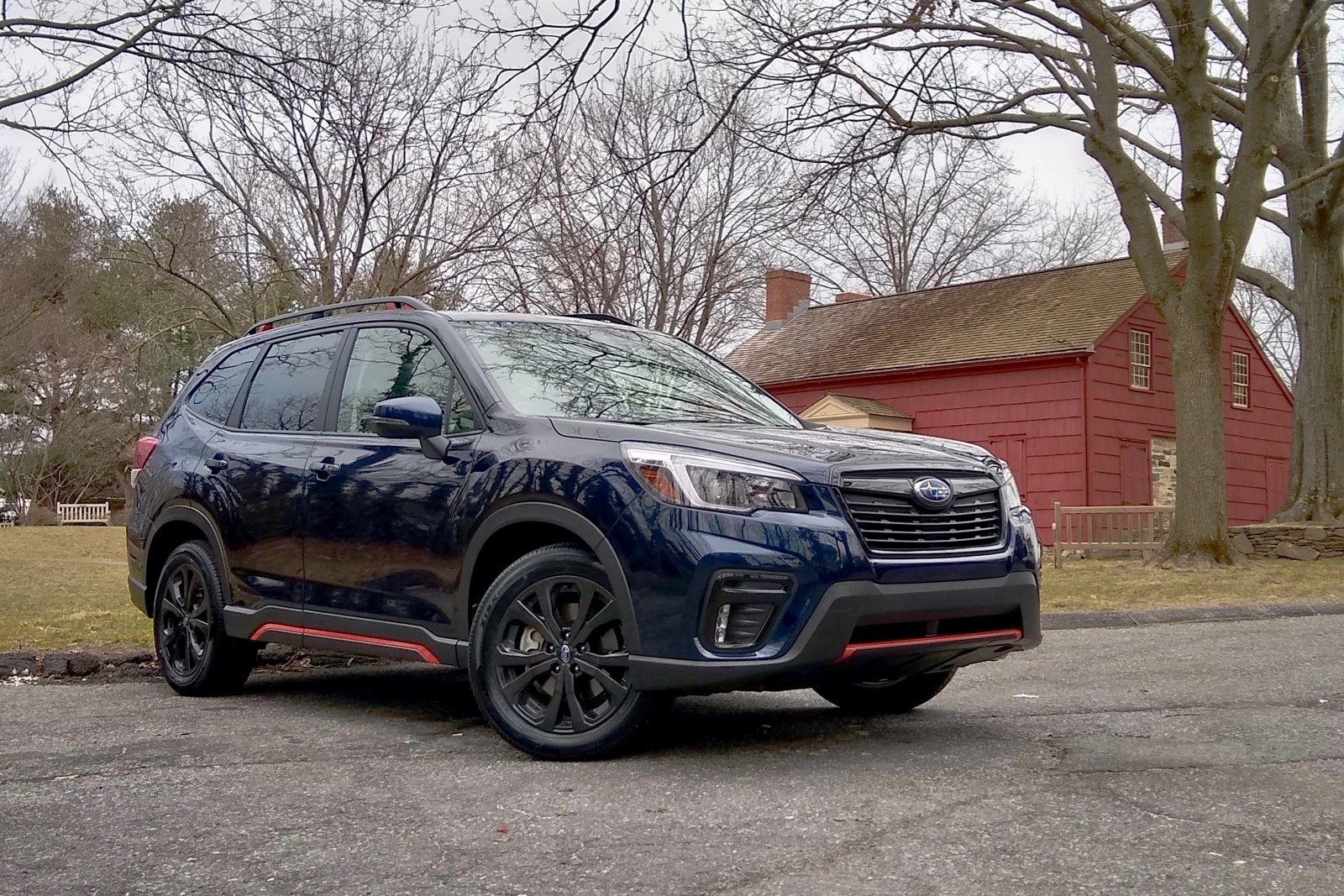
The Forester Sport trim added some visual flair with orange striping around the body and roof rails, a rear spoiler, and black 18-inch alloy wheels, which looked quite striking, especially in contrasting colors like Dark Blue Pearl.
Underneath, the Forester rode on the Subaru Global Platform, which it shared with models like the Impreza, Crosstrek, Legacy, Outback, and Ascent. This shared DNA meant the Forester presented itself as an SUV but retained the driving dynamics of a sedan or hatchback. Inside, the Forester offered a no-nonsense mix of materials designed for durability over aesthetics. The Sport trim interiors featured colored trim and cross-stitching to add a bit of zest. While low trims had cloth upholstery, the Limited and Touring trims stepped up to leather upholstery. An All-Weather Package, standard on Premium and higher trims, added practical features such as heated front seats, heated exterior mirrors, and a windshield de-icer.




The 2021 Toyota RAV4 offered a single gasoline engine option: the 2.5-liter “Dynamic Force” four-cylinder, producing 203 horsepower and 184 pound-feet of torque. This engine was paired with an eight-speed automatic transmission, with the choice of front-wheel drive (FWD) or all-wheel drive (AWD). Remarkably, this engine boasted 40% thermal efficiency, a level typically seen in racing engines, and delivered its power at high revs, peaking at 6,600 rpm.
Despite the capable engine, the rest of the RAV4’s driving dynamics didn’t quite match. The transmission was hesitant to shift, leading to a lackluster driving experience where the engine felt chained by the vehicle’s ordinary handling. Steering responsiveness was quick but felt disconnected, creating a somewhat videogame-like driving experience. Even with a "Sport" mode that added weight to the steering, the overall feel didn’t improve significantly.
However, on the highway, the RAV4 found its comfort zone. It offered a quiet cabin and a suspension that effectively dampened road imperfections. For those interested in off-road adventures, the RAV4 Adventure and TRD Off-Road models featured enhancements like torque-vectoring AWD, 8.6 inches of ground clearance, specific suspension tuning, Falken Wildpeak all-terrain tires, and a respectable towing capacity of 3,500 pounds.
In comparison, the 2021 Subaru Forester also came with a single powertrain option: a 2.5-liter four-cylinder boxer engine, producing 182 horsepower and 176 pound-feet of torque. This engine was paired exclusively with a continuously variable automatic transmission (CVT) and included a manual mode with paddle shifters on certain trims. The boxer engine design maintained a lower center of gravity.
With this setup, Subaru quoted a 1,500-pound towing capacity, supported by Trailer Stability Assist as standard. However, the Forester’s performance felt uninspired, particularly during highway merges or overtaking. The engine provided adequate power in most scenarios but lacked the robust thrust needed for more aggressive driving maneuvers. Furthermore, wind noise was quite noticeable at high speeds.
The Forester’s ride was comfortably soft but lacked body control, resulting in substantial body roll around corners and a lot of bounce on uneven pavements. Although AWD was standard and sophisticated with the inclusion of X-Mode for adapting to various driving surfaces, the Forester’s ride wasn’t particularly engaging for spirited driving. Premium and higher trims had hill-descent control and 8.7 inches of ground clearance, making them capable of handling rougher terrains than an average compact crossover.
The RAV4’s tall, upright roof offered competitive headroom in both rows and good outward visibility thanks to extensive glass surfaces. However, legroom fell behind some competitors. The front seats in the RAV4 TRD Off-Road seemed very comfortable, with a snug, form-fitting shape, while the rear seats had flat, hard cushions that made long journeys seem less appealing. The second-row seats didn’t slide forward or back, limiting flexibility compared to competitors like the Ford Escape or Nissan Rogue. Cargo capacity stood at 37.6 cubic feet with the rear seats in place, above average but still less than the class-leading Honda CR-V. The wide cargo opening eased loading, though the higher lip could be problematic for some users.
Knobs and controls in the RAV4 were oversized and functional, fitting the rugged styling theme even with gloves on. However, storage options like the center-console bin and phone-holding spaces were somewhat limited by larger control components.
The Forester excelled in offering generous headroom and legroom in both seating rows, partly due to its tall, flat roof design, which also enhanced the spacious feel and outward visibility. This design could let in a considerable amount of sunlight, raising cabin temperatures during sunny days. Cargo space in the Forester measured 35.4 cubic feet with rear seats up and 76.1 cubic feet with them down, outclassing the 2021 Honda CR-V and the 2022 Hyundai Tucson when seats were folded, but lagging slightly when seats were up. Unlike competitors, the Forester did not have a sliding second-row bench. A power liftgate was optional on the Sport trim and standard on Limited and Touring trims.
Though the Forester did not boast an extraordinary number of cupholders, those it had were adequately sized and practical. The center console was serviceable, but the phone-storage space was too small for average-sized phones, and wireless charging wasn’t available. Base trims didn’t get a power-adjustable driver’s seat, which was only standard from the Premium trim upwards.
The 2021 Toyota RAV4 was well-equipped on the technology front with standard Apple CarPlay and Android Auto, Amazon Alexa compatibility, and SiriusXM satellite radio. Most trims came with a 7-inch touchscreen, but the Limited trim got an 8-inch screen, and the RAV4 Prime plug-in hybrid could be equipped with a 9-inch screen. Other tech features included up to five USB ports and an optional JBL premium audio system.
While the infotainment system was user-friendly with easily readable graphics and shortcut buttons for essential functions, it was not particularly flashy or innovative. The gasoline RAV4 didn’t offer a head-up display, a feature reserved for the RAV4 Prime.
The 2021 Subaru Forester’s standard Starlink infotainment system included a 6.5-inch touchscreen with Apple CarPlay, Android Auto, Bluetooth, and SiriusXM satellite radio, plus USB ports for the front row and a CD player. The Sport trim added an 8-inch touchscreen and Harman Kardon audio system, while the Limited and Touring trims featured navigation and rear USB ports.
The Forester’s infotainment system was also easy to use, thanks to intuitive graphics and physical shortcut buttons, though it was slow to boot up when starting the car. Additional information screens in the center of the dashboard and in the instrument cluster offered detailed secondary information, but the abundance of displays felt somewhat redundant and overly complicated.
Safety was a strong point for both vehicles. The 2021 Toyota RAV4 earned high safety scores, receiving a “Top Safety Pick” from the IIHS with “Good” ratings in all crash tests and a “Superior” rating for front-crash prevention tech. It missed the highest “Top Safety Pick+” due to mixed headlight scores. The NHTSA awarded it a five-star overall rating, with four stars in frontal and rollover crash tests and five stars in side crash tests.
The RAV4 came standard with Toyota Safety Sense 2.0, which included features such as forward-collision warning, adaptive cruise control, lane-departure warning with steering assist, automatic high beams, road-sign recognition, and Lane Tracing Assist. Higher trims offered blind-spot monitoring, rear cross-traffic alert, reverse automatic emergency braking, and optional park assist and a 360-degree camera system.
The 2021 Subaru Forester also boasted impressive safety credentials, earning the highest “Top Safety Pick+” rating from the IIHS with “Good” ratings across all crash tests, a “Superior” rating for front-crash prevention, and a “Good” rating for headlights. The NHTSA gave it a five-star overall rating, with five stars in both frontal and side crash tests and four stars in rollover tests.
Subaru’s EyeSight system came standard, featuring adaptive cruise control, automatic emergency braking, lane-departure warning, and lead-vehicle start alert. The Forester was unique in offering a driver-monitoring system called DriverFocus, which checked for signs of driver distraction. Additional standard safety features included steering-responsive headlights, automatic high beams, and a rear seatbelt reminder. Optional safety features included blind-spot monitoring, rear cross-traffic alert, lane-keep assist, and reverse automatic braking.
CarGurus highlights
According to CarGurus experts, the overall rating for the 2021 Toyota RAV4 is 7.3 out of 10, while the 2021 Subaru Forester scores 7.5 out of 10. Both cars offer strong attributes in different areas, but with a slightly higher overall score, the Forester emerges as the more recommendable option. The Forester's better safety ratings, standard AWD, and substantial cargo space make it a preferable choice for most consumers.
Choose the 2021 Subaru Forester if:
- You need a spacious vehicle with superior headroom and generous cargo capacity.
- Off-road capability with standard AWD and advanced driving modes is crucial.
- Strong safety ratings and a comprehensive suite of driver-assist features are essential.


Choose the 2021 Toyota RAV4 if:
- You want a vehicle with a rugged SUV look and decent off-road capabilities.
- You prefer a more efficient and powerful engine with better high-rev performance.
- Safety features and a quiet, comfortable highway ride are your top priorities.


CarGurus highlights
According to CarGurus experts, the overall rating for the 2021 Toyota RAV4 is 7.3 out of 10, while the 2021 Subaru Forester scores 7.5 out of 10. Both cars offer strong attributes in different areas, but with a slightly higher overall score, the Forester emerges as the more recommendable option. The Forester's better safety ratings, standard AWD, and substantial cargo space make it a preferable choice for most consumers.
Choose the 2021 Subaru Forester if:
Shop Now- You need a spacious vehicle with superior headroom and generous cargo capacity.
- Off-road capability with standard AWD and advanced driving modes is crucial.
- Strong safety ratings and a comprehensive suite of driver-assist features are essential.
Choose the 2021 Toyota RAV4 if:
Shop Now- You want a vehicle with a rugged SUV look and decent off-road capabilities.
- You prefer a more efficient and powerful engine with better high-rev performance.
- Safety features and a quiet, comfortable highway ride are your top priorities.

By: CarGurus + AI
At CarGurus, our team of experienced automotive writers remain at the heart of our content operation, conducting hands-on car tests and writing insightful guides that are backed by years of industry experience. To complement this, we are harnessing AI to make our content offering more diverse and more helpful to shoppers than ever. To achieve this, our AI systems are based exclusively on CarGurus content, ratings and data, so that what we produce is both unique to CarGurus, and uniquely helpful to car shoppers.

