2021 Honda CR-V vs 2020 Toyota RAV4

Overview | |
MSRP$25,950 | MSRP$25,350 |
Listings1257 | Listings1279 |
Ratings & Reviews | |
User Reviews | User Reviews |
Expert reviews8.7 out of 10 | Expert reviews7.8 out of 10 |
Pros
Cons
| Pros
Cons
|
2020 Toyota RAV4 Reviews SummaryAmericans love the Toyota RAV4. The compact crossover SUV is the most popular vehicle in the U.S. that isn’t a pickup truck, and when you live with one for a while, it’s easy to understand why so many people buy a RAV4. Available with a gasoline 4-cylinder or a gas-electric hybrid powertrain (covered as a separate model), and in a wide range of configurations including sporty XSE, luxurious Limited, and rugged Adventure, the 2020 RAV4 meets a variety of customer wants and needs. | |
2021 Honda CR-V Reviews SummaryEven in a grim year, Honda is selling a staggering number of CR-Vs. The CR-V is the best-selling Honda by far. It’s also the second best-selling compact SUV, just behind the Toyota RAV4. And it's the fifth best-selling vehicle in the U.S., and if you take out all the commercial sales of full-size pickups it’s one of the two best-selling vehicles year in and year out. So it’s hard to argue against the CR-V formula. Honda’s been at this almost as long as crossovers have been a thing, launching the CR-V in 1997—a year after the RAV4 debuted. The funny thing is, aside from sales volume, there’s only one thing the CR-V particularly excels at. Aesthetics are subjective, but it would be hard to argue the CR-V is the best looking vehicle in its class. It’s not the cheapest. It’s not the best equipped, especially at the middle to lower trim levels. It’s not the fastest, nor is it the quietest, or the most fuel efficient. It’s not even the most reliable, showing up nowhere in J.D. Power's Most Reliable list. So what makes it so appealing to American consumers? Let’s see if we can figure that out. | |
No video found | |
Popular Features & Specs | |
Engine2.5L 203 hp I4 | Engine1.5L 190 hp I4 |
Drive TrainFWD | Drive TrainFWD |
Seating Capacity5 | Seating Capacity5 |
Horsepower | Horsepower190 hp @ 5600 rpm |
MPG City27 | MPG City28 |
MPG Highway35 | MPG Highway34 |
Engine | |
Engine Name2.5L 203 hp I4 | Engine Name1.5L 190 hp I4 |
Torque | Torque179 lb-ft @ 2000 rpm |
Horsepower | Horsepower190 hp @ 5600 rpm |
DrivetrainFWD | DrivetrainFWD |
Fuel Economy | |
MPG City27 | MPG City28 |
MPG Highway35 | MPG Highway34 |
Interior | |
Seating Capacity5 | Seating Capacity5 |
Safety | |
Front Crash Overall4 | Front Crash Overall5 |
Side Crash Overall5 | Side Crash Overall5 |
Dimensions & Capacity | |
Cargo Space37.6 cu ft | Cargo Space39.2 cu ft |
Curb Weight3370 lbs | Curb Weight3337 lbs |
Height67.0 in | Height66.1 in |
Length180.9 in | Length182.1 in |
Width73.0 in | Width73.0 in |
Wheelbase105.9 in | Wheelbase104.8 in |
Maximum Payload1240 lbs | Maximum Payload1358 lbs |
Number of doors4 | Number of doors4 |
Maximum Towing Capacity1500 lbs | Maximum Towing Capacity1500 lbs |
Overview | ||
MSRP | $25,950 | $25,350 |
Listings | ||
Ratings & Reviews | ||
User reviews | ||
Expert reviews | 8.7 out of 10Read full review | 7.8 out of 10Read full review |
Pros & cons | Pros
Cons
| Pros
Cons
|
Summary | Americans love the Toyota RAV4. The compact crossover SUV is the most popular vehicle in the U.S. that isn’t a pickup truck, and when you live with one for a while, it’s easy to understand why so many people buy a RAV4. Available with a gasoline 4-cylinder or a gas-electric hybrid powertrain (covered as a separate model), and in a wide range of configurations including sporty XSE, luxurious Limited, and rugged Adventure, the 2020 RAV4 meets a variety of customer wants and needs. | Even in a grim year, Honda is selling a staggering number of CR-Vs. The CR-V is the best-selling Honda by far. It’s also the second best-selling compact SUV, just behind the Toyota RAV4. And it's the fifth best-selling vehicle in the U.S., and if you take out all the commercial sales of full-size pickups it’s one of the two best-selling vehicles year in and year out. So it’s hard to argue against the CR-V formula. Honda’s been at this almost as long as crossovers have been a thing, launching the CR-V in 1997—a year after the RAV4 debuted. The funny thing is, aside from sales volume, there’s only one thing the CR-V particularly excels at. Aesthetics are subjective, but it would be hard to argue the CR-V is the best looking vehicle in its class. It’s not the cheapest. It’s not the best equipped, especially at the middle to lower trim levels. It’s not the fastest, nor is it the quietest, or the most fuel efficient. It’s not even the most reliable, showing up nowhere in J.D. Power's Most Reliable list. So what makes it so appealing to American consumers? Let’s see if we can figure that out. |
Video | No video found | |
Popular Features & Specs | ||
Engine | 2.5L 203 hp I4 | 1.5L 190 hp I4 |
Drive Train | FWD | FWD |
Seating Capacity | 5 | 5 |
Horsepower | 190 hp @ 5600 rpm | |
MPG City | 27 | 28 |
MPG Highway | 35 | 34 |
Engine | ||
Engine Name | 2.5L 203 hp I4 | 1.5L 190 hp I4 |
Torque | 179 lb-ft @ 2000 rpm | |
Horsepower | 190 hp @ 5600 rpm | |
Drivetrain | FWD | FWD |
Fuel Economy | ||
MPG City | 27 | 28 |
MPG Highway | 35 | 34 |
Interior | ||
Seating Capacity | 5 | 5 |
Safety | ||
Front Crash Overall | 4 | 5 |
Side Crash Overall | 5 | 5 |
Dimensions & Capacity | ||
Cargo Space | 37.6 cu ft | 39.2 cu ft |
Curb Weight | 3370 lbs | 3337 lbs |
Height | 67.0 in | 66.1 in |
Length | 180.9 in | 182.1 in |
Width | 73.0 in | 73.0 in |
Wheelbase | 105.9 in | 104.8 in |
Maximum Payload | 1240 lbs | 1358 lbs |
Number of doors | 4 | 4 |
Maximum Towing Capacity | 1500 lbs | 1500 lbs |
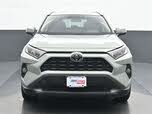
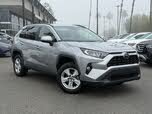
The 2020 Toyota RAV4 had established itself as a benchmark in the compact SUV category, competing directly with vehicles like the Mazda CX-5 and Honda CR-V. The 2020 model carried forward the bold and angular redesign introduced in 2019, which gave the car a more rugged and durable appearance. This aesthetic aligned well with its reputation for durability and reliability.
Among the RAV4’s multiple trim levels, the Adventure trim enhanced off-roading capabilities. It replaced the standard front-wheel drive (FWD) with a torque-vectoring all-wheel-drive (AWD) system, a traction control system with multiple driving modes tailored to different weather and terrain, and downhill assist control. Boasting 8.6 inches of ground clearance, the Adventure lived up to its name more than any other RAV4 trim.
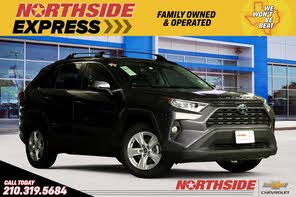
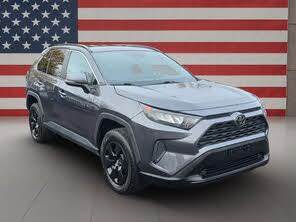
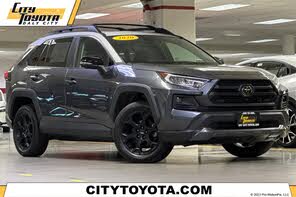
For 2020, the TRD Off-Road trim took things a step further. The TRD featured matte-black 18-inch alloy wheels and all-terrain tires designed for severe snow conditions. Additionally, it had a specialized Toyota Racing Development (TRD) suspension setup that provided excellent performance on various surfaces. Externally, the TRD Off-Road could be distinguished by its unique wheels, tires, and badges. My test vehicle showcased Toyota’s Lunar Rock gray paint with an optional white roof, a combination that was excellent at hiding dirt.
Inside, the TRD Off-Road version featured TRD logos on the front-seat head restraints, rubber floor mats, and a rubber cargo mat to help handle dirt and mud. Quality construction elements like plush center-armrest padding and soft-touch materials contrasted sharply with the more basic-looking plastics.
The RAV4’s trim levels ranged from the base LE with FWD at a starting price of $25,950 to the Limited with AWD, priced at $35,880. The lineup also included the XLE, XLE Premium, Adventure, and TRD Off-Road trims. For those looking for the best value, the XLE trim with the top options package was recommended, priced around $31,750 for the standard gas engine and FWD and slightly over $33,000 for the hybrid with AWD.
My test vehicle had a hefty price tag of $42,902, which included options and dealer-installed accessories worth more than $1,500.
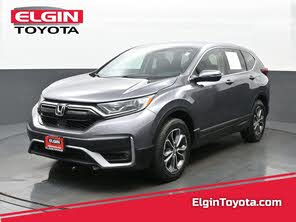
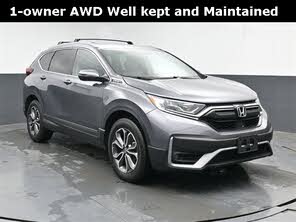
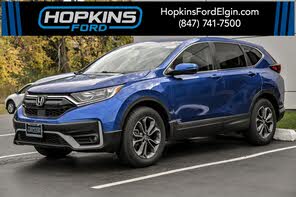
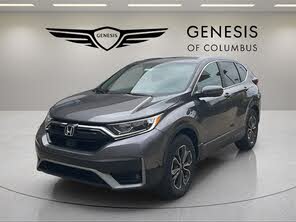
In contrast, the 2021 Honda CR-V faced criticism for its indistinguishable exterior design, which closely resembled most other compact crossovers on the market. Minor distinctions like the grille design and some chrome accents set it apart, but styling wasn't its main selling point.
Honda provided the CR-V in eight colors, but most were variations of gray, black, or white. There were two shades of blue and one vibrant red, but these were restricted to higher trims. Dealers often stocked the more common colors in larger quantities, making the vibrant hues harder to find.
Inside, the CR-V’s interior options included black, gray, and ivory cloth or leather, depending on the trim. Upgraded trims featured wood panels and more chrome for a luxurious appearance. The seating design was more angular compared to some competitors, with sharp details on the seat edges and headrests, giving it a modern look.
When compared to vehicles like the Kia Sportage and Hyundai Tucson, the CR-V found itself at a disadvantage in terms of distinctive exterior and interior styling. However, the emphasis was not on looks but rather on functionality.


The 2020 RAV4 came equipped with a 2.5-liter four-cylinder engine that produced 203 horsepower and 184 pound-feet of torque. Toyota also offered the RAV4 in a hybrid form, featuring 219 horsepower and a combined fuel economy of up to 40 mpg. However, the hybrid option wasn't available with the TRD Off-Road trim. The upcoming 2021 RAV4 Prime would introduce a high-performance plug-in hybrid variant.
The non-turbo, non-hybrid engine in my test model provided commendable power, making the RAV4 feel sufficiently energetic, especially in Sport mode. However, a turbocharged engine could have fared better at higher altitudes. The 8-speed automatic transmission managed power delivery well but occasionally had difficulty selecting the appropriate gear.
Unique to the TRD Off-Road, the RAV4 sported a torque-vectoring AWD system with fuel-saving driveline disconnect technology, as well as selectable terrain modes, which included Snow, Mud & Sand, and Rock & Dirt settings. Coupled with 8.6 inches of ground clearance, a downhill assist control system, and specialized suspension, this RAV4 variant was well-prepared for rugged terrains.
Despite its off-road capabilities, the vehicle proved versatile in urban settings, handling speed humps with ease and featuring a 360-degree surround-view camera that made parking straightforward. Although I averaged 23.4 mpg in fuel economy—short of the EPA's 27 mpg estimation—the overall performance was praiseworthy.
The 2021 Honda CR-V was not built for high-speed thrills but emphasized smooth and steady driving essentials. All non-hybrid CR-V trims featured a 190-horsepower turbocharged four-cylinder engine, which reached 60 mph in approximately 7.8 seconds—adequate but not outstanding.
The CR-V's continuously variable transmission (CVT) maintained constant engine revs as speed accumulated. This setup prioritized smoothness over driving engagement. Competitors such as the Kia Sportage, Hyundai Tucson, and VW Taos, with their more conventional transmissions and driving modes, offered a more engaging drive experience.
Standard with FWD and offering AWD as an option, the CR-V had a similar drivetrain setup to other competitors. However, the Subaru Forester distinguished itself by offering standard AWD.
The CR-V's suspension setup included a MacPherson strut design at the front and a multi-link suspension at the rear, common in this vehicle class. The handling and ride quality were consistently decent across the CR-V range.
Entering and exiting the RAV4 was convenient due to optimal seating hip points. The driver's seat featured an 8-way adjustability, providing a low and sporty driving position. Although the front passenger seat lacked a height adjuster, it still offered good support.
The TRD Off-Road’s interior had Toyota's SofTex simulated leather, which could trap sweat on hot days. The optional Weather Package, strongly recommended, included heated and ventilated front seats and a heated steering wheel.
Rear-seat passengers enjoyed generous legroom, air conditioning vents, and USB ports. The interior boasted ample storage options, such as a full-width dashboard shelf. The cargo space behind the rear seats measured 37.6 cubic feet, and with the rear seats folded, it expanded to 69.8 cubic feet. A hands-free power liftgate was available as an optional extra. The test vehicle’s roof rack with crossbars further increased its utility.
The CR-V’s form was clearly driven by its practical functionality. The vehicle offered 102.9 cubic feet of passenger volume, four cubic feet more than the RAV4. Additionally, the CR-V had slightly more cargo space behind the second row, amounting to 39.2 cubic feet, which expanded to 75.8 cubic feet with the rear seats folded.
The CR-V’s cargo access varied by trim. Higher trims featured power tailgates, with the Touring model offering a hands-free tailgate activated by waving a foot under the bumper—a feature that occasionally required precise positioning.
While the CR-V did not match the RAV4’s standard roof rack availability, its top Touring trim did include roof rails. However, lower trims lacked this feature.
Technology the 2020 RAV4 was designed to be user-friendly and beneficial. Depending on the trim, it featured either a 7- or 8-inch touchscreen display, the latter being standard on the TRD Off-Road. The infotainment system included Bluetooth, Apple CarPlay, Android Auto, Amazon Alexa, SiriusXM satellite radio, and multiple connected services.
The system had intuitive menu shortcuts, volume, and tuning knobs, separate climate controls, and optional upgrades like navigation and a JBL premium sound system. A remarkable highlight was its voice-recognition technology, which accurately and promptly responded to commands.
The base CR-V LX had a modest 5-inch color screen with basic Bluetooth connectivity. However, higher trims featured a 7-inch high-definition touchscreen with Apple CarPlay, Android Auto integration, and SMS text messaging.
The Special Edition and EX trims had a 180-watt, six-speaker audio system. The EX-L upgraded to eight speakers, and the Touring offered a 300-watt system with a subwoofer. From the EX trim onwards, features like Sirius XM and HD radio were standard, while the Touring trim alone included satellite navigation with voice recognition.
Charging ports were plentiful, excluding the base LX trim, with multiple USB ports and a 12-volt outlet in the center console. Wireless charging was exclusive to the Touring trim.
CarGurus highlights

According to CarGurus experts, the overall rating for the 2020 Toyota RAV4 was 8.7 out of 10, while the 2021 Honda CR-V scored 7.8 out of 10. Given these ratings, the 2020 Toyota RAV4 emerges as the recommended choice. It offers a more comprehensive package with robust off-road capabilities, advanced safety features, and versatile performance, making it a better overall option in this comparison.
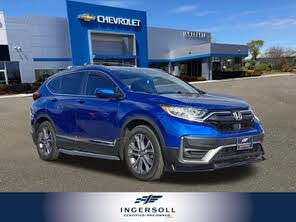
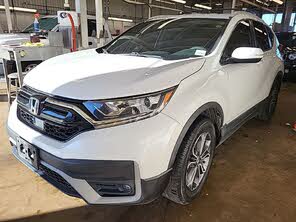
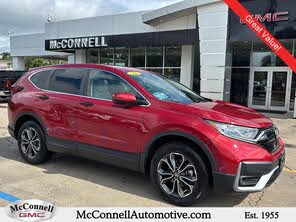
Choose the 2021 Honda CR-V if:
- You prioritize interior space and cargo capacity for both passengers and gear.
- Standard advanced safety features across all trim levels are a must-have.
- A smooth, steady ride with decent acceleration and predictable handling is what you seek.



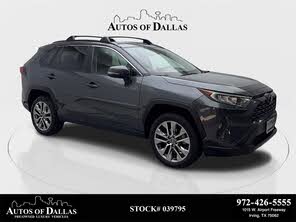
Choose the 2020 Toyota RAV4 if:
- You need robust off-road capabilities combined with a rugged, durable design.
- Advanced safety technologies and a suite of standard driver-assistance features are essential.
- Versatility in both urban settings and adventurous terrains is a priority.



CarGurus highlights
According to CarGurus experts, the overall rating for the 2020 Toyota RAV4 was 8.7 out of 10, while the 2021 Honda CR-V scored 7.8 out of 10. Given these ratings, the 2020 Toyota RAV4 emerges as the recommended choice. It offers a more comprehensive package with robust off-road capabilities, advanced safety features, and versatile performance, making it a better overall option in this comparison.
Choose the 2021 Honda CR-V if:
Shop Now- You prioritize interior space and cargo capacity for both passengers and gear.
- Standard advanced safety features across all trim levels are a must-have.
- A smooth, steady ride with decent acceleration and predictable handling is what you seek.










Choose the 2020 Toyota RAV4 if:
Shop Now- You need robust off-road capabilities combined with a rugged, durable design.
- Advanced safety technologies and a suite of standard driver-assistance features are essential.
- Versatility in both urban settings and adventurous terrains is a priority.







By: CarGurus + AI
At CarGurus, our team of experienced automotive writers remain at the heart of our content operation, conducting hands-on car tests and writing insightful guides that are backed by years of industry experience. To complement this, we are harnessing AI to make our content offering more diverse and more helpful to shoppers than ever. To achieve this, our AI systems are based exclusively on CarGurus content, ratings and data, so that what we produce is both unique to CarGurus, and uniquely helpful to car shoppers.