2021 Volkswagen Atlas vs 2020 Volkswagen Tiguan

Overview | |
MSRP$24,945 | MSRP$31,545 |
Listings914 | Listings1340 |
Ratings & Reviews | |
User Reviews | User Reviews |
Expert reviews7.7 out of 10 | Expert reviews6.5 out of 10 |
Pros
Cons
| Pros
Cons
|
2020 Volkswagen Tiguan Reviews SummaryThe Volkswagen Tiguan is one of only two compact crossover SUV’s that currently offer third-row seating. (And the other is the hopelessly outdated Mitsubishi Outlander.) To fit the extra pair of surprisingly spacious seats, VW made the Tiguan much larger than average for its competitive set—which suits a vehicle that fills big shoes in VW dealerships. With five trim levels and prices that stretch from just under $26,000 to a bit over $40,000, the Tiguan is the German brand’s best-selling vehicle in the U.S. | |
2021 Volkswagen Atlas Reviews SummaryIntroduced for the 2018 model year, the Atlas is Volkswagen's latest attempt to win over American buyers. Built in Chattanooga, Tennessee, the VW Atlas competes in the three-row crossover SUV segment against well-established nameplates like the Ford Explorer, Honda Pilot, and Toyota Highlander. Changes for 2021 are limited to exterior styling tweaks and a reshuffled option list. VW also offers the two-row Atlas Cross Sport. | |
No video found | |
Popular Features & Specs | |
Engine2.0L 184 hp I4 | Engine2.0L 235 hp I4 |
Drive TrainFWD | Drive TrainFWD |
Seating Capacity7 | Seating Capacity7 |
Horsepower184 hp @ 4400 rpm | Horsepower |
MPG City22 | MPG City21 |
MPG Highway29 | MPG Highway24 |
Engine | |
Engine Name2.0L 184 hp I4 | Engine Name2.0L 235 hp I4 |
Torque221 lb-ft @ 1600 rpm | Torque |
Horsepower184 hp @ 4400 rpm | Horsepower |
DrivetrainFWD | DrivetrainFWD |
Fuel Economy | |
MPG City22 | MPG City21 |
MPG Highway29 | MPG Highway24 |
Interior | |
Seating Capacity7 | Seating Capacity7 |
Safety | |
Front Crash Overall4 | Front Crash Overall4 |
Side Crash Overall5 | Side Crash Overall5 |
Dimensions & Capacity | |
Cargo Space12.0 cu ft | Cargo Space20.6 cu ft |
Curb Weight3757 lbs | Curb Weight4248 lbs |
Height66.3 in | Height70.1 in |
Length185.1 in | Length200.7 in |
Width72.4 in | Width78.4 in |
Wheelbase109.8 in | Wheelbase117.3 in |
Maximum Payload1124 lbs | Maximum Payload1080 lbs |
Number of doors4 | Number of doors4 |
Maximum Towing Capacity1500 lbs | Maximum Towing Capacity2000 lbs |
Overview | ||
MSRP | $24,945 | $31,545 |
Listings | ||
Ratings & Reviews | ||
User reviews | ||
Expert reviews | 7.7 out of 10Read full review | 6.5 out of 10Read full review |
Pros & cons | Pros
Cons
| Pros
Cons
|
Summary | The Volkswagen Tiguan is one of only two compact crossover SUV’s that currently offer third-row seating. (And the other is the hopelessly outdated Mitsubishi Outlander.) To fit the extra pair of surprisingly spacious seats, VW made the Tiguan much larger than average for its competitive set—which suits a vehicle that fills big shoes in VW dealerships. With five trim levels and prices that stretch from just under $26,000 to a bit over $40,000, the Tiguan is the German brand’s best-selling vehicle in the U.S. | Introduced for the 2018 model year, the Atlas is Volkswagen's latest attempt to win over American buyers. Built in Chattanooga, Tennessee, the VW Atlas competes in the three-row crossover SUV segment against well-established nameplates like the Ford Explorer, Honda Pilot, and Toyota Highlander. Changes for 2021 are limited to exterior styling tweaks and a reshuffled option list. VW also offers the two-row Atlas Cross Sport. |
Video | No video found | |
Popular Features & Specs | ||
Engine | 2.0L 184 hp I4 | 2.0L 235 hp I4 |
Drive Train | FWD | FWD |
Seating Capacity | 7 | 7 |
Horsepower | 184 hp @ 4400 rpm | |
MPG City | 22 | 21 |
MPG Highway | 29 | 24 |
Engine | ||
Engine Name | 2.0L 184 hp I4 | 2.0L 235 hp I4 |
Torque | 221 lb-ft @ 1600 rpm | |
Horsepower | 184 hp @ 4400 rpm | |
Drivetrain | FWD | FWD |
Fuel Economy | ||
MPG City | 22 | 21 |
MPG Highway | 29 | 24 |
Interior | ||
Seating Capacity | 7 | 7 |
Safety | ||
Front Crash Overall | 4 | 4 |
Side Crash Overall | 5 | 5 |
Dimensions & Capacity | ||
Cargo Space | 12.0 cu ft | 20.6 cu ft |
Curb Weight | 3757 lbs | 4248 lbs |
Height | 66.3 in | 70.1 in |
Length | 185.1 in | 200.7 in |
Width | 72.4 in | 78.4 in |
Wheelbase | 109.8 in | 117.3 in |
Maximum Payload | 1124 lbs | 1080 lbs |
Number of doors | 4 | 4 |
Maximum Towing Capacity | 1500 lbs | 2000 lbs |
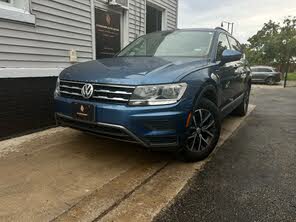
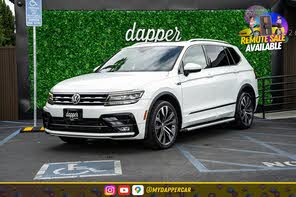
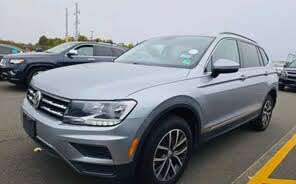
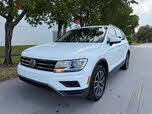
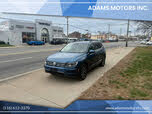
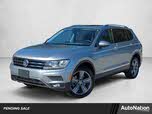
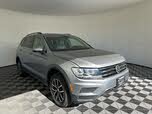
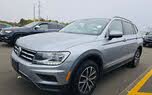
Volkswagen completely overhauled the Tiguan for the 2018 model year, introducing an all-new second generation of its compact crossover SUV. The redesign addressed the original Tiguan’s biggest shortcoming—its diminutive size—and aimed to make it more competitively priced against the Honda CR-V and Toyota RAV4. The result was a stylish and conservatively German vehicle on the surface, though some cost-cutting measures were evident upon closer inspection. The Tiguan featured clean and simple lines, with a horizontal grille connecting the headlights, and a new flat VW logo. Inside, however, the design was plain, with dull surfaces and hard black plastic, a far cry from Volkswagen’s previous interior excellence. The focus had shifted to electronics, with an optional digital dashboard and a glass-covered touchscreen infotainment system being the highlights.
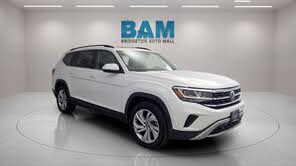
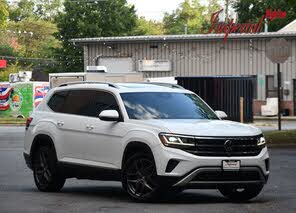
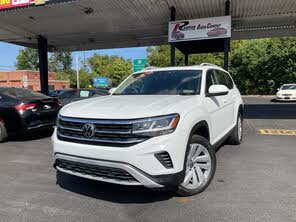
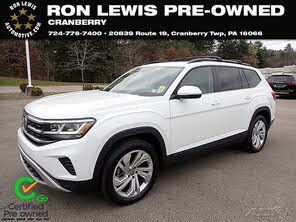
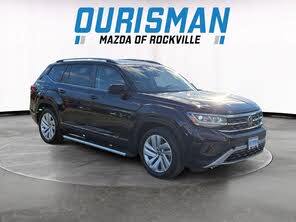
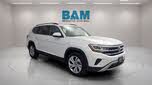
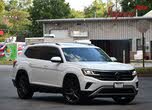
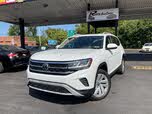
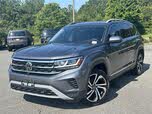
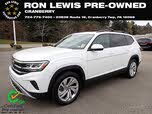
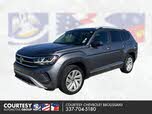
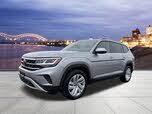
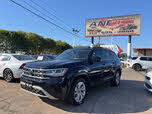
The 2021 Volkswagen Atlas received a styling refresh, including new front and rear bumpers, standard LED headlights and taillights, and a new grille shared with the two-row Atlas Cross Sport model. These changes added 2.4 inches to the length of the Atlas, giving it a more extroverted look compared to the conservatively-styled 2020 model. The R-Line trim package added sportier-looking front and rear bumpers, as well as side skirts. Despite the cosmetic changes, the Atlas still rode on the same MQB platform as before. The interior took a minimalist approach, with sensibly laid-out controls and a standard seating configuration of seven seats across three rows. However, material quality was below average, with cheap and tinny plastics and simulated wood and metal trim that were far from convincing.


The 2020 Volkswagen Tiguan was powered by a turbocharged 2.0-liter four-cylinder engine, producing 184 horsepower and 221 pound-feet of torque. This engine drove either the front or all four wheels through an eight-speed automatic transmission. The Tiguan’s powertrain offered a snappy throttle response with minimal turbo lag, but it was only moderately fleet of foot. The Tiguan’s handling was impacted by its larger size, with a longer wheelbase making it less nimble than some competitors. The suspension was soft, ensuring a comfortable driving experience even on rough roads. However, the Tiguan was not the best choice for those seeking a fun-to-drive compact crossover.
The 2021 Volkswagen Atlas offered two engine options: a standard 2.0-liter turbocharged inline-four producing 235 horsepower and 258 pound-feet of torque, and a 3.6-liter VR6 engine rated at 276 horsepower and 266 pound-feet of torque. Both engines were coupled to an eight-speed automatic transmission, with standard front-wheel drive or optional 4Motion all-wheel drive. The driving experience with the base 2.0-liter engine and AWD was underwhelming, with adequate acceleration but rough shifts. Handling was truck-like, and the ride quality was poor, with every pavement imperfection felt in the cabin. The VR6 engine offered better performance, but the Atlas still lacked the refinement and comfort expected in this segment.
The 2020 Volkswagen Tiguan excelled in practicality, with a second row of seats that could slide up to seven inches fore and aft, making the third row actually useful. Front-drive Tiguans came with a standard third row, while AWD models were standard five-seaters with the third row available as an option. The split second-row rear seats folded flat, providing a cargo capacity of 65.7 cubic feet with the third row collapsed, and 73.5 cubic feet in two-row models. The Tiguan’s interior felt roomy, with plenty of hip and shoulder room in the front seats, and a seating position that made the vehicle feel larger than it was.
The 2021 Volkswagen Atlas was designed as a family hauler, with a standard seating configuration of seven seats across three rows. The Atlas offered 96.8 cubic feet of cargo space behind the front seats and 20.6 cubic feet with all seats up. While the third row provided more legroom than most competitors, it came at the expense of second-row legroom, which was the worst among its competitive set. The second-row bench seat was also uncomfortable, with thin, flat cushions. The Atlas featured a tall driving position, but forward visibility was less than optimal. The interior controls were logically laid out, and up to five USB ports and an optional wireless charging pad were available.
The 2020 Volkswagen Tiguan featured the MIB II infotainment system, with a 6.5-inch touchscreen display in the base S trim and an 8-inch capacitive touchscreen in higher trims. The system was user-friendly, with bright colors and graphics, and a speedy processor. The Tiguan S had a single USB-C port in the front, while higher trims had two USB-A ports in the front and a third in the second row. A wireless charging pad was available on trims above S. VW’s Digital Cockpit, a fully digital instrument panel, was available on top SEL trims. Standard features included Apple CarPlay, Android Auto, Bluetooth connectivity, and a WiFi hotspot.
The 2021 Volkswagen Atlas came with Bluetooth and Apple CarPlay/Android Auto smartphone compatibility. The base S trim level had a 6.5-inch infotainment touchscreen, while other models had an 8-inch screen. Volkswagen’s Digital Cockpit was available on higher trim levels, replacing analog gauges with a 10.3-inch reconfigurable digital display. The Atlas was set to receive the new MIBIII infotainment system later in the 2021 model year, which would add multi-phone pairing capability, improved voice recognition, and a redesigned navigation system. A built-in 4G LTE WiFi hotspot was new for 2021, supporting up to four devices.
For the 2020 model year, Volkswagen improved the Tiguan’s standard safety package, adding forward-collision warning with automatic emergency braking, blind spot monitoring, and rear cross-traffic alert to all models. However, adaptive cruise control with lane-keeping assistance and LED headlights with automatic high beams were reserved for the top SEL trim. VW equipped all 2020 Tiguan models with Car-Net, a telematics package that connected the vehicle to an owner’s smartphone or watch through an app. The Tiguan received a Top Safety Pick rating from the Insurance Institute for Highway Safety (IIHS) for top-of-the-line SEL Premium models with LED headlights.
The 2021 Volkswagen Atlas received the top “good” rating in all IIHS crash tests, but with a “marginal” rating for child-seat anchors and mixed headlight ratings. The standard headlights were rated “marginal,” while the headlights on the SEL and SEL Premium trim levels were rated “good.” The National Highway Traffic Safety Administration (NHTSA) had not published ratings for the 2021 Atlas, but the 2020 model received a five-star overall rating. Every 2021 Atlas trim level came with standard automatic emergency braking and blind-spot monitoring. Adaptive cruise control and lane-keep assist were available on higher trim levels, as was a traffic-jam assist feature.
CarGurus highlights

According to CarGurus experts, the overall rating for the 2020 Volkswagen Tiguan is 7.7 out of 10, while the 2021 Volkswagen Atlas scores 6.5 out of 10. Based on these ratings, the 2020 Volkswagen Tiguan is the better choice, offering a more practical interior, a user-friendly infotainment system, and a good balance of comfort and driving dynamics.
Choose the 2021 Volkswagen Atlas if:
- You need a three-row crossover with ample third-row legroom.
- You prefer a vehicle with a minimalist interior design and logically laid-out controls.
- You want a family hauler with a tall driving position and plenty of USB ports.



Choose the 2020 Volkswagen Tiguan if:
- You need a compact crossover with a practical and spacious interior.
- You value a user-friendly infotainment system with a responsive touchscreen.
- You want a vehicle with a good balance of comfort and driving dynamics.





CarGurus highlights
According to CarGurus experts, the overall rating for the 2020 Volkswagen Tiguan is 7.7 out of 10, while the 2021 Volkswagen Atlas scores 6.5 out of 10. Based on these ratings, the 2020 Volkswagen Tiguan is the better choice, offering a more practical interior, a user-friendly infotainment system, and a good balance of comfort and driving dynamics.
Choose the 2021 Volkswagen Atlas if:
Shop Now- You need a three-row crossover with ample third-row legroom.
- You prefer a vehicle with a minimalist interior design and logically laid-out controls.
- You want a family hauler with a tall driving position and plenty of USB ports.

Choose the 2020 Volkswagen Tiguan if:
Shop Now- You need a compact crossover with a practical and spacious interior.
- You value a user-friendly infotainment system with a responsive touchscreen.
- You want a vehicle with a good balance of comfort and driving dynamics.




By: CarGurus + AI
At CarGurus, our team of experienced automotive writers remain at the heart of our content operation, conducting hands-on car tests and writing insightful guides that are backed by years of industry experience. To complement this, we are harnessing AI to make our content offering more diverse and more helpful to shoppers than ever. To achieve this, our AI systems are based exclusively on CarGurus content, ratings and data, so that what we produce is both unique to CarGurus, and uniquely helpful to car shoppers.