2020 Toyota 4Runner vs 2021 Chevrolet Traverse
Overview | |
MSRP$36,120 | MSRP$29,800 |
Listings201 | Listings257 |
Ratings & Reviews | |
User Reviews | User Reviews |
Expert reviews6.8 out of 10 | Expert reviews6.7 out of 10 |
Pros
Cons
| Pros
Cons
|
2020 Toyota 4Runner Reviews SummaryEven in its expensive Limited trim, the Toyota 4Runner remains clearly purpose-built for tackling terrain. Whether on a dusty cow path or snowy mountain road, the 4Runner looks most in its element when its outside the typical car’s comfort zone. For 2020, Toyota keeps enough chrome and leather available to market the 4Runner as a rough-and-tumble luxury alternative, but shoppers considering one had better have a real need for 4-wheel drive. | |
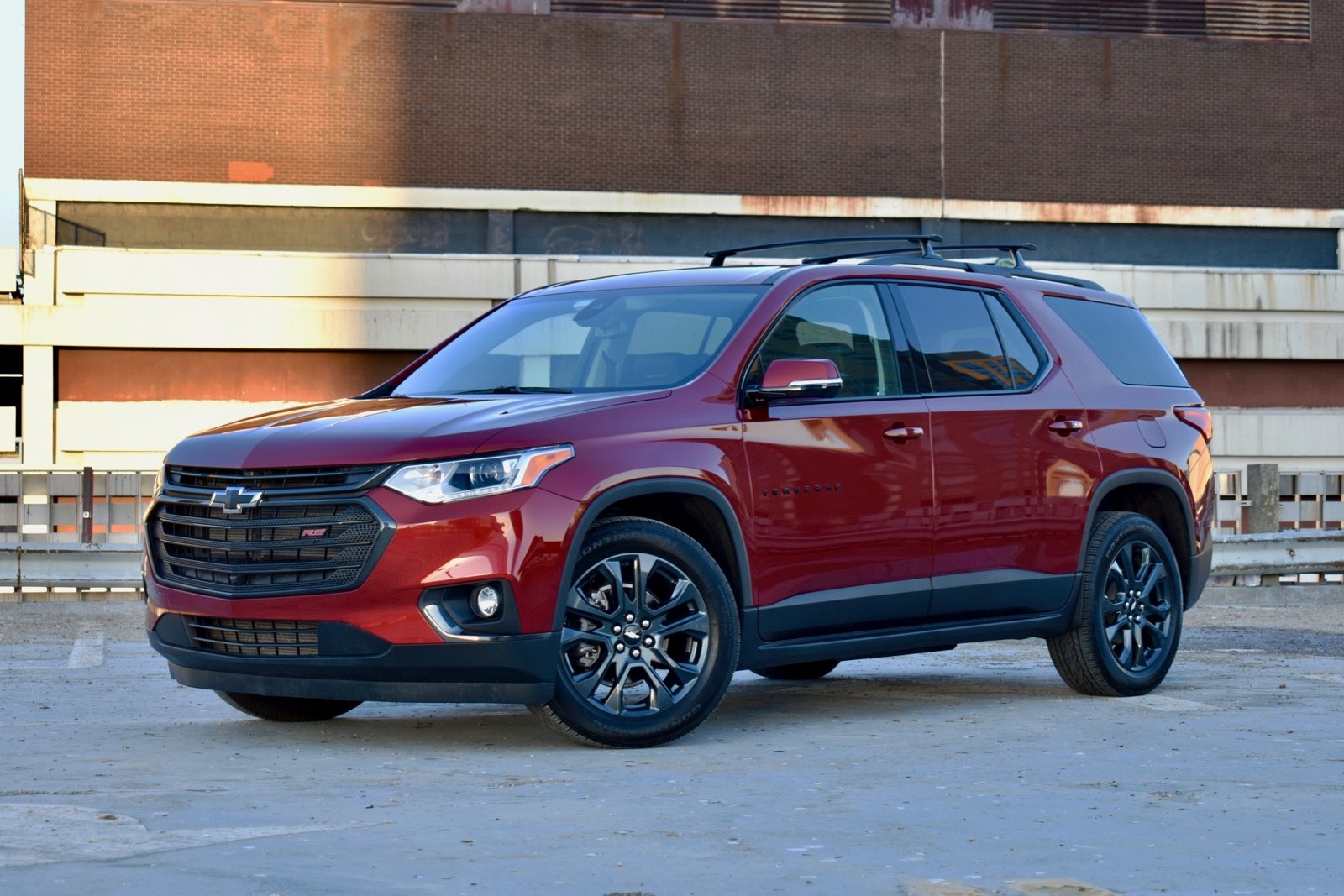
2021 Chevrolet Traverse Reviews SummaryLike a geological core sample, you can chart the evolution of the American family car by looking at the Chevrolet lineup. Go back a few decades and you have tail-finned and wood-paneled station wagons, then Lumina APV “Dustbuster” minivans. Today, you have the 2021 Chevrolet Traverse. The Traverse is a three-row crossover of the type that has largely eliminated the minivan from showrooms. As the new default choice for larger families, the three-row crossover has spawned a competitive market segment, encompassing the Ford Explorer, Honda Pilot, Hyundai Palisade, Kia Telluride, Mazda CX-9, Nissan Pathfinder, Subaru Ascent, Toyota Highlander, and Volkswagen Atlas. So buyers aren’t exactly lacking in choices here. The current-generation Traverse dates back to the 2018 model year, so it’s not the newest vehicle in the segment, but still fairly fresh. Chevy had some updates planned for the 2021 model year—including minor styling changes and wireless Apple CarPlay/Android Auto connectivity—but they’ve been pushed to 2022. However, these changes don’t appear significant enough to justify waiting around for the 2022 Traverse, which is scheduled to reach dealerships later this year. For 2021, the Traverse is available in L, LS, LT Cloth, LT Leather, RS, Premier, and High Country trim levels, with standard front-wheel drive (FWD) or optional all-wheel drive (AWD). Our test car was an AWD Traverse RS model. | |
No video found | No video found |
Popular Features & Specs | |
Engine4.0L 270 hp V6 | Engine3.6L 310 hp V6 |
Drive Train4X2 | Drive TrainFWD |
Seating Capacity7 | Seating Capacity8 |
Horsepower270 hp @ 5600 rpm | Horsepower310 hp @ 6800 rpm |
MPG City16 | MPG City18 |
MPG Highway19 | MPG Highway27 |
Engine | |
Engine Name4.0L 270 hp V6 | Engine Name3.6L 310 hp V6 |
Torque278 lb-ft @ 4400 rpm | Torque266 lb-ft @ 2800 rpm |
Horsepower270 hp @ 5600 rpm | Horsepower310 hp @ 6800 rpm |
Drivetrain4X2 | DrivetrainFWD |
Fuel Economy | |
MPG City16 | MPG City18 |
MPG Highway19 | MPG Highway27 |
Interior | |
Seating Capacity7 | Seating Capacity8 |
Safety | |
Front Crash Overall4 | Front Crash Overall4 |
Side Crash Overall5 | Side Crash Overall5 |
Dimensions & Capacity | |
Cargo Space47.2 cu ft | Cargo Space23.0 cu ft |
Curb Weight4400 lbs | Curb Weight4362 lbs |
Height71.5 in | Height70.7 in |
Length190.2 in | Length204.3 in |
Width75.8 in | Width78.6 in |
Wheelbase109.8 in | Wheelbase120.9 in |
Maximum Payload1700 lbs | Maximum Payload1798 lbs |
Number of doors4 | Number of doors4 |
Maximum Towing Capacity5000 lbs | Maximum Towing Capacity |
Standard Towing Capacity5000 lbs | Standard Towing Capacity |
Overview | ||
MSRP | $36,120 | $29,800 |
Listings | ||
Ratings & Reviews | ||
User reviews | ||
Expert reviews | 6.8 out of 10Read full review | 6.7 out of 10Read full review |
Pros & cons | Pros
Cons
| Pros
Cons
|
Summary | Even in its expensive Limited trim, the Toyota 4Runner remains clearly purpose-built for tackling terrain. Whether on a dusty cow path or snowy mountain road, the 4Runner looks most in its element when its outside the typical car’s comfort zone. For 2020, Toyota keeps enough chrome and leather available to market the 4Runner as a rough-and-tumble luxury alternative, but shoppers considering one had better have a real need for 4-wheel drive. | Like a geological core sample, you can chart the evolution of the American family car by looking at the Chevrolet lineup. Go back a few decades and you have tail-finned and wood-paneled station wagons, then Lumina APV “Dustbuster” minivans. Today, you have the 2021 Chevrolet Traverse. The Traverse is a three-row crossover of the type that has largely eliminated the minivan from showrooms. As the new default choice for larger families, the three-row crossover has spawned a competitive market segment, encompassing the Ford Explorer, Honda Pilot, Hyundai Palisade, Kia Telluride, Mazda CX-9, Nissan Pathfinder, Subaru Ascent, Toyota Highlander, and Volkswagen Atlas. So buyers aren’t exactly lacking in choices here. The current-generation Traverse dates back to the 2018 model year, so it’s not the newest vehicle in the segment, but still fairly fresh. Chevy had some updates planned for the 2021 model year—including minor styling changes and wireless Apple CarPlay/Android Auto connectivity—but they’ve been pushed to 2022. However, these changes don’t appear significant enough to justify waiting around for the 2022 Traverse, which is scheduled to reach dealerships later this year. For 2021, the Traverse is available in L, LS, LT Cloth, LT Leather, RS, Premier, and High Country trim levels, with standard front-wheel drive (FWD) or optional all-wheel drive (AWD). Our test car was an AWD Traverse RS model. |
Video | No video found | No video found |
Popular Features & Specs | ||
Engine | 4.0L 270 hp V6 | 3.6L 310 hp V6 |
Drive Train | 4X2 | FWD |
Seating Capacity | 7 | 8 |
Horsepower | 270 hp @ 5600 rpm | 310 hp @ 6800 rpm |
MPG City | 16 | 18 |
MPG Highway | 19 | 27 |
Engine | ||
Engine Name | 4.0L 270 hp V6 | 3.6L 310 hp V6 |
Torque | 278 lb-ft @ 4400 rpm | 266 lb-ft @ 2800 rpm |
Horsepower | 270 hp @ 5600 rpm | 310 hp @ 6800 rpm |
Drivetrain | 4X2 | FWD |
Fuel Economy | ||
MPG City | 16 | 18 |
MPG Highway | 19 | 27 |
Interior | ||
Seating Capacity | 7 | 8 |
Safety | ||
Front Crash Overall | 4 | 4 |
Side Crash Overall | 5 | 5 |
Dimensions & Capacity | ||
Cargo Space | 47.2 cu ft | 23.0 cu ft |
Curb Weight | 4400 lbs | 4362 lbs |
Height | 71.5 in | 70.7 in |
Length | 190.2 in | 204.3 in |
Width | 75.8 in | 78.6 in |
Wheelbase | 109.8 in | 120.9 in |
Maximum Payload | 1700 lbs | 1798 lbs |
Number of doors | 4 | 4 |
Maximum Towing Capacity | 5000 lbs | |
Standard Towing Capacity | 5000 lbs | |
The 2020 Toyota 4Runner had a timeless design characterized by tall slab sides, a high beltline, short overhangs, and a near-vertical front fascia. Its utilitarian attitude was reminiscent of an XJ Jeep Cherokee, with flared wheel wells designed to accommodate bulky off-road tires and short overhangs for tackling steep pitches. The hood scoop, a visual cue for the off-road-focused TRD trim, was one of the few non-functional elements. The front end featured small, angular headlights, and the grille varied by trim, with body-color bars on most trims and blacked-out accents on the TRD Pro. The Limited trim, aimed at comfort, featured leather upholstery and an 8-inch touchscreen, but still had plenty of plastic and a seating position designed for off-roading.
The 2021 Chevrolet Traverse had a more generic SUV design with a tall roof, chunky wheel arches, and a big grille. Chevy used styling details to differentiate trim levels, with blacked-out trim on the RS model and chrome on the High Country. The Traverse shared a platform with the Buick Enclave, GMC Acadia, and Cadillac XT6 but aimed for a more blue-collar feel. The interior featured a restrained design with an optional Dual SkyScape sunroof and materials that were fairly good but not quite worthy of the $50,000 MSRP. The Traverse had a solid yet comfortable feel on the highway, but lacked agility on twistier roads.


The 2020 Toyota 4Runner was powered by a 4-liter V6 engine producing 270 horsepower and 278 pound-feet of torque, paired with a 5-speed automatic transmission. This engine was not designed for smoothness or efficiency, but for durability and off-road capability. The 4Runner had a towing capacity of up to 5,000 pounds and an EPA-estimated fuel economy of 16 mpg city, 19 highway, and 17 combined. The 4Runner excelled off-road with its body-on-frame construction, advanced traction systems like CRAWL control, and Multi-Terrain Select. The Limited trim featured a full-time 4WD system, while the TRD models had a part-time system for better off-road performance.
The 2021 Chevrolet Traverse was equipped with a 3.6-liter V6 engine producing 310 horsepower and 266 pound-feet of torque, paired with a nine-speed automatic transmission. The V6 provided adequate power for highway merging and overtaking, but didn't feel particularly strong off the line. The Traverse had a maximum towing capacity of 5,000 pounds and featured a somewhat puzzling AWD system that required manual activation. The Traverse impressed with its highway road manners, combining a quiet cabin, bump-absorbing suspension, and precise steering. However, it lacked agility on twistier roads and had an average towing capacity compared to competitors.
The 2020 Toyota 4Runner offered excellent outward visibility and a relatively tidy turning radius of 18 feet, 7 inches. The interior featured large, chunky knobs for HVAC and stereo controls, and an 8-inch touchscreen. The seating position was very tall, and power-retractable running boards were available on the Limited trim. The 4Runner offered an optional third row of seats, but they were best suited for short and occasional use due to their lack of legroom and comfort.
The 2021 Chevrolet Traverse offered seating for seven or eight, with above-average headroom and legroom in all three rows. Heated front seats were standard on the RS trim, with ventilated front seats and heated outboard rear seats available on higher trims. The Traverse had a significant advantage in cargo space, with 23.0 cubic feet with all three rows in place, 57.8 cubic feet with the third row stowed, and 98.2 cubic feet with all rear seats folded. A power liftgate and power 60/40 split-folding third row were available on higher trims. However, the Traverse was stingy on interior storage options compared to minivans.
The 2020 Toyota 4Runner featured an 8-inch touchscreen infotainment system with Apple CarPlay and Android Auto compatibility. The system included Bluetooth connectivity, a single USB media port, and various subscription services like Sirius XM Radio, Safety Connect, and WiFi Connect. Higher trims offered a JBL stereo and navigation system. However, the 4Runner lagged behind competitors in total features and usability, with the top-of-the-line features hidden in the powertrain rather than the dashboard.
The 2021 Chevrolet Traverse came with a standard 7-inch touchscreen, Apple CarPlay/Android Auto, and Bluetooth. Higher trims offered an 8-inch touchscreen, navigation, 4G-LTE WiFi hotspot, and a Bose 10-speaker audio system. The Traverse retained analog controls for audio volume and climate control, and featured a rearview camera mirror and an optional HD surround-view camera system. Chevy provided 2 USB ports for each row as standard equipment, with wireless phone charging available on higher trims.
The 2020 Toyota 4Runner came equipped with Toyota Safety Sense P (TSS-P), which included adaptive cruise control, lane-departure alert, a pre-collision system with pedestrian detection, and automatic high beams. The 4Runner also had eight standard airbags. The NHTSA awarded it four out of five stars overall, with three stars in the rollover test. The IIHS gave it a Good rating in most crash tests, but a Marginal rating in the small overlap front: driver-side test.
The 2021 Chevrolet Traverse received top "Good" scores in all IIHS crash tests and a "Superior" rating for front-crash prevention tech. However, it received "Acceptable" and "Poor" headlight ratings and an "Acceptable" rating for LATCH child-seat anchor ease of use. The NHTSA gave the Traverse a five-star overall safety rating, with four stars in frontal and rollover crash tests, and five stars in side-impact crash tests. Chevy offered less standard driver-assist tech than competitors, with many features only available on higher trims.
CarGurus highlights

According to CarGurus experts, the overall rating for the 2020 Toyota 4Runner is 6.8 out of 10, while the 2021 Chevrolet Traverse scores 6.7 out of 10. Based on these ratings, the 2020 Toyota 4Runner is the better choice, especially if you need a vehicle with strong off-road capabilities and a rugged design. However, if you prioritize cargo space, comfort, and modern technology, the 2021 Chevrolet Traverse is also a solid option.
Choose the 2020 Toyota 4Runner if:
- You prioritize off-road capability and ruggedness.
- You value a high seating position and excellent outward visibility.
- You need a reliable and durable vehicle for tough terrains.


Choose the 2021 Chevrolet Traverse if:
- You need more cargo space and flexible seating options.
- You prefer a quieter and more comfortable highway driving experience.
- You want a vehicle with modern infotainment and safety features.


CarGurus highlights
According to CarGurus experts, the overall rating for the 2020 Toyota 4Runner is 6.8 out of 10, while the 2021 Chevrolet Traverse scores 6.7 out of 10. Based on these ratings, the 2020 Toyota 4Runner is the better choice, especially if you need a vehicle with strong off-road capabilities and a rugged design. However, if you prioritize cargo space, comfort, and modern technology, the 2021 Chevrolet Traverse is also a solid option.
Choose the 2020 Toyota 4Runner if:
Shop Now- You prioritize off-road capability and ruggedness.
- You value a high seating position and excellent outward visibility.
- You need a reliable and durable vehicle for tough terrains.
Choose the 2021 Chevrolet Traverse if:
Shop Now- You need more cargo space and flexible seating options.
- You prefer a quieter and more comfortable highway driving experience.
- You want a vehicle with modern infotainment and safety features.

By: CarGurus + AI
At CarGurus, our team of experienced automotive writers remain at the heart of our content operation, conducting hands-on car tests and writing insightful guides that are backed by years of industry experience. To complement this, we are harnessing AI to make our content offering more diverse and more helpful to shoppers than ever. To achieve this, our AI systems are based exclusively on CarGurus content, ratings and data, so that what we produce is both unique to CarGurus, and uniquely helpful to car shoppers.

