2021 Ford Explorer vs 2020 Land Rover Range Rover Velar

Overview | |
MSRP$56,300 | MSRP$32,925 |
Listings110 | Listings634 |
Ratings & Reviews | |
User Reviews | User Reviews |
Expert reviews7.3 out of 10 | Expert reviews7.5 out of 10 |
Pros
Cons
| Pros
Cons
|
2020 Land Rover Range Rover Velar Reviews SummaryThe original Land Rover Range Rover revolutionized the SUV game by combining off-road capability with a modicum of civility. Land Rover is now trying to milk that success by creating a “family” of Range Rover models, including some with more car-like styling and character. That’s where the Land Rover Range Rover Velar comes in. Launched for the 2018 model year, it sits above the Range Rover Evoque, but below the Range Rover Sport, in size and price (the traditional Range Rover remains the brand’s flagship). Land Rover chose the Velar name as a nod to the original 1969 Range Rover prototypes, which were badged Velar to hide their origin. The main change for the 2020 model year is the addition of an SVAutobiography Dynamic Edition to the lineup. It’s a one-year-only special that packs a V8 engine instead of the usual V6 or turbo-four. This is the version we tested as, aside from what’s under the hood, it is representative of other Velar models. | |
2021 Ford Explorer Reviews SummaryThere was a time when everybody in America seemingly drove an Explorer. That may be an exaggeration, but not by much. In its first four years of production, Ford sold over a million examples. In 1998, Ford was selling its second-generation Explorer at a rate of nearly 440,000 per year. Whether your family purchased an Explorer or not, this was the nameplate that invented the midsize SUV segment. Fast forward to the 2021 model year and the Explorer is in its sixth generation. It's now a three-row SUV that clocks in at a maximum of 4,700 pounds, with a price tag north of $50,000 for the Explorer Platinum trim level. Long gone are the days when it was the only game in town. Almost every automaker has a competitor. So how does the Explorer shake out for 2021? | |
No video found | No video found |
Popular Features & Specs | |
Engine2.0L 247 hp I4 | Engine2.3L 300 hp I4 |
Drive TrainAWD | Drive TrainRWD |
Seating Capacity5 | Seating Capacity7 |
Horsepower247 hp @ 5500 rpm | Horsepower |
MPG City21 | MPG City21 |
MPG Highway27 | MPG Highway28 |
Engine | |
Engine Name2.0L 247 hp I4 | Engine Name2.3L 300 hp I4 |
Torque269 lb-ft @ 1200 rpm | Torque |
Horsepower247 hp @ 5500 rpm | Horsepower |
DrivetrainAWD | DrivetrainRWD |
Fuel Economy | |
MPG City21 | MPG City21 |
MPG Highway27 | MPG Highway28 |
Interior | |
Leather SeatsStandard | Leather Seats |
Seating Capacity5 | Seating Capacity7 |
Key Features | |
Navigation SystemStandard | Navigation System |
Sunroof/MoonroofStandard | Sunroof/Moonroof |
Safety | |
Front Crash Overall | Front Crash Overall5 |
Side Crash Overall | Side Crash Overall5 |
Dimensions & Capacity | |
Cargo Space29.4 cu ft | Cargo Space18.2 cu ft |
Curb Weight4217 lbs | Curb Weight4345 lbs |
Height66.3 in | Height69.9 in |
Length188.9 in | Length198.8 in |
Width84.4 in | Width89.3 in |
Wheelbase113.1 in | Wheelbase119.1 in |
Maximum Payload1293 lbs | Maximum Payload1425 lbs |
Number of doors4 | Number of doors4 |
Maximum Towing Capacity5291 lbs | Maximum Towing Capacity5300 lbs |
Overview | ||
MSRP | $56,300 | $32,925 |
Listings | ||
Ratings & Reviews | ||
User reviews | ||
Expert reviews | 7.3 out of 10Read full review | 7.5 out of 10Read full review |
Pros & cons | Pros
Cons
| Pros
Cons
|
Summary | The original Land Rover Range Rover revolutionized the SUV game by combining off-road capability with a modicum of civility. Land Rover is now trying to milk that success by creating a “family” of Range Rover models, including some with more car-like styling and character. That’s where the Land Rover Range Rover Velar comes in. Launched for the 2018 model year, it sits above the Range Rover Evoque, but below the Range Rover Sport, in size and price (the traditional Range Rover remains the brand’s flagship). Land Rover chose the Velar name as a nod to the original 1969 Range Rover prototypes, which were badged Velar to hide their origin. The main change for the 2020 model year is the addition of an SVAutobiography Dynamic Edition to the lineup. It’s a one-year-only special that packs a V8 engine instead of the usual V6 or turbo-four. This is the version we tested as, aside from what’s under the hood, it is representative of other Velar models. | There was a time when everybody in America seemingly drove an Explorer. That may be an exaggeration, but not by much. In its first four years of production, Ford sold over a million examples. In 1998, Ford was selling its second-generation Explorer at a rate of nearly 440,000 per year. Whether your family purchased an Explorer or not, this was the nameplate that invented the midsize SUV segment. Fast forward to the 2021 model year and the Explorer is in its sixth generation. It's now a three-row SUV that clocks in at a maximum of 4,700 pounds, with a price tag north of $50,000 for the Explorer Platinum trim level. Long gone are the days when it was the only game in town. Almost every automaker has a competitor. So how does the Explorer shake out for 2021? |
Video | No video found | No video found |
Popular Features & Specs | ||
Engine | 2.0L 247 hp I4 | 2.3L 300 hp I4 |
Drive Train | AWD | RWD |
Seating Capacity | 5 | 7 |
Horsepower | 247 hp @ 5500 rpm | |
MPG City | 21 | 21 |
MPG Highway | 27 | 28 |
Engine | ||
Engine Name | 2.0L 247 hp I4 | 2.3L 300 hp I4 |
Torque | 269 lb-ft @ 1200 rpm | |
Horsepower | 247 hp @ 5500 rpm | |
Drivetrain | AWD | RWD |
Fuel Economy | ||
MPG City | 21 | 21 |
MPG Highway | 27 | 28 |
Interior | ||
Leather Seats | Standard | |
Seating Capacity | 5 | 7 |
Key Features | ||
Navigation System | Standard | |
Sunroof/Moonroof | Standard | |
Safety | ||
Front Crash Overall | 5 | |
Side Crash Overall | 5 | |
Dimensions & Capacity | ||
Cargo Space | 29.4 cu ft | 18.2 cu ft |
Curb Weight | 4217 lbs | 4345 lbs |
Height | 66.3 in | 69.9 in |
Length | 188.9 in | 198.8 in |
Width | 84.4 in | 89.3 in |
Wheelbase | 113.1 in | 119.1 in |
Maximum Payload | 1293 lbs | 1425 lbs |
Number of doors | 4 | 4 |
Maximum Towing Capacity | 5291 lbs | 5300 lbs |
The 2020 Land Rover Range Rover Velar presented a unique blend of style and functionality, positioned between the compact Evoque and the larger Range Rover. Its design was neither too sleek nor too boxy, offering a balanced aesthetic. The Velar's low roof and steeply-raked windshield gave it a distinct profile, setting it apart from the traditional upright Range Rover look. Despite its stylish appearance, the Velar maintained its SUV identity with a broad front end and short overhangs, enhancing its off-road capabilities. The SVAutobiography Dynamic Edition added sportier elements, such as larger air intakes and quad exhaust tips, emphasizing its performance potential. Inside, the Velar's interior was a departure from its 1969 predecessor, featuring high-quality leather and metal trim, creating a luxurious and cockpit-like feel.
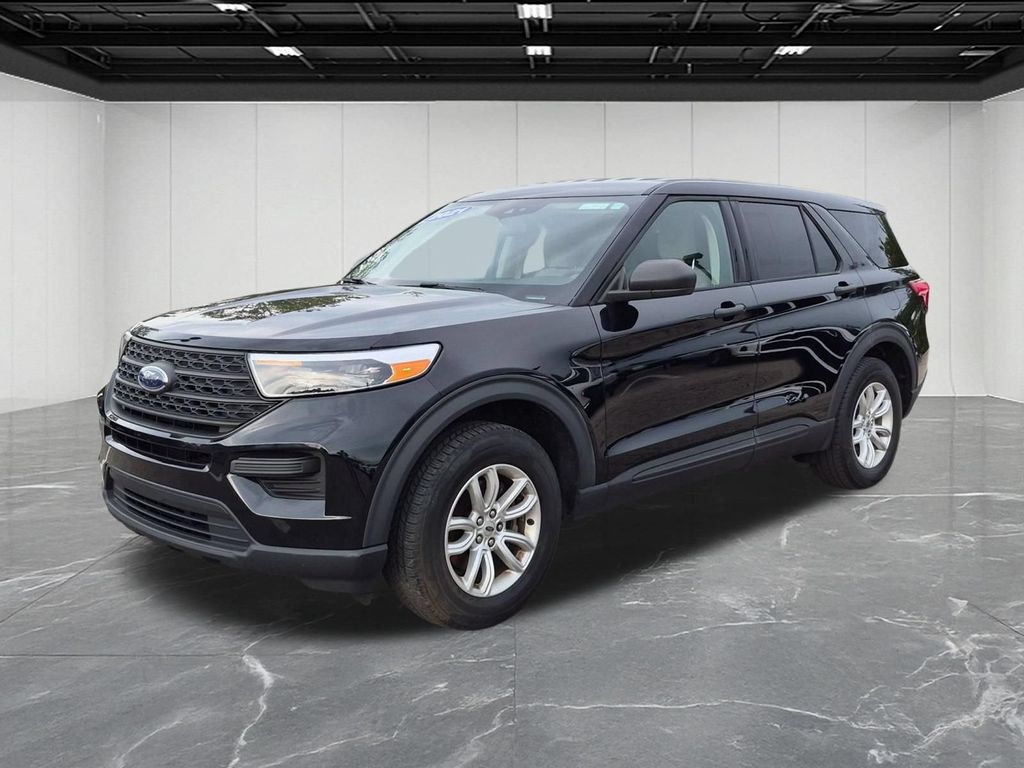
The 2021 Ford Explorer, on the other hand, adhered to Ford's "small, medium, large, XL" SUV production strategy, offering a family resemblance across its lineup. The Explorer's exterior was appealing, though it could be mistaken for the Edge at a quick glance. It featured six trim levels, each with distinct grille designs and varying levels of chrome. Inside, the Explorer provided three rows of seating as standard, with cloth upholstery on the base model. The dashboard was clean and user-friendly, dominated by an 8-inch LCD touchscreen and large knobs for audio and climate controls. The XLT trim, popular among consumers, offered enhanced features like a power front passenger seat and a 6.5-inch instrument panel screen, while higher trims provided leather upholstery and additional amenities.


The 2020 Land Rover Range Rover Velar, particularly in its SVAutobiography Dynamic Edition, marked a shift from being more show than go. It introduced a 5.0-liter supercharged V8 engine, delivering 550 horsepower and 502 pound-feet of torque, paired with an eight-speed automatic transmission and standard four-wheel drive. This setup allowed the Velar to accelerate from zero to 60 mph in 4.3 seconds, with a top speed of 177 mph. Despite these impressive figures, it wasn't the fastest in its class. The Dynamic Edition also featured bigger brakes, retuned four-wheel drive, and an active exhaust system, enhancing its performance capabilities. However, the Velar's chassis didn't feel as sharp as other performance SUVs, and its size made it less agile on tight roads. The rest of the Velar's powertrain lineup included a 2.0-liter turbocharged inline-four engine with 247 hp, and a 3.0-liter supercharged V6 with either 340 hp or 380 hp. The Velar also boasted off-road tech like the Terrain Response system and All-Terrain Progress Control, though it lacked a low range transfer case.
The 2021 Ford Explorer offered a range of powertrains, starting with a 2.3-liter EcoBoost turbocharged four-cylinder engine producing 300 horsepower and 310 pound-feet of torque. The Limited Hybrid trim increased power to 310 hp and 331 lb-ft of torque. Higher trims featured a 3.0-liter EcoBoost twin-turbo V6, delivering 365 hp and 380 lb-ft of torque, while the sport-oriented Explorer ST offered 400 hp and 415 lb-ft of torque. All trims were equipped with a 10-speed automatic transmission. The Explorer excelled in towing capacity, ranging from 5,000 to 5,600 pounds, depending on the trim and engine. While the Explorer prioritized towing power, it didn't offer the same level of engaging performance as some luxury SUVs.
The 2020 Land Rover Range Rover Velar occupied a unique position in terms of size, being larger than small luxury SUVs but smaller than midsize counterparts. Despite its size, the Velar didn't offer more interior space, with competitors like the GLC and X3 providing more legroom and headroom. Cargo space was competitive, with 15.7 cubic feet with the rear seats in place and 48.9 cubic feet with them folded. The Velar's avant-garde styling, including a chopped roof, limited headroom and visibility, creating a somewhat claustrophobic interior. The cockpit-like front seating area added to the cramped feeling, though the tall center console was easily accessible. The Velar's towing capacity was respectable, with the SVAutobiography Dynamic Edition and V6 models rated at 5,511 pounds, while the base four-cylinder model could tow 5,291 pounds.
The 2021 Ford Explorer offered seating for seven in the base trim, with captain's chairs in higher trims reducing capacity to six. It provided 39 inches of legroom for second-row passengers, placing it ahead of some competitors but behind others like the Kia Telluride. The Explorer's cargo space was impressive, with 21 cubic feet available even with the third row deployed. However, its overall cargo volume of 81 cubic feet with the rear seats folded was less competitive, comparable to smaller SUVs. The Explorer's interior was designed for practicality, with ample legroom and a user-friendly layout.
The 2020 Land Rover Range Rover Velar featured the InControl Touch Pro Duo infotainment system, with dual 10.0-inch touchscreens, a WiFi hotspot, Bluetooth, SiriusXM satellite radio, and Apple CarPlay/Android Auto compatibility. The upper screen handled smartphone, navigation, and media functions, while the lower screen managed vehicle settings and climate control. The system received praise for its high-quality graphics but was criticized for slow responses. Additional tech included a 12.3-inch digital instrument cluster, a head-up display, and capacitive steering-wheel controls.
The 2021 Ford Explorer offered a robust tech package, starting with an 8-inch touchscreen on the base trim, featuring AM/FM radio, SiriusXM satellite radio, Apple CarPlay and Android Auto, a 4G WiFi hotspot, and Ford's Sync 3 infotainment system. Higher trims provided a 12-speaker Bang & Olufsen audio system and an optional 10.1-inch touchscreen. The Explorer also offered multiple charging options, including USB ports and 12-volt power points, with a 110-volt AC power outlet available on higher trims.
The 2020 Land Rover Range Rover Velar lacked safety ratings from the IIHS and NHTSA, as low-volume luxury vehicles were not prioritized for crash testing. Standard safety features included automatic emergency braking, lane-keep assist, and front and rear parking aids. Adaptive cruise control and blind-spot monitoring were available as part of an option package. However, Land Rover's driver-assist tech offerings were less sophisticated compared to competitors, with some features only available as options.
The 2021 Ford Explorer was rated as a Top Safety Pick+ by the IIHS, achieving top scores in crash tests. It offered the Ford Co-Pilot360 suite of technology as standard, including auto high-beam headlights, blind-spot monitoring, rear cross-traffic alert, lane keeping assist, forward-collision warning, pedestrian detection, and automatic emergency braking. Higher trims provided additional features like adaptive cruise control, evasive steering assist, and speed sign recognition.
CarGurus highlights

According to CarGurus experts, the overall rating for the 2020 Land Rover Range Rover Velar is 7.3 out of 10, while the 2021 Ford Explorer scores 7.5 out of 10. Based on these ratings, the 2021 Ford Explorer is recommended for its higher overall score, offering a better balance of performance, practicality, and safety features.
Choose the 2021 Ford Explorer if:
- You need a versatile SUV with ample seating and cargo space.
- Advanced safety features and a high safety rating are a priority.
- You want a range of powertrain options, including a hybrid variant.




Choose the 2020 Land Rover Range Rover Velar if:
- You prioritize a luxury SUV with a unique and stylish design.
- Off-road capabilities and advanced off-road tech are important to you.
- You desire a high-performance V8 engine option in a luxury SUV.


CarGurus highlights
According to CarGurus experts, the overall rating for the 2020 Land Rover Range Rover Velar is 7.3 out of 10, while the 2021 Ford Explorer scores 7.5 out of 10. Based on these ratings, the 2021 Ford Explorer is recommended for its higher overall score, offering a better balance of performance, practicality, and safety features.
Choose the 2021 Ford Explorer if:
Shop Now- You need a versatile SUV with ample seating and cargo space.
- Advanced safety features and a high safety rating are a priority.
- You want a range of powertrain options, including a hybrid variant.
Choose the 2020 Land Rover Range Rover Velar if:
Shop Now- You prioritize a luxury SUV with a unique and stylish design.
- Off-road capabilities and advanced off-road tech are important to you.
- You desire a high-performance V8 engine option in a luxury SUV.

By: CarGurus + AI
At CarGurus, our team of experienced automotive writers remain at the heart of our content operation, conducting hands-on car tests and writing insightful guides that are backed by years of industry experience. To complement this, we are harnessing AI to make our content offering more diverse and more helpful to shoppers than ever. To achieve this, our AI systems are based exclusively on CarGurus content, ratings and data, so that what we produce is both unique to CarGurus, and uniquely helpful to car shoppers.

