2020 Honda CR-V Hybrid vs 2021 Volkswagen Tiguan

Overview | |
MSRP$27,850 | MSRP$25,245 |
Listings216 | Listings1325 |
Ratings & Reviews | |
User Reviews | User Reviews |
Expert reviews7.3 out of 10 | Expert reviews7.3 out of 10 |
Pros
Cons
| Pros
Cons
|
2020 Honda CR-V Hybrid Reviews SummaryOne of the forerunners to today’s seemingly never-ending onslaught of crossover SUV debuts, the Honda CR-V entered the market when SUV meant body-on-frame truck and CUV meant, well, nothing. The year was 1996 and the only other crossover option in the U.S. was the Toyota RAV4, which went on sale the year prior. Since then, hybrid technology has become commonplace. Yet, Americans have lived without a battery-assisted Honda crossover. That finally changes, with the debut of the 2020 Honda CR-V Hybrid. | |
2021 Volkswagen Tiguan Reviews SummaryYou may have noticed that crossover SUVs are popular. Among them, compact models dominate, having essentially replaced the traditional midsize sedan in American driveways. Offering room for five people, available all-wheel drive (AWD), and more cargo than any family car, they are the preferred method of transportation for a broad cross section of new vehicle buyers. But that’s not the only explanation for the runaway success of the 2021 Volkswagen Tiguan. | |
No video found | No video found |
Popular Features & Specs | |
Engine2.0L 212 hp I4 Hybrid | Engine2.0L 184 hp I4 |
Drive TrainAWD | Drive TrainFWD |
Seating Capacity5 | Seating Capacity7 |
Horsepower212 hp @ 6200 rpm | Horsepower184 hp @ 4400 rpm |
EV Battery Capacity1.3 kWh | EV Battery Capacity |
MPG City40 | MPG City23 |
MPG Highway35 | MPG Highway29 |
Engine | |
Engine Name2.0L 212 hp I4 Hybrid | Engine Name2.0L 184 hp I4 |
Torque | Torque221 lb-ft @ 1600 rpm |
Horsepower212 hp @ 6200 rpm | Horsepower184 hp @ 4400 rpm |
DrivetrainAWD | DrivetrainFWD |
Fuel Economy | |
EV Battery Capacity1.3 kWh | EV Battery Capacity |
MPG City40 | MPG City23 |
MPG Highway35 | MPG Highway29 |
Interior | |
Seating Capacity5 | Seating Capacity7 |
Safety | |
Front Crash Overall5 | Front Crash Overall4 |
Side Crash Overall5 | Side Crash Overall5 |
Dimensions & Capacity | |
Cargo Space33.2 cu ft | Cargo Space12.0 cu ft |
Curb Weight3649 lbs | Curb Weight3735 lbs |
Height66.5 in | Height66.3 in |
Length182.1 in | Length185.1 in |
Width73.0 in | Width72.4 in |
Wheelbase104.7 in | Wheelbase109.8 in |
Maximum Payload | Maximum Payload1146 lbs |
Number of doors4 | Number of doors4 |
Maximum Towing Capacity | Maximum Towing Capacity1500 lbs |
Overview | ||
MSRP | $27,850 | $25,245 |
Listings | ||
Ratings & Reviews | ||
User reviews | ||
Expert reviews | 7.3 out of 10Read full review | 7.3 out of 10Read full review |
Pros & cons | Pros
Cons
| Pros
Cons
|
Summary | One of the forerunners to today’s seemingly never-ending onslaught of crossover SUV debuts, the Honda CR-V entered the market when SUV meant body-on-frame truck and CUV meant, well, nothing. The year was 1996 and the only other crossover option in the U.S. was the Toyota RAV4, which went on sale the year prior. Since then, hybrid technology has become commonplace. Yet, Americans have lived without a battery-assisted Honda crossover. That finally changes, with the debut of the 2020 Honda CR-V Hybrid. | You may have noticed that crossover SUVs are popular. Among them, compact models dominate, having essentially replaced the traditional midsize sedan in American driveways. Offering room for five people, available all-wheel drive (AWD), and more cargo than any family car, they are the preferred method of transportation for a broad cross section of new vehicle buyers. But that’s not the only explanation for the runaway success of the 2021 Volkswagen Tiguan. |
Video | No video found | No video found |
Popular Features & Specs | ||
Engine | 2.0L 212 hp I4 Hybrid | 2.0L 184 hp I4 |
Drive Train | AWD | FWD |
Seating Capacity | 5 | 7 |
Horsepower | 212 hp @ 6200 rpm | 184 hp @ 4400 rpm |
EV Battery Capacity | 1.3 kWh | |
MPG City | 40 | 23 |
MPG Highway | 35 | 29 |
Engine | ||
Engine Name | 2.0L 212 hp I4 Hybrid | 2.0L 184 hp I4 |
Torque | 221 lb-ft @ 1600 rpm | |
Horsepower | 212 hp @ 6200 rpm | 184 hp @ 4400 rpm |
Drivetrain | AWD | FWD |
Fuel Economy | ||
EV Battery Capacity | 1.3 kWh | |
MPG City | 40 | 23 |
MPG Highway | 35 | 29 |
Interior | ||
Seating Capacity | 5 | 7 |
Safety | ||
Front Crash Overall | 5 | 4 |
Side Crash Overall | 5 | 5 |
Dimensions & Capacity | ||
Cargo Space | 33.2 cu ft | 12.0 cu ft |
Curb Weight | 3649 lbs | 3735 lbs |
Height | 66.5 in | 66.3 in |
Length | 182.1 in | 185.1 in |
Width | 73.0 in | 72.4 in |
Wheelbase | 104.7 in | 109.8 in |
Maximum Payload | 1146 lbs | |
Number of doors | 4 | 4 |
Maximum Towing Capacity | 1500 lbs | |
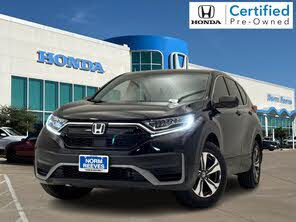
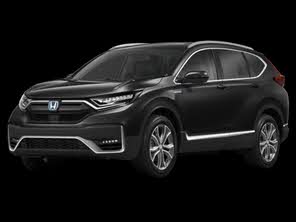
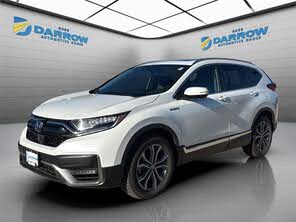
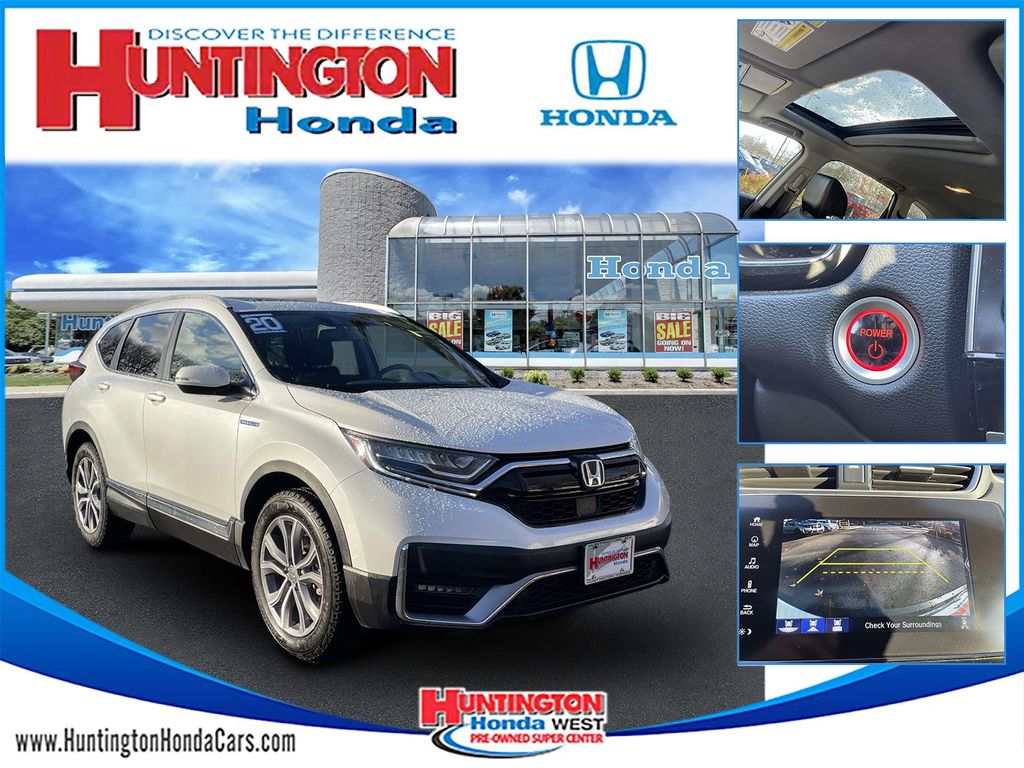
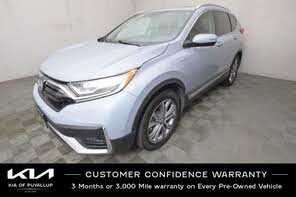
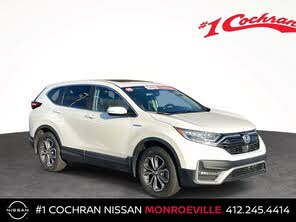
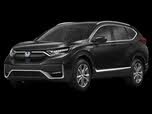
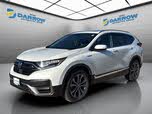
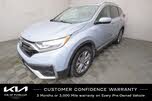
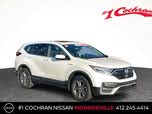
The 2020 Honda CR-V Hybrid, introduced as part of a mid-cycle refresh, closely resembled its gasoline counterpart in terms of dimensions and design. Measuring 182.1 inches in length, 73.0 inches in width, and 66.5 inches in height, it featured identical 19-inch alloy wheels. The interior also mirrored the gasoline model, with the same dash, multi-function center console, 7-inch infotainment screen, and steering-wheel-mounted functions. Subtle differences included blue-outlined Honda emblems, "Hybrid" badges, a hidden exhaust in the rear bumper, and LED fog lights on EX models and above. Inside, the gear shifter was replaced with a push-button selector, and paddle shifters adjusted brake regeneration rather than shifting gears.
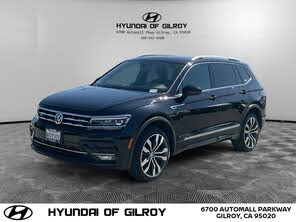
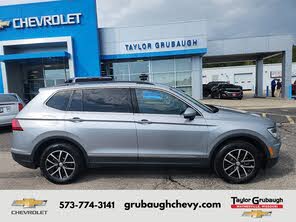
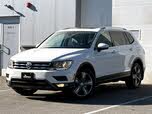
The 2021 Volkswagen Tiguan boasted clean lines and balanced proportions, offering a conservative, upscale, and timeless aesthetic. It was larger than its predecessor, nearly matching the interior space of a Hyundai Santa Fe or Kia Sorento. This upsizing resulted in a roomy interior, accommodating up to seven passengers with an optional third-row seat for AWD models. The interior featured modern geometric forms and a no-nonsense control layout, with the engine start button oddly placed on the center console. Shiny detailing, digital instrumentation, and a flush touchscreen infotainment system added a touch of sophistication, though the presence of hard plastics and flimsy steering wheel stalks detracted from the overall premium feel.


The 2020 Honda CR-V Hybrid featured a two-motor hybrid system with AWD, combining a 2.0-liter 4-cylinder gasoline engine with an electric generator/starter motor and a propulsion motor. This setup eliminated the need for a conventional transmission, using four fixed-ratio gear sets and a lock-up clutch. The total system output was 212 horsepower and 232 pound-feet of torque, compared to the gasoline model's 190 horsepower and 179 pound-feet of torque. The hybrid achieved an EPA rating of 40 mpg city, 35 highway, and 38 combined, significantly better than the gasoline model's 27/32/29 mpg. However, it ranked third among hybrid competitors, behind the Ford Escape Hybrid and Toyota RAV4 Hybrid. During testing in Tucson, Arizona, the CR-V Hybrid achieved nearly 41 mpg in city driving. The hybrid's EV mode was limited to about a mile under specific conditions, and the brake-regen adjustments were the primary driving options. The CR-V Hybrid offered a compliant ride and good steering feel, with the AWD system engaging as needed.
The 2021 Volkswagen Tiguan was powered by a turbocharged 2.0-liter four-cylinder engine producing 184 horsepower at 4,360 rpm and 221 pound-feet of torque at 1,600 rpm. An eight-speed automatic transmission sent power to the front wheels, with 4Motion AWD available as an option. The engine experienced some turbo lag, making it feel breathless during passing maneuvers or when extra power was needed. The Tiguan's nearly 4,000-pound curb weight contributed to this perception. The EPA rated the Tiguan at 25 mpg combined for FWD and 24 mpg for AWD, with testing revealing an average of 22.6 mpg for the AWD model. Despite the lag, the Tiguan offered a pleasurable driving experience with light, responsive steering, a compliant ride, refined braking, and nimble handling. However, it struggled over sharp speed bumps and railroad tracks, and the tires lost grip early in corners. The Tiguan excelled on the highway, providing a quiet and composed ride.
The 2020 Honda CR-V Hybrid, sharing its dimensions with the gasoline model, compromised on cargo capacity due to the battery pack beneath the cargo floor. It offered 33.2 cubic feet behind the rear seats and 68.7 cubic feet with the seats folded flat, compared to the non-hybrid's 39.2 and 75.8 cubic feet. Despite this, it still provided more volume than the Ford Escape Hybrid. The Toyota RAV4 Hybrid offered slightly more cargo space with 37.6 cubic feet behind the rear seats and 69.8 cubic feet when folded. The CR-V Hybrid featured a low cargo floor for easy loading and unloading and maintained passenger comfort with more overall space than its competitors. The configurable center console bin was a practical addition, though the armrest's adjustability was too loose.
The 2021 Volkswagen Tiguan prioritized comfort with large doors and tall seating hip points for easy entry and exit. The front seats offered a wide range of adjustments, ensuring proper support and excellent visibility. The V-Tex leatherette upholstery mimicked real leather, and the dual-zone climate control system was effective. The back seat provided generous legroom and foot space, with air conditioning vents and USB charging ports for passengers. The optional panoramic sunroof was enjoyable, thanks to a wind deflector that minimized noise. Storage space was limited, with a tricky-to-access slot for the wireless smartphone charger. The Tiguan's 40/20/40-split folding rear seat allowed for versatile cargo configurations, with cargo volume ranging from 33 to 37.6 cubic feet behind the second row and 65.7 to 73.5 cubic feet with the seats folded, depending on the presence of the third-row seat.
The 2020 Honda CR-V Hybrid came standard with Bluetooth connectivity, Pandora compatibility, and a single 1.0-amp USB connector in the front console. Higher trims added keyless entry, push-button start, and automatic headlights. The EX trim introduced a 7-inch touchscreen display, Honda Link, smartphone integration, SiriusXM and HD radio, a 180-watt stereo, and additional USB ports. The top-tier Touring trim offered navigation, wireless device charging, and a 330-watt premium audio system. The infotainment system lacked haptic feedback, and turning off the automatic beep sound required navigating through multiple menus. The instrument panel provided useful information but required flipping through various menus, which could be distracting while driving.
The 2021 Volkswagen Tiguan featured the next-generation Modular Infotainment Toolkit (MIB) platform called MIB3, available starting with the SE trim. MIB3 included an 8-inch touchscreen, faster processing, and expanded features such as wireless Apple CarPlay and Android Auto, WiFi for up to four devices, SiriusXM 360L satellite radio, Amazon Alexa compatibility, and Car-Net connected services. The infotainment system was an improvement but had quirks, and the voice recognition technology was subpar. The standard six-speaker sound system struggled with bass-heavy music, while the SEL Premium R-Line's nine-speaker Fender premium audio system performed better. The SEL and SEL Premium R-Line trims featured Volkswagen Digital Cockpit instrumentation, offering an understated approach to technology and information display.
The 2020 Honda CR-V Hybrid earned a Top Safety Pick designation from the IIHS and a 5-Star Safety Rating from NHTSA. It came standard with Honda Sensing, a suite of safety and driver-assistance technologies including automatic braking, forward-collision warning with pedestrian detection, lane-departure warning, lane-keep assist, adaptive cruise control with stop-and-go, automatic high beams, and a multi-angle rearview camera. Blind-spot monitoring and rear cross-traffic alert were available starting with the EX trim.
The 2021 Volkswagen Tiguan was equipped with IQ Drive, a collection of advanced driving assistance systems. Standard features included forward-collision warning, pedestrian detection, automatic emergency braking, blind-spot monitoring, and rear cross-traffic alert. The SE trim added adaptive cruise control, while the SEL trim included lane-departure warning with lane-keep assist. The SEL Premium R-Line featured automatic high-beam headlights and front and rear parking sensors. The adaptive cruise control demonstrated smooth braking but was slow to recognize vehicles cutting in. Lane-keep assist was effective but inconsistent, and the blind-spot warning indicator was easy to see. The parking sensors were sensitive, sometimes mistaking the street for a collision threat. The standard reversing camera provided a clear view, with a top-down surround-view available on the SEL Premium R-Line. Car-Net connected services offered numerous safety features, including automatic collision notification and Family Guardian alerts. The IIHS awarded the Tiguan a Top Safety Pick rating for the SEL and SEL Premium R-Line trims, while NHTSA had not published complete crash-test results.
CarGurus highlights
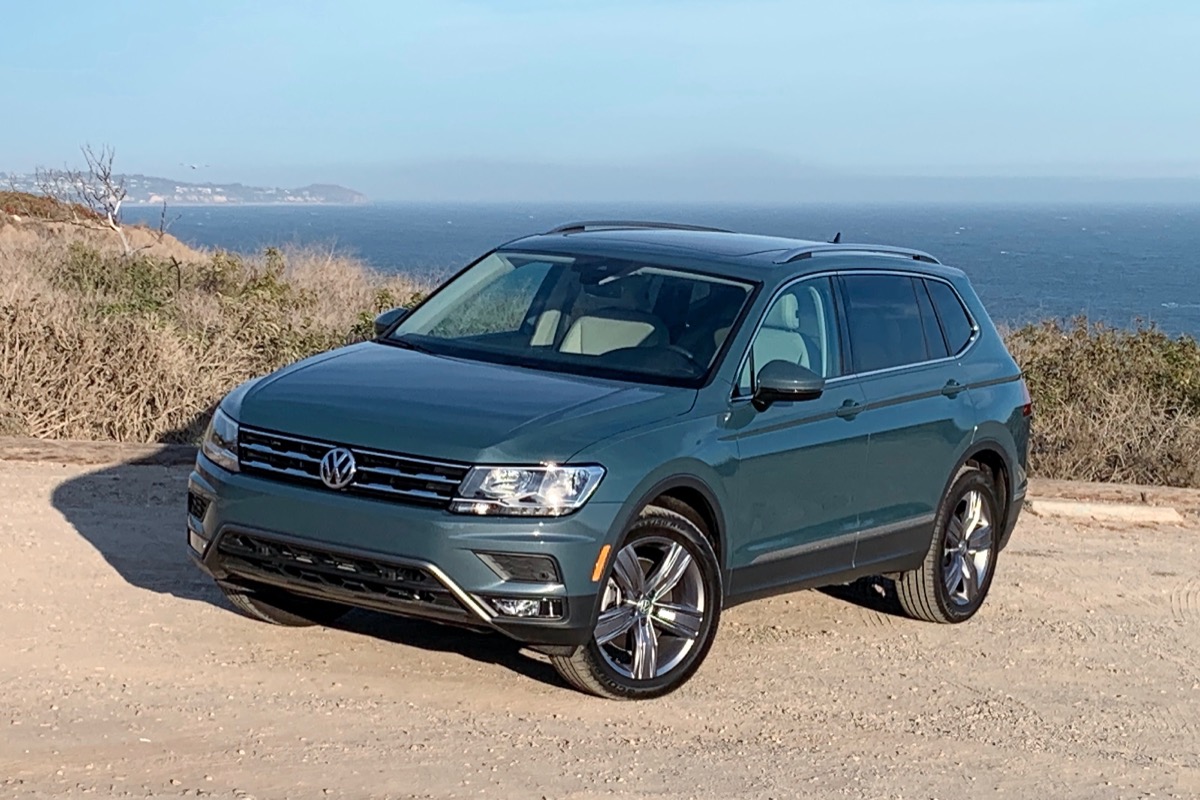
According to CarGurus experts, the overall rating for the 2020 Honda CR-V Hybrid is 7.3 out of 10, while the 2021 Volkswagen Tiguan scores 7.3 out of 10. Given these equal ratings, the final recommendation depends on your specific needs. If fuel efficiency and advanced safety features are your top priorities, the 2020 Honda CR-V Hybrid is the better choice. However, if you need a larger, more spacious SUV with modern infotainment and comfortable passenger accommodations, the 2021 Volkswagen Tiguan is the way to go.
Choose the 2020 Honda CR-V Hybrid if:
- You prioritize fuel efficiency and want a hybrid powertrain.
- You need a vehicle with a spacious interior and low cargo floor for easy loading.
- You value advanced safety features and top safety ratings.

Choose the 2021 Volkswagen Tiguan if:
- You prefer a larger, more spacious SUV with optional third-row seating.
- You want a modern infotainment system with wireless smartphone integration.
- You seek a comfortable ride with excellent front and rear passenger space.



CarGurus highlights
According to CarGurus experts, the overall rating for the 2020 Honda CR-V Hybrid is 7.3 out of 10, while the 2021 Volkswagen Tiguan scores 7.3 out of 10. Given these equal ratings, the final recommendation depends on your specific needs. If fuel efficiency and advanced safety features are your top priorities, the 2020 Honda CR-V Hybrid is the better choice. However, if you need a larger, more spacious SUV with modern infotainment and comfortable passenger accommodations, the 2021 Volkswagen Tiguan is the way to go.
Choose the 2020 Honda CR-V Hybrid if:
Shop Now- You prioritize fuel efficiency and want a hybrid powertrain.
- You need a vehicle with a spacious interior and low cargo floor for easy loading.
- You value advanced safety features and top safety ratings.





Choose the 2021 Volkswagen Tiguan if:
Shop Now- You prefer a larger, more spacious SUV with optional third-row seating.
- You want a modern infotainment system with wireless smartphone integration.
- You seek a comfortable ride with excellent front and rear passenger space.









By: CarGurus + AI
At CarGurus, our team of experienced automotive writers remain at the heart of our content operation, conducting hands-on car tests and writing insightful guides that are backed by years of industry experience. To complement this, we are harnessing AI to make our content offering more diverse and more helpful to shoppers than ever. To achieve this, our AI systems are based exclusively on CarGurus content, ratings and data, so that what we produce is both unique to CarGurus, and uniquely helpful to car shoppers.