2020 Ford Expedition vs 2021 Volvo XC40
Overview | |
MSRP$48,990 | MSRP$33,700 |
Listings326 | Listings45 |
Ratings & Reviews | |
User Reviews | User Reviews |
Expert reviews8.7 out of 10 | Expert reviews8.0 out of 10 |
Pros
Cons
| Pros
Cons
|
2020 Ford Expedition Reviews SummaryEquipped with three rows of legitimately comfortable seating for as many as eight passengers, able to hold as much as 121.5 cubic feet of cargo, capable of towing up to 9,300 pounds of trailer, and supplying a minimum of 9.7 inches of ground clearance, I can’t think of a better all-around SUV than the 2020 Ford Expedition. But all of this capability doesn’t come cheap. Prices start at $52,810 for an Expedition XLT, and our Expedition King Ranch test vehicle tallied up to $75,185, including its extra-cost paint and destination charge. | |
2021 Volvo XC40 Reviews SummaryIntroduced for the 2019 model year, the Volvo XC40 enters 2021 with one major change—the addition of an all-electric powertrain option. The 2021 Volvo XC40 Recharge is the Swedish automaker’s first mass-market electric vehicle, in fact. The Recharge will be sold alongside gasoline versions of the XC40, which carry over largely unchanged, and compete against small luxury crossovers like the Audi Q3, BMW X1, Mercedes-Benz GLA-Class, and Lexus UX. With its electric powertrain, the Recharge is a de facto Tesla Model Y competitor. It’s also priced similar to high-end versions of the Ford Mustang Mach-E, although the two electric crossovers have somewhat different philosophies. In addition to that zero-emission powertrain, the Recharge gets an Android-based operating system, over-the-air (OTA) software update capability for all vehicle systems, and some updates to driver-assist tech. These changes don’t apply to gasoline 2021 XC40 models, but Volvo does plan to add the Android operating system to more vehicles in the future. Since the Recharge is the main new thing for the 2021 XC40, that’s what we focused on for this review. While the gasoline XC40 is available in three trim levels—Momentum, R-Design, and Inscription—with front-wheel drive (FWD) or all-wheel drive (AWD), the Recharge is only offered in a single trim level, with standard AWD. | |
No video found | No video found |
Popular Features & Specs | |
Engine3.5L 375 hp V6 | Engine2.0L 187 hp I4 |
Drivetrain4X2 | DrivetrainFWD |
Seating Capacity8 | Seating Capacity5 |
Horsepower375 hp @ 5000 rpm | Horsepower187 hp @ 4700 rpm |
MPG City17 | MPG City23 |
MPG Highway23 | MPG Highway32 |
Engine | |
Engine Name3.5L 375 hp V6 | Engine Name2.0L 187 hp I4 |
Torque470 lb-ft @ 2250 rpm | Torque221 lb-ft @ 1400 rpm |
Horsepower375 hp @ 5000 rpm | Horsepower187 hp @ 4700 rpm |
Drivetrain4X2 | DrivetrainFWD |
Fuel Economy | |
MPG City17 | MPG City23 |
MPG Highway23 | MPG Highway32 |
Interior | |
Leather Seats | Leather SeatsStandard |
Seating Capacity8 | Seating Capacity5 |
Safety | |
Front Crash Overall5 | Front Crash Overall5 |
Side Crash Overall5 | Side Crash Overall5 |
Dimensions & Capacity | |
Cargo Space20.9 cu ft | Cargo Space20.7 cu ft |
Curb Weight5443 lbs | Curb Weight3627 lbs |
Height76.6 in | Height65.3 in |
Length210.0 in | Length174.2 in |
Width93.4 in | Width80.1 in |
Wheelbase122.5 in | Wheelbase106.4 in |
Maximum Payload1750 lbs | Maximum Payload1133 lbs |
Number of doors4 | Number of doors4 |
Maximum Towing Capacity9300 lbs | Maximum Towing Capacity3500 lbs |
Standard Towing Capacity6000 lbs | Standard Towing Capacity |
Overview | ||
MSRP | $48,990 | $33,700 |
Listings | ||
Ratings & Reviews | ||
User reviews | ||
Expert reviews | 8.7 out of 10Read full review | 8.0 out of 10Read full review |
Pros & cons | Pros
Cons
| Pros
Cons
|
Summary | Equipped with three rows of legitimately comfortable seating for as many as eight passengers, able to hold as much as 121.5 cubic feet of cargo, capable of towing up to 9,300 pounds of trailer, and supplying a minimum of 9.7 inches of ground clearance, I can’t think of a better all-around SUV than the 2020 Ford Expedition. But all of this capability doesn’t come cheap. Prices start at $52,810 for an Expedition XLT, and our Expedition King Ranch test vehicle tallied up to $75,185, including its extra-cost paint and destination charge. | Introduced for the 2019 model year, the Volvo XC40 enters 2021 with one major change—the addition of an all-electric powertrain option. The 2021 Volvo XC40 Recharge is the Swedish automaker’s first mass-market electric vehicle, in fact. The Recharge will be sold alongside gasoline versions of the XC40, which carry over largely unchanged, and compete against small luxury crossovers like the Audi Q3, BMW X1, Mercedes-Benz GLA-Class, and Lexus UX. With its electric powertrain, the Recharge is a de facto Tesla Model Y competitor. It’s also priced similar to high-end versions of the Ford Mustang Mach-E, although the two electric crossovers have somewhat different philosophies. In addition to that zero-emission powertrain, the Recharge gets an Android-based operating system, over-the-air (OTA) software update capability for all vehicle systems, and some updates to driver-assist tech. These changes don’t apply to gasoline 2021 XC40 models, but Volvo does plan to add the Android operating system to more vehicles in the future. Since the Recharge is the main new thing for the 2021 XC40, that’s what we focused on for this review. While the gasoline XC40 is available in three trim levels—Momentum, R-Design, and Inscription—with front-wheel drive (FWD) or all-wheel drive (AWD), the Recharge is only offered in a single trim level, with standard AWD. |
Video | No video found | No video found |
Popular Features & Specs | ||
Engine | 3.5L 375 hp V6 | 2.0L 187 hp I4 |
Drivetrain | 4X2 | FWD |
Seating Capacity | 8 | 5 |
Horsepower | 375 hp @ 5000 rpm | 187 hp @ 4700 rpm |
MPG City | 17 | 23 |
MPG Highway | 23 | 32 |
Engine | ||
Engine Name | 3.5L 375 hp V6 | 2.0L 187 hp I4 |
Torque | 470 lb-ft @ 2250 rpm | 221 lb-ft @ 1400 rpm |
Horsepower | 375 hp @ 5000 rpm | 187 hp @ 4700 rpm |
Drivetrain | 4X2 | FWD |
Fuel Economy | ||
MPG City | 17 | 23 |
MPG Highway | 23 | 32 |
Interior | ||
Leather Seats | Standard | |
Seating Capacity | 8 | 5 |
Safety | ||
Front Crash Overall | 5 | 5 |
Side Crash Overall | 5 | 5 |
Dimensions & Capacity | ||
Cargo Space | 20.9 cu ft | 20.7 cu ft |
Curb Weight | 5443 lbs | 3627 lbs |
Height | 76.6 in | 65.3 in |
Length | 210.0 in | 174.2 in |
Width | 93.4 in | 80.1 in |
Wheelbase | 122.5 in | 106.4 in |
Maximum Payload | 1750 lbs | 1133 lbs |
Number of doors | 4 | 4 |
Maximum Towing Capacity | 9300 lbs | 3500 lbs |
Standard Towing Capacity | 6000 lbs | |
The 2020 Ford Expedition, last redesigned in 2018, was a full-size SUV with a clean, albeit somewhat boring, design. This simplicity, however, contributed to its timeless appeal, making it a good long-term investment. The King Ranch variant stood out with its 22-inch aluminum wheels, mesh grille insert, LED headlights, and exclusive gray-painted lower exterior trim. The Star White metallic paint added to its visual appeal, although some design elements like the taillights and roof C-pillar could have been improved. Inside, the King Ranch featured special Del Rio leather in Mesa over Ebony, adorned with King Ranch cattle-brand logos, which sparked mixed reactions from passengers. Despite the luxurious feel, the presence of hard plastic, especially in lower trims, was a drawback, making the Lincoln Navigator a more appealing option for those willing to spend more.
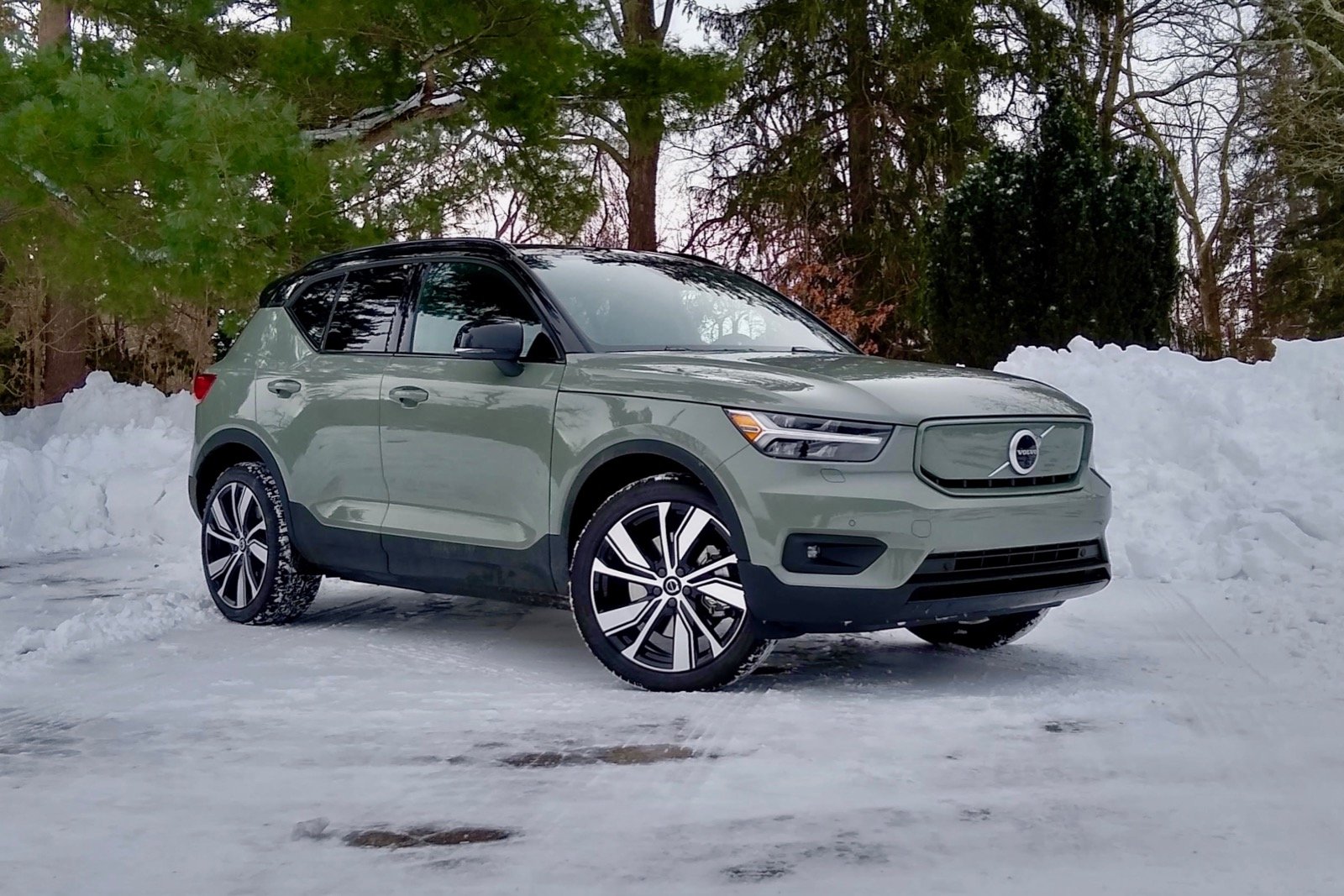
The 2021 Volvo XC40 had a more traditional SUV styling with a tall, flat roof and upright rear hatch, fitting well within the Volvo family with its “Thor’s Hammer” LED headlights and simple oval grille. The XC40 Recharge, the electric variant, featured a blanked-off grille, subtle “Recharge” badging, and model-specific alloy wheels, with a gloss black roof and mirror caps. The Sage Green Metallic color was exclusive to the Recharge. The interior was minimalist yet premium, with real metal trim and a combination of Nappa leather and Nubuck textile upholstery. The design was coherent, with elements like the portrait-oriented touchscreen and air vents blending seamlessly. Unlike many competitors, Volvo did not compromise on interior design to meet a price point, maintaining a high-quality feel throughout.


The 2020 Ford Expedition was powered by a twin-turbocharged 3.5-liter EcoBoost V6 engine, delivering 375 horsepower at 5,000 rpm and 470 pound-feet of torque at 2,250 rpm. The 10-speed automatic transmission provided smooth power delivery to the rear wheels, with an optional four-wheel-drive system available. The Expedition had a ground clearance of 9.8 inches (9.7 inches for the MAX 4WD) and impressive towing capacities of 9,300 pounds (rear-drive) and 9,200 pounds (4WD). The driving experience was generally pleasant, with the engine providing ample power and the 10-speed automatic ensuring the right gear at the right time. The adaptive damping suspension on the King Ranch variant helped manage ride motions, although the large 22-inch wheels sometimes made the ride busy on imperfect roads. The independent rear suspension improved ride and handling, as well as interior space. Fuel economy averaged 17.7 mpg, slightly below the EPA rating of 19 mpg.
The 2021 Volvo XC40 offered a three-tiered powertrain lineup, with the electric Recharge at the top. The gasoline options included a 2.0-liter turbo four-cylinder engine with an eight-speed automatic transmission. The base FWD T4 produced 187 horsepower and 221 pound-feet of torque, while the AWD T5 had 248 hp and 258 lb-ft. The Recharge, sharing its powertrain with the Polestar 2, featured one electric motor per axle, providing AWD and a combined 402 hp and 486 lb-ft, powered by a 78-kilowatt-hour battery pack. The Recharge accelerated from zero to 60 mph in 4.7 seconds, while the T5 and T4 took 6.1 and 8.1 seconds, respectively. All versions were electronically limited to 112 mph. The Recharge emphasized quiet and comfort over performance, with excellent ride quality even on rough roads. It also offered one-pedal driving using regenerative braking. The Recharge had a towing capacity of 2,000 pounds, a rarity among electric cars.
The 2020 Ford Expedition excelled at towing, carrying cargo, and hauling people. The King Ranch variant featured power running boards for easy access, and all seats were comfortable, especially the heated and ventilated front seats. The second-row captain’s chairs provided first-class accommodations, with easy access to the third-row bench, which was genuinely comfortable for adults. The independent rear suspension contributed to the impressive legroom in the third row. Cargo space in the standard-length Expedition was 19.3 cubic feet behind the third row, expanding to 57.5 cubic feet with the third row folded, and 104.6 cubic feet with the second row folded. The long-wheelbase Expedition MAX offered 34.3 cubic feet behind the third row, 73.3 cubic feet with the third row folded, and 121.5 cubic feet with the second row folded.
The 2021 Volvo XC40 Recharge had the same passenger and cargo space as the gasoline models, but it was less spacious compared to competitors like the Tesla Model Y and Ford Mustang Mach-E. The Recharge had less legroom in both the front and rear seats and a smaller cargo area. The frunk was also small, with much of the space occupied by powertrain hardware. The gasoline XC40 was more competitive in interior space compared to rivals like the Audi Q3 and BMW X1. Volvo compensated for the lack of space with clever storage solutions, such as a removable trash bin in the center console, a bag hook in the glovebox door, and extra-large door bins. The storage cubby ahead of the shifter was well-shaped to hold a phone, with an optional wireless charging pad and a standard USB-C port. However, second-row occupants did not have phone-charging options.
The 2020 Ford Expedition featured an 8-inch touchscreen infotainment system with Sync 3, which, while easy to use, was slow to load and respond. The system included Apple CarPlay and Android Auto, allowing users to bypass some of Sync 3’s shortcomings. Other highlights included FordPass Connect with a 4G LTE WiFi hotspot, a navigation system, an available Bang & Olufsen premium sound system, a rear-seat entertainment system, and Pro Trailer Backup Assist. The trailer technology was particularly useful for frequent towing, providing a knob on the dashboard to control the trailer’s direction.
The 2021 Volvo XC40 Recharge introduced the Android Automotive OS infotainment system, featuring Google apps like Google Assistant and Google Maps. The system included Apple CarPlay, Android Auto, and Bluetooth connectivity, with a 9-inch touchscreen and a 12.3-inch digital instrument cluster. The Recharge also had OTA update capability, allowing for updates to any vehicle function controlled by software. The Recharge lacked a start button, instead requiring the driver to shift out of park with the key fob present. The Polestar 2’s Digital Key feature, allowing smartphone use in place of the key fob, was expected to be available via OTA update, but Volvo had not confirmed it for the XC40.
The 2020 Ford Expedition came with Ford Co-Pilot360 as standard, including adaptive cruise control, forward collision warning, automatic emergency braking, blind-spot warning, rear cross-traffic warning, lane-departure warning, and lane-keeping assistance. The ADAS worked well, providing smooth and accurate assistance. The Expedition received 5-star ratings in every NHTSA crash test, with a 4-star rollover resistance rating. The IIHS had not tested the Expedition at the time of the review.
The gasoline 2021 Volvo XC40 received the highest “Top Safety Pick+” rating from the IIHS and a five-star overall crash-test rating from the NHTSA. These ratings did not apply to the electric XC40 Recharge, but Volvo expected it to perform well in crash tests due to a safety cage around the battery and a redesigned front crash structure. The XC40 came with a long list of standard safety features, including lane-keep assist, blind-spot monitoring, automatic emergency braking, rear parking sensors, hill-start assist, and hill-descent control. Optional features included traffic-sign recognition, reverse automatic emergency braking, a driver-alertness monitor, run-off road mitigation, oncoming lane mitigation, and Volvo’s Pilot Assist driver-assistance system. The Recharge model also had Volvo’s latest sensor suite, capable of pulling data from the cloud to improve driver aid performance.
CarGurus highlights

According to CarGurus experts, the overall rating for the 2020 Ford Expedition is 8.7 out of 10, while the 2021 Volvo XC40 scores 8.0 out of 10. Based on these ratings, the 2020 Ford Expedition is the recommended choice, offering superior performance, comfort, and utility for those in need of a full-size SUV.
Choose the 2020 Ford Expedition if:
- You need a vehicle with high towing capacity and ample cargo space.
- You prioritize comfort and space for all passengers, including those in the third row.
- You value advanced trailer technology for easier towing.


Choose the 2021 Volvo XC40 if:
- You prefer a vehicle with a minimalist, high-quality interior design.
- You want an electric vehicle with excellent ride quality and one-pedal driving capability.
- You appreciate advanced infotainment features, including Google apps and OTA updates.


CarGurus highlights
According to CarGurus experts, the overall rating for the 2020 Ford Expedition is 8.7 out of 10, while the 2021 Volvo XC40 scores 8.0 out of 10. Based on these ratings, the 2020 Ford Expedition is the recommended choice, offering superior performance, comfort, and utility for those in need of a full-size SUV.
Choose the 2020 Ford Expedition if:
Shop Now- You need a vehicle with high towing capacity and ample cargo space.
- You prioritize comfort and space for all passengers, including those in the third row.
- You value advanced trailer technology for easier towing.
Choose the 2021 Volvo XC40 if:
Shop Now- You prefer a vehicle with a minimalist, high-quality interior design.
- You want an electric vehicle with excellent ride quality and one-pedal driving capability.
- You appreciate advanced infotainment features, including Google apps and OTA updates.

By: CarGurus + AI
At CarGurus, our team of experienced automotive writers remain at the heart of our content operation, conducting hands-on car tests and writing insightful guides that are backed by years of industry experience. To complement this, we are harnessing AI to make our content offering more diverse and more helpful to shoppers than ever. To achieve this, our AI systems are based exclusively on CarGurus content, ratings and data, so that what we produce is both unique to CarGurus, and uniquely helpful to car shoppers.

