2021 Hyundai Tucson vs 2020 Ford Edge

Overview | |
MSRP$31,100 | MSRP$23,700 |
Listings1066 | Listings638 |
Ratings & Reviews | |
User Reviews | User Reviews |
Expert reviews8.0 out of 10 | Expert reviews7.7 out of 10 |
Pros
Cons
| Pros
Cons
|
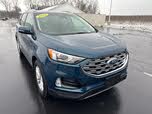
2020 Ford Edge Reviews SummaryThe Ford Edge isn’t exactly memorable, which isn’t a bad thing. It isn’t a good thing either. Cars can be remembered for attractive design, fun driving dynamics, or being a solid value. They can also be remembered in a negative light for a polarizing design, poor build quality, or being unsafe to the point of scandal. But the 2020 Ford Edge is just... there. It is a midsize two-row SUV that doesn’t offend, but also doesn’t “wow.” But just as critically, the Edge is getting long in the tooth. In the SUV segment, constant iteration is necessary for survival, and the Edge is in need of a redesign. But in lieu of new blood, Ford has done well to keep the Edge fitted with the latest infotainment and safety technology. It also offers a performance variant, called the Edge ST. This is something that you won’t find in the Edge’s competitors, the Nissan Murano and Honda Passport. But is it enough to keep the Edge relevant against its more contemporary rivals? Read on to find out. | |
2021 Hyundai Tucson Reviews SummaryIt’s no secret that small SUVs are among the most popular new-car segments. You see them everywhere on the road today. Automakers put a lot of pressure on themselves to continually offer the latest and greatest. But that also means even the not-so-new are still terrific vehicles and provide a great value. Case in point: the 2021 Hyundai Tucson. The current generation of this compact SUV was introduced for the 2016 model year, and this 2021 edition represents the final model year before a new generation is ushered in. So why go with the older model? Because Hyundai has loaded it up with plenty of tech and safety features and it is offered at a competitive price. | |
No video found | No video found |
Popular Features & Specs | |
Engine2.0L 250 hp I4 | Engine2.0L 161 hp I4 |
Drive TrainFWD | Drive TrainFWD |
Seating Capacity5 | Seating Capacity5 |
Horsepower250 hp @ 5500 rpm | Horsepower161 hp @ 6200 rpm |
MPG City21 | MPG City23 |
MPG Highway29 | MPG Highway28 |
Engine | |
Engine Name2.0L 250 hp I4 | Engine Name2.0L 161 hp I4 |
Torque280 lb-ft @ 3000 rpm | Torque150 lb-ft @ 4700 rpm |
Horsepower250 hp @ 5500 rpm | Horsepower161 hp @ 6200 rpm |
DrivetrainFWD | DrivetrainFWD |
Fuel Economy | |
MPG City21 | MPG City23 |
MPG Highway29 | MPG Highway28 |
Interior | |
Seating Capacity5 | Seating Capacity5 |
Safety | |
Front Crash Overall5 | Front Crash Overall5 |
Side Crash Overall5 | Side Crash Overall5 |
Dimensions & Capacity | |
Cargo Space39.2 cu ft | Cargo Space31.0 cu ft |
Curb Weight4027 lbs | Curb Weight3309 lbs |
Height68.3 in | Height64.8 in |
Length188.8 in | Length176.4 in |
Width85.8 in | Width72.8 in |
Wheelbase112.2 in | Wheelbase105.1 in |
Maximum Payload1243 lbs | Maximum Payload1146 lbs |
Number of doors4 | Number of doors4 |
Maximum Towing Capacity1500 lbs | Maximum Towing Capacity1500 lbs |
Overview | ||
MSRP | $31,100 | $23,700 |
Listings | ||
Ratings & Reviews | ||
User reviews | ||
Expert reviews | 8.0 out of 10Read full review | 7.7 out of 10Read full review |
Pros & cons | Pros
Cons
| Pros
Cons
|
Summary | The Ford Edge isn’t exactly memorable, which isn’t a bad thing. It isn’t a good thing either. Cars can be remembered for attractive design, fun driving dynamics, or being a solid value. They can also be remembered in a negative light for a polarizing design, poor build quality, or being unsafe to the point of scandal. But the 2020 Ford Edge is just... there. It is a midsize two-row SUV that doesn’t offend, but also doesn’t “wow.” But just as critically, the Edge is getting long in the tooth. In the SUV segment, constant iteration is necessary for survival, and the Edge is in need of a redesign. But in lieu of new blood, Ford has done well to keep the Edge fitted with the latest infotainment and safety technology. It also offers a performance variant, called the Edge ST. This is something that you won’t find in the Edge’s competitors, the Nissan Murano and Honda Passport. But is it enough to keep the Edge relevant against its more contemporary rivals? Read on to find out. | It’s no secret that small SUVs are among the most popular new-car segments. You see them everywhere on the road today. Automakers put a lot of pressure on themselves to continually offer the latest and greatest. But that also means even the not-so-new are still terrific vehicles and provide a great value. Case in point: the 2021 Hyundai Tucson. The current generation of this compact SUV was introduced for the 2016 model year, and this 2021 edition represents the final model year before a new generation is ushered in. So why go with the older model? Because Hyundai has loaded it up with plenty of tech and safety features and it is offered at a competitive price. |
Video | No video found | No video found |
Popular Features & Specs | ||
Engine | 2.0L 250 hp I4 | 2.0L 161 hp I4 |
Drive Train | FWD | FWD |
Seating Capacity | 5 | 5 |
Horsepower | 250 hp @ 5500 rpm | 161 hp @ 6200 rpm |
MPG City | 21 | 23 |
MPG Highway | 29 | 28 |
Engine | ||
Engine Name | 2.0L 250 hp I4 | 2.0L 161 hp I4 |
Torque | 280 lb-ft @ 3000 rpm | 150 lb-ft @ 4700 rpm |
Horsepower | 250 hp @ 5500 rpm | 161 hp @ 6200 rpm |
Drivetrain | FWD | FWD |
Fuel Economy | ||
MPG City | 21 | 23 |
MPG Highway | 29 | 28 |
Interior | ||
Seating Capacity | 5 | 5 |
Safety | ||
Front Crash Overall | 5 | 5 |
Side Crash Overall | 5 | 5 |
Dimensions & Capacity | ||
Cargo Space | 39.2 cu ft | 31.0 cu ft |
Curb Weight | 4027 lbs | 3309 lbs |
Height | 68.3 in | 64.8 in |
Length | 188.8 in | 176.4 in |
Width | 85.8 in | 72.8 in |
Wheelbase | 112.2 in | 105.1 in |
Maximum Payload | 1243 lbs | 1146 lbs |
Number of doors | 4 | 4 |
Maximum Towing Capacity | 1500 lbs | 1500 lbs |
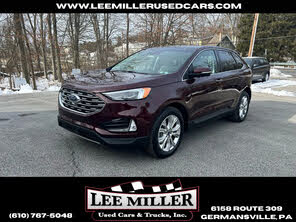
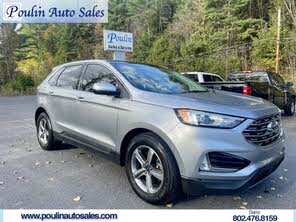
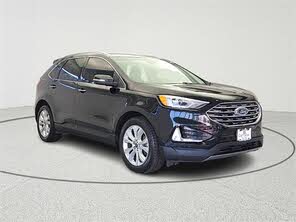
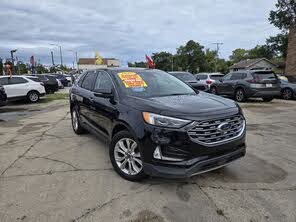
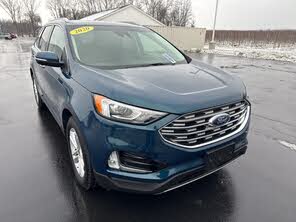
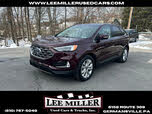
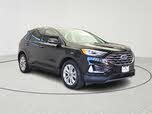
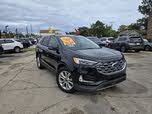
The 2020 Ford Edge, introduced in 2006, was based on the Ford Fusion sedan platform, offering a car-like ride and ample cabin space. The second generation, updated in 2019, carried over to 2020 with angular headlights and a large trapezoidal grille, giving it a crossover version of the Fusion look. Inside, the layout remained largely unchanged since 2015, with small, awkwardly arranged climate and radio controls. The rotary shifter was a contemporary design cue, solving some space issues. The cabin quality was decent, with soft-touch materials and solid fit-and-finish, but the heavy use of hard plastics detracted from the overall feel.
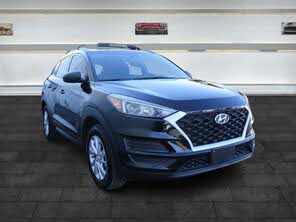
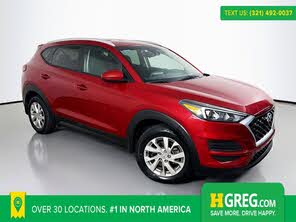
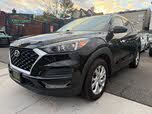
The 2021 Hyundai Tucson featured a more conventional design compared to its futuristic successor. It had an upright layout providing a commanding road view. Inside, the Tucson boasted a modern, attractive dash design with tech features seamlessly integrated. Buttons and dials were easy to find, enhancing user experience. The Tucson's trim levels ranged from SE to Ultimate, each adding progressively more features, from 17-inch alloy wheels and a 7-inch touchscreen in the SE to an 8-inch touchscreen, heated and ventilated front seats, and a panoramic sunroof in the Ultimate.


The 2020 Ford Edge came standard with a 2.0-liter turbocharged four-cylinder engine, producing 250 horsepower and 275 pound-feet of torque. This engine, paired with an eight-speed automatic transmission, provided solid low-end acceleration but struggled at higher speeds. The Edge ST variant featured a 2.7-liter EcoBoost V6 engine, delivering 335 horsepower and 380 pound-feet of torque, with standard all-wheel drive. The ST's performance was enhanced by a Sport mode, offering lively throttle response and improved handling.
The 2021 Hyundai Tucson offered two engine options: a base 2.0-liter four-cylinder engine with 161 horsepower and 150 pound-feet of torque, and a 2.4-liter four-cylinder engine with 181 horsepower and 175 pound-feet of torque available on higher trims. Both engines were paired with a six-speed automatic transmission and offered standard front-wheel drive or optional all-wheel drive. The base engine felt underwhelming, while the 2.4-liter engine provided a livelier performance. The Tucson's ride was comfortable and refined, striking a balance between softness and athleticism. The Tucson's towing capacity was 1,500 pounds with the base engine and 2,000 pounds with the 2.4-liter engine.
The 2020 Ford Edge excelled in cabin layout, offering a commanding road view without being overly upright. The seats were surrounded by ample cubbies and compartments, designed for commuting or road trips. The second-row head- and legroom were plentiful, and the two rows provided were spacious and comfortable. The Edge offered 39.2 cubic feet of cargo space behind the rear seats, expanding to 73.4 cubic feet with the rear seats folded. The SEL and Titanium trims featured a hands-free foot-activated power rear liftgate.
The 2021 Hyundai Tucson provided 31 cubic feet of cargo space behind the rear seats, expanding to 61.9 cubic feet with the rear seats folded. While this was on the low side for the compact SUV segment, it offered adequate space for weekend bags or large boxes. The Tucson's front seats provided solid headroom and legroom, with comfortable and supportive seats even on long trips. The rear seats were accommodating enough for adults on road trips. The Tucson featured plenty of cubbies and compartments, with helpful trays for the driver.
The 2020 Ford Edge came standard with Ford’s SYNC 3 infotainment system, featuring an 8-inch touchscreen with easy-to-use icons and a helpful home button. SYNC 3 included Apple CarPlay and Android Auto integration, eliminating the need for additional navigation systems. A voice-activated navigation system was optional on the SEL and ST trims and standard on the Titanium. The Edge also featured two smart-charging USB ports and an optional dual rear-seat entertainment system.
The 2021 Hyundai Tucson came standard with a 7-inch touchscreen infotainment system with Apple CarPlay and Android Auto. The Ultimate trim featured an upgraded 8-inch touchscreen, which was optional on other trims. The touchscreen was user-friendly with logical menu layouts and helpful hard buttons. Additional available features included navigation, satellite radio, and wireless device charging.
The 2020 Ford Edge came standard with a full array of front and side-impact airbags, AdvanceTrac traction control, and a tire pressure monitoring system. The Ford Co-Pilot360 safety system, standard on all trims, included automatic emergency braking, forward collision warning, lane departure warning, automatic high beams, and blind-spot monitoring. The SEL trim offered the Co-Pilot360 Assist+ package, adding adaptive cruise control and active lane centering. The Edge received a "Top Safety Pick" rating from the IIHS and a five-star overall safety rating from the NHTSA.
The 2021 Hyundai Tucson provided standard driver-assistance features such as automatic emergency braking, forward collision warning, lane departure warning, lane-keeping assist, and driver drowsiness monitoring. Upper-tier trims offered additional features like adaptive cruise control, pedestrian detection, automatic high-beams, a 360-degree parking monitor, and blind-spot monitoring. The Tucson earned a five-star safety rating from the NHTSA and a "Top Safety Pick" rating from the IIHS.
CarGurus highlights

According to CarGurus experts, the overall rating for the 2020 Ford Edge is 8.0 out of 10, while the 2021 Hyundai Tucson scores 7.7 out of 10. Based on these ratings, the 2020 Ford Edge is the recommended choice, offering a more spacious interior, better performance options, and a higher overall rating.
Choose the 2021 Hyundai Tucson if:
- You prefer a compact SUV with a modern, attractive interior design.
- You value a user-friendly infotainment system with standard Apple CarPlay and Android Auto.
- You want a vehicle with a solid list of standard driver-assistance features.



Choose the 2020 Ford Edge if:
- You prioritize a spacious and comfortable cabin with ample cargo space.
- You want a vehicle with a strong suite of standard safety features.
- You seek a performance-oriented variant with the Edge ST.



CarGurus highlights
According to CarGurus experts, the overall rating for the 2020 Ford Edge is 8.0 out of 10, while the 2021 Hyundai Tucson scores 7.7 out of 10. Based on these ratings, the 2020 Ford Edge is the recommended choice, offering a more spacious interior, better performance options, and a higher overall rating.
Choose the 2021 Hyundai Tucson if:
Shop Now- You prefer a compact SUV with a modern, attractive interior design.
- You value a user-friendly infotainment system with standard Apple CarPlay and Android Auto.
- You want a vehicle with a solid list of standard driver-assistance features.






Choose the 2020 Ford Edge if:
Shop Now- You prioritize a spacious and comfortable cabin with ample cargo space.
- You want a vehicle with a strong suite of standard safety features.
- You seek a performance-oriented variant with the Edge ST.





By: CarGurus + AI
At CarGurus, our team of experienced automotive writers remain at the heart of our content operation, conducting hands-on car tests and writing insightful guides that are backed by years of industry experience. To complement this, we are harnessing AI to make our content offering more diverse and more helpful to shoppers than ever. To achieve this, our AI systems are based exclusively on CarGurus content, ratings and data, so that what we produce is both unique to CarGurus, and uniquely helpful to car shoppers.