2021 Volkswagen Atlas vs 2020 Audi Q7

Overview | |
MSRP$54,800 | MSRP$31,545 |
Listings157 | Listings164 |
Ratings & Reviews | |
User Reviews | User Reviews |
Expert reviews7.7 out of 10 | Expert reviews6.5 out of 10 |
Pros
Cons
| Pros
Cons
|
2020 Audi Q7 Reviews SummaryFrom its styling and interior to its powertrain and technology, the 2020 Audi Q7 gets a thorough update that brings it in line with other high-end cars and SUVs wearing four chrome rings on their grilles. Simultaneously, the changes for the 2020 model year keep this Audi competitive against the BMW X5 and Mercedes-Benz GLE-Class, its primary rivals in the midsize luxury SUV class. We packed a Q7 Prestige full of family and luggage and set off for Lake Tahoe to assess this Audi’s improvements on the open road. | |
2021 Volkswagen Atlas Reviews SummaryIntroduced for the 2018 model year, the Atlas is Volkswagen's latest attempt to win over American buyers. Built in Chattanooga, Tennessee, the VW Atlas competes in the three-row crossover SUV segment against well-established nameplates like the Ford Explorer, Honda Pilot, and Toyota Highlander. Changes for 2021 are limited to exterior styling tweaks and a reshuffled option list. VW also offers the two-row Atlas Cross Sport. | |
No video found | |
Popular Features & Specs | |
Engine2.0L 248 hp I4 | Engine2.0L 235 hp I4 |
Drive TrainAWD | Drive TrainFWD |
Seating Capacity7 | Seating Capacity7 |
Horsepower248 hp @ 5000 rpm | Horsepower |
MPG City19 | MPG City21 |
MPG Highway23 | MPG Highway24 |
Engine | |
Engine Name2.0L 248 hp I4 | Engine Name2.0L 235 hp I4 |
Torque273 lb-ft @ 1600 rpm | Torque |
Horsepower248 hp @ 5000 rpm | Horsepower |
DrivetrainAWD | DrivetrainFWD |
Fuel Economy | |
MPG City19 | MPG City21 |
MPG Highway23 | MPG Highway24 |
Interior | |
Leather SeatsStandard | Leather Seats |
Seating Capacity7 | Seating Capacity7 |
Key Features | |
Navigation SystemStandard | Navigation System |
Sunroof/MoonroofStandard | Sunroof/Moonroof |
Safety | |
Front Crash Overall | Front Crash Overall4 |
Side Crash Overall5 | Side Crash Overall5 |
Dimensions & Capacity | |
Cargo Space14.2 cu ft | Cargo Space20.6 cu ft |
Curb Weight4784 lbs | Curb Weight4248 lbs |
Height68.5 in | Height70.1 in |
Length199.6 in | Length200.7 in |
Width87.1 in | Width78.4 in |
Wheelbase117.9 in | Wheelbase117.3 in |
Maximum Payload1367 lbs | Maximum Payload1080 lbs |
Number of doors4 | Number of doors4 |
Maximum Towing Capacity4400 lbs | Maximum Towing Capacity2000 lbs |
Overview | ||
MSRP | $54,800 | $31,545 |
Listings | ||
Ratings & Reviews | ||
User reviews | ||
Expert reviews | 7.7 out of 10Read full review | 6.5 out of 10Read full review |
Pros & cons | Pros
Cons
| Pros
Cons
|
Summary | From its styling and interior to its powertrain and technology, the 2020 Audi Q7 gets a thorough update that brings it in line with other high-end cars and SUVs wearing four chrome rings on their grilles. Simultaneously, the changes for the 2020 model year keep this Audi competitive against the BMW X5 and Mercedes-Benz GLE-Class, its primary rivals in the midsize luxury SUV class. We packed a Q7 Prestige full of family and luggage and set off for Lake Tahoe to assess this Audi’s improvements on the open road. | Introduced for the 2018 model year, the Atlas is Volkswagen's latest attempt to win over American buyers. Built in Chattanooga, Tennessee, the VW Atlas competes in the three-row crossover SUV segment against well-established nameplates like the Ford Explorer, Honda Pilot, and Toyota Highlander. Changes for 2021 are limited to exterior styling tweaks and a reshuffled option list. VW also offers the two-row Atlas Cross Sport. |
Video | No video found | |
Popular Features & Specs | ||
Engine | 2.0L 248 hp I4 | 2.0L 235 hp I4 |
Drive Train | AWD | FWD |
Seating Capacity | 7 | 7 |
Horsepower | 248 hp @ 5000 rpm | |
MPG City | 19 | 21 |
MPG Highway | 23 | 24 |
Engine | ||
Engine Name | 2.0L 248 hp I4 | 2.0L 235 hp I4 |
Torque | 273 lb-ft @ 1600 rpm | |
Horsepower | 248 hp @ 5000 rpm | |
Drivetrain | AWD | FWD |
Fuel Economy | ||
MPG City | 19 | 21 |
MPG Highway | 23 | 24 |
Interior | ||
Leather Seats | Standard | |
Seating Capacity | 7 | 7 |
Key Features | ||
Navigation System | Standard | |
Sunroof/Moonroof | Standard | |
Safety | ||
Front Crash Overall | 4 | |
Side Crash Overall | 5 | 5 |
Dimensions & Capacity | ||
Cargo Space | 14.2 cu ft | 20.6 cu ft |
Curb Weight | 4784 lbs | 4248 lbs |
Height | 68.5 in | 70.1 in |
Length | 199.6 in | 200.7 in |
Width | 87.1 in | 78.4 in |
Wheelbase | 117.9 in | 117.3 in |
Maximum Payload | 1367 lbs | 1080 lbs |
Number of doors | 4 | 4 |
Maximum Towing Capacity | 4400 lbs | 2000 lbs |
The 2020 Audi Q7 offered multiple variations, including the 45 TFSI with a turbocharged 2.0-liter four-cylinder engine and the 55 TFSI with a mild-hybrid turbocharged 3.0-liter V6. A performance-tuned SQ7 with a twin-turbo 4.0-liter V8 was also new for 2020. The Q7 55 TFSI, starting at $60,800, was available in Premium, Premium Plus, and Prestige trims. The test vehicle, a Prestige trim, featured Navarra Blue metallic paint, a Cold Weather Package, and a Towing Package, totaling $74,290. Design updates included new front and rear styling, wheels, and lighting elements, aligning the Q7 with the flagship Q8 model. The interior adopted the high-tech dashboard and instrumentation from the Q8, featuring three digital displays and Audi’s Virtual Cockpit panel. The cabin, decked out in Okapi Brown leather and Gray/Brown Fine Grain Ash natural wood inlays, exuded an upscale and high-tech vibe, enhanced by multi-color ambient lighting.
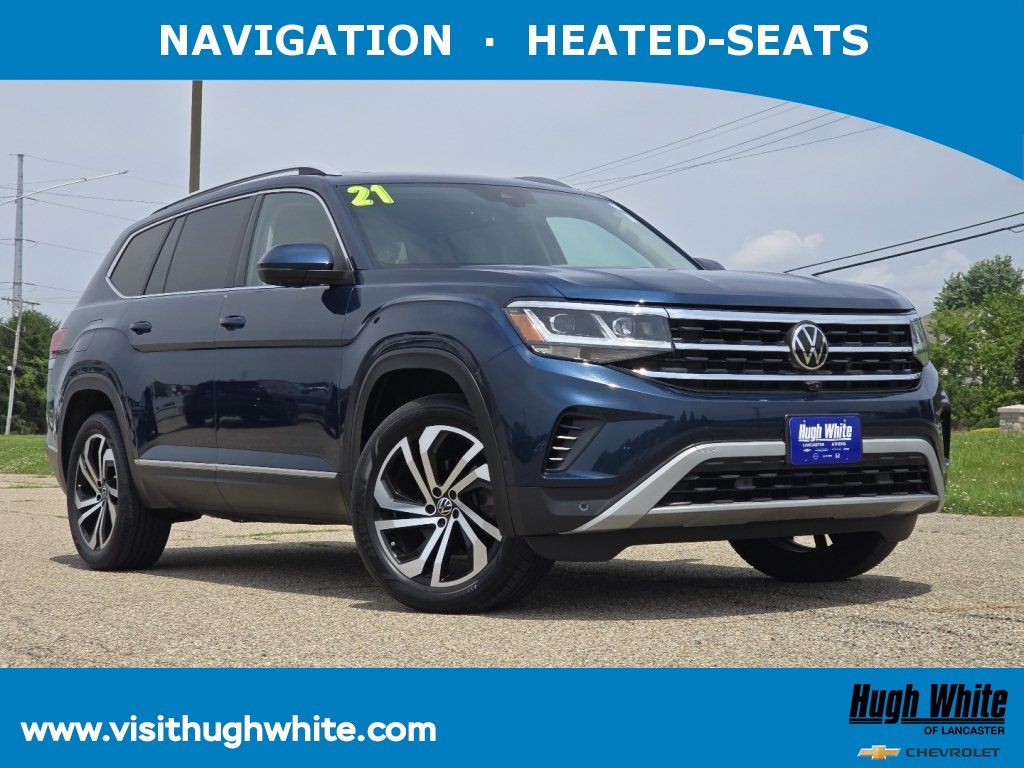
The 2021 Volkswagen Atlas received a styling refresh, including new front and rear bumpers, standard LED headlights and taillights, and a new grille shared with the two-row Atlas Cross Sport model. These changes added 2.4 inches to the Atlas's length. The Atlas had a more extroverted look compared to the conservatively-styled 2020 model, though the fake chrome exhaust tips were considered cheesy. The R-Line trim package added sportier-looking bumpers and side skirts. The Atlas still rode on the same MQB platform, used by most current VW models. S and SE trims got 18-inch alloy wheels, while higher trims got 20-inch wheels, with 21-inch wheels available on R-Line packages. The interior was minimalist, with a standard seven-seat configuration and available second-row captain’s chairs. Material quality on the mid-level SE with Technology trim was below average, with cheap-feeling plastics and simulated wood and metal trim.


The 2020 Audi Q7 55 TFSI featured a new 3.0-liter turbocharged V6 engine, generating 335 horsepower and 369 pound-feet of torque. It included a 48-volt mild-hybrid electrical system to conserve fuel, paired with an eight-speed automatic transmission and Quattro all-wheel-drive. Audi Drive Select offered several driving modes, including Comfort, Auto, Dynamic, Individual, and Allroad. The Q7 could accelerate from zero to 60 mph in 5.7 seconds and had a maximum tow rating of 7,700 pounds. The EPA rated it at 18 mpg combined, and it averaged 21 mpg during a road trip. The Prestige trim included an adaptive air suspension, adjustable for different driving conditions. The Q7 provided speedy acceleration, especially in Dynamic mode, and maintained performance at high altitudes. The mild-hybrid technology operated transparently, and the cabin remained quiet thanks to dual-pane acoustic side window glass.
The 2021 Volkswagen Atlas offered two engine options: a 2.0-liter turbocharged inline-four producing 235 horsepower and 258 pound-feet of torque, and a 3.6-liter VR6 rated at 276 hp and 266 lb-ft. Both engines were paired with an eight-speed automatic transmission, with standard front-wheel drive or optional 4Motion all-wheel drive. The 4Motion system defaulted to FWD under low load to save fuel. The base 2.0-liter engine with AWD provided adequate acceleration but had rough shifts and truck-like handling. The ride quality was poor, with noticeable impacts from pavement imperfections. AWD models included an Active Control feature with different drive modes, but it didn’t improve on-road handling. The VR6 models had a 5,000-pound towing capacity, while the four-cylinder models were rated to tow 2,000 pounds. Fuel economy for the four-cylinder models was 22 mpg combined with FWD, and 21 mpg with AWD. VR6 models were rated at 19 mpg combined with FWD, and 18 mpg with AWD.
The 2020 Audi Q7, though a three-row SUV, was best used as a five-passenger vehicle. The third-row seat was suitable only for young children and required sliding the second-row seats forward. With the third-row seat in use, cargo space was limited to 14.2 cubic feet, expandable to 35.7 cubic feet with the third row folded, and 69.6 cubic feet with both rows folded. The Q7 was comfortable for a family of four, with agreeable front seats and plenty of second-row legroom. The test vehicle’s four-zone climate control, heated rear seats, and panoramic sunroof added to the comfort. However, interior storage was limited, with the center console and dashboard screen taking up most of the space. Second-row occupants had netted storage on the front seatbacks and door-panel bins.
The 2021 Volkswagen Atlas, designed as a family hauler, offered 96.8 cubic feet of cargo space behind the front seats and 20.6 cubic feet with all seats up. It provided more third-row legroom than most competitors but had the worst second-row legroom in its class. The second-row bench seat was uncomfortable with thin, flat cushions. Folding and raising the second- and third-row seats was straightforward, and third-row access was easy thanks to a sliding second-row bench. Controls were logically laid out and within easy reach of the driver. The Atlas had up to five USB ports and an optional wireless charging pad. It also featured up to 17 cupholders. The tall driving position provided a commanding view, but forward visibility was less than optimal. Ultrasonic parking sensors were standard, with low-speed automatic braking and active park assist available on higher trims.
The 2020 Audi Q7 introduced the Multi-Media Interface (MMI) Touch Response technology, combining a 10.1-inch upper touchscreen with an 8.6-inch lower touchscreen. The system included natural voice recognition, handwriting recognition, wireless Apple CarPlay and Android Auto, navigation with Google Earth imagery, and Audi Connect subscription services with a 4G LTE WiFi hotspot. The user interface was generally intuitive, though dry fingertips sometimes made the virtual buttons unresponsive. The Prestige trim included a full-color head-up display and a Bose premium sound system. The 2021 model would feature a 19-speaker Bang & Olufsen system.
The 2021 Volkswagen Atlas came with Bluetooth and Apple CarPlay/Android Auto compatibility. The base S trim had a 6.5-inch infotainment touchscreen, while other models had an 8-inch screen. Higher trims offered Volkswagen’s Digital Cockpit, replacing analog gauges with a 10.3-inch digital display. The Atlas would get VW’s new MIBIII infotainment system later in the model year, adding multi-phone pairing, improved voice recognition, and a redesigned navigation system. The SE with Technology trim had an 8-inch screen, but the displays were plain and text-heavy. The base six-speaker audio system was decent, with a 12-speaker Fender audio system available on higher trims. A built-in 4G LTE WiFi hotspot was new for 2021, supporting up to four devices.
The 2020 Audi Q7 featured HD Matrix LED headlights, rated "poor" by the IIHS for excessive glare but praised for their illumination capabilities. The Q7 included numerous advanced driving-assistance systems, with upgrades available on higher trims. Highlights included Emergency Assist, Turn Assist, and Adaptive Cruise Assist. The adaptive cruise control had issues with traffic-sign recognition, and Active Lane Assist was sometimes confusing. The Q7 received the highest IIHS ratings, except for the "poor" headlight assessment.
The 2021 Volkswagen Atlas received top "good" ratings in all IIHS crash tests, with a "marginal" rating for child-seat anchors and mixed headlight ratings. The NHTSA gave the 2020 model a five-star overall rating. The Atlas had standard automatic emergency braking and blind-spot monitoring, with adaptive cruise control and lane-keep assist available on higher trims. Later in the model year, SEL and SEL Premium trims would get Travel Assist and Emergency Assist.
CarGurus highlights
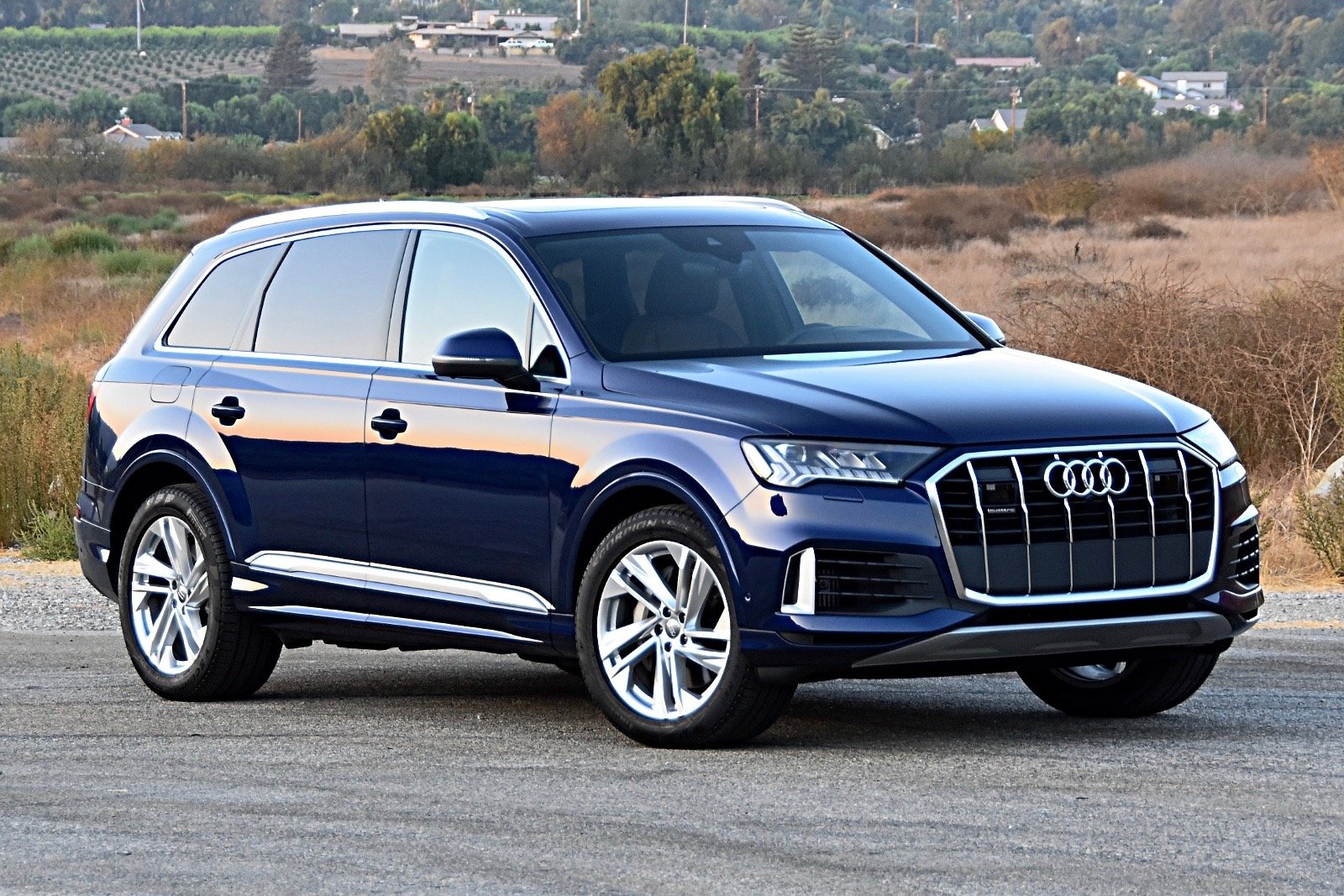
According to CarGurus experts, the overall rating for the 2020 Audi Q7 is 7.7 out of 10, while the 2021 Volkswagen Atlas scores 6.5 out of 10. Based on these ratings, the 2020 Audi Q7 is the recommended choice, offering a more luxurious interior, better performance, and higher overall satisfaction.
Choose the 2021 Volkswagen Atlas if:
- You need more third-row legroom for passengers.
- You prefer a minimalist interior design with logical control placement.
- You want a vehicle with a built-in 4G LTE WiFi hotspot.




Choose the 2020 Audi Q7 if:
- You prioritize a luxurious and high-tech interior.
- You need a vehicle with significant towing capacity.
- You value a quiet and comfortable ride.


CarGurus highlights
According to CarGurus experts, the overall rating for the 2020 Audi Q7 is 7.7 out of 10, while the 2021 Volkswagen Atlas scores 6.5 out of 10. Based on these ratings, the 2020 Audi Q7 is the recommended choice, offering a more luxurious interior, better performance, and higher overall satisfaction.
Choose the 2021 Volkswagen Atlas if:
Shop Now- You need more third-row legroom for passengers.
- You prefer a minimalist interior design with logical control placement.
- You want a vehicle with a built-in 4G LTE WiFi hotspot.
Choose the 2020 Audi Q7 if:
Shop Now- You prioritize a luxurious and high-tech interior.
- You need a vehicle with significant towing capacity.
- You value a quiet and comfortable ride.

By: CarGurus + AI
At CarGurus, our team of experienced automotive writers remain at the heart of our content operation, conducting hands-on car tests and writing insightful guides that are backed by years of industry experience. To complement this, we are harnessing AI to make our content offering more diverse and more helpful to shoppers than ever. To achieve this, our AI systems are based exclusively on CarGurus content, ratings and data, so that what we produce is both unique to CarGurus, and uniquely helpful to car shoppers.

