2020 Audi Q7 vs 2021 Toyota Highlander
Overview | |
MSRP$54,800 | MSRP$35,085 |
Listings157 | Listings249 |
Ratings & Reviews | |
User Reviews | User Reviews |
Expert reviews7.7 out of 10 | Expert reviews7.5 out of 10 |
Pros
Cons
| Pros
Cons
|
2020 Audi Q7 Reviews SummaryFrom its styling and interior to its powertrain and technology, the 2020 Audi Q7 gets a thorough update that brings it in line with other high-end cars and SUVs wearing four chrome rings on their grilles. Simultaneously, the changes for the 2020 model year keep this Audi competitive against the BMW X5 and Mercedes-Benz GLE-Class, its primary rivals in the midsize luxury SUV class. We packed a Q7 Prestige full of family and luggage and set off for Lake Tahoe to assess this Audi’s improvements on the open road. | |
2021 Toyota Highlander Reviews SummaryToyota hardly needs any help selling three-row Highlanders. It already sits close to the top of the sales charts for its segment, and few vehicles carry the name recognition as the Highlander, which enters into its 20th year of production. But the three-row marketplace is a competitive one, and even after a 2020 redesign, Toyota would be foolish to rest on its laurels. As such, the Highlander enters this year with additional safety-feature technology listed as standard equipment. | |
No video found | |
Popular Features & Specs | |
Engine2.0L 248 hp I4 | Engine3.5L 295 hp V6 |
Drive TrainAWD | Drive TrainFWD |
Seating Capacity7 | Seating Capacity8 |
Horsepower248 hp @ 5000 rpm | Horsepower295 hp @ 6600 rpm |
MPG City19 | MPG City20 |
MPG Highway23 | MPG Highway28 |
Engine | |
Engine Name2.0L 248 hp I4 | Engine Name3.5L 295 hp V6 |
Torque273 lb-ft @ 1600 rpm | Torque263 lb-ft @ 4700 rpm |
Horsepower248 hp @ 5000 rpm | Horsepower295 hp @ 6600 rpm |
DrivetrainAWD | DrivetrainFWD |
Fuel Economy | |
MPG City19 | MPG City20 |
MPG Highway23 | MPG Highway28 |
Interior | |
Leather SeatsStandard | Leather Seats |
Seating Capacity7 | Seating Capacity8 |
Key Features | |
Navigation SystemStandard | Navigation System |
Sunroof/MoonroofStandard | Sunroof/Moonroof |
Safety | |
Front Crash Overall | Front Crash Overall4 |
Side Crash Overall5 | Side Crash Overall5 |
Dimensions & Capacity | |
Cargo Space14.2 cu ft | Cargo Space16.0 cu ft |
Curb Weight4784 lbs | Curb Weight4145 lbs |
Height68.5 in | Height68.1 in |
Length199.6 in | Length194.9 in |
Width87.1 in | Width76.0 in |
Wheelbase117.9 in | Wheelbase112.2 in |
Maximum Payload1367 lbs | Maximum Payload1685 lbs |
Number of doors4 | Number of doors4 |
Maximum Towing Capacity4400 lbs | Maximum Towing Capacity5000 lbs |
Overview | ||
MSRP | $54,800 | $35,085 |
Listings | ||
Ratings & Reviews | ||
User reviews | ||
Expert reviews | 7.7 out of 10Read full review | 7.5 out of 10Read full review |
Pros & cons | Pros
Cons
| Pros
Cons
|
Summary | From its styling and interior to its powertrain and technology, the 2020 Audi Q7 gets a thorough update that brings it in line with other high-end cars and SUVs wearing four chrome rings on their grilles. Simultaneously, the changes for the 2020 model year keep this Audi competitive against the BMW X5 and Mercedes-Benz GLE-Class, its primary rivals in the midsize luxury SUV class. We packed a Q7 Prestige full of family and luggage and set off for Lake Tahoe to assess this Audi’s improvements on the open road. | Toyota hardly needs any help selling three-row Highlanders. It already sits close to the top of the sales charts for its segment, and few vehicles carry the name recognition as the Highlander, which enters into its 20th year of production. But the three-row marketplace is a competitive one, and even after a 2020 redesign, Toyota would be foolish to rest on its laurels. As such, the Highlander enters this year with additional safety-feature technology listed as standard equipment. |
Video | No video found | |
Popular Features & Specs | ||
Engine | 2.0L 248 hp I4 | 3.5L 295 hp V6 |
Drive Train | AWD | FWD |
Seating Capacity | 7 | 8 |
Horsepower | 248 hp @ 5000 rpm | 295 hp @ 6600 rpm |
MPG City | 19 | 20 |
MPG Highway | 23 | 28 |
Engine | ||
Engine Name | 2.0L 248 hp I4 | 3.5L 295 hp V6 |
Torque | 273 lb-ft @ 1600 rpm | 263 lb-ft @ 4700 rpm |
Horsepower | 248 hp @ 5000 rpm | 295 hp @ 6600 rpm |
Drivetrain | AWD | FWD |
Fuel Economy | ||
MPG City | 19 | 20 |
MPG Highway | 23 | 28 |
Interior | ||
Leather Seats | Standard | |
Seating Capacity | 7 | 8 |
Key Features | ||
Navigation System | Standard | |
Sunroof/Moonroof | Standard | |
Safety | ||
Front Crash Overall | 4 | |
Side Crash Overall | 5 | 5 |
Dimensions & Capacity | ||
Cargo Space | 14.2 cu ft | 16.0 cu ft |
Curb Weight | 4784 lbs | 4145 lbs |
Height | 68.5 in | 68.1 in |
Length | 199.6 in | 194.9 in |
Width | 87.1 in | 76.0 in |
Wheelbase | 117.9 in | 112.2 in |
Maximum Payload | 1367 lbs | 1685 lbs |
Number of doors | 4 | 4 |
Maximum Towing Capacity | 4400 lbs | 5000 lbs |
The 2020 Audi Q7 came in various configurations. The 45 TFSI version included a turbocharged 2.0-liter four-cylinder engine, while the 55 TFSI equipped the SUV with a mild-hybrid turbocharged 3.0-liter V6. New for 2020, the Audi SQ7 emerged, featuring a twin-turbo 4.0-liter V8. Our evaluation centered on the Q7 55 TFSI starting at $60,800 and upgraded to the Prestige trim level. With Navarra Blue metallic paint, a Cold Weather Package, and a Towing Package, the total price reached $74,290, including the $995 destination fee.
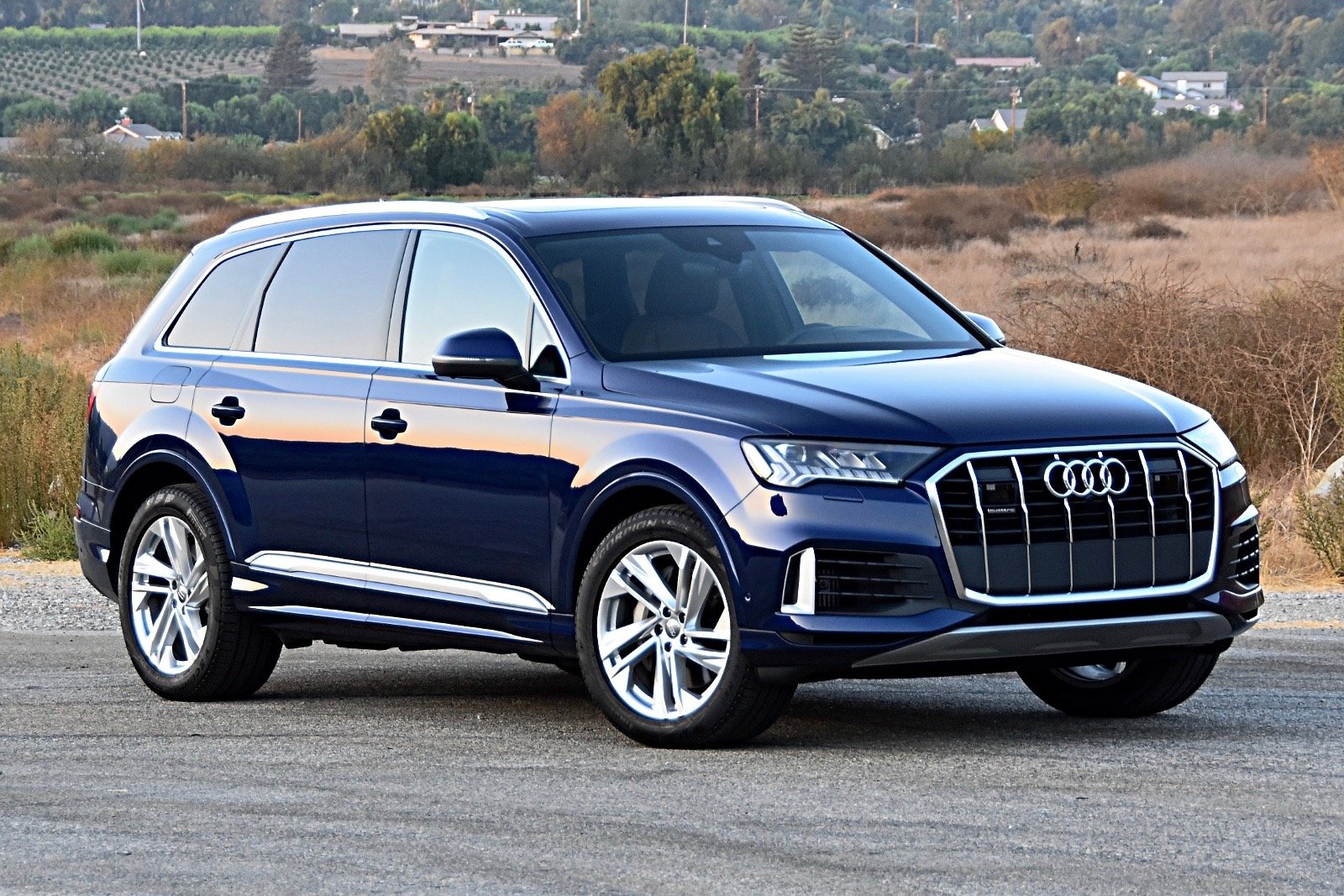
Design updates in 2020 altered the Q7’s front and rear styling, with new wheels and lighting elements, aligning it aesthetically with the flagship Q8 model. It sported standard 20-inch turbine-style wheels with 285/45 Pirelli Scorpion Verde run-flat all-season tires. Inside, the Q7 adopted the Q8’s dashboard and instrumentation. The removal of most physical controls introduced three digital displays: Audi’s Virtual Cockpit panel with various themes and configurations and two touchscreens on the center console. The test vehicle featured Okapi Brown leather with Gray/Brown Fine Grain Ash natural wood inlays, coupled with a black cloth headliner.
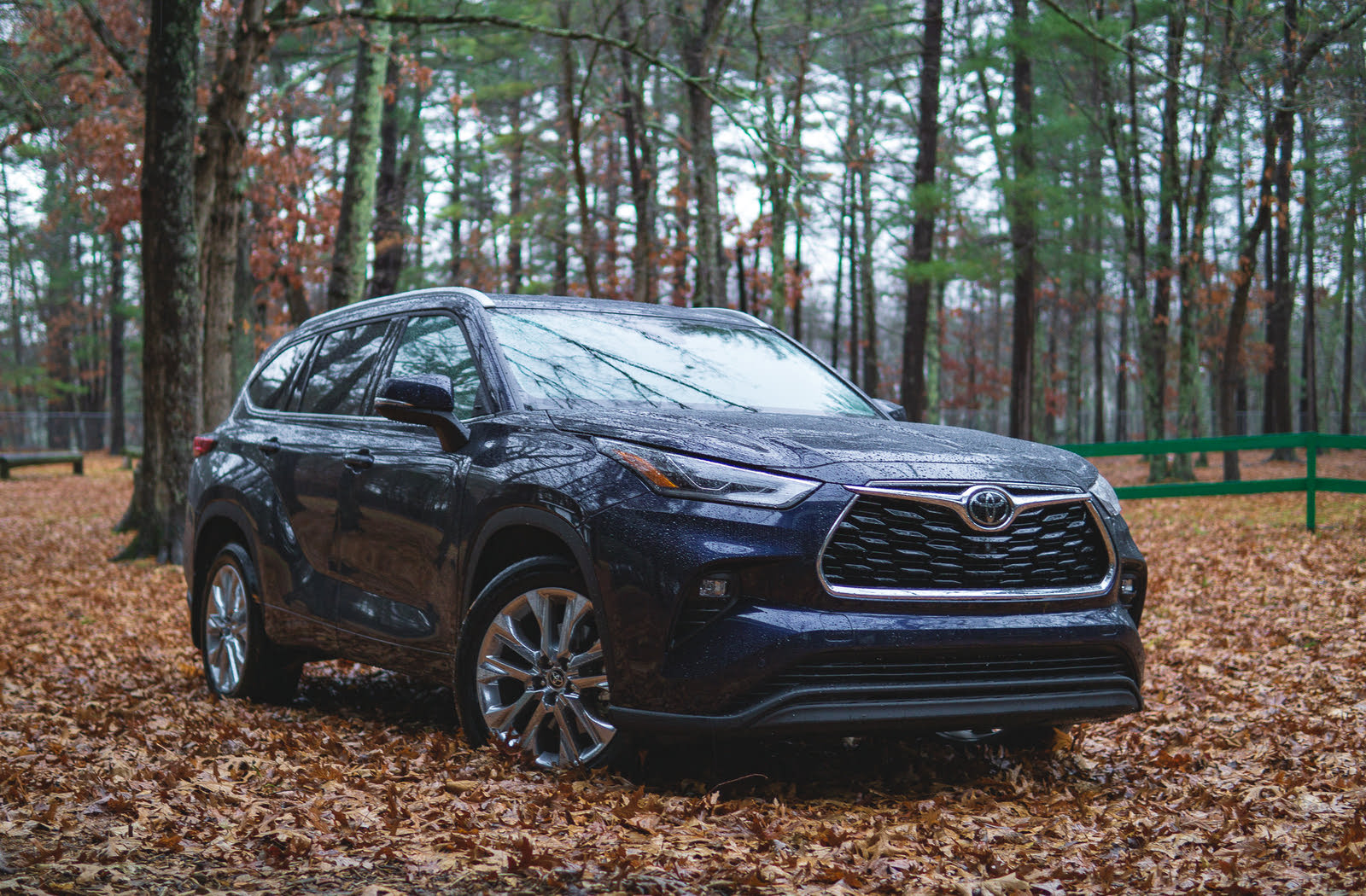
The 2021 Toyota Highlander also sought to be distinctive among midsize SUVs and crossovers with its assertive styling. Its front end displayed wide headlights, a long hood, and a trapezoidal grille. A character line along the side echoed the profile of the Supra sports car, and the taillights appeared similar to those of a Lexus model. For 2021, the new XSE trim level came with a more aggressive front end, stiffer suspension, and unique 20-inch wheels. Our test vehicle sported the Limited trim, visually enhanced with chrome roof rails and accents. The interior boasted tan leather seats complemented by dark brown trim, and faux wood details that appeared sophisticated.


The 2020 Audi Q7 55 TFSI introduced a 3.0-liter turbocharged V6 engine that generated 335 horsepower and 369 lb-ft of torque. Its 48-volt mild-hybrid system, powered by a lithium-ion battery, helped improve fuel efficiency. The engine paired with an eight-speed automatic transmission and Audi’s Quattro all-wheel-drive system, allowing the SUV to sprint from 0 to 60 mph in 5.7 seconds. The maximum towing capacity was an impressive 7,700 pounds, and the EPA estimated combined fuel economy at 18 mpg. During a road trip, it averaged 21 mpg and 18.1 mpg locally.
The Prestige trim featured an adaptive air suspension with Audi Drive Select, offering firmness adjustments and various suspension height settings. Off-road during a trail, the Q7 had no issues in Allroad drive mode and Off-Road suspension settings. On pavement, the Q7 excelled in acceleration, especially in Dynamic mode, which reduced off-the-line laziness. Its mild-hybrid technology provided a seamless experience, efficiently using the engine stop/start system without compromising the climate control’s effectiveness.
The 2021 Toyota Highlander, powered by a 3.5-liter V6 engine producing 295 horsepower and 263 lb-ft of torque, provided smooth and predictable performance. The engine, mated to an eight-speed automatic transmission, offered both front-wheel and all-wheel-drive options. While not a racecar, it delivered adequate performance for highway merging and general driving. When compared to competitors, its power output was on par with the Hyundai Palisade and Kia Telluride while falling slightly behind the Honda Pilot and surpassing the Chevy Traverse. The XSE trim’s sportier suspension and steering upgrades provided a more engaging drive but did not make the Highlander a sports vehicle.
The 2020 Audi Q7, equipped with three rows and seven-passenger capacity, was most practical as a five-passenger vehicle. The third-row seat, suitable only for young children, required sliding the second-row seats forward, limiting cargo space. With the third row in use, cargo space was a mere 14.2 cubic feet, expanding to 35.7 cubic feet with it folded down and reaching 69.6 cubic feet with both rows folded. During a family trip, the Prestige trim’s eight-way power-adjustable, heated, and ventilated front seats, along with the agreeable second-row seats, provided comfort throughout varying temperatures. The panoramic sunroof offered scenic views and additional storage options.
In contrast, the 2021 Toyota Highlander excelled in practical storage solutions. A set of shelves ahead of the front seats accommodated large cell phones and allowed charging cables to connect to USB ports. The wireless charging pad was standard on trims above LE. Second-row passengers enjoyed ample legroom, and sliding seats maximized space for either the middle or third row. The third row, although usable for adults when the middle row adjusted, was best suited for children. Cargo space was 16 cubic feet behind the third row, 48.4 cubic feet with it folded, and a generous 84.3 cubic feet with both rows down.
The 2020 Audi Q7’s new Multi-Media Interface (MMI) Touch Response technology combined an upper 10.1-inch touchscreen with a lower 8.6-inch touchscreen. The system included natural voice and handwriting recognition, wireless Apple CarPlay and Android Auto, navigation with Google Earth imagery, and Audi Connect subscription services with a 4G LTE WiFi hotspot. Despite being an improvement, dry fingertips sometimes caused unresponsiveness in touch controls. The system was generally intuitive after setup, with a separate volume knob and efficient voice-recognition. The Prestige trim added a full-color head-up display and a Bose premium sound system, though Audi switched to a 19-speaker Bang & Olufsen system for the 2021 model.
The 2021 Toyota Highlander featured an 8-inch touchscreen, with an optional 12.3-inch screen on Limited trims and standard on the Platinum trim. Both systems were user-friendly, but the navigation struggled with points of interest, necessitating reliance on standard Android Auto and Apple CarPlay. The 12.3-inch screen was visually impressive but limited some app displays to 8-inch sections. The JBL audio system provided good sound quality but was not overly remarkable.
The 2020 Audi Q7 excelled at night driving, thanks to the HD Matrix LED headlights, despite IIHS rating them “poor” due to glare. Standard advanced driving assistance systems (ADAS) included new features on the Prestige trim like Emergency Assist and Turn Assist. Adaptive Cruise Assist with adaptive cruise control, traffic-jam assistance, and lane-centering assistance were available, but the traffic-sign-recognition system occasionally misread signs, causing inappropriate braking. The Active Lane Assist was also problematic on certain roads. The IIHS gave the Q7 top ratings, missing “Top Safety Pick+” due to headlight performance.
The 2021 Toyota Highlander upgraded to Toyota Safety Sense 2.5+, featuring automatic emergency braking with pedestrian detection and intersection support, leading the way in safety technology. Other features included road-sign assist, adaptive cruise control, lane-departure warning, lane-keeping assist, lane-tracing assist, and automatic high beams. The NHTSA awarded it five stars, and the IIHS named it a Top Safety Pick+.
CarGurus highlights
According to CarGurus experts, the overall rating for the 2020 Audi Q7 is 7.7 out of 10, while the 2021 Toyota Highlander scores 7.5 out of 10. Based on these ratings, the 2020 Audi Q7 emerges as the better option. Its luxurious features, superior performance, and detailed attention to passenger comfort and technology make it a standout choice for those seeking a premium driving experience.
Choose the 2020 Audi Q7 if:
- You desire a luxury SUV with sophisticated technology and advanced features.
- You prioritize excellent performance and significant towing capacity.
- You appreciate a quiet, upscale, and high-tech interior.


Choose the 2021 Toyota Highlander if:
- Your focus is on reliability, smooth operation, and safety features.
- You need ample cargo space and practical interior storage solutions.
- You seek a comfortable family vehicle with a high level of convenience.


CarGurus highlights
According to CarGurus experts, the overall rating for the 2020 Audi Q7 is 7.7 out of 10, while the 2021 Toyota Highlander scores 7.5 out of 10. Based on these ratings, the 2020 Audi Q7 emerges as the better option. Its luxurious features, superior performance, and detailed attention to passenger comfort and technology make it a standout choice for those seeking a premium driving experience.
Choose the 2020 Audi Q7 if:
Shop Now- You desire a luxury SUV with sophisticated technology and advanced features.
- You prioritize excellent performance and significant towing capacity.
- You appreciate a quiet, upscale, and high-tech interior.
Choose the 2021 Toyota Highlander if:
Shop Now- Your focus is on reliability, smooth operation, and safety features.
- You need ample cargo space and practical interior storage solutions.
- You seek a comfortable family vehicle with a high level of convenience.

By: CarGurus + AI
At CarGurus, our team of experienced automotive writers remain at the heart of our content operation, conducting hands-on car tests and writing insightful guides that are backed by years of industry experience. To complement this, we are harnessing AI to make our content offering more diverse and more helpful to shoppers than ever. To achieve this, our AI systems are based exclusively on CarGurus content, ratings and data, so that what we produce is both unique to CarGurus, and uniquely helpful to car shoppers.

