2020 Nissan Rogue vs 2019 Subaru Forester
Overview | |
MSRP$24,295 | MSRP$25,490 |
Listings223 | Listings290 |
Ratings & Reviews | |
User Reviews | User Reviews |
Expert reviews8.2 out of 10 | Expert reviews6.0 out of 10 |
Pros
Cons
| Pros
Cons
|
2019 Subaru Forester Reviews SummaryConsumers are hungry for all-weather capability, plenty of space for passengers, and plenty of space for the gear that comes with those passengers. Crossovers can offer all of this, while also providing solid fuel economy. So, it makes sense that crossovers of different sizes and price ranges are dominating the new car market. Nearly every automaker out there today offers at least one, if not multiple crossovers, in their showrooms. But while this is a new trend for some brands, Subaru has been offering multiple vehicles that fit the crossover formula for decades. In particular, the Subaru Forester has been around since 1997. When it arrived, the Forester provided standard all-wheel drive, reasonable fuel economy, plenty of cargo space, and an affordable base price. It was not the first vehicle to come standard with all-wheel drive—that would be the AMC Eagle of the 1970s. But the AMC brand is no more, and the '97 Forester offered all these attributes while also being incredibly reliable, and thus set the blueprint for the modern crossover craze. The modern compact SUV market includes popular vehicles like the Honda CR-V, Toyota RAV4, Mazda CX-5, Volkswagen Tiguan, and more. With all these rivals, can the all-new 2019 Subaru Forester once again set the curve in this segment? | |
2020 Nissan Rogue Reviews SummaryNissan hasn’t redesigned the Rogue since 2014, but an all-new version of this SUV is coming for the 2021 model year. In the meantime, dealers will be eager to sell remaining stocks of the outgoing 2020 Nissan Rogue, and the deals on these new cars ought to be mighty juicy. Should you bite? Should you wait? Or should you shop for something else? The answers to these questions depend on who you are and what you value in a compact crossover SUV. | |
No video found | |
Popular Features & Specs | |
Engine2.5L 182 hp H4 | Engine2.5L 170 hp I4 |
Drive TrainAWD | Drive TrainFWD |
Seating Capacity5 | Seating Capacity5 |
Horsepower182 hp @ 5800 rpm | Horsepower170 hp @ 6000 rpm |
MPG City26 | MPG City26 |
MPG Highway33 | MPG Highway33 |
Engine | |
Engine Name2.5L 182 hp H4 | Engine Name2.5L 170 hp I4 |
Torque178 lb-ft @ 4400 rpm | Torque175 lb-ft @ 4400 rpm |
Horsepower182 hp @ 5800 rpm | Horsepower170 hp @ 6000 rpm |
DrivetrainAWD | DrivetrainFWD |
Fuel Economy | |
MPG City26 | MPG City26 |
MPG Highway33 | MPG Highway33 |
Interior | |
Seating Capacity5 | Seating Capacity5 |
Safety | |
Front Crash Overall5 | Front Crash Overall4 |
Side Crash Overall5 | Side Crash Overall5 |
Dimensions & Capacity | |
Cargo Space35.4 cu ft | Cargo Space39.3 cu ft |
Curb Weight3449 lbs | Curb Weight3463 lbs |
Height67.5 in | Height66.3 in |
Length182.1 in | Length184.5 in |
Width80.9 in | Width72.4 in |
Wheelbase105.1 in | Wheelbase106.5 in |
Maximum Payload1442 lbs | Maximum Payload1127 lbs |
Number of doors4 | Number of doors4 |
Maximum Towing Capacity1500 lbs | Maximum Towing Capacity |
Overview | ||
MSRP | $24,295 | $25,490 |
Listings | ||
Ratings & Reviews | ||
User reviews | ||
Expert reviews | 8.2 out of 10Read full review | 6.0 out of 10Read full review |
Pros & cons | Pros
Cons
| Pros
Cons
|
Summary | Consumers are hungry for all-weather capability, plenty of space for passengers, and plenty of space for the gear that comes with those passengers. Crossovers can offer all of this, while also providing solid fuel economy. So, it makes sense that crossovers of different sizes and price ranges are dominating the new car market. Nearly every automaker out there today offers at least one, if not multiple crossovers, in their showrooms. But while this is a new trend for some brands, Subaru has been offering multiple vehicles that fit the crossover formula for decades. In particular, the Subaru Forester has been around since 1997. When it arrived, the Forester provided standard all-wheel drive, reasonable fuel economy, plenty of cargo space, and an affordable base price. It was not the first vehicle to come standard with all-wheel drive—that would be the AMC Eagle of the 1970s. But the AMC brand is no more, and the '97 Forester offered all these attributes while also being incredibly reliable, and thus set the blueprint for the modern crossover craze. The modern compact SUV market includes popular vehicles like the Honda CR-V, Toyota RAV4, Mazda CX-5, Volkswagen Tiguan, and more. With all these rivals, can the all-new 2019 Subaru Forester once again set the curve in this segment? | Nissan hasn’t redesigned the Rogue since 2014, but an all-new version of this SUV is coming for the 2021 model year. In the meantime, dealers will be eager to sell remaining stocks of the outgoing 2020 Nissan Rogue, and the deals on these new cars ought to be mighty juicy. Should you bite? Should you wait? Or should you shop for something else? The answers to these questions depend on who you are and what you value in a compact crossover SUV. |
Video | No video found | |
Popular Features & Specs | ||
Engine | 2.5L 182 hp H4 | 2.5L 170 hp I4 |
Drive Train | AWD | FWD |
Seating Capacity | 5 | 5 |
Horsepower | 182 hp @ 5800 rpm | 170 hp @ 6000 rpm |
MPG City | 26 | 26 |
MPG Highway | 33 | 33 |
Engine | ||
Engine Name | 2.5L 182 hp H4 | 2.5L 170 hp I4 |
Torque | 178 lb-ft @ 4400 rpm | 175 lb-ft @ 4400 rpm |
Horsepower | 182 hp @ 5800 rpm | 170 hp @ 6000 rpm |
Drivetrain | AWD | FWD |
Fuel Economy | ||
MPG City | 26 | 26 |
MPG Highway | 33 | 33 |
Interior | ||
Seating Capacity | 5 | 5 |
Safety | ||
Front Crash Overall | 5 | 4 |
Side Crash Overall | 5 | 5 |
Dimensions & Capacity | ||
Cargo Space | 35.4 cu ft | 39.3 cu ft |
Curb Weight | 3449 lbs | 3463 lbs |
Height | 67.5 in | 66.3 in |
Length | 182.1 in | 184.5 in |
Width | 80.9 in | 72.4 in |
Wheelbase | 105.1 in | 106.5 in |
Maximum Payload | 1442 lbs | 1127 lbs |
Number of doors | 4 | 4 |
Maximum Towing Capacity | 1500 lbs | |
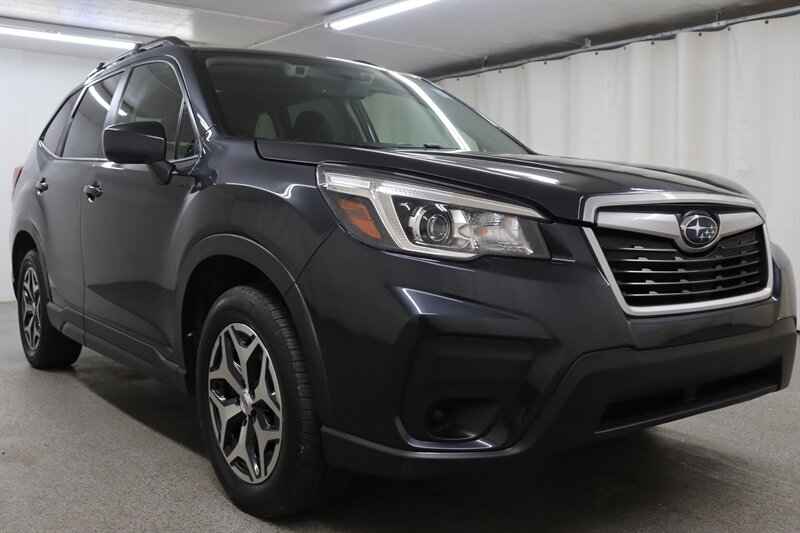
The 2019 Subaru Forester underwent a slight size increase compared to its predecessor, presenting a wider and larger frame. The exterior took inspiration from the Subaru Ascent, a larger sibling with a third row, resulting in a visual continuity between the models. Inside, the Forester's cabin was modern yet heavily prioritized functionality over the luxury aesthetic some competitors offered. This ensured that every design choice serviced practicality, making the vehicle suitable for a utilitarian lifestyle.
The Forester came in Base, Premium, Sport, Limited, and Touring trims. Each offered standard LED headlights, symmetrical all-wheel drive (AWD), and Subaru’s EyeSight driver-assistance systems. The Base model was well-equipped with features like 60/40 split-fold rear seats, dual front USB ports, and a 6.5-inch touchscreen. The Premium trim added 17-inch alloy wheels, a roof spoiler, panoramic moonroof, and 10-way power front seats, among other enhancements. The Sport trim introduced unique styling elements and additional features like a windshield wiper de-icer, heated front seats, and paddle shifters. Limited and Touring trims added further luxury with leather upholstery, power rear tailgate, dual-zone climate control, and an 8-inch touchscreen.
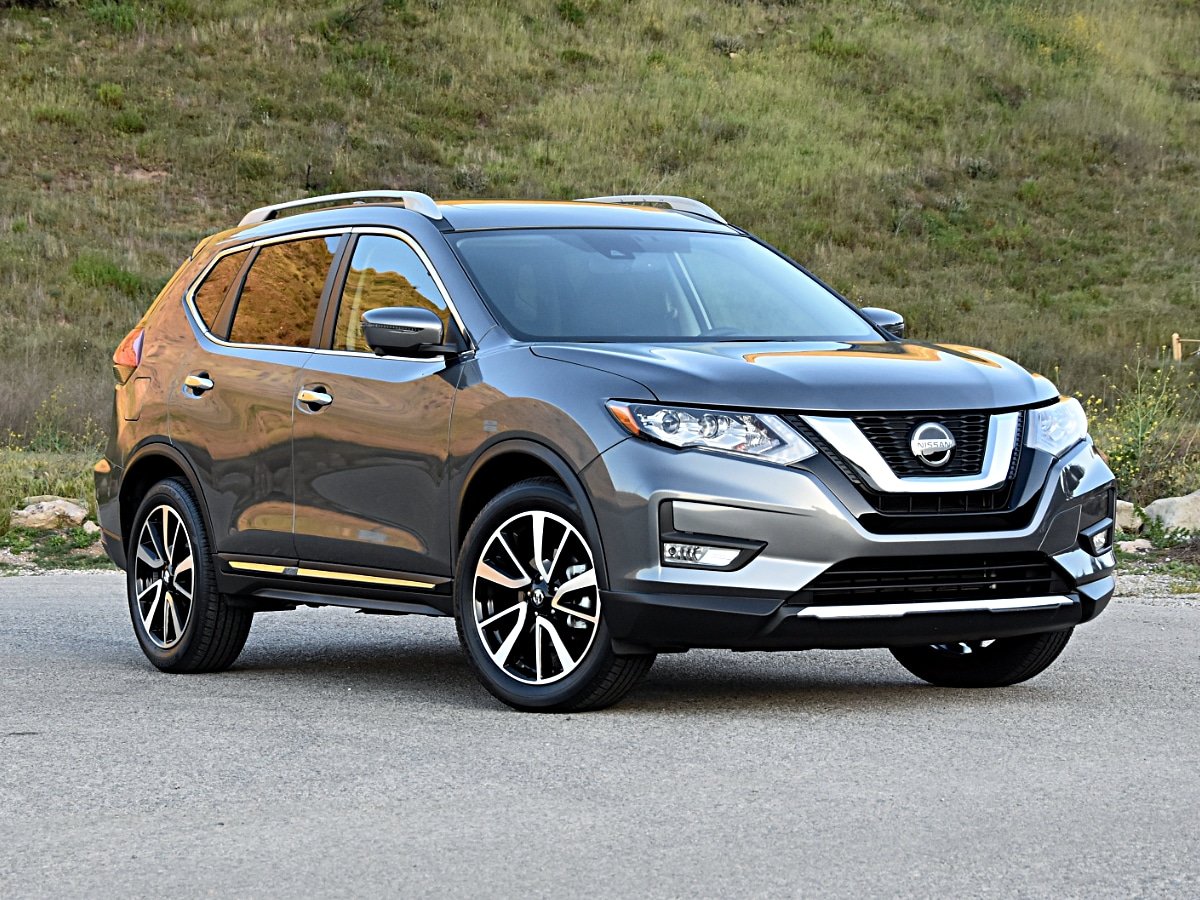
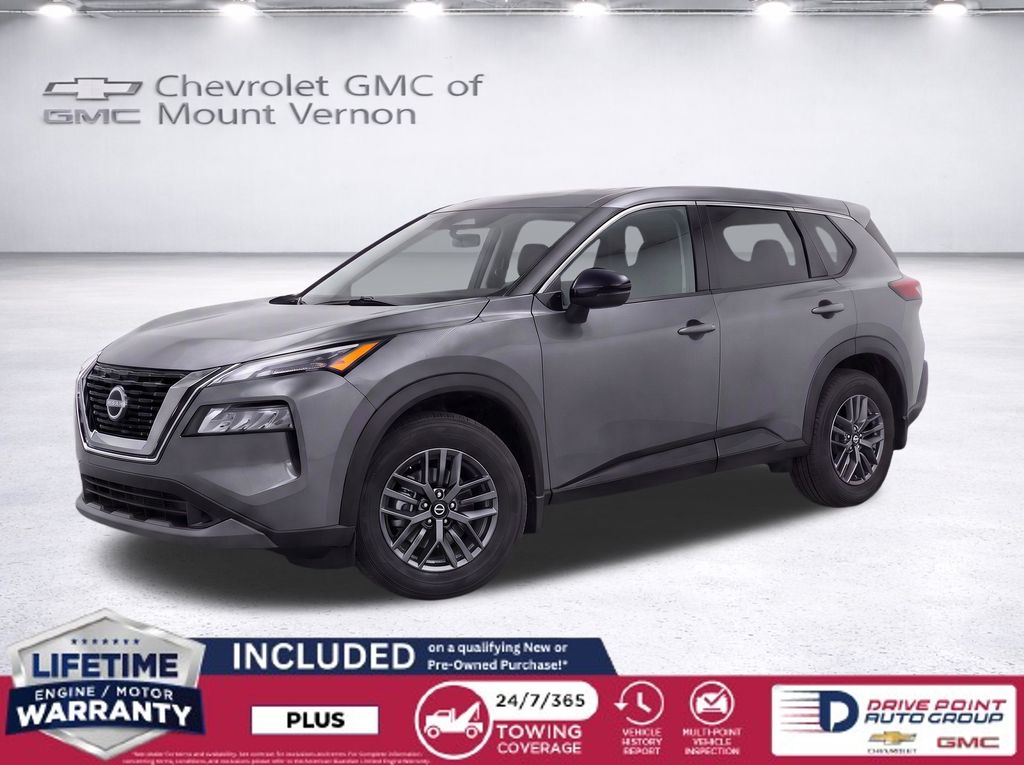
In contrast, the 2020 Nissan Rogue had a broader appeal despite its age. While it featured the significant V-Motion grille and exaggerated fender swells, the design remained attractive, especially with the SL trim's 19-inch aluminum wheels. However, the interior showed its age with older styling themes and less impressive plastic surfaces. Yet, the padded sides of the center console added thoughtful comfort.
Available in S, SV, and SL trims, the Rogue's approach was simpler, featuring a single engine and transmission with the option of FWD or AWD. The Rogue SL added an upscale feel with its Premium Package, carpeted floor and cargo mats, and a first-aid kit, totaling $34,870 with destination charges. The interior control panel and broader forms were older in style, contrasting the modern expectations set by newer models.


The 2019 Subaru Forester housed a 2.5-liter 4-cylinder boxer engine, producing 182 horsepower and 176 pound-feet of torque. Although this was a slight improvement from its predecessor, the discontinued turbocharged 2.0XT trim left performance enthusiasts wanting. The sole engine was paired with a continuously variable transmission (CVT), which prioritized efficiency over powerful acceleration. Subaru's standard symmetrical AWD and SI-Drive, which offered Intelligent and Sport drive modes, enhanced performance slightly. Despite lacking an exhilarating acceleration, the Forester's ride quality was commendable, handling town and highway driving with ease.
Fuel economy figures stood at 26 mpg city, 33 highway, and 29 combined, with real-world testing corroborating these numbers.
Meanwhile, the 2020 Nissan Rogue's performance was marked by its 2.5-liter four-cylinder engine, generating 170 horsepower. Paired with a CVT, the Rogue struggled to deliver spirited performance, especially under demanding conditions like freeway merging and uphill climbs. Though it featured a Sport driving mode, the mode did little to enhance its sporty credentials.
The Rogue’s strength lay in its ride and handling, thanks to technologies like Intelligent Trace Control and Active Ride Control, which improved cornering and ride smoothness over speed bumps. However, its 19-inch wheels couldn’t mask the Rogue’s lifeless steering and occasional CVT drone, making the driving experience less enjoyable. Fuel economy disappointingly averaged at 24.9 mpg, falling short of the expected 29 mpg.
The 2019 Subaru Forester excelled in interior space, with a significant increase from its previous model. It featured a class-leading 76.1 cubic feet of cargo space in the Base trim, while other trims offered 70.9 cubic feet. By comparison, the 2018 Toyota RAV4 offered 73.4 cubic feet, the Honda CR-V 75.8 cubic feet, and the Volkswagen Tiguan 73.5 cubic feet.
The expanded wheelbase provided ample backseat space, and the Forester’s combination of 8.7-inch ground clearance and seat height made it accessible for older drivers. The cabin was designed with numerous cubbies, compartments, and bottle holders, reinforcing Subaru's "Function First" philosophy. The tall greenhouse offered superb visibility, reducing reliance on reversing cameras and blind-spot monitoring systems.
In the 2020 Nissan Rogue, the front seats' comfort was subpar, with difficulty adjusting the seat height to accommodate taller drivers. Despite featuring Nissan’s Zero Gravity cushion design, adjustments were cumbersome, leading to discomfort over long drives.
However, the backseat was impressive, with high seat cushions and excellent thigh support, complemented by stadium-style seating and a panoramic sunroof, making it a preferred location for passengers. Cargo space was generous at 39 cubic feet behind the back seat, equipped with underfloor storage compartments and the Divide-n-Hide cargo management system.
The 2019 Subaru Forester's Starlink infotainment system, available in 6.5-inch and 8-inch screens, was highly regarded. It offered quick responsiveness, high resolution, and standard Apple CarPlay and Android Auto. The interface was intuitive, and transitioning between Starlink and CarPlay was seamless. Subaru’s EyeSight suite included useful features like Lead Vehicle Alert, forward-collision warning, adaptive cruise control, and lane-keeping Assist.
Conversely, the 2020 Nissan Rogue's NissanConnect interface was less sophisticated. Though it offered an impressive array of connectivity features, including Bluetooth, Apple CarPlay, Android Auto, and hands-free text messaging, its 7-inch touchscreen felt outdated. The slow response to inputs, especially in navigation, and subpar voice-recognition technology detracted from its modern appeal. Higher trims offered subscription-based NissanConnect Services, including Amazon Alexa, Google Assistant, and remote access features, with limited free trial periods.
The 2019 Subaru Forester excelled in safety with all trims featuring the comprehensive EyeSight suite, which included forward-collision warning, adaptive cruise control, lane-departure warning, and lane-keeping Assist. Additional features like a reversing camera and adaptive headlights ensured safety was both active and passive, supported by the Forester’s excellent visibility.
The 2020 Nissan Rogue similarly provided a robust array of standard safety features through its Safety Shield 360 collection, which included forward-collision warning, pedestrian detection, blind-spot monitoring, and rear cross-traffic alert. Additional features like Rear Door Alert and Tire Fill Alert added convenience. However, ProPilot Assist, though innovative at introduction, felt outdated compared to competitors. Safety ratings reflected its age, with a 4-star overall rating from NHTSA and issues highlighted by IIHS, preventing it from achieving a Top Safety Pick designation.
CarGurus highlights

According to CarGurus experts, the overall rating for the 2019 Subaru Forester is 8.2 out of 10, while the 2020 Nissan Rogue scores 6.0 out of 10. Given these ratings, the 2019 Subaru Forester is the recommended choice. Its superior blend of practicality, advanced safety features, better cargo capacity, and higher overall rating makes it the clear winner in this comparison.
Choose the 2020 Nissan Rogue if:
- Rear passenger comfort with enhanced seating and amenities is vital.
- An attractive base-level infotainment setup with connectivity features is sufficient.
- You prefer a vehicle with multiple advanced driver-assistance systems (ADAS).




Choose the 2019 Subaru Forester if:
- You value a balance of utility and functionality with a user-friendly cabin.
- Robust safety features like Subaru’s EyeSight suite are a priority.
- Superior cargo capacity is essential for your lifestyle.






CarGurus highlights
According to CarGurus experts, the overall rating for the 2019 Subaru Forester is 8.2 out of 10, while the 2020 Nissan Rogue scores 6.0 out of 10. Given these ratings, the 2019 Subaru Forester is the recommended choice. Its superior blend of practicality, advanced safety features, better cargo capacity, and higher overall rating makes it the clear winner in this comparison.
Choose the 2020 Nissan Rogue if:
Shop Now- Rear passenger comfort with enhanced seating and amenities is vital.
- An attractive base-level infotainment setup with connectivity features is sufficient.
- You prefer a vehicle with multiple advanced driver-assistance systems (ADAS).
Choose the 2019 Subaru Forester if:
Shop Now- You value a balance of utility and functionality with a user-friendly cabin.
- Robust safety features like Subaru’s EyeSight suite are a priority.
- Superior cargo capacity is essential for your lifestyle.

By: CarGurus + AI
At CarGurus, our team of experienced automotive writers remain at the heart of our content operation, conducting hands-on car tests and writing insightful guides that are backed by years of industry experience. To complement this, we are harnessing AI to make our content offering more diverse and more helpful to shoppers than ever. To achieve this, our AI systems are based exclusively on CarGurus content, ratings and data, so that what we produce is both unique to CarGurus, and uniquely helpful to car shoppers.

