2019 Ford Edge vs 2019 Toyota RAV4 Hybrid

Overview | |
MSRP$29,995 | MSRP$27,850 |
Listings1015 | Listings394 |
Ratings & Reviews | |
User Reviews | User Reviews |
Expert reviews7.3 out of 10 | Expert reviews8.5 out of 10 |
Pros
Cons
| |
2019 Ford Edge Reviews SummaryThe Edge was a key vehicle in the evolution of the family SUV market when Ford first introduced it for the 2007 model year. Back then, automakers were experimenting with just what a “crossover” could constitute—look at the Pontiac Aztec and first-generation Chrysler Pacifica if you disagree. But with the Edge, the midsize, two-row SUV template started to take shape. Ford offers the 2019 Edge with an ST trim, grafting performance onto the utilitarian Edge blueprint. But that begs a question—can a vehicle still be good at family hauling and commuting while also delivering speed and performance? | |
2019 Toyota RAV4 Hybrid Reviews SummaryThe Toyota Prius has become a household name over its 20-year lifespan, the Camry Hybrid arrived back in 2007, and Ford was first with a hybrid crossover in 2009. So, the RAV4 Hybrid was beyond overdue when it launched for 2016. The newest 2019 RAV4 Hybrid isn't the Corolla-looking lump that it resembled a year before. It now looks tougher, more rugged. Also, the hybrid version is the sportiest and most cost-effective way to rock a RAV4—seriously, it's so good and priced so right, you can ignore the standard model. | |
Popular Features & Specs | |
Engine2.0L 250 hp I4 | Engine2.5L 219 hp I4 Hybrid |
Drive TrainFWD | Drive TrainAWD |
Seating Capacity5 | Seating Capacity5 |
Horsepower250 hp @ 5500 rpm | Horsepower |
EV Battery Capacity | EV Battery Capacity1.6 kWh |
MPG City22 | MPG City41 |
MPG Highway29 | MPG Highway38 |
Engine | |
Engine Name2.0L 250 hp I4 | Engine Name2.5L 219 hp I4 Hybrid |
Torque280 lb-ft @ 3000 rpm | Torque |
Horsepower250 hp @ 5500 rpm | Horsepower |
DrivetrainFWD | DrivetrainAWD |
Fuel Economy | |
EV Battery Capacity | EV Battery Capacity1.6 kWh |
MPG City22 | MPG City41 |
MPG Highway29 | MPG Highway38 |
Interior | |
Seating Capacity5 | Seating Capacity5 |
Safety | |
Front Crash Overall5 | Front Crash Overall4 |
Side Crash Overall5 | Side Crash Overall5 |
Dimensions & Capacity | |
Cargo Space39.2 cu ft | Cargo Space37.6 cu ft |
Curb Weight4027 lbs | Curb Weight3710 lbs |
Height68.3 in | Height67.0 in |
Length188.8 in | Length180.9 in |
Width85.8 in | Width73.0 in |
Wheelbase112.2 in | Wheelbase105.9 in |
Maximum Payload1243 lbs | Maximum Payload1210 lbs |
Number of doors4 | Number of doors4 |
Maximum Towing Capacity1500 lbs | Maximum Towing Capacity1750 lbs |
Overview | ||
MSRP | $29,995 | $27,850 |
Listings | ||
Ratings & Reviews | ||
User reviews | ||
Expert reviews | 7.3 out of 10Read full review | 8.5 out of 10Read full review |
Pros & cons | Pros
Cons
| |
Summary | The Edge was a key vehicle in the evolution of the family SUV market when Ford first introduced it for the 2007 model year. Back then, automakers were experimenting with just what a “crossover” could constitute—look at the Pontiac Aztec and first-generation Chrysler Pacifica if you disagree. But with the Edge, the midsize, two-row SUV template started to take shape. Ford offers the 2019 Edge with an ST trim, grafting performance onto the utilitarian Edge blueprint. But that begs a question—can a vehicle still be good at family hauling and commuting while also delivering speed and performance? | The Toyota Prius has become a household name over its 20-year lifespan, the Camry Hybrid arrived back in 2007, and Ford was first with a hybrid crossover in 2009. So, the RAV4 Hybrid was beyond overdue when it launched for 2016. The newest 2019 RAV4 Hybrid isn't the Corolla-looking lump that it resembled a year before. It now looks tougher, more rugged. Also, the hybrid version is the sportiest and most cost-effective way to rock a RAV4—seriously, it's so good and priced so right, you can ignore the standard model. |
Video | ||
Popular Features & Specs | ||
Engine | 2.0L 250 hp I4 | 2.5L 219 hp I4 Hybrid |
Drive Train | FWD | AWD |
Seating Capacity | 5 | 5 |
Horsepower | 250 hp @ 5500 rpm | |
EV Battery Capacity | 1.6 kWh | |
MPG City | 22 | 41 |
MPG Highway | 29 | 38 |
Engine | ||
Engine Name | 2.0L 250 hp I4 | 2.5L 219 hp I4 Hybrid |
Torque | 280 lb-ft @ 3000 rpm | |
Horsepower | 250 hp @ 5500 rpm | |
Drivetrain | FWD | AWD |
Fuel Economy | ||
EV Battery Capacity | 1.6 kWh | |
MPG City | 22 | 41 |
MPG Highway | 29 | 38 |
Interior | ||
Seating Capacity | 5 | 5 |
Safety | ||
Front Crash Overall | 5 | 4 |
Side Crash Overall | 5 | 5 |
Dimensions & Capacity | ||
Cargo Space | 39.2 cu ft | 37.6 cu ft |
Curb Weight | 4027 lbs | 3710 lbs |
Height | 68.3 in | 67.0 in |
Length | 188.8 in | 180.9 in |
Width | 85.8 in | 73.0 in |
Wheelbase | 112.2 in | 105.9 in |
Maximum Payload | 1243 lbs | 1210 lbs |
Number of doors | 4 | 4 |
Maximum Towing Capacity | 1500 lbs | 1750 lbs |
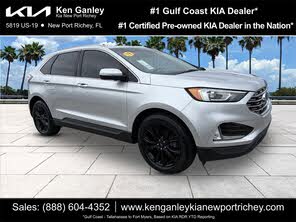
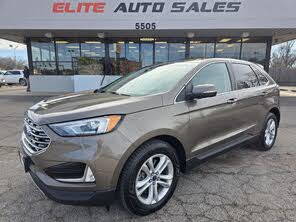
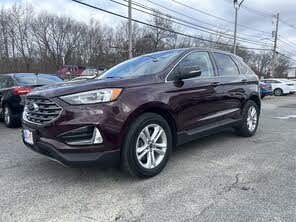
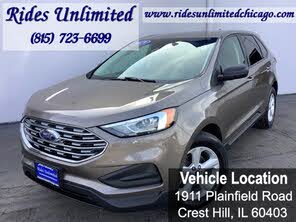
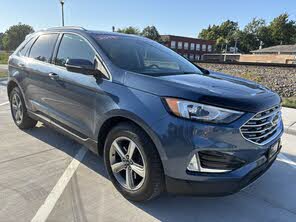
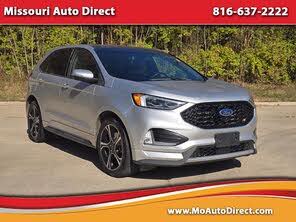
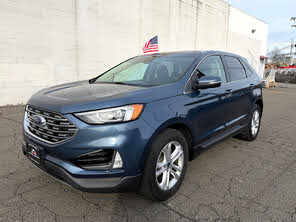
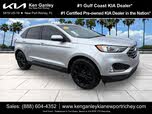
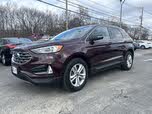
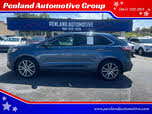
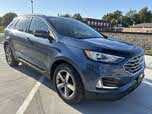
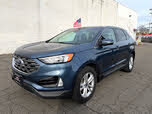
The 2019 Ford Edge received a facelift that included a new grille, headlights, and lower front fascia, giving it a sportier appearance. The rear also saw updates with new taillights and a larger black panel replacing the red connector between the taillights. Despite these exterior changes, the interior remained largely unchanged from previous models, feeling dated and heavily reliant on plastics. The cabin did offer useful features like a new rotary shifter and plenty of standard and available features across its SE, SEL, Titanium, and ST trims. The SEL trim, in particular, provided a good balance of features and price, while the ST trim added performance touches from Ford Performance, including a blacked-out grille and 20-inch machined aluminum wheels.
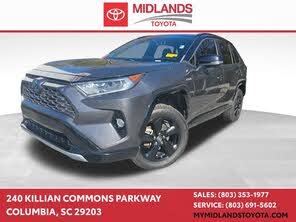
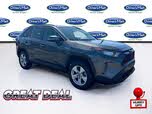
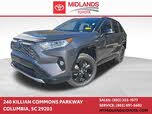
In contrast, the 2019 Toyota RAV4 Hybrid's design echoed Toyota's classic trucks, with a front that resembled the 4Runner and a body that reclaimed the original RAV4's large greenhouse. The XSE trim, exclusive to the Hybrid, featured glossy black trim on the roof, A-pillars, mirrors, fender flares, and 18-inch wheels, giving it a sporty look. The interior boasted high-quality materials, including padded dash and door trim with blue stitching, and large, easy-to-use knobs and buttons. The cabin felt upscale with features like a thick PRNDL gear selector, tall door handles, and snug front seats with blue-striped cloth inserts.


The 2019 Ford Edge offered a 2.0-liter turbocharged 4-cylinder engine across all non-ST trims, producing 250 horsepower and 280 pound-feet of torque. This engine, paired with an 8-speed automatic transmission, provided a reliable performance with either front-wheel drive or optional all-wheel drive. The ST trim, however, featured a more powerful 2.7-liter EcoBoost V6 engine, delivering 335 horsepower and 380 pound-feet of torque, exclusively with all-wheel drive. The ST's performance was impressive, with fantastic acceleration and balanced handling, especially on curving back roads. Fuel economy for the base 2.0-liter engine with front-wheel drive was 22 mpg city, 29 highway, and 25 combined, while the ST returned 19/26/21.
The 2019 Toyota RAV4 Hybrid combined a 2.5-liter 4-cylinder engine with two electric motors and a 1.6-kilowatt battery, producing a total of 219 horsepower. The hybrid system provided a seamless and quiet driving experience, with the continuously variable transmission (CVT) ensuring smooth power delivery. The RAV4 Hybrid's handling was stable and responsive, particularly in the XSE trim with sport-tuned dampers and springs. Fuel efficiency was a standout feature, with the RAV4 Hybrid averaging 36 mpg over 400 miles and EPA ratings of 41 mpg city, 38 highway, and 40 combined.
The 2019 Ford Edge's cabin, though dated, was practical with deep cargo bins, USB ports, and available wireless charging. The front seats were comfortable, but the ST's bucket seats were not ideal for taller drivers. The rear seats offered ample head- and legroom, and the cargo space was generous with 39 cubic feet behind the rear seats and 73.4 cubic feet with the seats folded down.
The 2019 Toyota RAV4 Hybrid provided excellent sightlines and generous cargo space, with 37.5 cubic feet behind the rear seats and 70 cubic feet with the seats folded. The second-row legroom was ample, and the air conditioning was highly effective. The large knobs and switches enhanced ergonomics, though some controls were not illuminated at night. The infotainment system was user-friendly, with clear menus and customizable home screens.
The 2019 Ford Edge's base infotainment system featured a small 4.2-inch non-touchscreen with basic functionality, including a USB port, WiFi hotspot, and Bluetooth. The available 8-inch Sync 3 system, standard on higher trims, offered a more intuitive interface with Apple CarPlay, Android Auto, and Amazon Alexa integration.
The 2019 Toyota RAV4 Hybrid's infotainment system was superior to those in Lexus models, with a touchscreen that accepted swiping and pinching gestures. The system included Apple CarPlay but not Android Auto. The JBL stereo was adequate, and the lane-keep assist was not designed for semi-automated operation. Toyota's Safety Connect provided standard stolen-vehicle alerts, automatic crash notifications, and SOS assistance for three years.
The 2019 Ford Edge came standard with a reversing camera, traction control, and a full complement of airbags. Ford’s Co-Pilot360 suite of driver-assistance features, including automatic emergency braking, forward-collision warning, lane-departure warning, automatic high-beams, and blind-spot monitoring with rear cross-traffic alert, was also standard. Higher trims could be upgraded with the Co-Pilot360 Assist+ package, adding adaptive cruise control, evasive steering assist, and a lane-centering system.
The 2019 Toyota RAV4 Hybrid earned a 5-star overall rating from the NHTSA and top ratings from the IIHS, except for its headlights. Toyota Safety Sense, standard on the RAV4 Hybrid, included forward emergency braking, pedestrian detection, lane-keep assist, blind-spot monitoring, adaptive cruise, traffic-sign recognition, and auto high beams. Unique safety features included an airbag in the front passenger seat's cushion and a driver's knee airbag. Rear emergency braking was optional.
CarGurus highlights

According to CarGurus experts, the overall rating for the 2019 Ford Edge is 7.3 out of 10, while the 2019 Toyota RAV4 Hybrid scores 8.5 out of 10. Based on these ratings, the 2019 Toyota RAV4 Hybrid is the clear winner, offering better fuel efficiency, a more modern and high-quality interior, and superior safety features.
Choose the 2019 Ford Edge if:
- You prefer a sportier appearance with performance touches from Ford Performance.
- You need a practical and spacious interior with ample cargo space.
- You value a comprehensive suite of driver-assistance features with available upgrades.



Choose the 2019 Toyota RAV4 Hybrid if:
- You want a fuel-efficient hybrid with seamless and quiet driving experience.
- You appreciate a high-quality interior with user-friendly technology.
- You prioritize top safety ratings and advanced safety features.


CarGurus highlights
According to CarGurus experts, the overall rating for the 2019 Ford Edge is 7.3 out of 10, while the 2019 Toyota RAV4 Hybrid scores 8.5 out of 10. Based on these ratings, the 2019 Toyota RAV4 Hybrid is the clear winner, offering better fuel efficiency, a more modern and high-quality interior, and superior safety features.
Choose the 2019 Ford Edge if:
Shop Now- You prefer a sportier appearance with performance touches from Ford Performance.
- You need a practical and spacious interior with ample cargo space.
- You value a comprehensive suite of driver-assistance features with available upgrades.




Choose the 2019 Toyota RAV4 Hybrid if:
Shop Now- You want a fuel-efficient hybrid with seamless and quiet driving experience.
- You appreciate a high-quality interior with user-friendly technology.
- You prioritize top safety ratings and advanced safety features.





By: CarGurus + AI
At CarGurus, our team of experienced automotive writers remain at the heart of our content operation, conducting hands-on car tests and writing insightful guides that are backed by years of industry experience. To complement this, we are harnessing AI to make our content offering more diverse and more helpful to shoppers than ever. To achieve this, our AI systems are based exclusively on CarGurus content, ratings and data, so that what we produce is both unique to CarGurus, and uniquely helpful to car shoppers.