Toyota Sequoia vs Chevrolet Bolt
Overview | |
Years produced2001-Present | Years produced2027 |
MSRP$62,425 | MSRP$27,600 |
Listings250 | Listings2 |
Ratings & Reviews | |
User Reviews | User Reviews |
Expert reviews5.5 out of 10 | Expert reviews6.3 out of 10 |
Pros
Cons
| Pros
Cons
|
Reviews SummaryThe 2025 Sequoia is Toyota’s full-size SUV, based on the same platform as the Tundra pickup truck and using the same i-Force Max hybrid powertrain. It seats up to eight people, holds up to 86.9 cubic feet of cargo, carries up to 1,730 pounds of payload, and tows up to 9,520 pounds of trailer. The new Sequoia 1794 Edition slots into the lineup as a Texas-themed luxury model, and it certainly is nice. But it cannot mask this SUV’s fundamental flaws. Verdict: People buy full-size SUVs to carry lots of people, haul lots of cargo, and tow lots of weight. However, due to its packaging requirements, the Sequoia is a rock star only if you’re attaching a trailer to it, and even then, it’s not class-leading in capability. | |
Reviews SummaryWith more range, more power, and improved technology, the Chevrolet Bolt EV returns after a three-year hiatus. It also claims the title of the most affordable EV in the U.S., but is due to remain in production only until mid-2027. Verdict: The 2027 Chevrolet Bolt EV is an excellent choice for shoppers seeking an electric vehicle that won't break the bank. It may not be all that fancy or refined, but it gets the basics right when it comes to range and capabilities. | |
No video found | No video found |
Popular Features & Specs | |
Engine3.4L 437 hp V6 Hybrid | Engine |
Drivetrain4X2 | Drivetrain |
Seating Capacity8 | Seating Capacity5 |
Horsepower437 hp @ 5200 rpm | Horsepower |
EV Battery Capacity1.9 kWh | EV Battery Capacity65 kWh |
MPG City21 | MPG City |
MPG Highway24 | MPG Highway |
Battery Charge Time (120V) | Battery Charge Time (120V)64 hours |
Battery Charge Time (240V) | Battery Charge Time (240V)9.8 hours |
Engine | |
Engine Name3.4L 437 hp V6 Hybrid | Engine Name210 hp Electric |
Torque583 lb-ft @ 2400 rpm | Torque |
Horsepower437 hp @ 5200 rpm | Horsepower |
Battery Charge Time (120V) | Battery Charge Time (120V)64 hours |
Battery Charge Time (240V) | Battery Charge Time (240V)9.8 hours |
Drivetrain4X2 | DrivetrainFWD |
Fuel Economy | |
EV Battery Capacity1.9 kWh | EV Battery Capacity65 kWh |
MPG City21 | MPG City |
MPG Highway24 | MPG Highway |
Interior | |
Seating Capacity8 | Seating Capacity5 |
Key Features | |
Navigation System | Navigation SystemStandard |
Sunroof/MoonroofStandard | Sunroof/Moonroof |
Dimensions & Capacity | |
Cargo Space22.3 cu ft | Cargo Space16.2 cu ft |
Curb Weight5620 lbs | Curb Weight3776 lbs |
Height74.5 in | Height63.9 in |
Length208.1 in | Length169.6 in |
Width79.8 in | Width80.1 in |
Wheelbase122.0 in | Wheelbase105.3 in |
Maximum Payload1730 lbs | Maximum Payload873 lbs |
Number of doors4 | Number of doors4 |
Maximum Towing Capacity9520 lbs | Maximum Towing Capacity |
Standard Towing Capacity9520 lbs | Standard Towing Capacity |
Overview | ||
Years produced | 2001-Present | 2027 |
MSRP | $62,425 | $27,600 |
Listings | ||
Ratings & Reviews | ||
User reviews | ||
Expert reviews | 5.5 out of 10Read full review | 6.3 out of 10Read full review |
Pros & cons | Pros
Cons
| Pros
Cons
|
Summary | The 2025 Sequoia is Toyota’s full-size SUV, based on the same platform as the Tundra pickup truck and using the same i-Force Max hybrid powertrain. It seats up to eight people, holds up to 86.9 cubic feet of cargo, carries up to 1,730 pounds of payload, and tows up to 9,520 pounds of trailer. The new Sequoia 1794 Edition slots into the lineup as a Texas-themed luxury model, and it certainly is nice. But it cannot mask this SUV’s fundamental flaws. Verdict: People buy full-size SUVs to carry lots of people, haul lots of cargo, and tow lots of weight. However, due to its packaging requirements, the Sequoia is a rock star only if you’re attaching a trailer to it, and even then, it’s not class-leading in capability. | With more range, more power, and improved technology, the Chevrolet Bolt EV returns after a three-year hiatus. It also claims the title of the most affordable EV in the U.S., but is due to remain in production only until mid-2027. Verdict: The 2027 Chevrolet Bolt EV is an excellent choice for shoppers seeking an electric vehicle that won't break the bank. It may not be all that fancy or refined, but it gets the basics right when it comes to range and capabilities. |
Video | No video found | No video found |
Popular Features & Specs | ||
Engine | 3.4L 437 hp V6 Hybrid | |
Drivetrain | 4X2 | |
Seating Capacity | 8 | 5 |
Horsepower | 437 hp @ 5200 rpm | |
EV Battery Capacity | 1.9 kWh | 65 kWh |
MPG City | 21 | |
MPG Highway | 24 | |
Battery Charge Time (120V) | 64 hours | |
Battery Charge Time (240V) | 9.8 hours | |
Engine | ||
Engine Name | 3.4L 437 hp V6 Hybrid | 210 hp Electric |
Torque | 583 lb-ft @ 2400 rpm | |
Horsepower | 437 hp @ 5200 rpm | |
Battery Charge Time (120V) | 64 hours | |
Battery Charge Time (240V) | 9.8 hours | |
Drivetrain | 4X2 | FWD |
Fuel Economy | ||
EV Battery Capacity | 1.9 kWh | 65 kWh |
MPG City | 21 | |
MPG Highway | 24 | |
Interior | ||
Seating Capacity | 8 | 5 |
Key Features | ||
Navigation System | Standard | |
Sunroof/Moonroof | Standard | |
Dimensions & Capacity | ||
Cargo Space | 22.3 cu ft | 16.2 cu ft |
Curb Weight | 5620 lbs | 3776 lbs |
Height | 74.5 in | 63.9 in |
Length | 208.1 in | 169.6 in |
Width | 79.8 in | 80.1 in |
Wheelbase | 122.0 in | 105.3 in |
Maximum Payload | 1730 lbs | 873 lbs |
Number of doors | 4 | 4 |
Maximum Towing Capacity | 9520 lbs | |
Standard Towing Capacity | 9520 lbs | |
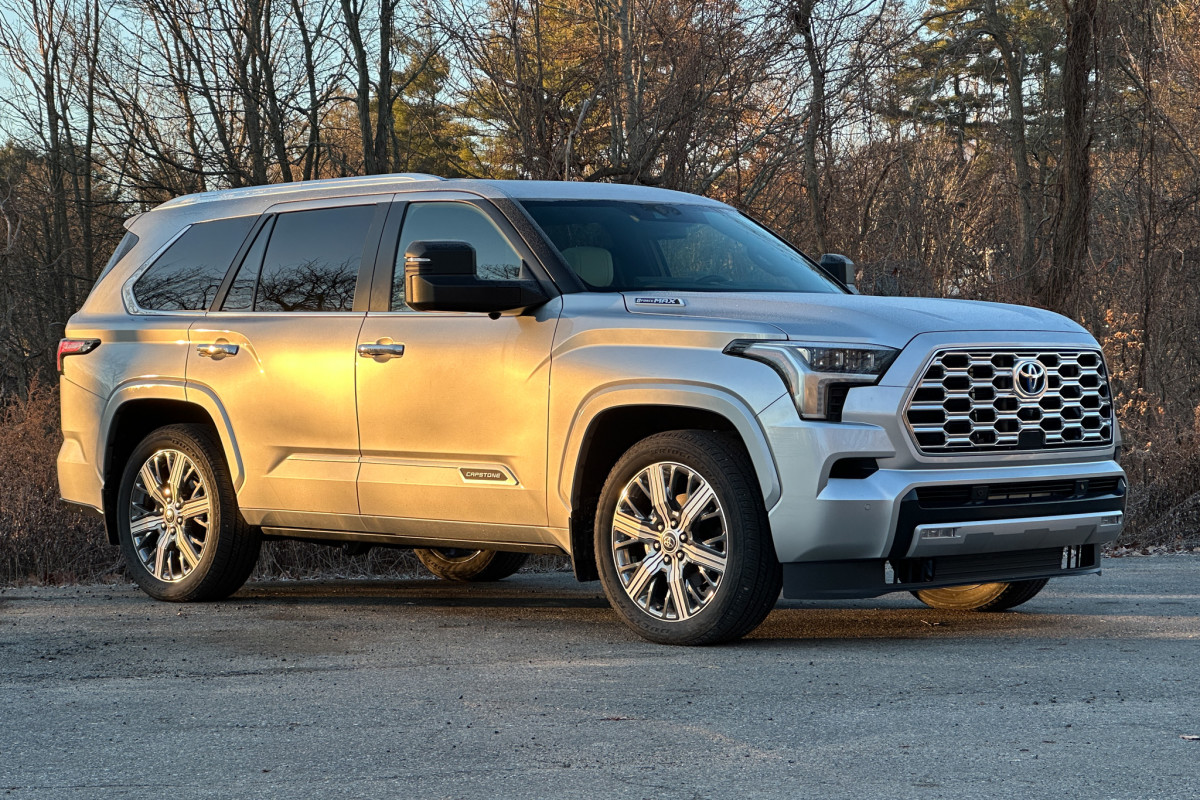
The 2025 Toyota Sequoia 1794 Edition was a nod to its Texas roots, named after the year the ranch was established where its assembly plant now stands. This full-size SUV aimed to capture attention with its machined-finish 20-inch wheels, chrome accents, and luxurious Saddle Tan leather upholstery. Despite its hefty price tag, the interior was a mix of high-end materials and typical Toyota-grade plastics, which detracted from its premium feel. The TRD Off-Road Package added rugged elements like a front skid plate and off-road wheels, but the overall design was more about making a statement than blending seamlessly with its off-road capabilities.
In contrast, the 2027 Chevrolet Bolt maintained a familiar look with subtle styling tweaks, such as a more conventional front end and a single body style. Its tall, narrow design prioritized utility and interior space, offering a practical yet budget-friendly feel. The interior saw a more significant update with a larger digital instrument panel and infotainment touchscreen, while the cabin was dominated by hard plastics. Despite its econobox-like footprint, the Bolt provided ample headroom and a flat floor, enhancing passenger comfort. The RS trim added a touch of sportiness with gloss black exterior trim and Evotex synthetic leather upholstery.
The 2025 Toyota Sequoia came equipped with an i-Force Max hybrid powertrain, featuring a twin-turbocharged 3.4-liter V6 engine, an electric motor, and a 1.87-kilowatt-hour nickel metal hydride battery pack. This setup delivered an impressive 437 horsepower and 583 pound-feet of torque, paired with a 10-speed automatic transmission. Despite its muscular performance, the Sequoia's fuel economy fell short, averaging only 16.2 mpg in real-world testing compared to the EPA's 20 mpg estimate. The SUV's towing capacity was a strong point, with a maximum of 9,010 pounds, but its driving dynamics were compromised by a solid rear axle and rear-mounted battery pack, leading to a jittery ride and excessive body motion.
The 2027 Chevrolet Bolt featured a new 65-kilowatt-hour lithium-iron phosphate battery pack, reducing costs and reliance on rare earth minerals. Its motor, borrowed from the Chevy Equinox EV, produced 210 horsepower and 169 pound-feet of torque, achieving 0-60 mph in the low seven-second range. While not the fastest EV, the Bolt's acceleration was quick compared to gas-powered subcompact SUVs. The ride was firm but not overly harsh, and the low center of gravity contributed to agile handling. The Bolt's range improved to 262 miles on a full charge, and its charging speed increased to 150 kW, allowing for a quick recharge from 10% to 80% in 25 minutes.
The 2025 Toyota Sequoia offered seating for up to eight, though the third row was best suited for shorter passengers due to limited headroom. The 1794 Edition's front seats provided comfort with power adjustments, heating, ventilation, and massage functions. Accessing the third row was challenging due to the high floor and low roof, and cargo space was limited, with only 11.5 cubic feet behind the third row. Folding the seats expanded the cargo area to 86.9 cubic feet, but this was still less than rival full-size SUVs.
The 2027 Chevrolet Bolt provided a more upright driving position with ample space for larger occupants. The rear seats offered plenty of headroom and thigh support, with a flat floor enhancing comfort for center-seat passengers. Cargo capacity was 16.2 cubic feet behind the rear seats, with a large bin underneath the floor for additional storage. The rear seatbacks folded flat with the cargo floor, maximizing space for larger items. While there was no frunk, the Bolt offered ample storage for personal items, including a large bin with dividers and a deep center armrest bin.
The 2025 Toyota Sequoia 1794 Edition featured a 12.3-inch digital instrumentation panel and a 14-inch touchscreen infotainment system. It offered various connected services plans, with trial subscriptions ranging from one to ten years. Wireless Apple CarPlay and Android Auto were standard, along with a 14-speaker JBL premium sound system. The system's natural voice recognition was reasonably capable but had limitations, and the lack of a tuning knob was a minor annoyance. The Sequoia also included a surround-view camera system and a digital rearview mirror for added convenience.
The 2027 Chevrolet Bolt came with an 11-inch digital instrument panel and an 11.3-inch center touchscreen, running on a Google-based operating system. While Apple CarPlay and standalone Android Auto were not supported, the system offered logical menus, sharp graphics, and quick responses. The optional Technology package added a surround-view camera system, a digital rear-view mirror, and a wireless charging pad. The Bolt's navigation system could locate charging stations and precondition the battery for optimal charging rates. Additionally, the Bolt offered vehicle-to-load charging, allowing it to serve as a backup power source for a home.
The 2025 Toyota Sequoia was equipped with Toyota Safety Sense 2.5, which included adaptive cruise control, forward collision warning, automatic emergency braking, lane departure warning, lane keep assist, lane-centering assist, and automatic high-beam headlights. Blind-spot monitoring and rear cross-traffic alert were also standard. While the safety tech was helpful, the lane assist features could be aggravating, with frequent false lane departure warnings. At the time of publication, crash-test ratings from the IIHS and NHTSA were not available.
The 2027 Chevrolet Bolt had not yet been crash-tested by the NHTSA or IIHS, but it was expected to achieve high scores based on its platform. Standard safety features included forward collision warning, automatic emergency braking, adaptive cruise control, lane-keep assist, blind-spot monitors, and a safety alert seat. The optional Technology package added a surround-view camera system, a digital rear-view mirror, and traffic-sign recognition. GM's Super Cruise hands-free automated highway driving system was available for an additional cost, making the Bolt one of the few budget EVs to offer such advanced technology.
CarGurus highlights
According to CarGurus experts, the overall rating for the 2025 Toyota Sequoia is 5.5 out of 10, while the 2027 Chevrolet Bolt scores 6.3 out of 10. Based on these ratings, the 2027 Chevrolet Bolt is the recommended choice, offering a better balance of practicality, technology, and value for consumers seeking an efficient and modern vehicle.
Choose the 2025 Toyota Sequoia if:
- You need a full-size SUV with impressive towing capacity and off-road capabilities.
- You prefer a luxurious interior with premium materials and advanced comfort features.
- You value a muscular hybrid powertrain with strong acceleration and torque.


Choose the 2027 Chevrolet Bolt if:
- You want an affordable EV with a practical design and ample interior space.
- You prioritize a long electric range and fast charging capabilities.
- You seek advanced safety features and optional hands-free driving technology.


CarGurus highlights
According to CarGurus experts, the overall rating for the 2025 Toyota Sequoia is 5.5 out of 10, while the 2027 Chevrolet Bolt scores 6.3 out of 10. Based on these ratings, the 2027 Chevrolet Bolt is the recommended choice, offering a better balance of practicality, technology, and value for consumers seeking an efficient and modern vehicle.
Choose the 2025 Toyota Sequoia if:
Shop Now- You need a full-size SUV with impressive towing capacity and off-road capabilities.
- You prefer a luxurious interior with premium materials and advanced comfort features.
- You value a muscular hybrid powertrain with strong acceleration and torque.
Choose the 2027 Chevrolet Bolt if:
Shop Now- You want an affordable EV with a practical design and ample interior space.
- You prioritize a long electric range and fast charging capabilities.
- You seek advanced safety features and optional hands-free driving technology.

By: CarGurus + AI
At CarGurus, our team of experienced automotive writers remain at the heart of our content operation, conducting hands-on car tests and writing insightful guides that are backed by years of industry experience. To complement this, we are harnessing AI to make our content offering more diverse and more helpful to shoppers than ever. To achieve this, our AI systems are based exclusively on CarGurus content, ratings and data, so that what we produce is both unique to CarGurus, and uniquely helpful to car shoppers.

