Genesis GV80 vs Hyundai Ioniq 5
Overview | |
MSRP$58,200 | MSRP$35,000 |
Listings196 | Listings154 |
Ratings & Reviews | |
User Reviews | User Reviews |
Expert reviews8.0 out of 10 | Expert reviews8.0 out of 10 |
Pros
Cons
| Pros
Cons
|
Reviews SummaryThe Genesis GV80 was introduced in 2021 and has proved itself to be a strong contender as a luxury crossover. Although the powertrain remains the same for 2025, the mid-size SUV gets a redesign both inside and out, adding a bit more sophistication, two new exterior colors and some sumptuous interior materials. We’ll see a sporty GV80 coupe with a supercharged engine later in 2025, but for now this traditional crossover is the company’s answer to luxury at an affordable price. Verdict: Genesis improved the technology of the GV80 for 2025 by adding wireless Apple CarPlay and Android Auto, but the SUV returns poor fuel economy and the seats are far from comfortable. Still, the GV80 undercuts its European counterparts on price and definitely deserves a test drive. | |
Reviews SummaryMany automakers have had a tough time launching electric vehicles, as teething problems have resulted in build-quality issues, gremlins, and production delays. Hyundai, however, got it right from the start with the Ioniq 5. Not only did this compact crossover nail the basics, it has also struck a chord for its stylish looks, fast charging capability, good range, and practicality. Verdict: Five years into its run, the Ioniq 5 is still the electric vehicle we would recommend to most EV buyers. A drive around Hyundai’s factory in Savannah, Georgia, only reinforced our position. | |
No video found | |
Popular Features & Specs | |
Engine2.5L 300 hp I4 | Engine168 hp Electric |
DrivetrainAWD | DrivetrainRWD |
Seating Capacity5 | Seating Capacity5 |
Horsepower300 hp @ 5800 rpm | Horsepower |
EV Battery Capacity | EV Battery Capacity63 kWh |
MPG City19 | MPG City131 |
MPG Highway24 | MPG Highway100 |
Battery Charge Time (120V) | Battery Charge Time (120V)54 hours |
Battery Charge Time (240V) | Battery Charge Time (240V)5.7 hours |
Engine | |
Engine Name2.5L 300 hp I4 | Engine Name168 hp Electric |
Torque311 lb-ft @ 1650 rpm | Torque |
Horsepower300 hp @ 5800 rpm | Horsepower |
Battery Charge Time (120V) | Battery Charge Time (120V)54 hours |
Battery Charge Time (240V) | Battery Charge Time (240V)5.7 hours |
DrivetrainAWD | DrivetrainRWD |
Fuel Economy | |
EV Battery Capacity | EV Battery Capacity63 kWh |
MPG City19 | MPG City131 |
MPG Highway24 | MPG Highway100 |
Interior | |
Seating Capacity5 | Seating Capacity5 |
Key Features | |
Navigation SystemStandard | Navigation SystemStandard |
Safety | |
Front Crash Overall4 | Front Crash Overall4 |
Side Crash Overall5 | Side Crash Overall5 |
Dimensions & Capacity | |
Cargo Space34.9 cu ft | Cargo Space26.3 cu ft |
Curb Weight4850 lbs | Curb Weight4145 lbs |
Height67.5 in | Height63.0 in |
Length194.5 in | Length183.3 in |
Width77.8 in | Width74.4 in |
Wheelbase116.3 in | Wheelbase118.1 in |
Maximum Payload1180 lbs | Maximum Payload1080 lbs |
Number of doors4 | Number of doors4 |
Maximum Towing Capacity6000 lbs | Maximum Towing Capacity |
Overview | ||
MSRP | $58,200 | $35,000 |
Listings | ||
Ratings & Reviews | ||
User reviews | ||
Expert reviews | 8.0 out of 10Read full review | 8.0 out of 10Read full review |
Pros & cons | Pros
Cons
| Pros
Cons
|
Summary | The Genesis GV80 was introduced in 2021 and has proved itself to be a strong contender as a luxury crossover. Although the powertrain remains the same for 2025, the mid-size SUV gets a redesign both inside and out, adding a bit more sophistication, two new exterior colors and some sumptuous interior materials. We’ll see a sporty GV80 coupe with a supercharged engine later in 2025, but for now this traditional crossover is the company’s answer to luxury at an affordable price. Verdict: Genesis improved the technology of the GV80 for 2025 by adding wireless Apple CarPlay and Android Auto, but the SUV returns poor fuel economy and the seats are far from comfortable. Still, the GV80 undercuts its European counterparts on price and definitely deserves a test drive. | Many automakers have had a tough time launching electric vehicles, as teething problems have resulted in build-quality issues, gremlins, and production delays. Hyundai, however, got it right from the start with the Ioniq 5. Not only did this compact crossover nail the basics, it has also struck a chord for its stylish looks, fast charging capability, good range, and practicality. Verdict: Five years into its run, the Ioniq 5 is still the electric vehicle we would recommend to most EV buyers. A drive around Hyundai’s factory in Savannah, Georgia, only reinforced our position. |
Video | No video found | |
Popular Features & Specs | ||
Engine | 2.5L 300 hp I4 | 168 hp Electric |
Drivetrain | AWD | RWD |
Seating Capacity | 5 | 5 |
Horsepower | 300 hp @ 5800 rpm | |
EV Battery Capacity | 63 kWh | |
MPG City | 19 | 131 |
MPG Highway | 24 | 100 |
Battery Charge Time (120V) | 54 hours | |
Battery Charge Time (240V) | 5.7 hours | |
Engine | ||
Engine Name | 2.5L 300 hp I4 | 168 hp Electric |
Torque | 311 lb-ft @ 1650 rpm | |
Horsepower | 300 hp @ 5800 rpm | |
Battery Charge Time (120V) | 54 hours | |
Battery Charge Time (240V) | 5.7 hours | |
Drivetrain | AWD | RWD |
Fuel Economy | ||
EV Battery Capacity | 63 kWh | |
MPG City | 19 | 131 |
MPG Highway | 24 | 100 |
Interior | ||
Seating Capacity | 5 | 5 |
Key Features | ||
Navigation System | Standard | Standard |
Safety | ||
Front Crash Overall | 4 | 4 |
Side Crash Overall | 5 | 5 |
Dimensions & Capacity | ||
Cargo Space | 34.9 cu ft | 26.3 cu ft |
Curb Weight | 4850 lbs | 4145 lbs |
Height | 67.5 in | 63.0 in |
Length | 194.5 in | 183.3 in |
Width | 77.8 in | 74.4 in |
Wheelbase | 116.3 in | 118.1 in |
Maximum Payload | 1180 lbs | 1080 lbs |
Number of doors | 4 | 4 |
Maximum Towing Capacity | 6000 lbs | |
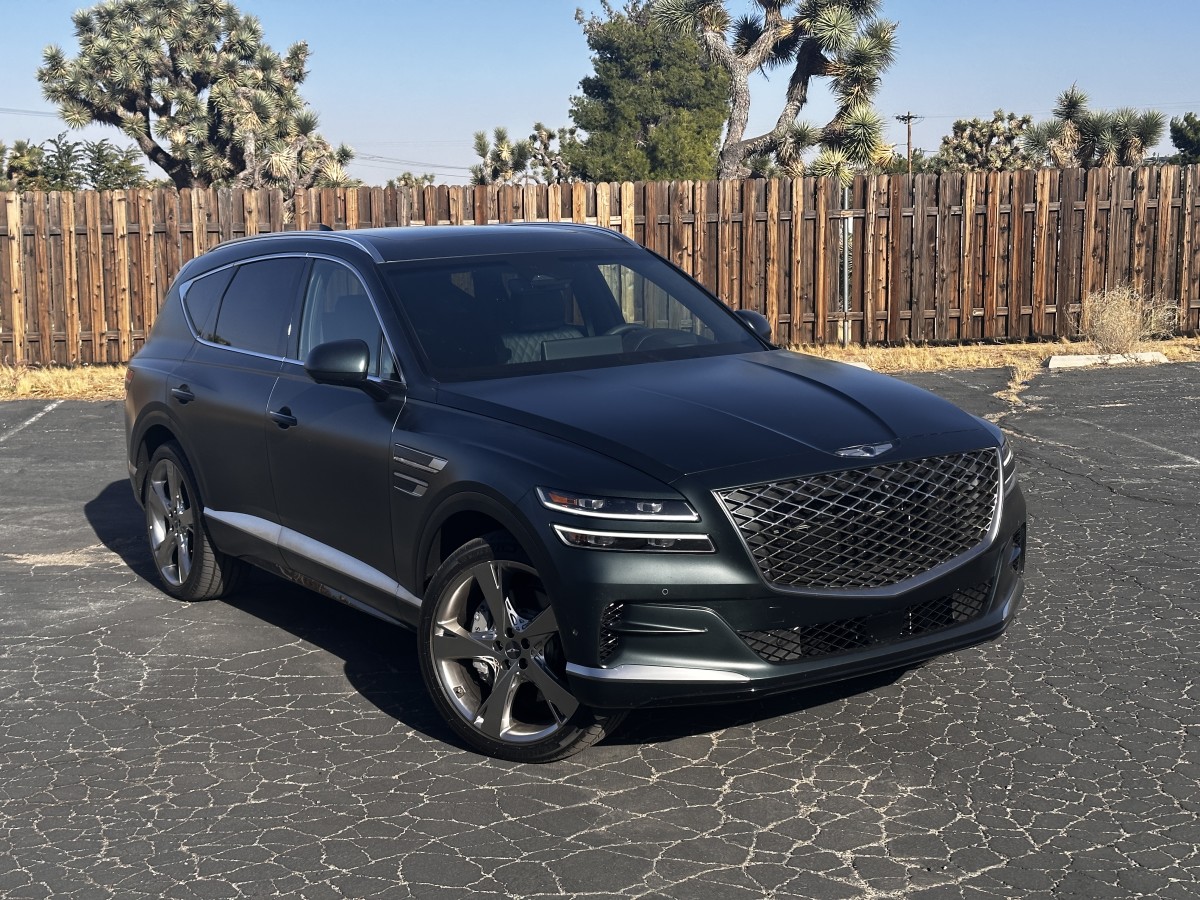
The 2025 Genesis GV80 was a testament to sophisticated design, offering two engine options and five trims, with the top Prestige trim featuring a 3.5-liter twin-turbocharged engine. The redesign enhanced its already handsome appearance, with a more aggressive front bumper and a grille with added depth. The micro lens array headlights and subtle rear changes, along with new color options like Storr Green, added to its allure. Inside, the GV80 boasted quilted Nappa leather seats, a suede headliner, and unique interior accents, including basalt or recycled newspaper trim. The center console featured three tactile dials, though the redundant infotainment dial seemed less practical compared to the touchscreen.
The 2026 Hyundai Ioniq 5 combined a 1980s hatchback vibe with modern crossover SUV elements, resulting in a unique and attractive design. Its angular lines and triangular profile, along with dark cladding, gave it a crossover flavor. The front featured a visor slit with rectangular headlights, while the rear had an integrated spoiler and darkened panels. The XRT model stood out with 18-inch alloys, pixel-patterned cladding, and a rally car-like appearance. Inside, the Ioniq 5 was more utilitarian, with standard cloth upholstery and synthetic leather in higher trims. The tech-focused interior included dual 12.3-inch screens and touch controls, though the overall look was somewhat sterile.


The 2025 Genesis GV80 retained its powertrain options, with a 2.5-liter turbocharged four-cylinder engine producing 300 horsepower and 311 lb-ft of torque. The top trim featured a twin-turbocharged six-cylinder engine delivering 375 horsepower and 391 lb-ft of torque. All trims came with all-wheel drive, capable of sending up to 100% of torque to the rear wheels. The GV80 offered modes like Snow and Eco for different driving conditions. While acceleration was satisfying, the SUV was more suited for cruising than sporty driving. The brakes were firm and linear, ensuring confident stops, and the interior remained quiet even on rough roads.
The 2026 Hyundai Ioniq 5 offered a single-motor, rear-wheel-drive powertrain with 168 horsepower and 258 lb-ft of torque in the base trim, while other trims had 220 horsepower. The dual-motor, all-wheel-drive option increased output to 320 horsepower and 446 lb-ft of torque. The Ioniq 5 N performance model boasted 641 horsepower and 568 lb-ft of torque. The dual-motor powertrain provided robust power, with a 0-60 mph time of 5.3 seconds. Regenerative braking settings allowed for customizable driving experiences. The Ioniq 5 XRT offered off-road capabilities with terrain modes and improved ground clearance, though it lacked some rally car features.
The 2025 Genesis GV80 came well-equipped with features like power-adjustable heated seats, power-folding mirrors, and the Mood Curator for a spa-like experience. The top trim included heated armrests, three-zone climate control, and ventilated front seats. However, the seats were uncomfortable for long trips. Most trims seated five, with a power-adjustable second row offering 39 inches of legroom. The optional third row was best for small children due to limited legroom. Cargo space was similar to the 2024 model's 35 cubic feet, and the GV80 could tow 6,000 pounds with trailer brakes.
The 2026 Hyundai Ioniq 5 featured spacious front seats with standard eight-way power adjustments and heated seats. The Limited trim added ventilated front seats and a "Relaxation" seat for the driver. The rear seat offered 39.4 inches of legroom, accommodating two adults comfortably. Cargo space was 26.3 cubic feet with the rear seats up, expanding to 58.5 cubic feet when folded. The front trunk added 0.85 cubic feet. While cargo space was slightly smaller than some gas-powered crossovers, it was comparable to the Mustang Mach-E.
The 2025 Genesis GV80 featured a 27-inch OLED screen for the digital gauge cluster and infotainment system, with wireless Apple CarPlay and Android Auto available later. The infotainment system had clean graphics but could be cumbersome to navigate. Standard tech included wireless charging, a Wi-Fi hotspot, and four USB-C ports. Higher trims offered a digital key, a head-up display, and a digital rearview mirror. The 18-speaker Bang & Olufsen stereo system provided sophisticated sound quality.
The 2026 Hyundai Ioniq 5 boasted a 12.3-inch digital instrument cluster and infotainment touchscreen, with wireless Apple CarPlay and Android Auto. The Limited trim added a head-up display. The base audio system had six speakers, while the XRT and Limited trims featured an eight-speaker Bose system. The MyHyundai app allowed for remote control and monitoring of the vehicle. The infotainment screen was user-friendly, with voice commands and separate climate controls.
The 2025 Genesis GV80 included advanced driver aids like lane keeping assist, forward collision avoidance, and blind-spot monitoring. Upper trims added features like remote smart parking and a 360-degree camera system. The Highway Drive Assist system monitored driver attention and worked well in traffic. The 2024 model received high safety ratings, but the 2025 model had not yet been rated by NHTSA or IIHS.
The 2026 Hyundai Ioniq 5 came with standard safety features like blind-spot monitors, forward-collision warning, and adaptive cruise control. Options included a surround-view camera system and Highway Driving Assist 2. The Ioniq 5 earned a Top Safety Pick+ from IIHS, but NHTSA ratings were unavailable. The lane-keep assist and blind-spot camera system were particularly effective.
CarGurus highlights

According to CarGurus experts, the overall rating for the 2025 Genesis GV80 is 8.0 out of 10, while the 2026 Hyundai Ioniq 5 scores 8.0 out of 10. Both vehicles offer unique strengths, but the Hyundai Ioniq 5's advanced technology, spacious interior, and off-road capabilities make it a compelling choice for those seeking a modern and versatile EV.
Choose the 2026 Hyundai Ioniq 5 if:
- You want a modern EV with advanced technology and user-friendly features.
- You need a spacious interior with ample legroom for passengers.
- You seek a vehicle with off-road capabilities and customizable driving modes.


Choose the 2025 Genesis GV80 if:
- You prioritize a sophisticated design with luxurious interior materials.
- You need a vehicle with strong towing capabilities.
- You prefer a quiet and comfortable ride for city cruising.


CarGurus highlights
According to CarGurus experts, the overall rating for the 2025 Genesis GV80 is 8.0 out of 10, while the 2026 Hyundai Ioniq 5 scores 8.0 out of 10. Both vehicles offer unique strengths, but the Hyundai Ioniq 5's advanced technology, spacious interior, and off-road capabilities make it a compelling choice for those seeking a modern and versatile EV.
Choose the 2026 Hyundai Ioniq 5 if:
Shop Now- You want a modern EV with advanced technology and user-friendly features.
- You need a spacious interior with ample legroom for passengers.
- You seek a vehicle with off-road capabilities and customizable driving modes.
Choose the 2025 Genesis GV80 if:
Shop Now- You prioritize a sophisticated design with luxurious interior materials.
- You need a vehicle with strong towing capabilities.
- You prefer a quiet and comfortable ride for city cruising.

By: CarGurus + AI
At CarGurus, our team of experienced automotive writers remain at the heart of our content operation, conducting hands-on car tests and writing insightful guides that are backed by years of industry experience. To complement this, we are harnessing AI to make our content offering more diverse and more helpful to shoppers than ever. To achieve this, our AI systems are based exclusively on CarGurus content, ratings and data, so that what we produce is both unique to CarGurus, and uniquely helpful to car shoppers.

