Toyota Land Cruiser vs Hyundai Ioniq 5
Overview | |
MSRP$56,700 | MSRP$35,000 |
Listings133 | Listings173 |
Ratings & Reviews | |
User Reviews | User Reviews |
Expert reviews6.8 out of 10 | Expert reviews8.0 out of 10 |
Pros
Cons
| Pros
Cons
|
Reviews SummaryThis two-row midsize SUV is designed for traveling almost anywhere at almost any time. It shares its platform with the rugged Toyota 4Runner SUV and Tacoma pickup truck, and is equipped with a turbocharged hybrid powertrain better at supplying power than efficiency. Additionally, it is more affordable than it has been in the past, but still commands a premium over its primary rivals. The 2025 Land Cruiser is almost unchanged following its 2024 redesign, which introduced the current 250-series model (known as the Land Cruiser Prado overseas) to the United States. Verdict: There is a lot to like about the Land Cruiser, especially if you don’t care about fuel economy. Our test vehicle averaged 15.7 mpg, falling well short of expectations. That thirst for fuel easily ranks as the worst thing about this SUV. Also, we recommend upgrading from the base 1958 trim level. | |
Reviews SummaryMany automakers have had a tough time launching electric vehicles, as teething problems have resulted in build-quality issues, gremlins, and production delays. Hyundai, however, got it right from the start with the Ioniq 5. Not only did this compact crossover nail the basics, it has also struck a chord for its stylish looks, fast charging capability, good range, and practicality. Verdict: Five years into its run, the Ioniq 5 is still the electric vehicle we would recommend to most EV buyers. A drive around Hyundai’s factory in Savannah, Georgia, only reinforced our position. | |
No video found | No video found |
Popular Features & Specs | |
Engine2.4L 326 hp I4 Hybrid | Engine |
Drive Train4X4 | Drive Train |
Seating Capacity5 | Seating Capacity5 |
EV Battery Capacity1.9 kWh | EV Battery Capacity63 kWh |
MPG City22 | MPG City |
MPG Highway25 | MPG Highway |
Battery Charge Time (120V) | Battery Charge Time (120V)54 hours |
Battery Charge Time (240V) | Battery Charge Time (240V)5.7 hours |
Engine | |
Engine Name2.4L 326 hp I4 Hybrid | Engine Name |
Battery Charge Time (120V) | Battery Charge Time (120V)54 hours |
Battery Charge Time (240V) | Battery Charge Time (240V)5.7 hours |
Drivetrain4X4 | Drivetrain |
Fuel Economy | |
EV Battery Capacity1.9 kWh | EV Battery Capacity63 kWh |
MPG City22 | MPG City |
MPG Highway25 | MPG Highway |
Interior | |
Seating Capacity5 | Seating Capacity5 |
Key Features | |
Navigation System | Navigation SystemStandard |
Dimensions & Capacity | |
Cargo Space46.2 cu ft | Cargo Space26.3 cu ft |
Curb Weight5360 lbs | Curb Weight4145 lbs |
Height75.7 in | Height63.0 in |
Length196.4 in | Length183.3 in |
Width83.2 in | Width74.4 in |
Wheelbase112.2 in | Wheelbase118.1 in |
Maximum Payload1100 lbs | Maximum Payload1080 lbs |
Number of doors4 | Number of doors4 |
Maximum Towing Capacity6000 lbs | Maximum Towing Capacity |
Standard Towing Capacity6000 lbs | Standard Towing Capacity |
Overview | ||
MSRP | $56,700 | $35,000 |
Listings | ||
Ratings & Reviews | ||
User reviews | ||
Expert reviews | 6.8 out of 10Read full review | 8.0 out of 10Read full review |
Pros & cons | Pros
Cons
| Pros
Cons
|
Summary | This two-row midsize SUV is designed for traveling almost anywhere at almost any time. It shares its platform with the rugged Toyota 4Runner SUV and Tacoma pickup truck, and is equipped with a turbocharged hybrid powertrain better at supplying power than efficiency. Additionally, it is more affordable than it has been in the past, but still commands a premium over its primary rivals. The 2025 Land Cruiser is almost unchanged following its 2024 redesign, which introduced the current 250-series model (known as the Land Cruiser Prado overseas) to the United States. Verdict: There is a lot to like about the Land Cruiser, especially if you don’t care about fuel economy. Our test vehicle averaged 15.7 mpg, falling well short of expectations. That thirst for fuel easily ranks as the worst thing about this SUV. Also, we recommend upgrading from the base 1958 trim level. | Many automakers have had a tough time launching electric vehicles, as teething problems have resulted in build-quality issues, gremlins, and production delays. Hyundai, however, got it right from the start with the Ioniq 5. Not only did this compact crossover nail the basics, it has also struck a chord for its stylish looks, fast charging capability, good range, and practicality. Verdict: Five years into its run, the Ioniq 5 is still the electric vehicle we would recommend to most EV buyers. A drive around Hyundai’s factory in Savannah, Georgia, only reinforced our position. |
Video | No video found | No video found |
Popular Features & Specs | ||
Engine | 2.4L 326 hp I4 Hybrid | |
Drive Train | 4X4 | |
Seating Capacity | 5 | 5 |
EV Battery Capacity | 1.9 kWh | 63 kWh |
MPG City | 22 | |
MPG Highway | 25 | |
Battery Charge Time (120V) | 54 hours | |
Battery Charge Time (240V) | 5.7 hours | |
Engine | ||
Engine Name | 2.4L 326 hp I4 Hybrid | |
Battery Charge Time (120V) | 54 hours | |
Battery Charge Time (240V) | 5.7 hours | |
Drivetrain | 4X4 | |
Fuel Economy | ||
EV Battery Capacity | 1.9 kWh | 63 kWh |
MPG City | 22 | |
MPG Highway | 25 | |
Interior | ||
Seating Capacity | 5 | 5 |
Key Features | ||
Navigation System | Standard | |
Dimensions & Capacity | ||
Cargo Space | 46.2 cu ft | 26.3 cu ft |
Curb Weight | 5360 lbs | 4145 lbs |
Height | 75.7 in | 63.0 in |
Length | 196.4 in | 183.3 in |
Width | 83.2 in | 74.4 in |
Wheelbase | 112.2 in | 118.1 in |
Maximum Payload | 1100 lbs | 1080 lbs |
Number of doors | 4 | 4 |
Maximum Towing Capacity | 6000 lbs | |
Standard Towing Capacity | 6000 lbs | |
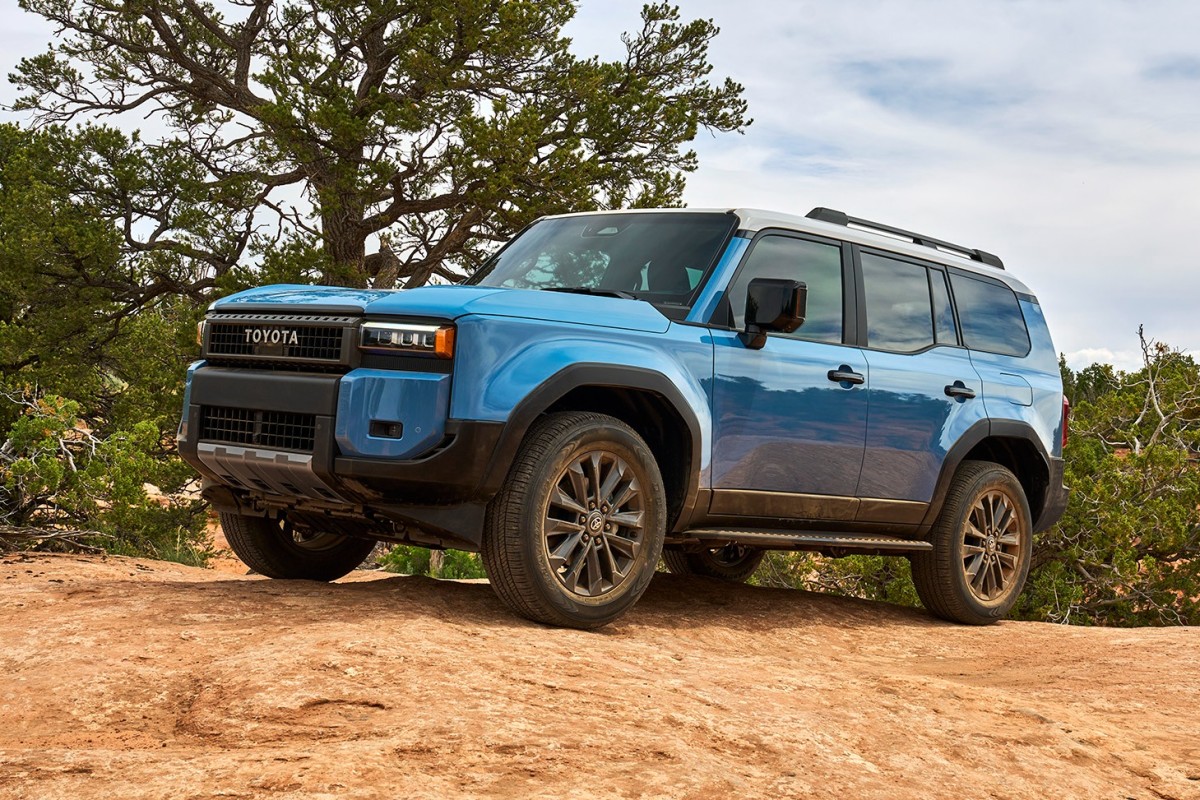
The 2025 Toyota Land Cruiser was offered in two trim levels, with the base model named the 1958, a nod to the year it first hit the US market. This version had a retro aesthetic, featuring round headlights, cloth seats, and basic equipment, available in three paint colors. Despite its nostalgic charm, the 1958 model was priced at $58,195, making it a costly choice for those seeking a budget-friendly SUV. The more modern Land Cruiser trim, priced at $62,965, boasted a contemporary and upscale appearance, with a wider color palette, enhanced interior features, and essential off-roading capabilities. The Premium Package added leather upholstery and advanced technology, elevating the vehicle's appeal. Our test vehicle, equipped with the Premium Package, Heritage Blue and Grayscape paint, 20-inch wheels, and an accessory roof rack, reached a total price of $71,004, including destination charges.
The Land Cruiser's design was traditional, with a two-box SUV structure that maximized off-road clearances and visibility. Its utilitarian interior featured traditional switchgear, and the Java-colored leather added a touch of elegance. The dual 12.3-inch digital screens enhanced its technological appeal. Despite its utilitarian nature, the Land Cruiser's interior was more refined than the 1958 model, justifying its price. The steering-wheel controls were notably intuitive, especially when compared to those in a Lexus RX. Overall, the Land Cruiser offered a blend of classic design and modern functionality, appealing to those seeking a capable off-road vehicle with a touch of luxury.
The 2026 Hyundai Ioniq 5 combined the essence of a 1980s hatchback with modern crossover SUV elements, resulting in a unique and appealing design. Its profile was distinctly hatchback, yet larger than typical models like the Volkswagen GTI or Toyota Corolla. Angular lines and a character line rising from the rear wheels to the front doors created a triangular shape that defined its profile. Dark cladding around the wheels and lower body added a crossover flavor. The front featured a visor slit housing rectangular headlights, while the rear had an integrated spoiler and darkened panels, giving it a car-like appearance despite its crossover classification. The hatchback design made it appear smaller than it was, with wheel sizes ranging from 18 to 20 inches.
The XRT model stood out with unique 18-inch alloys resembling steel wheels and leaned into dark trim with pixel-patterned cladding. It featured almost fully darkened fascias, black window trim, and side sills, creating a rally car-like appearance. Inside, the Ioniq 5 was utilitarian yet technologically advanced, with standard cloth upholstery and synthetic leather in higher trims. The interior had a cold theme with black and gray upholstery, but the tech was impressive, featuring dual 12.3-inch screens and touch controls for the climate system. The overall look was sterile, typical of modern EVs, but the technology and design made it a compelling choice for those seeking a futuristic vehicle.

The 2025 Toyota Land Cruiser was equipped with Toyota’s i-Force Max hybrid system, combining a turbocharged 2.4-liter four-cylinder engine with an eight-speed automatic transmission and an electric motor. This setup delivered 326 horsepower and 465 pound-feet of torque, transferred through a full-time four-wheel-drive system with electronic locking rear and center differentials. It had a maximum towing capacity of 6,000 pounds. Standard features included Downhill Assist Control and Crawl Control, while the higher-priced Land Cruiser model added Multi-Terrain Select off-roading modes, Multi-Terrain Monitor camera views, and a front stabilizer bar disconnect feature. Despite an official EPA rating of 23 mpg combined, real-world testing yielded only 15.7 mpg, partly due to extreme heat and constant air conditioning use.
The Land Cruiser excelled as a daily driver and off-road adventurer, though it struggled on twisty mountain roads due to its tires and suspension tuning. It handled urban and suburban driving well, with a high seating position offering excellent visibility. Off-road, it was capable, thanks to features like the front stabilizer bar disconnect, Crawl Control, and Multi-Terrain Monitor. The Land Cruiser felt powerful and responsive, aided by the electric assist motor and turbocharged torque, but acceleration tests revealed modest results with noticeable rear-end squat. Hard braking caused nose dive, and the vehicle leaned in corners, making slow and steady driving the best approach.
The 2026 Hyundai Ioniq 5 offered a range of powertrain options, starting with a single-motor, rear-wheel-drive setup producing 168 horsepower and 258 pound-feet of torque in the base SE Standard Range trim. Other trims had 220 hp with the same torque. A dual-motor, all-wheel-drive powertrain increased output to 320 hp and 446 lb-ft, while the Ioniq 5 N performance model boasted up to 641 hp and 568 lb-ft. The Limited and XRT trims, both with dual-motor powertrains, provided quiet, robust power, especially from a stop. Sport mode enhanced throttle response and passing ease, with an estimated 5.3-second 0-60 mph time, making it quicker than most gas-powered crossovers.
Drivers could choose from five regenerative braking settings using steering wheel paddles, ranging from freewheeling to one-pedal driving. The Ioniq 5 rode smoothly, even with large 255/45R20 tires, though smaller wheels offered an even smoother ride. Steering was direct but numb, and handling was pleasant but not overly agile. The XRT trim offered a different driving experience, sitting an inch higher with seven inches of ground clearance and unique fascias for improved approach and departure angles. It featured all-terrain tires and three terrain modes—Mud, Sand, and Snow—adjusting traction control and throttle mapping for optimal performance. The XRT excelled on loose, silty trails, with Sand mode providing excellent traction and stability control allowing for controlled slides. However, it lacked underbody skid plates and high-performance shocks, limiting its rally car potential.
The 2025 Toyota Land Cruiser offered an upgrade from cloth upholstery to Toyota’s SofTex artificial leather in the higher trim, with heated and ventilated front seats and a heated steering wheel. The Premium Package added real leather and a power sunroof. The front seats were comfortable and supportive for long trips, but the second-row seats lacked thigh support and had an uncomfortable backrest angle. Long-legged passengers might find the running boards obstructive when entering and exiting, though they were useful for roof rack access. The rear window design was less than ideal, as it didn't power down into the tailgate like the 4Runner, limiting cabin airflow. The center console's cool box, part of the Premium Package, seemed unnecessary and reduced storage space. The Land Cruiser offered 46.2 cubic feet of cargo space with the rear seats up and 82.1 cubic feet with them folded, though the high load floor required effort when loading heavy items.
The 2026 Hyundai Ioniq 5 featured spacious front seats with an eight-way power-adjustable driver’s seat standard, and the same for the front passenger seat in all but the base trim, which had six-way manual adjustments. Heated front seats were standard, with the Limited trim adding ventilated seats, driver’s seat memory, and a “Relaxation” seat for the driver with a power footrest. The rear seat offered 39.4 inches of legroom, accommodating two adults comfortably, though a third would be cramped for shoulder room. The absence of a driveshaft hump improved rear seat comfort. The Limited trim included heated outboard rear seats. Cargo space was slightly smaller than average for compact crossovers, with 26.3 cubic feet behind the rear seats and 58.5 cubic feet with them folded. A 0.85-cubic-foot front trunk added minimal space. The Ioniq 5's cargo capacity was less than gas-powered compact crossovers but comparable to the Mustang Mach-E, though the rear hatch's steep angle reduced usability.
The 2025 Toyota Land Cruiser featured a technology upgrade from the Land Cruiser 1958, with dual 12.3-inch displays replacing the smaller screens. The Toyota Audio Multimedia (TAM) infotainment system included wireless Apple CarPlay and Android Auto, SiriusXM satellite radio, and access to Apple Music and Amazon Music accounts. Five connected service plans were available, including Service Connect, Safety Connect, Remote Connect, Wi-Fi Connect, and Drive Connect. Drive Connect offered cloud-based navigation and a conversational digital assistant, which performed well in voice recognition tests. The Premium Package added a 14-speaker JBL premium sound system, a wireless smartphone charger, a head-up display, a digital camera-based rearview mirror, and digital key technology.
The 2026 Hyundai Ioniq 5 boasted up-to-date technology with a 12.3-inch digital instrument cluster and a 12.3-inch infotainment touchscreen under a single glass panel. Standard features included wireless Apple CarPlay and Android Auto, built-in navigation, and a Wi-Fi hotspot. All but the base trim had a wireless smartphone charger, and the Limited trim added a head-up display. The base audio system had six speakers, while the XRT and Limited trims featured a Bose eight-speaker unit. The MyHyundai smartphone app allowed owners to precondition the car, monitor the state of charge, unlock doors remotely, set charging schedules, check battery levels, and use connected navigation with real-time traffic information. Hyundai Pay enabled payment at charging stations through the app. The XRT and Limited trims offered a digital key. The infotainment screen was easily accessible, with a simple command structure and voice command capability. Climate functions were controlled by touch in a separate panel below the center screen.
The 2025 Toyota Land Cruiser came equipped with Toyota Safety Sense 3.0 (TSS 3.0), the automaker’s latest suite of advanced driving assistance systems (ADAS). TSS 3.0 included forward-collision warning, automatic emergency braking, and pedestrian, cyclist, and motorcyclist detection. It also featured lane-departure warning, lane-keeping assist, and lane-centering assist. When combined with adaptive cruise control, these features provided a semi-autonomous highway driving aid. Additional safety features included a road sign reader, automatic high-beam headlights, and Predictive Driving Assist (PDA). The standard blind-spot monitoring system and rear cross-traffic alert system were separate from TSS 3.0. The Premium Package added front cross-traffic alert, lane-change assist, and Traffic Jam Assist. The Land Cruiser received a four-star overall rating from the National Highway Traffic Safety Administration (NHTSA), with four stars in frontal-impact tests, five stars in side-impact tests, and a three-star rollover resistance rating.
The 2026 Hyundai Ioniq 5 offered a comprehensive list of standard safety features, including blind-spot monitors, front and rear parking sensors, rear cross-traffic alert, forward-collision warning with pedestrian and cyclist detection, automatic emergency braking, lane-keep assist, a driver-attention monitor, safe-exit assist, adaptive cruise control, high-beam assist, rear-occupant alert, and Hyundai's Highway Driving Assist 1. Optional features included steering support for the blind-spot monitor, a surround-view camera system, blind-spot cameras, side parking sensors, brake support for parking sensors, evasive steering assist, and Highway Driving Assist 2 with automatic lane changes. The Ioniq 5 earned a Top Safety Pick+ from the Insurance Institute for Highway Safety (IIHS), though no crash-test ratings from the NHTSA were available. The lane-keep assist was effective, and the blind-spot camera system was particularly useful.
CarGurus highlights

According to CarGurus experts, the overall rating for the 2025 Toyota Land Cruiser is 6.8 out of 10, while the 2026 Hyundai Ioniq 5 scores 8.0 out of 10. Based on these ratings, the Hyundai Ioniq 5 is the recommended choice, offering a more modern design, advanced technology, and a higher safety rating.
Choose the 2025 Toyota Land Cruiser if:
- You prioritize off-road capability and need a vehicle with advanced off-roading features like Multi-Terrain Select and Crawl Control.
- You prefer a traditional SUV design with a high seating position for excellent visibility and a utilitarian interior.
- You value a blend of classic design and modern functionality, with options for leather upholstery and advanced technology.


Choose the 2026 Hyundai Ioniq 5 if:
- You seek a modern, stylish EV with a unique design that combines hatchback and crossover elements.
- You prioritize advanced technology and connectivity features, including a comprehensive infotainment system and smartphone app integration.
- You want a vehicle with a strong safety record, including a Top Safety Pick+ rating from the IIHS and a wide range of standard and optional safety features.


CarGurus highlights
According to CarGurus experts, the overall rating for the 2025 Toyota Land Cruiser is 6.8 out of 10, while the 2026 Hyundai Ioniq 5 scores 8.0 out of 10. Based on these ratings, the Hyundai Ioniq 5 is the recommended choice, offering a more modern design, advanced technology, and a higher safety rating.
Choose the 2025 Toyota Land Cruiser if:
Shop Now- You prioritize off-road capability and need a vehicle with advanced off-roading features like Multi-Terrain Select and Crawl Control.
- You prefer a traditional SUV design with a high seating position for excellent visibility and a utilitarian interior.
- You value a blend of classic design and modern functionality, with options for leather upholstery and advanced technology.
Choose the 2026 Hyundai Ioniq 5 if:
Shop Now- You seek a modern, stylish EV with a unique design that combines hatchback and crossover elements.
- You prioritize advanced technology and connectivity features, including a comprehensive infotainment system and smartphone app integration.
- You want a vehicle with a strong safety record, including a Top Safety Pick+ rating from the IIHS and a wide range of standard and optional safety features.

By: CarGurus + AI
At CarGurus, our team of experienced automotive writers remain at the heart of our content operation, conducting hands-on car tests and writing insightful guides that are backed by years of industry experience. To complement this, we are harnessing AI to make our content offering more diverse and more helpful to shoppers than ever. To achieve this, our AI systems are based exclusively on CarGurus content, ratings and data, so that what we produce is both unique to CarGurus, and uniquely helpful to car shoppers.

