Ford Escape vs Subaru Crosstrek Hybrid
Overview | |
MSRP$24,885 | MSRP$34,995 |
Listings271 | Listings22 |
Ratings & Reviews | |
User Reviews | User Reviews |
Expert reviews8.0 out of 10 | Expert reviews6.8 out of 10 |
Pros
Cons
| Pros
Cons
|
Reviews SummaryIn case you didn’t hear, Ford came out with an electric crossover, calling it the Mustang Mach-E. Ford could have called it something else, but the marketing department decided to leverage the famous Mustang name to capture headlines and, hopefully, shoppers. What should not be overlooked is the fact Ford chose to make its first-ever standalone electric vehicle a crossover. This choice is a testament to how far the sport utility vehicle has come. Paired with Ford's decision to phase out sedans and hatchbacks, it's clear the company is putting all of its eggs into its trucks, SUVs, and crossovers. Suffice it to say, there is just a bit of pressure on the redesigned 2020 Ford Escape. While the Escape has been around since 2000, it came into its own in 2013 when the “One Ford” philosophy was adopted, meaning that vehicles would be sold in multiple markets around the globe. As a result, the U.S. got Europe’s Ford Kuga, rebranded as the Escape—a high-tech, handsome, and surprisingly athletic small SUV. So, with all this mind, the new Escape needs to not only be an improvement over the previous generation to compete against the rest of the compact crossover segment, it also needs to win over would-be sedan and hatchback customers. Can the 2020 Escape rise to the occasion? | |
Reviews SummaryWhen the original Subaru Crosstrek Hybrid debuted in 2014, it was by no means early to the hybrid game. But most hybrids were sedans, and few automakers had attempted a hybrid crossover. As Subaru’s first-ever production hybrid, sold from 2014 to 2016, it signaled Subaru's interest in the green-car market. After a nearly three-year hiatus, the Crosstrek hybrid is back, now as a plug-in hybrid. However, it has some stiff competition. The compact crossover segment has exploded, and brought us some unique green cars for eco-friendly shoppers on a budget. You could get the RAV4 Hybrid back in 2015, but now there’s also the Kia Niro, Hyundai Ioniq, and Prius Prime (which was introduced in 2016) all offering plug-in capability and some modest utility. The new Crosstrek Hybrid has the latest infotainment and driver-assistance features, but will that be enough to ensure its relevance in this affordable green-car landscape? | |
Popular Features & Specs | |
Engine1.5L 181 hp I3 | Engine2.0L 148 hp H4 Hybrid |
Drive TrainFWD | Drive TrainAWD |
Seating Capacity5 | Seating Capacity5 |
EV Battery Capacity | EV Battery Capacity8.8 kWh |
MPG City27 | MPG City99 |
MPG Highway33 | MPG Highway80 |
Battery Charge Time (240V) | Battery Charge Time (240V)2 hours |
Engine | |
Engine Name1.5L 181 hp I3 | Engine Name2.0L 148 hp H4 Hybrid |
Battery Charge Time (240V) | Battery Charge Time (240V)2 hours |
DrivetrainFWD | DrivetrainAWD |
Fuel Economy | |
EV Battery Capacity | EV Battery Capacity8.8 kWh |
MPG City27 | MPG City99 |
MPG Highway33 | MPG Highway80 |
Interior | |
Seating Capacity5 | Seating Capacity5 |
Safety | |
Front Crash Overall5 | Front Crash Overall |
Side Crash Overall5 | Side Crash Overall |
Dimensions & Capacity | |
Cargo Space37.5 cu ft | Cargo Space15.9 cu ft |
Curb Weight3299 lbs | Curb Weight3726 lbs |
Height66.1 in | Height62.8 in |
Length180.5 in | Length175.8 in |
Width85.6 in | Width79.6 in |
Wheelbase106.7 in | Wheelbase104.9 in |
Maximum Payload | Maximum Payload1175 lbs |
Number of doors4 | Number of doors4 |
Maximum Towing Capacity | Maximum Towing Capacity1000 lbs |
Overview | ||
MSRP | $24,885 | $34,995 |
Listings | ||
Ratings & Reviews | ||
User reviews | ||
Expert reviews | 8.0 out of 10Read full review | 6.8 out of 10Read full review |
Pros & cons | Pros
Cons
| Pros
Cons
|
Summary | In case you didn’t hear, Ford came out with an electric crossover, calling it the Mustang Mach-E. Ford could have called it something else, but the marketing department decided to leverage the famous Mustang name to capture headlines and, hopefully, shoppers. What should not be overlooked is the fact Ford chose to make its first-ever standalone electric vehicle a crossover. This choice is a testament to how far the sport utility vehicle has come. Paired with Ford's decision to phase out sedans and hatchbacks, it's clear the company is putting all of its eggs into its trucks, SUVs, and crossovers. Suffice it to say, there is just a bit of pressure on the redesigned 2020 Ford Escape. While the Escape has been around since 2000, it came into its own in 2013 when the “One Ford” philosophy was adopted, meaning that vehicles would be sold in multiple markets around the globe. As a result, the U.S. got Europe’s Ford Kuga, rebranded as the Escape—a high-tech, handsome, and surprisingly athletic small SUV. So, with all this mind, the new Escape needs to not only be an improvement over the previous generation to compete against the rest of the compact crossover segment, it also needs to win over would-be sedan and hatchback customers. Can the 2020 Escape rise to the occasion? | When the original Subaru Crosstrek Hybrid debuted in 2014, it was by no means early to the hybrid game. But most hybrids were sedans, and few automakers had attempted a hybrid crossover. As Subaru’s first-ever production hybrid, sold from 2014 to 2016, it signaled Subaru's interest in the green-car market. After a nearly three-year hiatus, the Crosstrek hybrid is back, now as a plug-in hybrid. However, it has some stiff competition. The compact crossover segment has exploded, and brought us some unique green cars for eco-friendly shoppers on a budget. You could get the RAV4 Hybrid back in 2015, but now there’s also the Kia Niro, Hyundai Ioniq, and Prius Prime (which was introduced in 2016) all offering plug-in capability and some modest utility. The new Crosstrek Hybrid has the latest infotainment and driver-assistance features, but will that be enough to ensure its relevance in this affordable green-car landscape? |
Video | ||
Popular Features & Specs | ||
Engine | 1.5L 181 hp I3 | 2.0L 148 hp H4 Hybrid |
Drive Train | FWD | AWD |
Seating Capacity | 5 | 5 |
EV Battery Capacity | 8.8 kWh | |
MPG City | 27 | 99 |
MPG Highway | 33 | 80 |
Battery Charge Time (240V) | 2 hours | |
Engine | ||
Engine Name | 1.5L 181 hp I3 | 2.0L 148 hp H4 Hybrid |
Battery Charge Time (240V) | 2 hours | |
Drivetrain | FWD | AWD |
Fuel Economy | ||
EV Battery Capacity | 8.8 kWh | |
MPG City | 27 | 99 |
MPG Highway | 33 | 80 |
Interior | ||
Seating Capacity | 5 | 5 |
Safety | ||
Front Crash Overall | 5 | |
Side Crash Overall | 5 | |
Dimensions & Capacity | ||
Cargo Space | 37.5 cu ft | 15.9 cu ft |
Curb Weight | 3299 lbs | 3726 lbs |
Height | 66.1 in | 62.8 in |
Length | 180.5 in | 175.8 in |
Width | 85.6 in | 79.6 in |
Wheelbase | 106.7 in | 104.9 in |
Maximum Payload | 1175 lbs | |
Number of doors | 4 | 4 |
Maximum Towing Capacity | 1000 lbs | |
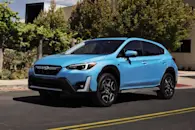
The 2019 Subaru Crosstrek Hybrid distinguished itself from its conventionally powered siblings with unique visual elements. It featured bright gray inserts along the sides and front lower bumper, as well as blue frames around the upgraded headlight clusters. The exclusive "Lagoon Blue" color added to its eye-catching appeal. Inside, the Crosstrek Hybrid boasted blue inserts and two-tone leather seats with blue contrast stitching, all standard. Despite its well-equipped nature, the Crosstrek Hybrid had to compensate for reduced rear cargo space due to the battery placement, offering a higher cargo floor than the conventional model.
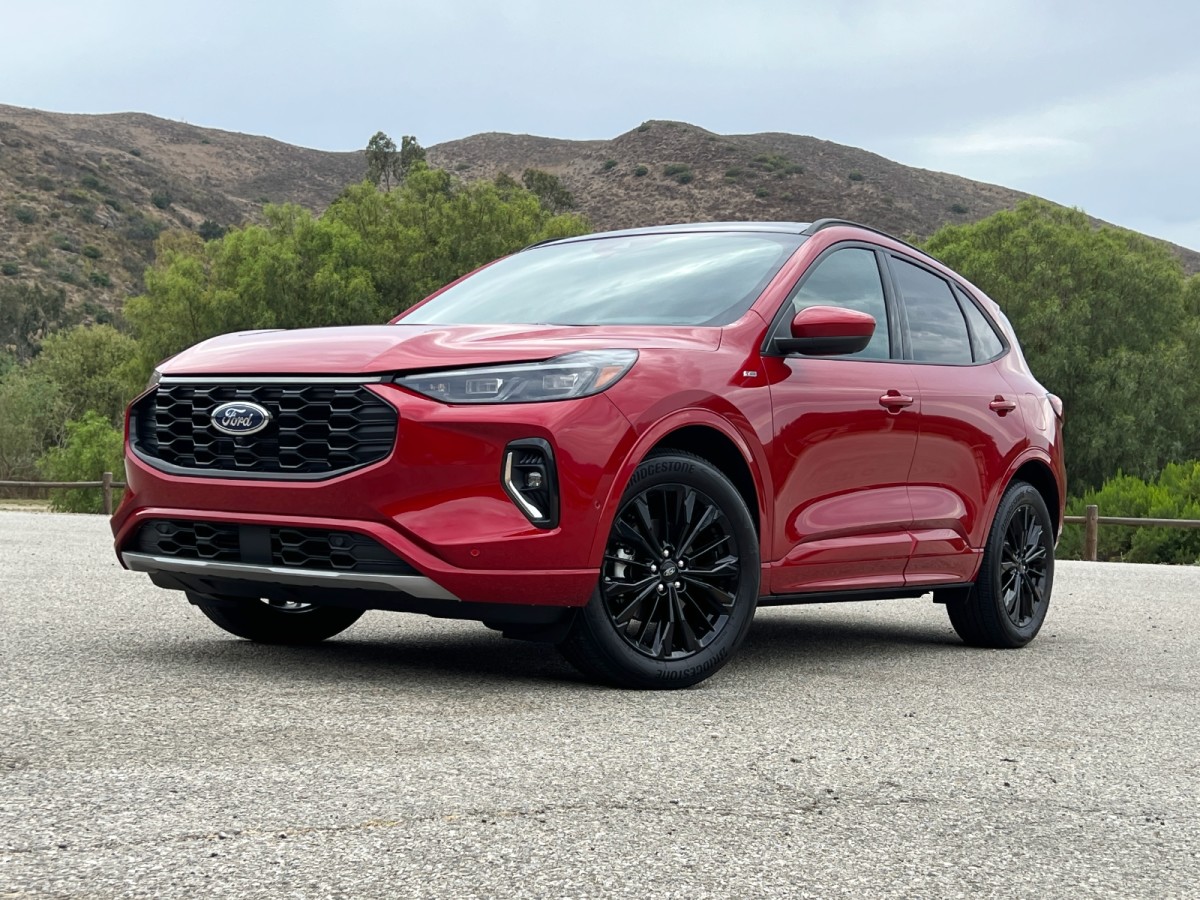
The 2020 Ford Escape presented a sleek and modern design, sharing its large grille with the Fiesta and Focus hatchbacks, and drawing inspiration from the Ford GT supercar for its headlights. The interior was modern yet practical, featuring a fully digital instrument panel and a floating infotainment screen. The Escape was available in multiple trims, each offering a range of features from basic to luxurious. The Titanium trim, in particular, stood out with its unique 19-inch wheels, dual-panel moonroof, and premium B&O audio system, making it a compelling choice for those seeking a blend of style and functionality.
The 2019 Subaru Crosstrek Hybrid featured a gas-electric powertrain with a 2.0-liter Boxer four-cylinder engine producing 137 horsepower and 134 pound-feet of torque. It utilized a CVT and two electric motors, with an 8.8-kilowatt-hour battery pack. The all-wheel-drive system was integrated before the drivetrain split, offering traditional AWD composure. The plug-in system allowed for a 17-mile electric-only range, with a full charge taking five hours on a 120-volt outlet or two hours on a 240-volt station. Despite its capabilities, the Crosstrek Hybrid's acceleration was underwhelming, and the added weight affected handling. However, it excelled in off-road conditions with 8.7 inches of ground clearance and X-Mode with hill-descent control. The EPA rated it at 90 MPGe, with a combined 35 mpg on gas.
The 2020 Ford Escape offered four engine options, including a 3-cylinder engine with 180 horsepower and 177 pound-feet of torque, standard in the S, SE, and SEL trims. The 2.0-liter turbocharged 4-cylinder engine, available on the SEL and standard on the Titanium, delivered 250 horsepower and 275 pound-feet of torque, providing brisk acceleration. The hybrid setup, with a 2.5-liter 4-cylinder engine, produced 198 horsepower, while a plug-in hybrid variant was optional. The Escape's steering was direct and taut, offering an athletic feel, and the brakes were strong and responsive. The most efficient version was the non-Sport hybrid, with a combined fuel economy of 41 mpg.
The 2019 Subaru Crosstrek Hybrid featured an electronic emergency-brake toggle, allowing for a more spacious front console layout. The interior offered a commanding driving position and decent rear seat space, accommodating taller passengers comfortably. However, the cargo area was limited to 41 cubic feet due to the battery pack, compared to 55 cubic feet in the gas-powered Crosstrek.
The 2020 Ford Escape's sleek design resulted in reduced cargo space, with 37.5 cubic feet behind the second row and 34.4 cubic feet in hybrid models. Folding the backseat provided 65.4 cubic feet, or 60.8 cubic feet in upper trims. Despite this, the Escape prioritized passenger space, offering ample headroom and legroom in the second row. The front seats provided a commanding view, and the interior featured numerous storage solutions, emphasizing real-world usability.
The 2019 Subaru Crosstrek Hybrid came standard with the Starlink infotainment system and an 8-inch touchscreen, featuring Apple CarPlay and Android Auto. The system was user-friendly, with large icons and a sensible menu layout. A color multi-information display atop the dash provided additional information, controlled by a steering wheel button.
The 2020 Ford Escape's base trim featured a 4.2-inch audio control screen, while the SE trim upgraded to an 8-inch Sync screen with Android Auto and Apple CarPlay. The Titanium trim included a head-up display, though its flip-up screen design limited its effectiveness for taller drivers. The latest Sync version allowed for multitasking, enhancing the user experience.
The 2019 Subaru Crosstrek Hybrid included standard safety features such as airbags, traction control, a reversing camera, and a tire pressure monitoring system. Subaru's EyeSight suite offered advanced driver-assistance features, including forward-collision warning, adaptive cruise control, lane-departure warning, and lane-keeping assist. EyeSight also provided semi-autonomous highway driving capabilities.
The 2020 Ford Escape came with a comprehensive array of airbags, a reversing camera, traction control, and TPMS. It earned a Good rating from the IIHS in all testing phases. Ford Co-Pilot360, standard on the Escape, included forward-collision warning, lane-keeping assist, adaptive cruise control, and automatic high beams, along with blind-spot monitoring and rear cross-traffic alert.
CarGurus highlights

According to CarGurus experts, the overall rating for the 2019 Subaru Crosstrek Hybrid is 6.8 out of 10, while the 2020 Ford Escape scores 8.0 out of 10. Based on these ratings, the 2020 Ford Escape is the recommended choice, offering a more versatile engine lineup, modern technology, and a better balance of style and functionality.
Choose the 2020 Ford Escape if:
- You desire a variety of engine options, including a powerful turbocharged engine.
- You appreciate a modern interior with advanced technology and infotainment features.
- You prioritize passenger space and real-world storage solutions over maximum cargo capacity.


Choose the 2019 Subaru Crosstrek Hybrid if:
- You prioritize off-road capability with standard all-wheel drive and X-Mode.
- You value a well-equipped interior with standard leather seats and an 8-inch touchscreen.
- You seek a unique design with exclusive color options and distinctive styling elements.


CarGurus highlights
According to CarGurus experts, the overall rating for the 2019 Subaru Crosstrek Hybrid is 6.8 out of 10, while the 2020 Ford Escape scores 8.0 out of 10. Based on these ratings, the 2020 Ford Escape is the recommended choice, offering a more versatile engine lineup, modern technology, and a better balance of style and functionality.
Choose the 2020 Ford Escape if:
Shop Now- You desire a variety of engine options, including a powerful turbocharged engine.
- You appreciate a modern interior with advanced technology and infotainment features.
- You prioritize passenger space and real-world storage solutions over maximum cargo capacity.
Choose the 2019 Subaru Crosstrek Hybrid if:
Shop Now- You prioritize off-road capability with standard all-wheel drive and X-Mode.
- You value a well-equipped interior with standard leather seats and an 8-inch touchscreen.
- You seek a unique design with exclusive color options and distinctive styling elements.

By: CarGurus + AI
At CarGurus, our team of experienced automotive writers remain at the heart of our content operation, conducting hands-on car tests and writing insightful guides that are backed by years of industry experience. To complement this, we are harnessing AI to make our content offering more diverse and more helpful to shoppers than ever. To achieve this, our AI systems are based exclusively on CarGurus content, ratings and data, so that what we produce is both unique to CarGurus, and uniquely helpful to car shoppers.

