2021 Honda Pilot vs 2021 Ford Edge
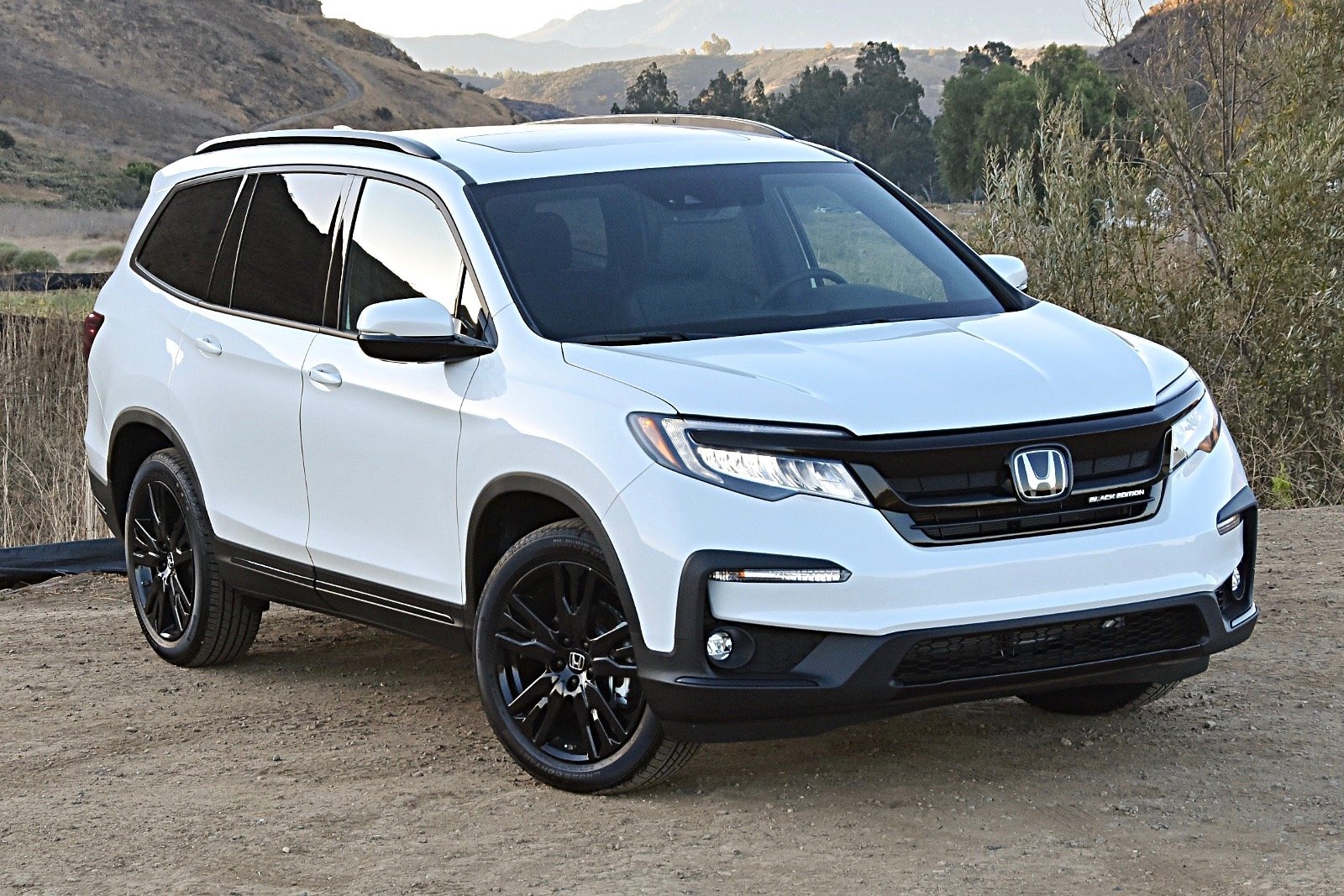
Overview | |
MSRP$32,550 | MSRP$32,750 |
Listings185 | Listings202 |
Ratings & Reviews | |
User Reviews | User Reviews |
Expert reviews7.2 out of 10 | Expert reviews7.2 out of 10 |
Pros
Cons
| Pros
Cons
|
2021 Honda Pilot Reviews SummaryIt’s been seven years since Honda last redesigned the Pilot, the automaker’s popular midsize three-row crossover SUV. In most ways, age has been kind to it, but to love a 2021 Honda Pilot you must first live with one. Unlike some competitors, the styling is not a strong suit. Rather, it is the Pilot’s interior, powertrain, driving dynamics, and simple but useful technology that makes you appreciate it each and every day. Well, that, and the cheap lease payment. | |
2021 Ford Edge Reviews SummaryThe Ford Edge proves that trends run in cycles. Launched in the early 2000s, the original Edge was one of the first midsize crossover SUVs, sporting car-like styling that sharply contrasted the more traditional-looking Ford Explorer of the time. However, new-car buyers realized they liked the roominess of three-row SUVs like the Explorer more, and interest in the two-row Edge waned. Now, however, car shoppers are once again eyeing two-row midsize SUVs, this time as an alternative to sedans. The Edge is now part of a growing market segment that includes the Chevrolet Blazer, Honda Passport, Hyundai Santa Fe, Jeep Grand Cherokee, Nissan Murano, and Volkswagen Atlas Cross Sport. Yet while market dynamics have changed, the Edge hasn’t. The current second-generation Edge dates back to the 2015 model year, and even a substantial update undertaken for the 2019 model year is quickly receding in the rearview mirror. The Edge now sits between the much newer Explorer and Ford Escape in the automaker's SUV-heavy lineup. Aside from some new tech features, the 2021 Ford Edge doesn’t get many significant changes, so we can evaluate it based on our experience with previous model years. As with the 2020 model year, trim levels include SE, SEL, ST-Line, Titanium, and ST. | |
No video found | No video found |
Popular Features & Specs | |
Engine3.5L 280 hp V6 | Engine2.0L 250 hp I4 |
Drive TrainFWD | Drive TrainFWD |
Seating Capacity8 | Seating Capacity5 |
Horsepower280 hp @ 6000 rpm | Horsepower250 hp @ 5500 rpm |
MPG City20 | MPG City21 |
MPG Highway27 | MPG Highway29 |
Engine | |
Engine Name3.5L 280 hp V6 | Engine Name2.0L 250 hp I4 |
Torque262 lb-ft @ 4700 rpm | Torque280 lb-ft @ 3000 rpm |
Horsepower280 hp @ 6000 rpm | Horsepower250 hp @ 5500 rpm |
DrivetrainFWD | DrivetrainFWD |
Fuel Economy | |
MPG City20 | MPG City21 |
MPG Highway27 | MPG Highway29 |
Interior | |
Seating Capacity8 | Seating Capacity5 |
Safety | |
Front Crash Overall4 | Front Crash Overall5 |
Side Crash Overall5 | Side Crash Overall5 |
Dimensions & Capacity | |
Cargo Space16.5 cu ft | Cargo Space39.2 cu ft |
Curb Weight3982 lbs | Curb Weight3960 lbs |
Height70.6 in | Height68.3 in |
Length196.5 in | Length188.8 in |
Width78.6 in | Width85.8 in |
Wheelbase111.0 in | Wheelbase112.2 in |
Maximum Payload1563 lbs | Maximum Payload1310 lbs |
Number of doors4 | Number of doors4 |
Maximum Towing Capacity3500 lbs | Maximum Towing Capacity1500 lbs |
Overview | ||
MSRP | $32,550 | $32,750 |
Listings | ||
Ratings & Reviews | ||
User reviews | ||
Expert reviews | 7.2 out of 10Read full review | 7.2 out of 10Read full review |
Pros & cons | Pros
Cons
| Pros
Cons
|
Summary | It’s been seven years since Honda last redesigned the Pilot, the automaker’s popular midsize three-row crossover SUV. In most ways, age has been kind to it, but to love a 2021 Honda Pilot you must first live with one. Unlike some competitors, the styling is not a strong suit. Rather, it is the Pilot’s interior, powertrain, driving dynamics, and simple but useful technology that makes you appreciate it each and every day. Well, that, and the cheap lease payment. | The Ford Edge proves that trends run in cycles. Launched in the early 2000s, the original Edge was one of the first midsize crossover SUVs, sporting car-like styling that sharply contrasted the more traditional-looking Ford Explorer of the time. However, new-car buyers realized they liked the roominess of three-row SUVs like the Explorer more, and interest in the two-row Edge waned. Now, however, car shoppers are once again eyeing two-row midsize SUVs, this time as an alternative to sedans. The Edge is now part of a growing market segment that includes the Chevrolet Blazer, Honda Passport, Hyundai Santa Fe, Jeep Grand Cherokee, Nissan Murano, and Volkswagen Atlas Cross Sport. Yet while market dynamics have changed, the Edge hasn’t. The current second-generation Edge dates back to the 2015 model year, and even a substantial update undertaken for the 2019 model year is quickly receding in the rearview mirror. The Edge now sits between the much newer Explorer and Ford Escape in the automaker's SUV-heavy lineup. Aside from some new tech features, the 2021 Ford Edge doesn’t get many significant changes, so we can evaluate it based on our experience with previous model years. As with the 2020 model year, trim levels include SE, SEL, ST-Line, Titanium, and ST. |
Video | No video found | No video found |
Popular Features & Specs | ||
Engine | 3.5L 280 hp V6 | 2.0L 250 hp I4 |
Drive Train | FWD | FWD |
Seating Capacity | 8 | 5 |
Horsepower | 280 hp @ 6000 rpm | 250 hp @ 5500 rpm |
MPG City | 20 | 21 |
MPG Highway | 27 | 29 |
Engine | ||
Engine Name | 3.5L 280 hp V6 | 2.0L 250 hp I4 |
Torque | 262 lb-ft @ 4700 rpm | 280 lb-ft @ 3000 rpm |
Horsepower | 280 hp @ 6000 rpm | 250 hp @ 5500 rpm |
Drivetrain | FWD | FWD |
Fuel Economy | ||
MPG City | 20 | 21 |
MPG Highway | 27 | 29 |
Interior | ||
Seating Capacity | 8 | 5 |
Safety | ||
Front Crash Overall | 4 | 5 |
Side Crash Overall | 5 | 5 |
Dimensions & Capacity | ||
Cargo Space | 16.5 cu ft | 39.2 cu ft |
Curb Weight | 3982 lbs | 3960 lbs |
Height | 70.6 in | 68.3 in |
Length | 196.5 in | 188.8 in |
Width | 78.6 in | 85.8 in |
Wheelbase | 111.0 in | 112.2 in |
Maximum Payload | 1563 lbs | 1310 lbs |
Number of doors | 4 | 4 |
Maximum Towing Capacity | 3500 lbs | 1500 lbs |
In 2021, the Honda Pilot aspired to blend rugged appeal with sophistication. After a 2019 refresh and the introduction of the 2020 Black Edition, Honda sought to deliver a more aggressive SUV appearance. The 2021 lineup offered seven trims, ranging from the LX to the top-tier Black Edition, with prices between $32,250 and $49,920. Front-wheel drive was standard, but all-wheel drive was available for an extra $2,000 on most models.
The Special Edition trim debuted in 2021, adding striking black 20-inch wheels, blacked-out trim, wireless smartphone charging, and a hands-free power tailgate. The Black Edition, driven extensively, included exclusive black leather upholstery with red accents and ambient lighting. While it featured a V-shaped front with a solid grille, flat dashboard, and low console, it projected more of a minivan aura from the inside. Despite high-quality materials, its design was considered an acquired taste with practical but uninspired aesthetics.
Contrastingly, the 2021 Ford Edge maintained a cleaner and more modern look since its 2019 refresh, aligning with contemporary Ford styling. The Edge's design exuded a well-integrated, refined appearance that stood distinctively more minimalist compared to rivals like the Chevy Blazer and Hyundai Santa Fe.
The Edge came in various trims, including the Titanium with extra chrome and the sportier ST with a blacked-out grille and 20-inch wheels. However, the interior struggled with outdated design feeling cramped despite updates such as the larger touchscreen. The Edge ST featured leather-wrapped sporty seats, but much of the Edge’s layout reflected a vehicle showing its age and piecemeal enhancements.


Under the hood of every 2021 Honda Pilot was a 3.5-liter V6 engine producing 280 horsepower and 262 pound-feet of torque. This powertrain provided a spirited driving experience, complemented by a smooth nine-speed automatic transmission. With the available torque-vectoring all-wheel-drive system, the Pilot could direct up to 70 percent of power to a single rear wheel, enhancing its agility.
The Pilot delivered 22 mpg in combined driving with AWD, close to its EPA rating of 21.5 mpg. Suspension-wise, the MacPherson strut front and multi-link rear setup offered a comfortable ride with surprisingly athletic handling, largely due to its torque-vectoring AWD and 20-inch wheels.
Conversely, most 2021 Ford Edge models housed a 2.0-liter turbocharged EcoBoost four-cylinder engine generating 250 horsepower and 275 pound-feet of torque. Paired with an eight-speed automatic transmission, the Edge facilitated either front-wheel or all-wheel-drive configurations.
For performance enthusiasts, the Edge ST featured a 2.7-liter twin-turbo V6 engine with 335 horsepower and 380 pound-feet of torque on premium fuel. This variant included AWD, model-specific suspension tuning, and optional 21-inch wheels with enhanced brakes. The ST model aimed for sporty versatility, benchmarking formidable rivals but often regarded as a stretch compared to luxury competitors like Porsche. The Edge's towing capacity ranged up to 4,525 pounds, falling behind some rivals like the Honda Passport and Volkswagen Atlas Cross Sport, both capable of 5,000 pounds.
The 2021 Honda Pilot touted family-friendly versatility, seating up to eight. The test vehicle provided leather-wrapped, heated, and ventilated front seats. These were notably supportive; however, the front passenger seat was constrained to a four-way adjustment. Higher trims boasted second-row captain’s chairs with heating and forward-sliding capability, optimizing third-row access.
Cargo-wise, the Pilot excelled with 16.5 cubic feet behind the third row, expanding to 46.8 cubic feet with the seats down, and a maximum of 83.9 cubic feet. Storage solutions were practical and plentiful, including hidden compartments and various tray setups, ideal for families needing organization space for road trips.
The 2021 Ford Edge, while smaller, still ranked well for a two-row midsize crossover. It offered superior rear-seat headroom and generous legroom, enhancing passenger comfort. Dual-zone automatic climate control was standard, contributing to a pleasant cabin environment.
In storage capacity, the Edge trailed the Pilot, offering 39.2 cubic feet with all seats up and 73.4 cubic feet with the rear seats folded. Its power liftgate featured on higher trims, although center console space was underwhelming despite a rotary shift knob designed for space optimization. The console’s raised design allowed for an extra storage nook, but its difficult-to-reach placement often meant items were forgotten.
Honda aimed for comprehensive tech accessibility in the 2021 Pilot. An 8-inch touchscreen infotainment system was standard on most trims, facilitating Bluetooth, Apple CarPlay, Android Auto, text-messaging support, and satellite radio. However, the screen felt small, and the system lacked a tuning knob, making usability less intuitive. Upper trims featured navigation, a 10-speaker audio system, a rear-seat entertainment system, and more.
In contrast, the 2021 Ford Edge led with its Sync 4 infotainment system, including wireless Apple CarPlay/Android Auto through a standard 12-inch touchscreen. Bluetooth, satellite radio, a built-in WiFi hotspot, and additional USB ports bolstered its tech offerings, particularly with the Bang & Olufsen audio system on the ST trim. The Edge’s tech integration remained user-friendly, leveraging straightforward graphics and efficient controls that resonated well with users.
Safety was paramount in the 2021 Honda Pilot, with standard Honda Sensing across all trims. This package included adaptive cruise control, forward-collision warning, automatic emergency braking, and lane-keeping assist. From the EX trim level upward, blind-spot monitoring/rear cross-traffic alert was also standard. Despite utilizing an older version of these systems, the Pilot maintained favorable crash-test ratings, earning a five-star overall from NHTSA and high ratings from IIHS, albeit with some minor areas for improvement.
Similarly, the 2021 Ford Edge earned strong safety credentials. It was an IIHS “Top Safety Pick,” scoring well in crash tests and for front crash prevention tech, though its pedestrian detection and headlight performance had mixed reviews. The Edge came with the Ford Co-Pilot360 suite, including features like automatic high beams, blind-spot monitoring, lane-keeping assist, and more. Higher trims further benefited from adaptive cruise control and evasive steering assist, contributing to a comprehensive safety package.
CarGurus highlights

According to CarGurus experts, the overall rating for the 2021 Honda Pilot is 7.2 out of 10, while the 2021 Ford Edge scores 7.2 out of 10. Given these ratings, the choice between the two ultimately depends on specific needs and preferences. The Honda Pilot stands out for those needing maximum space and family-friendly features, while the Ford Edge caters more to tech enthusiasts and those valuing modern design and performance. Based on the scores and versatility, consumers looking for a balanced and spacious midsize SUV might find the Honda Pilot more ideal.
Choose the 2021 Honda Pilot if:
- You need ample cargo and passenger space, especially for large families.
- You want numerous storage solutions and organizational features for long trips.
- You appreciate a balance of comfort, athletic handling, and smooth driving experience.


Choose the 2021 Ford Edge if:
- You prefer a modern, clean exterior design and up-to-date tech features.
- You seek a midsize crossover with competitive rear-seat space and comfort.
- You’re interested in a sportier drive with the performance-oriented Edge ST.


CarGurus highlights
According to CarGurus experts, the overall rating for the 2021 Honda Pilot is 7.2 out of 10, while the 2021 Ford Edge scores 7.2 out of 10. Given these ratings, the choice between the two ultimately depends on specific needs and preferences. The Honda Pilot stands out for those needing maximum space and family-friendly features, while the Ford Edge caters more to tech enthusiasts and those valuing modern design and performance. Based on the scores and versatility, consumers looking for a balanced and spacious midsize SUV might find the Honda Pilot more ideal.
Choose the 2021 Honda Pilot if:
Shop Now- You need ample cargo and passenger space, especially for large families.
- You want numerous storage solutions and organizational features for long trips.
- You appreciate a balance of comfort, athletic handling, and smooth driving experience.
Choose the 2021 Ford Edge if:
Shop Now- You prefer a modern, clean exterior design and up-to-date tech features.
- You seek a midsize crossover with competitive rear-seat space and comfort.
- You’re interested in a sportier drive with the performance-oriented Edge ST.

By: CarGurus + AI
At CarGurus, our team of experienced automotive writers remain at the heart of our content operation, conducting hands-on car tests and writing insightful guides that are backed by years of industry experience. To complement this, we are harnessing AI to make our content offering more diverse and more helpful to shoppers than ever. To achieve this, our AI systems are based exclusively on CarGurus content, ratings and data, so that what we produce is both unique to CarGurus, and uniquely helpful to car shoppers.

