2021 Volkswagen Atlas vs 2020 Hyundai Santa Fe

Overview | |
MSRP$26,275 | MSRP$31,545 |
Listings1154 | Listings1264 |
Ratings & Reviews | |
User Reviews | User Reviews |
Expert reviews8.8 out of 10 | Expert reviews6.5 out of 10 |
Pros
Cons
| Pros
Cons
|
2020 Hyundai Santa Fe Reviews SummaryLast year, Hyundai changed its approach to the Santa Fe. The smaller five-passenger Santa Fe Sport got drop-kicked from the automaker’s lineup, replaced by this completely redesigned version of the SUV. The larger seven-passenger Santa Fe got a new name for one year (Santa Fe XL), and then the all-new 2020 Hyundai Palisade replaced that vehicle. With the Palisade’s arrival, there is just one Santa Fe for 2020, a five-passenger crossover that resides in a sweet spot between traditional compact and midsize models. It gets several updates, too, including a standard rear-seat reminder system, an available camera-based Blind-Spot View Monitor system, and new design accents to better distinguish the top trim level. | |
2021 Volkswagen Atlas Reviews SummaryIntroduced for the 2018 model year, the Atlas is Volkswagen's latest attempt to win over American buyers. Built in Chattanooga, Tennessee, the VW Atlas competes in the three-row crossover SUV segment against well-established nameplates like the Ford Explorer, Honda Pilot, and Toyota Highlander. Changes for 2021 are limited to exterior styling tweaks and a reshuffled option list. VW also offers the two-row Atlas Cross Sport. | |
Popular Features & Specs | |
Engine2.4L 185 hp I4 | Engine2.0L 235 hp I4 |
Drive TrainFWD | Drive TrainFWD |
Seating Capacity5 | Seating Capacity7 |
Horsepower185 hp @ 6000 rpm | Horsepower |
MPG City22 | MPG City21 |
MPG Highway29 | MPG Highway24 |
Engine | |
Engine Name2.4L 185 hp I4 | Engine Name2.0L 235 hp I4 |
Torque178 lb-ft @ 4000 rpm | Torque |
Horsepower185 hp @ 6000 rpm | Horsepower |
DrivetrainFWD | DrivetrainFWD |
Fuel Economy | |
MPG City22 | MPG City21 |
MPG Highway29 | MPG Highway24 |
Interior | |
Seating Capacity5 | Seating Capacity7 |
Safety | |
Front Crash Overall4 | Front Crash Overall4 |
Side Crash Overall5 | Side Crash Overall5 |
Dimensions & Capacity | |
Cargo Space35.9 cu ft | Cargo Space20.6 cu ft |
Curb Weight3591 lbs | Curb Weight4248 lbs |
Height66.1 in | Height70.1 in |
Length187.8 in | Length200.7 in |
Width74.4 in | Width78.4 in |
Wheelbase108.9 in | Wheelbase117.3 in |
Maximum Payload1138 lbs | Maximum Payload1080 lbs |
Number of doors4 | Number of doors4 |
Maximum Towing Capacity2000 lbs | Maximum Towing Capacity2000 lbs |
Overview | ||
MSRP | $26,275 | $31,545 |
Listings | ||
Ratings & Reviews | ||
User reviews | ||
Expert reviews | 8.8 out of 10Read full review | 6.5 out of 10Read full review |
Pros & cons | Pros
Cons
| Pros
Cons
|
Summary | Last year, Hyundai changed its approach to the Santa Fe. The smaller five-passenger Santa Fe Sport got drop-kicked from the automaker’s lineup, replaced by this completely redesigned version of the SUV. The larger seven-passenger Santa Fe got a new name for one year (Santa Fe XL), and then the all-new 2020 Hyundai Palisade replaced that vehicle. With the Palisade’s arrival, there is just one Santa Fe for 2020, a five-passenger crossover that resides in a sweet spot between traditional compact and midsize models. It gets several updates, too, including a standard rear-seat reminder system, an available camera-based Blind-Spot View Monitor system, and new design accents to better distinguish the top trim level. | Introduced for the 2018 model year, the Atlas is Volkswagen's latest attempt to win over American buyers. Built in Chattanooga, Tennessee, the VW Atlas competes in the three-row crossover SUV segment against well-established nameplates like the Ford Explorer, Honda Pilot, and Toyota Highlander. Changes for 2021 are limited to exterior styling tweaks and a reshuffled option list. VW also offers the two-row Atlas Cross Sport. |
Video | ||
Popular Features & Specs | ||
Engine | 2.4L 185 hp I4 | 2.0L 235 hp I4 |
Drive Train | FWD | FWD |
Seating Capacity | 5 | 7 |
Horsepower | 185 hp @ 6000 rpm | |
MPG City | 22 | 21 |
MPG Highway | 29 | 24 |
Engine | ||
Engine Name | 2.4L 185 hp I4 | 2.0L 235 hp I4 |
Torque | 178 lb-ft @ 4000 rpm | |
Horsepower | 185 hp @ 6000 rpm | |
Drivetrain | FWD | FWD |
Fuel Economy | ||
MPG City | 22 | 21 |
MPG Highway | 29 | 24 |
Interior | ||
Seating Capacity | 5 | 7 |
Safety | ||
Front Crash Overall | 4 | 4 |
Side Crash Overall | 5 | 5 |
Dimensions & Capacity | ||
Cargo Space | 35.9 cu ft | 20.6 cu ft |
Curb Weight | 3591 lbs | 4248 lbs |
Height | 66.1 in | 70.1 in |
Length | 187.8 in | 200.7 in |
Width | 74.4 in | 78.4 in |
Wheelbase | 108.9 in | 117.3 in |
Maximum Payload | 1138 lbs | 1080 lbs |
Number of doors | 4 | 4 |
Maximum Towing Capacity | 2000 lbs | 2000 lbs |
The 2020 Hyundai Santa Fe offered a bold and experimental design that was not universally appealing. Its exterior featured a distinctive grille shape, stacked lighting elements, and asymmetrical fender stampings, which could be polarizing for some buyers. Inside, the Santa Fe boasted a dramatic dual-cowl dashboard design with diamond-textured speaker grilles, creating a high-contrast visual experience. While the materials used in the interior were not top-notch, the build quality was exceptional, and the controls operated with refinement. Overall, the Santa Fe's daring design was a standout feature, appealing to those who appreciated a unique aesthetic.
In contrast, the 2021 Volkswagen Atlas underwent a styling refresh, resulting in a more extroverted appearance compared to its predecessor. The new front and rear bumpers, along with standard LED headlights and taillights, contributed to its updated look. The Atlas maintained its boxy, high-riding utility vehicle design, with an R-Line trim package adding sportier elements. While the changes were primarily cosmetic, the Atlas retained its MQB platform, ensuring a familiar driving experience. The interior of the Atlas was minimalist, with a focus on functionality, although the material quality was below average. Despite its spaciousness, the Atlas's second-row legroom was lacking, and the ride quality was less than ideal.


The 2020 Hyundai Santa Fe offered two engine options, with the standout being the turbocharged 2.0-liter four-cylinder engine producing 235 horsepower and 260 lb-ft of torque. This engine provided a significant boost in power compared to the standard 185-horsepower 2.4-liter engine. The turbocharged engine delivered a smooth ride, decent handling, and light-effort steering, making it a competent daily driver. The Santa Fe's towing capacity reached 3,500 pounds when properly equipped, and its fuel economy was rated at 23 mpg combined for the 2.0T front-wheel-drive model. While the Santa Fe excelled in moderate off-roading, it was more of a practical tool than an engaging driving experience.
The 2021 Volkswagen Atlas offered two engine choices: a 2.0-liter turbocharged inline-four with 235 horsepower and 258 lb-ft of torque, and a 3.6-liter VR6 engine producing 276 horsepower and 266 lb-ft of torque. Both engines were paired with an eight-speed automatic transmission, with front-wheel drive as standard and optional 4Motion all-wheel drive. The Atlas's driving experience was underwhelming, with rough shifts and truck-like handling. The ride quality was poor, and the suspension tuning missed the mark. The Atlas's towing capacity varied, with the VR6 models capable of towing 5,000 pounds, while the four-cylinder models were limited to 2,000 pounds. Fuel economy ratings were unimpressive, with the four-cylinder models achieving 22 mpg combined with front-wheel drive.
The 2020 Hyundai Santa Fe excelled in providing thoughtful attention to detail, with creative storage spaces and stain-resistant fabric in cloth-seat versions. The interior featured comfortable eight-way power-adjustable front seats with heating and ventilation, along with a heated steering wheel. The dual-zone automatic climate control system included a Clean Air ionizer, ensuring effective air conditioning even with the panoramic sunroof. The back seat offered comfort with air conditioning vents, rear side-window sunshades, and heated bottom cushions. However, the Santa Fe fell short in cargo space, offering 35.9 cubic feet behind the rear seat and a maximum of 71.3 cubic feet. The hands-free "smart" liftgate was a convenient feature, allowing easy access to the cargo area.
The 2021 Volkswagen Atlas, as a three-row crossover, provided ample passenger and cargo space, with 96.8 cubic feet behind the front seats and 20.6 cubic feet with all seats up. While the third-row legroom was commendable, the second-row legroom was lacking, and the bench seat was uncomfortable. The Atlas featured a straightforward folding and raising mechanism for the second and third-row seats, with easy access to the third row. The interior controls were logically laid out, with up to five USB ports and an optional wireless charging pad. The Atlas offered a tall driving position, but forward visibility was limited. Safety features like ultrasonic parking sensors and active park assist were available on higher trim levels.
The 2020 Hyundai Santa Fe's infotainment system was a highlight, with a user-friendly touchscreen perched high on the dashboard. It featured stereo control knobs, main menu shortcut buttons, and a programmable button for personalized functions. Bluetooth connectivity, Apple CarPlay, and Android Auto were standard across all trims. The SEL trim added SiriusXM satellite radio and Blue Link connected services with three years of free service. The Limited trim offered a larger 8-inch display, navigation, a surround-view camera, wireless smartphone charging, and a 12-speaker Infinity surround sound system. The head-up display provided valuable information, including blind-spot alerts, enhancing the driving experience.
The 2021 Volkswagen Atlas came equipped with Bluetooth and Apple CarPlay/Android Auto compatibility. The base S trim featured a 6.5-inch infotainment touchscreen, while higher trims received an 8-inch screen. Volkswagen's Digital Cockpit, available on select trims, replaced analog gauges with a 10.3-inch digital display. The Atlas was set to receive the MIBIII infotainment system later in the model year, offering multi-phone pairing, improved voice recognition, and a redesigned navigation system. The base audio system was decent, with an option to center sound in specific rows. A 12-speaker Fender audio system was available on higher trims. The Atlas also introduced a built-in 4G LTE WiFi hotspot, supporting up to four devices.
The 2020 Hyundai Santa Fe was a safe choice, earning a five-star overall crash-test rating from the NHTSA and a Top Safety Pick rating from the IIHS. It came equipped with a range of safety features, including adaptive cruise control, forward collision warning, automatic emergency braking, lane-departure warning, and lane-keeping assistance. A driver monitoring system and rear-seat reminder system were standard. The SEL trim added blind-spot warning and rear cross-traffic warning, along with a safe exit assist system. The Limited trim featured a Blind-Spot View Monitor, providing a live video feed of blind spots.
The 2021 Volkswagen Atlas received top "good" ratings in IIHS crash tests, with a "marginal" rating for child-seat anchors and mixed headlight ratings. The NHTSA had not published ratings for the 2021 model, but the 2020 model received a five-star overall rating. Standard safety features included automatic emergency braking and blind-spot monitoring. Higher trims offered adaptive cruise control, lane-keep assist, and traffic-jam assist. The Atlas was set to receive more advanced driver aids later in the model year, including Travel Assist and Emergency Assist on SEL and SEL Premium trims.
CarGurus highlights
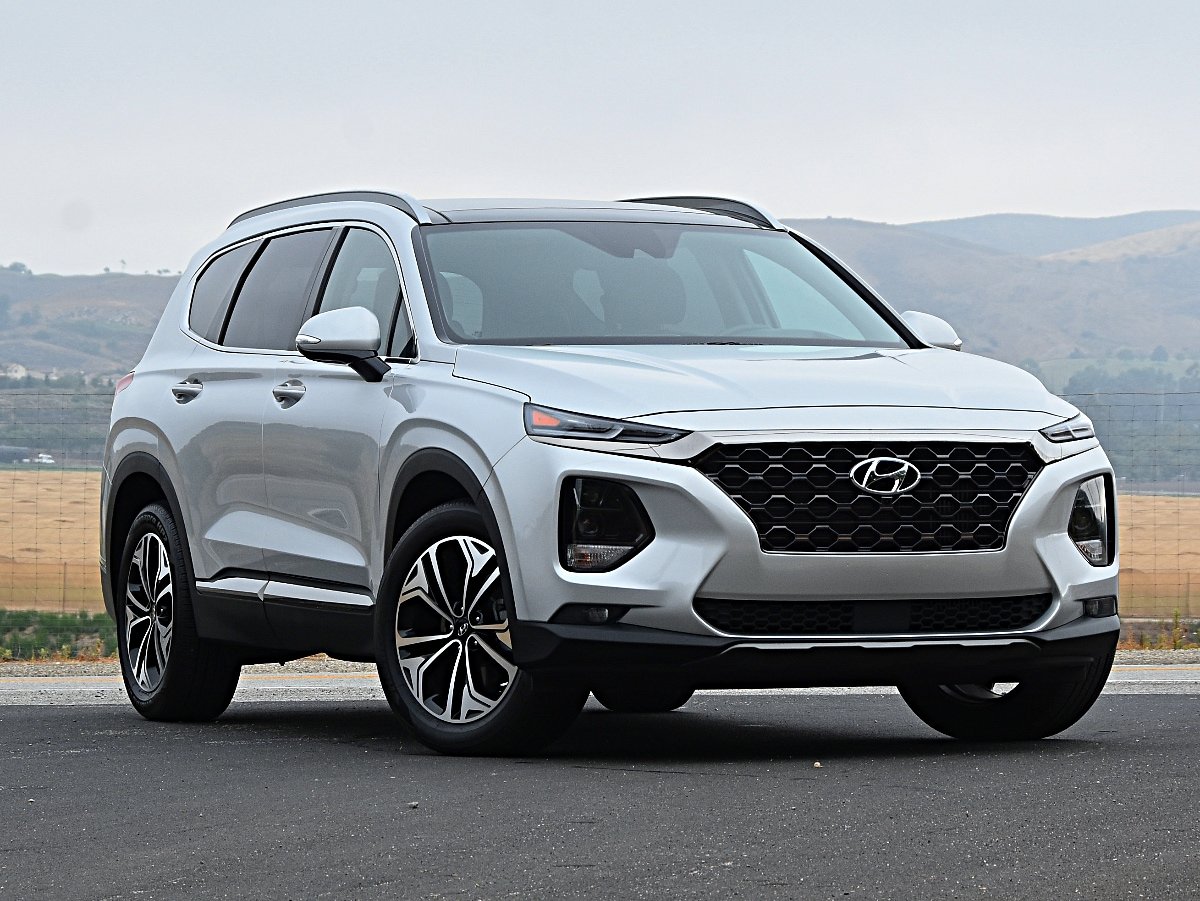
According to CarGurus experts, the overall rating for the 2020 Hyundai Santa Fe is 8.8 out of 10, while the 2021 Volkswagen Atlas scores 6.5 out of 10. Based on these ratings, the Hyundai Santa Fe is the recommended choice, offering a better combination of design, safety, and driving experience.
Choose the 2021 Volkswagen Atlas if:
- You need a spacious three-row SUV with ample cargo capacity.
- You prefer a minimalist interior design with straightforward controls.
- You require advanced driver assistance features for highway driving.


Choose the 2020 Hyundai Santa Fe if:
- You value a bold and unique design with a well-crafted interior.
- You prioritize safety features and high safety ratings.
- You seek a comfortable and smooth daily driving experience.




CarGurus highlights
According to CarGurus experts, the overall rating for the 2020 Hyundai Santa Fe is 8.8 out of 10, while the 2021 Volkswagen Atlas scores 6.5 out of 10. Based on these ratings, the Hyundai Santa Fe is the recommended choice, offering a better combination of design, safety, and driving experience.
Choose the 2021 Volkswagen Atlas if:
Shop Now- You need a spacious three-row SUV with ample cargo capacity.
- You prefer a minimalist interior design with straightforward controls.
- You require advanced driver assistance features for highway driving.


Choose the 2020 Hyundai Santa Fe if:
Shop Now- You value a bold and unique design with a well-crafted interior.
- You prioritize safety features and high safety ratings.
- You seek a comfortable and smooth daily driving experience.








By: CarGurus + AI
At CarGurus, our team of experienced automotive writers remain at the heart of our content operation, conducting hands-on car tests and writing insightful guides that are backed by years of industry experience. To complement this, we are harnessing AI to make our content offering more diverse and more helpful to shoppers than ever. To achieve this, our AI systems are based exclusively on CarGurus content, ratings and data, so that what we produce is both unique to CarGurus, and uniquely helpful to car shoppers.