2020 Ford Explorer vs 2021 BMW X5
Overview | |
MSRP$32,765 | MSRP$59,400 |
Listings525 | Listings296 |
Ratings & Reviews | |
User Reviews | User Reviews |
Expert reviews7.2 out of 10 | Expert reviews8.0 out of 10 |
Pros
Cons
| Pros
Cons
|
2020 Ford Explorer Reviews SummaryFor nearly 30 years, the Ford Explorer has settled into the American lexicon like Cheerios. We've gobbled up millions of them, from the rock-crawling Eddie Bauers of the 1990s to the brand-new ST that can take down sports cars. The 2020 Explorer brings an all-new chassis, cranks up the technology, and introduces hybrid and high-performance powertrains in a space the size of a small living room. The Explorer's also getting very expensive while other automakers catch on to Ford's winning formula—for a lot less money. | |
2021 BMW X5 Reviews SummaryThe BMW X5 was fully redesigned for the 2019 model year. In 2020, high-performance models were added to the mix and for 2021, the SUV’s second-generation plug-in hybrid variant joins the family. All feature similar body design and utility, including a large cargo area. | |
No video found | |
Popular Features & Specs | |
Engine2.3L 300 hp I4 | Engine3.0L 335 hp I6 |
Drive TrainRWD | Drive TrainRWD |
Seating Capacity7 | Seating Capacity7 |
Horsepower | Horsepower335 hp @ 5500 rpm |
MPG City21 | MPG City21 |
MPG Highway28 | MPG Highway26 |
Engine | |
Engine Name2.3L 300 hp I4 | Engine Name3.0L 335 hp I6 |
Torque | Torque330 lb-ft @ 1500 rpm |
Horsepower | Horsepower335 hp @ 5500 rpm |
DrivetrainRWD | DrivetrainRWD |
Fuel Economy | |
MPG City21 | MPG City21 |
MPG Highway28 | MPG Highway26 |
Interior | |
Seating Capacity7 | Seating Capacity7 |
Key Features | |
Navigation System | Navigation SystemStandard |
Sunroof/Moonroof | Sunroof/MoonroofStandard |
Safety | |
Front Crash Overall5 | Front Crash Overall4 |
Side Crash Overall5 | Side Crash Overall5 |
Dimensions & Capacity | |
Cargo Space18.2 cu ft | Cargo Space33.9 cu ft |
Curb Weight4345 lbs | Curb Weight4828 lbs |
Height69.9 in | Height68.7 in |
Length198.8 in | Length194.3 in |
Width89.3 in | Width87.3 in |
Wheelbase119.1 in | Wheelbase117.1 in |
Maximum Payload1425 lbs | Maximum Payload974 lbs |
Number of doors4 | Number of doors4 |
Maximum Towing Capacity5300 lbs | Maximum Towing Capacity7209 lbs |
Overview | ||
MSRP | $32,765 | $59,400 |
Listings | ||
Ratings & Reviews | ||
User reviews | ||
Expert reviews | 7.2 out of 10Read full review | 8.0 out of 10Read full review |
Pros & cons | Pros
Cons
| Pros
Cons
|
Summary | For nearly 30 years, the Ford Explorer has settled into the American lexicon like Cheerios. We've gobbled up millions of them, from the rock-crawling Eddie Bauers of the 1990s to the brand-new ST that can take down sports cars. The 2020 Explorer brings an all-new chassis, cranks up the technology, and introduces hybrid and high-performance powertrains in a space the size of a small living room. The Explorer's also getting very expensive while other automakers catch on to Ford's winning formula—for a lot less money. | The BMW X5 was fully redesigned for the 2019 model year. In 2020, high-performance models were added to the mix and for 2021, the SUV’s second-generation plug-in hybrid variant joins the family. All feature similar body design and utility, including a large cargo area. |
Video | No video found | |
Popular Features & Specs | ||
Engine | 2.3L 300 hp I4 | 3.0L 335 hp I6 |
Drive Train | RWD | RWD |
Seating Capacity | 7 | 7 |
Horsepower | 335 hp @ 5500 rpm | |
MPG City | 21 | 21 |
MPG Highway | 28 | 26 |
Engine | ||
Engine Name | 2.3L 300 hp I4 | 3.0L 335 hp I6 |
Torque | 330 lb-ft @ 1500 rpm | |
Horsepower | 335 hp @ 5500 rpm | |
Drivetrain | RWD | RWD |
Fuel Economy | ||
MPG City | 21 | 21 |
MPG Highway | 28 | 26 |
Interior | ||
Seating Capacity | 7 | 7 |
Key Features | ||
Navigation System | Standard | |
Sunroof/Moonroof | Standard | |
Safety | ||
Front Crash Overall | 5 | 4 |
Side Crash Overall | 5 | 5 |
Dimensions & Capacity | ||
Cargo Space | 18.2 cu ft | 33.9 cu ft |
Curb Weight | 4345 lbs | 4828 lbs |
Height | 69.9 in | 68.7 in |
Length | 198.8 in | 194.3 in |
Width | 89.3 in | 87.3 in |
Wheelbase | 119.1 in | 117.1 in |
Maximum Payload | 1425 lbs | 974 lbs |
Number of doors | 4 | 4 |
Maximum Towing Capacity | 5300 lbs | 7209 lbs |
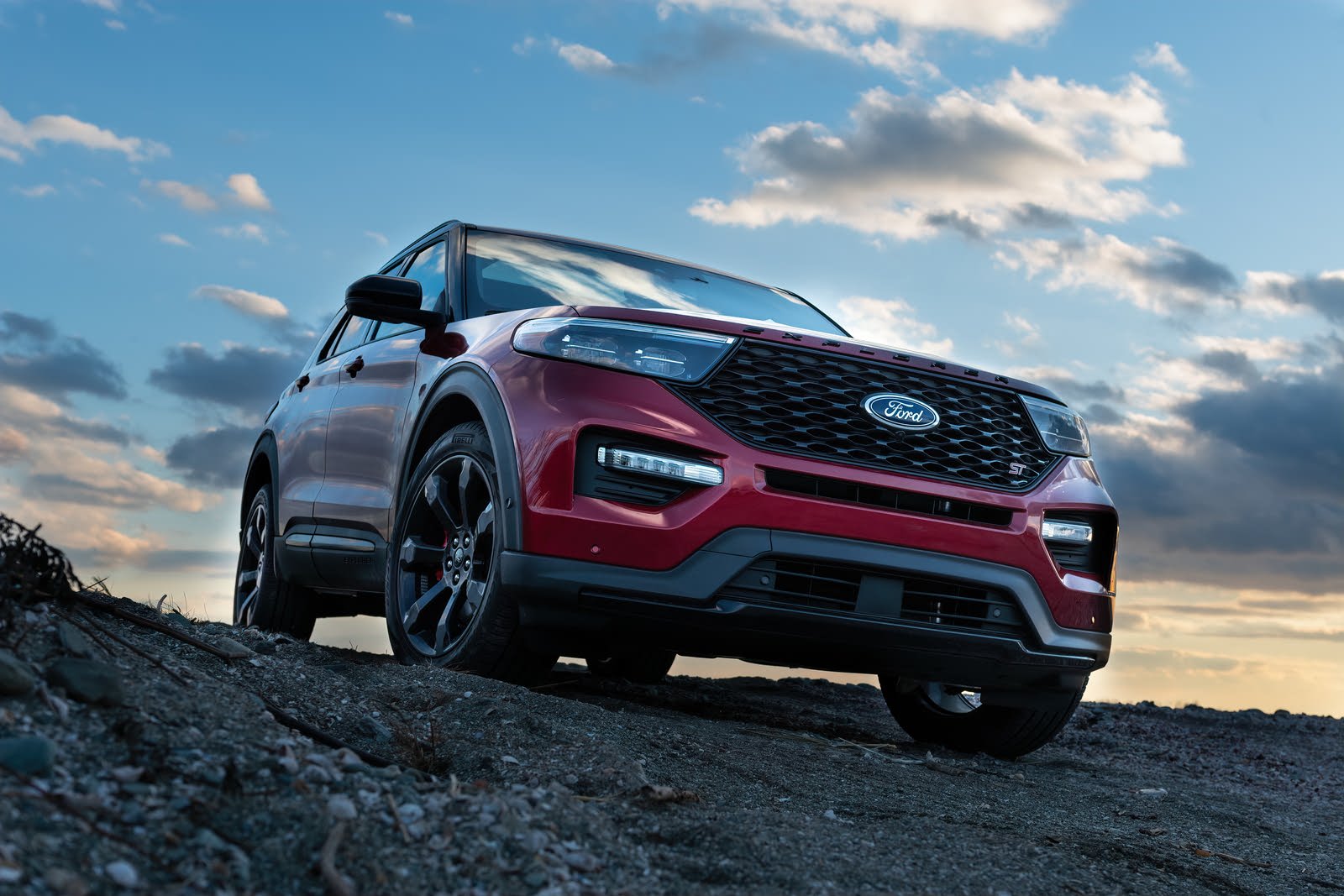
The 2020 Ford Explorer was a striking vehicle, more handsome than the Land Rover Discovery. The latest model refined its upscale, utilitarian design by slimming down the body panels and giving it a lower, more athletic appearance. The widened headlights, extra-large grille, and italic "Explorer" lettering on the hood created a prominent and recognizable face. The ST version, with its black 21-inch rims, blacked-out trim, red brake calipers, rich Rapid Red paint, and quad exhaust pipes, was particularly eye-catching. However, the interior was a letdown. Despite the high price tag, the materials felt cheap, with low-grade vinyl and rough-grained plastic dominating the cabin. The switchgear felt solid, but the overall interior quality did not match the price, making it less appealing compared to competitors like the Kia Telluride and Toyota Highlander.
The 2021 BMW X5, on the other hand, exemplified high-quality craftsmanship. Its design was unmistakably BMW, from the kidney grille to the body shape. The X5 featured full adaptive LED headlights and a variety of trim options, including the sporty M Sport styling. The interior, while suffering from some sameness across BMW models, was well-crafted with plenty of leather and soft-touch materials. The M Sport models added unique styling elements like an M sports steering wheel and M-specific pedals. However, the abundance of black plastic that easily collected dust was a minor drawback. Overall, the X5's look and feel were more luxurious and refined compared to the Explorer.


The 2020 Ford Explorer offered a range of engines and a rear-wheel-drive (RWD) chassis, providing a more balanced weight distribution. The ST trim featured a 3.0-liter twin-turbo V6 with 400 horsepower and 415 pound-feet of torque, paired with a 10-speed automatic transmission. The ST's performance was impressive, with smooth power delivery and precise steering. The Explorer also offered a 2.3-liter turbo inline-four engine with 300 hp and 310 lb-ft, and a gas-electric hybrid option with a net 318 hp. The hybrid, however, did not offer significant fuel economy benefits. Towing capacity varied from 5,000 to 5,600 pounds depending on the engine. The Explorer's seven drive modes catered to various driving conditions, enhancing its versatility.
The 2021 BMW X5 came with several powertrain options, all paired with an eight-speed automatic transmission. The base X5 sDrive40i/xDrive40i featured a 3.0-liter inline six-cylinder engine with 335 hp and 330 lb-ft of torque. The X5 M50i boasted a twin-turbocharged 4.4-liter V8 with 523 hp and 553 lb-ft, while the X5 M offered up to 617 hp with the Competition Package. The new X5 xDrive45e plug-in hybrid delivered 389 hp and 443 lb-ft, with up to 30 miles of all-electric range. The X5's performance was generally strong, but its steering dynamics were less engaging than expected, especially at higher speeds. The hybrid model's transition between power sources was seamless, but its steering response was lacking.
The 2020 Ford Explorer excelled in interior space and practicality. On a road trip to Maine, it provided ample space for passengers and cargo. The second row felt like first class with air vents, USB ports, and a panoramic moonroof. The third row was more spacious than previous models, accommodating six-foot-tall adults for short trips. Cargo space was generous, with 18 cubic feet behind the third row, 48 cubic feet behind the second row, and 88 cubic feet with all seats folded. The Explorer's physical knobs and switches made it user-friendly, though the thick D-pillars and fuzzy 360-degree cameras were drawbacks.
The 2021 BMW X5 made good use of space, with well-placed cupholders and a wireless phone charging pad. The front seats were comfortable for short trips but felt hard after a few hours. The rear seats were spacious, and the available third row added versatility. The split liftgate and vehicle height adjustment button made loading cargo easier. The X5's cargo area was spacious, though slightly reduced in the hybrid model. The climate controls were easy to manage, but the console controls were harder to differentiate at night.
The 2020 Ford Explorer came standard with an 8-inch touchscreen, Sync 3 infotainment, Apple CarPlay, Android Auto, and 4G WiFi. The Premium Technology Package added a 10-inch vertical touchscreen and a 12-inch digital instrument cluster. The touchscreen was user-friendly, but the instrument panel felt unfinished, with wasted screen space and limited customization. The Co-Pilot360 Assist+ semi-automated driving system was not as effective as competitors' systems.
The 2021 BMW X5 featured a 12.3-inch infotainment touchscreen, wireless Apple CarPlay, wireless Android Auto, a 12.3-inch digital gauge cluster, and a 10-speaker sound system. Additional options included remote start, a head-up display, massaging seats, and premium audio systems. The iDrive system required some acclimation but was easy to use once familiar. However, wireless Apple CarPlay had connectivity issues, often taking over musical operations unexpectedly.
The 2020 Ford Explorer came standard with Ford Co-Pilot 360, which included forward emergency braking, blind-spot monitoring, auto high beams, and lane-keep assist. The Assist+ option added adaptive cruise control with steering assist and reverse braking, though the latter activated falsely during testing. The Explorer received an Acceptable rating in the small overlap test from the IIHS.
The 2021 BMW X5 was equipped with a comprehensive list of standard safety features, including blind-spot monitoring, forward collision warning, automatic emergency braking, and adaptive cruise control. However, the adaptive cruise control system did not always react in time to stopped traffic, and the lane-keeping system struggled in bright sunlight and light rain. The X5 received nearly all Good ratings from the IIHS and a four-star overall safety rating from the NHTSA.
CarGurus highlights

According to CarGurus experts, the overall rating for the 2020 Ford Explorer is 7.2 out of 10, while the 2021 BMW X5 scores 8.0 out of 10. Based on these ratings, the 2021 BMW X5 is the better choice, offering superior craftsmanship, a more luxurious interior, and advanced technology features.
Choose the 2020 Ford Explorer if:
- You need a spacious and practical SUV with ample cargo and passenger space.
- You prefer a vehicle with physical knobs and switches for easy control.
- You want a powerful engine option at a competitive price.


Choose the 2021 BMW X5 if:
- You value high-quality craftsmanship and a luxurious interior.
- You want a variety of powertrain options, including a plug-in hybrid.
- You prefer advanced technology features and a user-friendly infotainment system.


CarGurus highlights
According to CarGurus experts, the overall rating for the 2020 Ford Explorer is 7.2 out of 10, while the 2021 BMW X5 scores 8.0 out of 10. Based on these ratings, the 2021 BMW X5 is the better choice, offering superior craftsmanship, a more luxurious interior, and advanced technology features.
Choose the 2020 Ford Explorer if:
Shop Now- You need a spacious and practical SUV with ample cargo and passenger space.
- You prefer a vehicle with physical knobs and switches for easy control.
- You want a powerful engine option at a competitive price.
Choose the 2021 BMW X5 if:
Shop Now- You value high-quality craftsmanship and a luxurious interior.
- You want a variety of powertrain options, including a plug-in hybrid.
- You prefer advanced technology features and a user-friendly infotainment system.

By: CarGurus + AI
At CarGurus, our team of experienced automotive writers remain at the heart of our content operation, conducting hands-on car tests and writing insightful guides that are backed by years of industry experience. To complement this, we are harnessing AI to make our content offering more diverse and more helpful to shoppers than ever. To achieve this, our AI systems are based exclusively on CarGurus content, ratings and data, so that what we produce is both unique to CarGurus, and uniquely helpful to car shoppers.

