2019 Ford Edge vs 2019 Toyota RAV4

Overview | |
MSRP$29,995 | MSRP$25,650 |
Listings210 | Listings251 |
Ratings & Reviews | |
User Reviews | User Reviews |
Expert reviews7.3 out of 10 | Expert reviews8.0 out of 10 |
Pros
Cons
| |
2019 Ford Edge Reviews SummaryThe Edge was a key vehicle in the evolution of the family SUV market when Ford first introduced it for the 2007 model year. Back then, automakers were experimenting with just what a “crossover” could constitute—look at the Pontiac Aztec and first-generation Chrysler Pacifica if you disagree. But with the Edge, the midsize, two-row SUV template started to take shape. Ford offers the 2019 Edge with an ST trim, grafting performance onto the utilitarian Edge blueprint. But that begs a question—can a vehicle still be good at family hauling and commuting while also delivering speed and performance? | |
2019 Toyota RAV4 Reviews SummaryThere’s a reason small SUVs like the 2019 Toyota RAV4 are among the most popular vehicles on the new car market. Consider the RAV4 and its rivals, the Honda CR-V, Mazda CX-5, and Ford Escape—what do they have in common? To put it simply, these vehicles are asked to do it all. Daily commuter car? Check. Family-hauler to school, practice, and the mall? Check, check, and check. Road-trip vehicle? Yeah, that too. On top of it all, these vehicles have to be affordable, efficient, and reliable. Sales of traditional sedans have been dwindling, but if sedans could do as much as crossovers can, they would still be popular vehicles. The RAV4 is one of the oldest vehicles in the segment, and its story tells us how these small SUVs became so popular. The previous RAV4 was an extremely competent vehicle for Toyota, covering all the things we ask of compact SUVs. But the new 2020 RAV4 goes a few steps further. It has standout Tonka-truck styling, a surprisingly upscale interior, and something that it had lost since debuting more than two decades ago: a bit of off-road ability. We’ll see whether this makes it better than the RAV4 it replaces, and if it allows the 2020 RAV4 to stand out in a crowded small SUV market. | |
Popular Features & Specs | |
Engine2.0L 250 hp I4 | Engine2.5L 203 hp I4 |
Drive TrainFWD | Drive TrainFWD |
Seating Capacity5 | Seating Capacity5 |
Horsepower250 hp @ 5500 rpm | Horsepower203 hp @ 6000 rpm |
MPG City22 | MPG City26 |
MPG Highway29 | MPG Highway35 |
Engine | |
Engine Name2.0L 250 hp I4 | Engine Name2.5L 203 hp I4 |
Torque280 lb-ft @ 3000 rpm | Torque184 lb-ft @ 5000 rpm |
Horsepower250 hp @ 5500 rpm | Horsepower203 hp @ 6000 rpm |
DrivetrainFWD | DrivetrainFWD |
Fuel Economy | |
MPG City22 | MPG City26 |
MPG Highway29 | MPG Highway35 |
Interior | |
Seating Capacity5 | Seating Capacity5 |
Safety | |
Front Crash Overall5 | Front Crash Overall4 |
Side Crash Overall5 | Side Crash Overall5 |
Dimensions & Capacity | |
Cargo Space39.2 cu ft | Cargo Space37.5 cu ft |
Curb Weight4027 lbs | Curb Weight3370 lbs |
Height68.3 in | Height67.0 in |
Length188.8 in | Length180.9 in |
Width85.8 in | Width73.0 in |
Wheelbase112.2 in | Wheelbase105.9 in |
Maximum Payload1243 lbs | Maximum Payload1240 lbs |
Number of doors4 | Number of doors4 |
Maximum Towing Capacity1500 lbs | Maximum Towing Capacity1500 lbs |
Overview | ||
MSRP | $29,995 | $25,650 |
Listings | ||
Ratings & Reviews | ||
User reviews | ||
Expert reviews | 7.3 out of 10Read full review | 8.0 out of 10Read full review |
Pros & cons | Pros
Cons
| |
Summary | The Edge was a key vehicle in the evolution of the family SUV market when Ford first introduced it for the 2007 model year. Back then, automakers were experimenting with just what a “crossover” could constitute—look at the Pontiac Aztec and first-generation Chrysler Pacifica if you disagree. But with the Edge, the midsize, two-row SUV template started to take shape. Ford offers the 2019 Edge with an ST trim, grafting performance onto the utilitarian Edge blueprint. But that begs a question—can a vehicle still be good at family hauling and commuting while also delivering speed and performance? | There’s a reason small SUVs like the 2019 Toyota RAV4 are among the most popular vehicles on the new car market. Consider the RAV4 and its rivals, the Honda CR-V, Mazda CX-5, and Ford Escape—what do they have in common? To put it simply, these vehicles are asked to do it all. Daily commuter car? Check. Family-hauler to school, practice, and the mall? Check, check, and check. Road-trip vehicle? Yeah, that too. On top of it all, these vehicles have to be affordable, efficient, and reliable. Sales of traditional sedans have been dwindling, but if sedans could do as much as crossovers can, they would still be popular vehicles. The RAV4 is one of the oldest vehicles in the segment, and its story tells us how these small SUVs became so popular. The previous RAV4 was an extremely competent vehicle for Toyota, covering all the things we ask of compact SUVs. But the new 2020 RAV4 goes a few steps further. It has standout Tonka-truck styling, a surprisingly upscale interior, and something that it had lost since debuting more than two decades ago: a bit of off-road ability. We’ll see whether this makes it better than the RAV4 it replaces, and if it allows the 2020 RAV4 to stand out in a crowded small SUV market. |
Video | ||
Popular Features & Specs | ||
Engine | 2.0L 250 hp I4 | 2.5L 203 hp I4 |
Drive Train | FWD | FWD |
Seating Capacity | 5 | 5 |
Horsepower | 250 hp @ 5500 rpm | 203 hp @ 6000 rpm |
MPG City | 22 | 26 |
MPG Highway | 29 | 35 |
Engine | ||
Engine Name | 2.0L 250 hp I4 | 2.5L 203 hp I4 |
Torque | 280 lb-ft @ 3000 rpm | 184 lb-ft @ 5000 rpm |
Horsepower | 250 hp @ 5500 rpm | 203 hp @ 6000 rpm |
Drivetrain | FWD | FWD |
Fuel Economy | ||
MPG City | 22 | 26 |
MPG Highway | 29 | 35 |
Interior | ||
Seating Capacity | 5 | 5 |
Safety | ||
Front Crash Overall | 5 | 4 |
Side Crash Overall | 5 | 5 |
Dimensions & Capacity | ||
Cargo Space | 39.2 cu ft | 37.5 cu ft |
Curb Weight | 4027 lbs | 3370 lbs |
Height | 68.3 in | 67.0 in |
Length | 188.8 in | 180.9 in |
Width | 85.8 in | 73.0 in |
Wheelbase | 112.2 in | 105.9 in |
Maximum Payload | 1243 lbs | 1240 lbs |
Number of doors | 4 | 4 |
Maximum Towing Capacity | 1500 lbs | 1500 lbs |
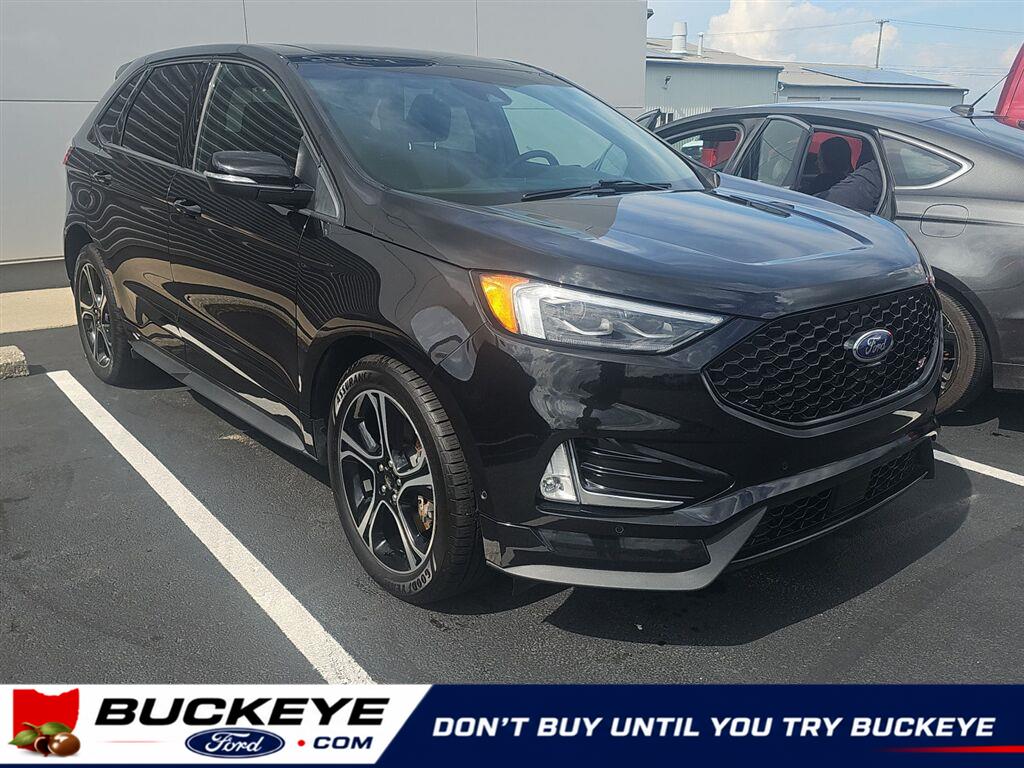
The 2019 Ford Edge was stylishly refreshed to offer a sportier appearance. The front fascia featured a redesigned grille, new headlights, and an updated lower front fascia, contributing to its modern look. The rear end received new taillights and a larger black panel replacing the older red connector, giving the Edge a more aggressive stance. Despite these exterior updates, the interior felt largely unchanged from earlier models, reminiscent of the 2014 Edge. The heavy reliance on plastic materials and a dated design left the cabin feeling outmoded. The rotary shifter was a new addition, but the cabin still felt like a relic from the past.
The Ford Edge was offered in SE, SEL, Titanium, and ST trims. The SE came with 18-inch alloy wheels, keyless entry, push-button start, and rain-sensing wipers. The SEL added black roof rails, dual-zone climate control, power-adjustable front seats, rear parking sensors, and a leather-wrapped steering wheel. Additional packages for the SEL included leather upholstery, heated front seats, and a hands-free power liftgate. The Titanium trim added 19-inch alloy wheels, a Bang & Olufsen 12-speaker sound system, and several other luxury features. The ST trim went further, adding blacked-out grille, front lip and side skirts, 20-inch machined aluminum wheels, and multiple performance enhancements.
The 2019 Toyota RAV4 presented an aggressive and futuristic design, drawing inspiration from the Toyota Tacoma pickup. Its chunky design and sharp edges conveyed strength, extending to the side-profile and taillights reminiscent of Lexus models. The RAV4's design included a distinct character line breaking up the rear C-pillar, which was functional for two-tone roof options but perhaps added unnecessary design clutter for monotone color variants.
Inside, the RAV4's cabin leaned towards simplicity and elegance. The center stack featured a “pod” design grouping essential controls and a minimalistic shifter design, creating a tidy and functional layout. Trims ranged from LE to XLE, XLE Premium, Adventure, and Limited. The base LE offered a suite of features including 17-inch steel wheels, LED lighting, and privacy-tinted windows. The XLE trim added 17-inch alloy wheels, a power moonroof, sport bucket seats, and dual-zone climate control. The XLE Premium upped the ante with 19-inch wheels, a power liftgate, an 8-way power driver’s seat, and SofTex leatherette upholstery. The Adventure trim, which focused on ruggedness, included unique 19-inch wheels, black fender cladding, and orange interior accents. The Limited trim aimed for luxury, with chrome-finished wheels, unique grille design, and a suite of upscale features.


Under the hood, the 2019 Ford Edge equipped the SE, SEL, and Titanium trims with a 2.0-liter EcoBoost turbocharged 4-cylinder engine. This powertrain produced a robust 250 horsepower and 280 pound-feet of torque, paired with an 8-speed automatic transmission, available in front-wheel drive (FWD) or all-wheel drive (AWD) configurations. The ST trim, however, boasted a 2.7-liter EcoBoost V6 engine, delivering an impressive 335 horsepower and 380 pound-feet of torque, exclusively with AWD. This engine, shared with the Ford F-150, provided the ST with jaw-dropping acceleration and agile cornering capabilities. Despite its power, the ST maintained a balanced, precise ride. The base engine's fuel economy was rated at 22 mpg city, 29 highway, and 25 combined for FWD, whereas the ST returned 19/26/21. Our Edge ST test car averaged 19.9 mpg in a week of spirited driving.
The 2019 Toyota RAV4 featured a 2.5-liter 4-cylinder engine across all trims, generating 203 horsepower and 184 pound-feet of torque. This engine was mated to an 8-speed automatic transmission, available in FWD or AWD. The RAV4 offered two types of AWD systems: the base AWD, featuring Snow, Sand & Mud, and Rock & Dirt drive modes (included in most trims), and the Adventure trim’s torque-vectoring AWD, which could distribute power dynamically to the wheels that needed it the most. While our XLE test model featured base AWD and had sufficient power for highway speeds, it lagged in low-end power during stop-and-go traffic, resulting in a noisy engine during acceleration.
The RAV4 handled uneven terrain with relative ease but exhibited noticeable body roll and a twitchy steering response during fast cornering, making it less refined than some competitors. Fuel economy was a strong point for the RAV4, with the FWD version achieving 26 mpg city, 35 highway, 30 combined. The AWD variant returned 27 city and 34 highway, while the torque-vectoring AWD came in at 25/33/28. Our AWD test vehicle achieved an impressive 29.3 miles per gallon in mixed driving conditions.
The 2019 Ford Edge offered a competent, though dated, cabin with practical storage solutions. The center console featured a deep cargo bin and another bin at the bottom of the center stack, housing USB ports and an optional wireless charger. The in-door pockets were spacious, including large bottle holders. The front seats were comfortable, with the ST trim featuring performance-oriented bucket seats from Ford Performance, though not ideal for taller drivers. Rear seats provided ample space, especially for taller passengers, and offered 39 cubic feet of cargo space, expandable to 73.4 cubic feet with the rear seats folded.
On the other hand, the 2019 Toyota RAV4 boasted a clean, upscale interior with practical storage solutions and user-friendly controls. The center stack’s “pod” design grouped drive-mode controls, climate controls, and the shifter efficiently, and a thin tray above the glove box added extra storage. While the RAV4's cargo capacity of 37.6 cubic feet with the rear seats up and 69.8 cubic feet with them folded was slightly lower than the Edge, it still offered plenty of space for most needs.
The basic infotainment system in the 2019 Ford Edge was somewhat underwhelming, featuring a small 4.2-inch non-touchscreen with limited functionality for the base SE trim. It included a USB port, a WiFi hotspot, streaming music, Bluetooth, and voice recognition but felt cheap compared to competitors. Upgrading to the 8-inch Sync 3 system available on the SEL and standard on the Titanium and ST trims improved the technology offering significantly. This system was more user-friendly, despite its average graphics, and included Apple CarPlay, Android Auto, and Amazon Alexa integration.
For the 2019 Toyota RAV4, the LE trim featured a 7-inch touchscreen with the latest Entune 3.0 system, functional and straightforward but lacking Android Auto. This system included Apple CarPlay, Bluetooth connectivity, a USB port, and a WiFi hotspot. The XLE trim further offered five USB ports and a slightly upgraded infotainment layout. The Adventure trim provided enhanced tech with a panoramic reversing camera, a 7-inch instrument display, and an 8-inch Entune screen. The Limited trim allowed for pairing with a JBL premium stereo system.
Safety was a priority for both vehicles. The 2019 Ford Edge came standard with a reversing camera, traction control, and a comprehensive array of front- and side-impact airbags. It included Ford's Co-Pilot360 suite, featuring automatic emergency braking, forward-collision warning, lane-departure warning, automatic high-beams, and blind-spot monitoring with rear cross-traffic alert. Higher trims offered the Co-Pilot360 Assist+ package, which added adaptive cruise control, evasive steering assist, and a lane-centering system.
The 2019 Toyota RAV4 matched up well with a full complement of front- and side-impact airbags, a reversing camera, and traction control. It came standard with Toyota Safety Sense 2.0, including forward-collision warning, lane-departure warning, automatic high-beams, and dynamic radar cruise control. Additional features like traffic-sign detection and Lane-Tracing Assist exemplified Toyota’s commitment to safety.
CarGurus highlights
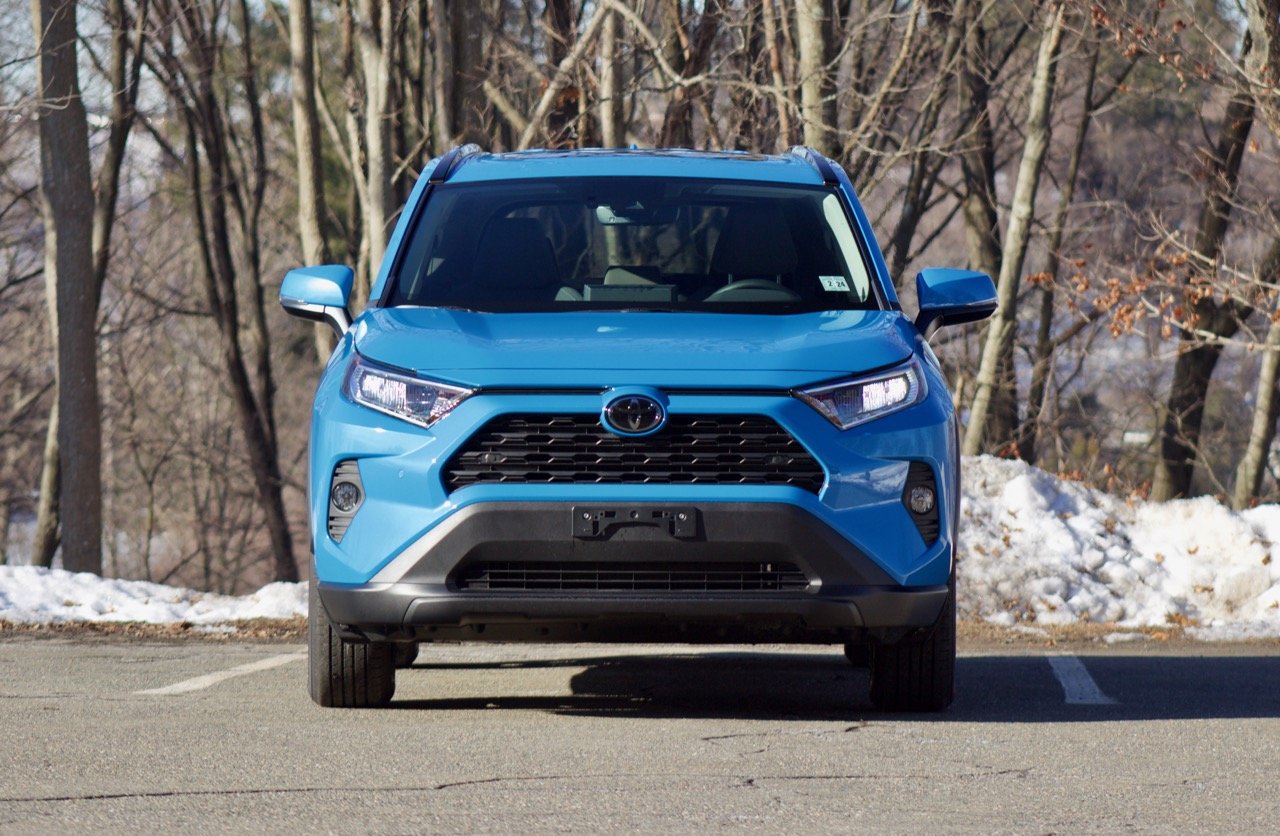
According to CarGurus experts, the overall rating for the 2019 Ford Edge was 7.3 out of 10, while the 2019 Toyota RAV4 scored 8.0 out of 10. Given these ratings, the Toyota RAV4 came out as the better overall choice. It provided a more refined interior, impressive fuel efficiency, and advanced safety features as standard, making it a well-rounded vehicle suitable for a wide range of buyers.
Choose the 2019 Ford Edge if:
- You seek a vehicle with powerful engine options and sporty performance.
- You require more cargo space than most similar-sized crossovers.
- You appreciate the availability of luxury and performance trims like the Titanium and ST.




Choose the 2019 Toyota RAV4 if:
- You prioritize fuel efficiency and are drawn to a rugged, off-road capable design.
- You appreciate a clean, modern interior layout with ample practical storage solutions.
- You value advanced safety features as standard across all trims.


CarGurus highlights
According to CarGurus experts, the overall rating for the 2019 Ford Edge was 7.3 out of 10, while the 2019 Toyota RAV4 scored 8.0 out of 10. Given these ratings, the Toyota RAV4 came out as the better overall choice. It provided a more refined interior, impressive fuel efficiency, and advanced safety features as standard, making it a well-rounded vehicle suitable for a wide range of buyers.
Choose the 2019 Ford Edge if:
Shop Now- You seek a vehicle with powerful engine options and sporty performance.
- You require more cargo space than most similar-sized crossovers.
- You appreciate the availability of luxury and performance trims like the Titanium and ST.
Choose the 2019 Toyota RAV4 if:
Shop Now- You prioritize fuel efficiency and are drawn to a rugged, off-road capable design.
- You appreciate a clean, modern interior layout with ample practical storage solutions.
- You value advanced safety features as standard across all trims.

By: CarGurus + AI
At CarGurus, our team of experienced automotive writers remain at the heart of our content operation, conducting hands-on car tests and writing insightful guides that are backed by years of industry experience. To complement this, we are harnessing AI to make our content offering more diverse and more helpful to shoppers than ever. To achieve this, our AI systems are based exclusively on CarGurus content, ratings and data, so that what we produce is both unique to CarGurus, and uniquely helpful to car shoppers.

