There have been three Toyota MR2 designs in all, each with a very different personality, but at heart, they’re simple, honest sports cars. Even the name tells you what it is: MR2 stands for midship, runabout, two-seater. Such cars are rare today, and the last MR2 went out of production in 2007, which makes these cars all the more certain to be future classics. The first two generations of “Mister Two” have already reached the stage where good ones go for sizeable sums at auction.
Toyota MR2 Buying Guide: Cost, Reliability, and the Best Years to Buy
Search for Toyota MR2
See all


Being high-quality Toyotas, all three can still make good daily drivers if your life can fit into a 2-seater, mid-engine sports car. In fact, according to MR2 owners and forums, they are surprisingly practical, perhaps reflecting the car’s origin as a low-cost runabout conjured up in the wake of the 1970s gas crises. The three iterations couldn’t be more different from one another, though, even though they’re all mid-engine, rear-wheel drive, four-cylinder sports cars.
If you’re looking to saddle up with a classic MR2 or the later MR2 Spyder, our buyer’s guide breaks down each generation in detail, complete with some advice about what to watch out for and what to pay.
Toyota MR2 Buying Guide: Cost, Reliability, and the Best Years to Buy
- Frequently Asked Questions
- Toyota MR2 Pros and Cons
- Toyota MR2 Generations
- Third Generation (2000-2005)
- Second Generation (1991-1995)
- First Generation (1985-1989)
Frequently Asked Questions
Which Toyota MR2 years are the best?
The Toyota MR2 and MR2 Spyder are very reliable by the standards of sporty mid-engine cars, and any of the cars in the first two generations (1985 to 1995) are a safe bet for reliable and fun motoring. The MR2 Spyder is also very robust, but later models, from 2003 to 2005, tend to have fewer issues than the early cars.
What are the worst Toyota MR2 years?
There are really no truly bad MR2 years, but the early days of the third-generation MR2 Spyder, roughly from 2000 to 2002, saw complaints about excessive oil consumption and a variety of other new-model problems. This doesn’t mean these cars should be avoided at all costs, but more careful inspection is warranted.
Is a used Toyota MR2 a good deal?
Yes. The second-generation 1990s-era MR2 is now quite expensive and not as good a deal as it used to be, but the first and third-generation models are great deals. Both are lots of fun to drive and generally very reliable cars if you shop carefully. No, they’re not all that fast in a straight line, but both are grin-inducing in the same way a Mazda MX-5 Miata is, only these are less common.
Toyota MR2 Pros and Cons
Pros:
- Relatively affordable even in the earliest years
- Toyota reliability
- Outstanding fun in all generations
Cons:
- Age is catching up to them, even with the latest cars
- Non-existent aftermarket compared to Miata
- Making a choice among these radically different cars can be difficult
Toyota MR2 Generations
Third Generation (2000-2005)
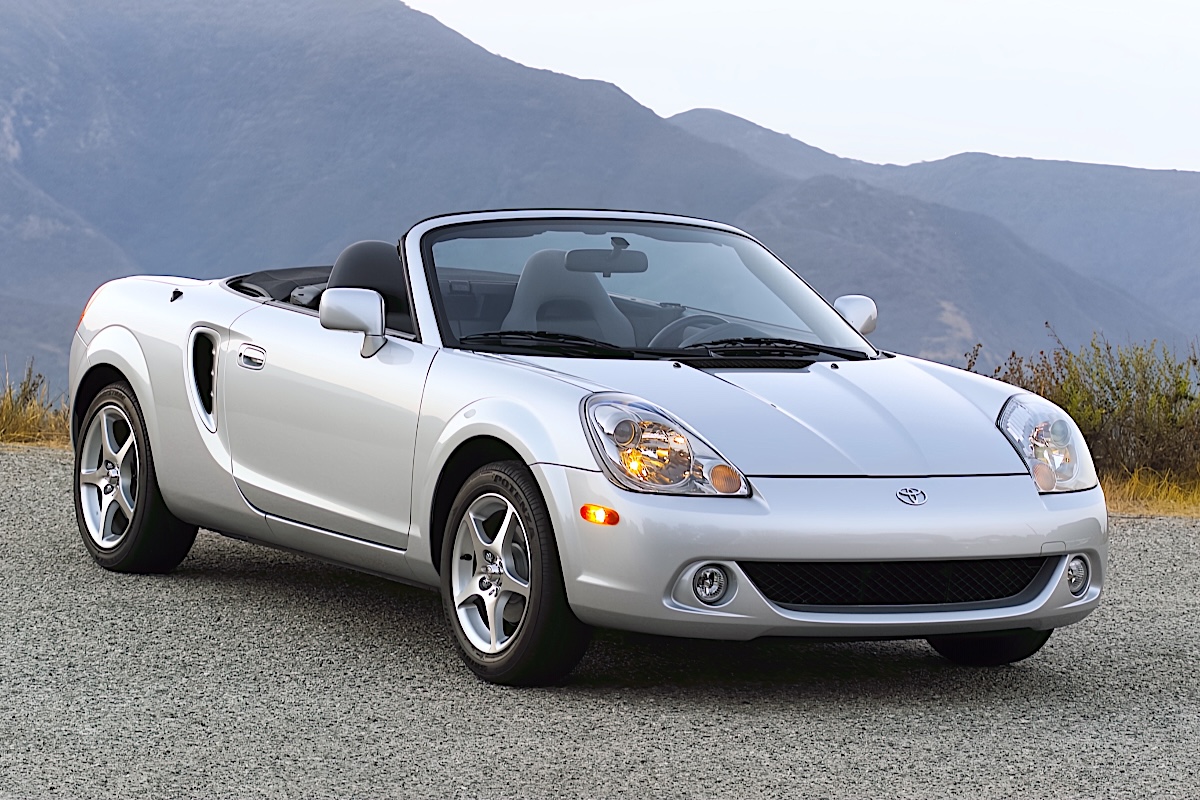
Known as the MR-S in Japan, in the United States the third-generation Toyota MR2 got a slight name change to “MR2 Spyder”. This reflected the single biggest change to the car over the previous models: it comes with a convertible top. The earlier versions had removable roof panels, but they were designed as fixed-roof coupes rather than mid-engine roadsters. The decision to change the MR2 this way had much to do with the success of the Mazda MX-5 Miata, BMW Z3, MGF, and the Porsche Boxster. As the sleek 1990s MR2 had seen flagging sales, interest in roadsters had soared, so Toyota decided to remake the car to capture some of this market.
To Americans, the MR2 Spyder was also a belated revival of the car, but this wasn’t the case overseas, as the second-generation mode had continued into 1999 in Japan and a few other countries. It was also designed to compete globally, and there weren’t really many other mid-engine roadsters around other than the MGF (which wasn’t sold in the U.S.) and the Boxster. That made the MR2 Spyder a unique proposition—Boxster moves on a Maita budget—albeit a controversial one.
The MR2 Spyder’s aesthetics, in contrast to the gorgeous second-generation model, were—how to say this politely—“controversial.” The cars were slab-sided, with big bug-eye headlamps reminiscent of the Boxster’s, and large square taillights. They had a high-waisted profile that stuck the driver and passenger deep down inside, with the edges of the doors at ear-level, so that to be in the driver’s seat was not unlike sitting in a large bathtub. But the driving personality? Lovely.
The only engine in the MR2 Spyder was a naturally aspirated 1.8-liter four-cylinder with variable valve timing and 138 horsepower and 126 pound-feet of torque, directly sourced from the Toyota Celica GT of the same era. 138 hp might not seem like a lot, but the 2000 Miata only had 140 hp, and the MR2 offered a 138-pound weight saving over the Mazda.
The only gearbox for the first two years was a five-speed manual. In 2002, the manual transmission got six gears, and for the first time, the MR2 Spyder was available with an automatic transmission. But in true weirdo MR2 form, the transmission wasn’t some basic five-speed you could get in a Corolla. It was a five-speed SMT, or “clutchless” sequential manual transmission.
These transmissions took care of all the boring clutch-related duties while leaving the driver to manage the fun part of rowing through the gears with a forward—and rearward—rocking gearshift. Unlike the “AutoStick” style transmissions you’ll find today with paddle shifters, this automatic had no fully automatic mode. If you bought one, you were shifting gears all the time, whether you wanted to or not. It defeated the purpose of being an automatic.
Inside, the MR2 Spyder’s cabin was basic and workmanlike, and not unlike the cabin of the Honda S2000 only with cheaper parts and more than a few Corolla pieces. Being a small roadster, it is a tight fit for anybody over six-foot-three, though trying it for size can’t hurt. It’s not uncomfortable, but is basic. Since the MR2 Spyder cost about 15% more than the Miata and its controversial style never quite resonated as the earlier versions had, it was comparatively rare. 7,233 were sold in 2000, after which it suffered a precipitous drop to just 780 cars in 2005.
But what was not appreciated then has earned fans since. Aside from a few early teething troubles, the MR2 Spyder is as reliable as a Corolla and really does feel like a cut-price Boxster behind the steering wheel. It does have some issues, though. Early models are known for heavy oil consumption and were actually recalled as a result, which only partly fixed the problem. They also seem to consume oxygen sensors and parking brake cables, though these are easier repairs than the oil issue.
Best of all, unlike its predecessor, the MR2 Spyder is still pretty affordable. Clean MR2 Spyders with under 100,000 miles sell for roughly $9,000 to $18,000. A few really nice ones with very low mileage might be more, and you can find high-mileage examples for less, but shopping around will boost your chances of getting a good deal. We’d recommend avoiding the automatic, which detracts from the experience, and also avoid any cars that have been wrecked or extensively modified.
Second Generation (1991-1995)
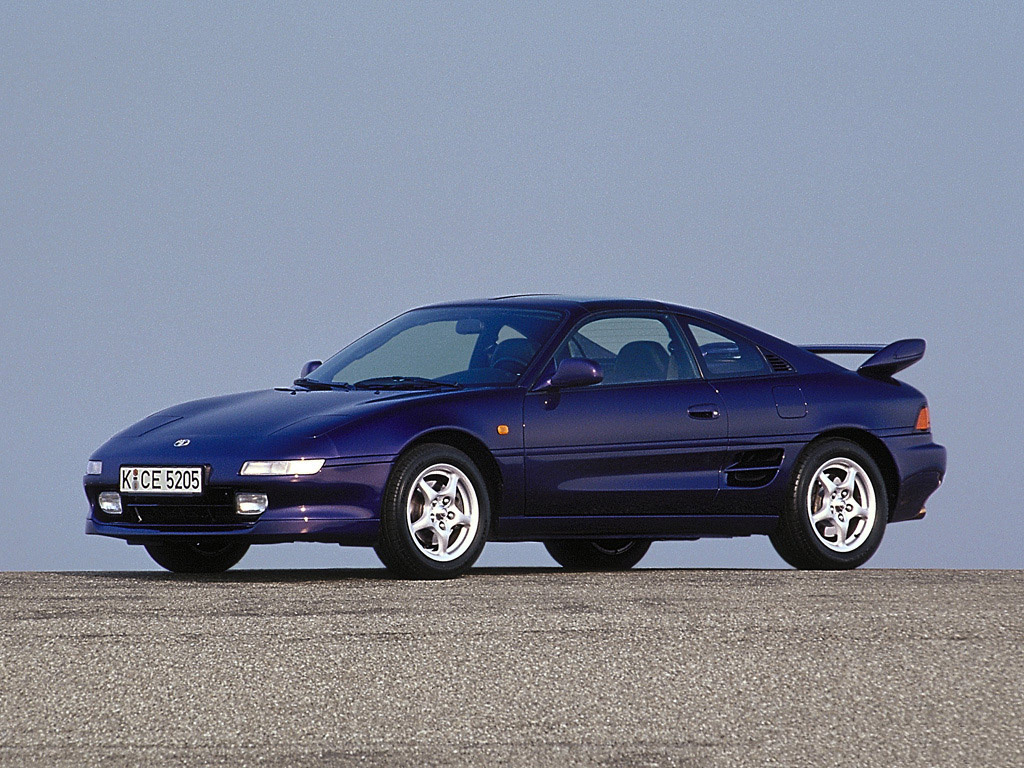
The second-generation MR2 is arguably the best-looking of the three generations. These cars were often referred to as “Baby Ferraris,” thanks to styling that very closely (and possibly intentionally) mimicked the Ferrari 348, and they also shared a bit of an aerodynamic profile from the later MkIV Toyota Supra. The upmarket intent of these second-generation cars, commonly known as the “W20” generation, came from Chief Engineer Kazutoshi Arima. The original MR2 had been an affordable sports car, but owners were punished with high insurance rates so why not make the car bigger, faster, and more exciting?
The car was different-looking enough that there were early rumors that it wouldn’t replace the Mk1 but be a whole new car, possibly aimed at the Acura NSX or Lotus Esprit, and carry a big V6 engine. In actuality, the added size not only gave it more gravitas but helped make it more comfortable for taller drivers, though it’s still a squeeze for anybody over six feet four inches. The car was introduced in the fall of 1989 in Japan and arrived in the U.S. in early 1990 as a 1991 model.
U.S.-spec cars were offered in two basic versions: The MR2 featured a naturally aspirated, 2.2-liter inline four-cylinder engine making 130 horsepower and 140 pound-feet of torque. The MR2 Turbo was equipped with a smaller 2.0-liter engine but turbocharging boosted this powertrain’s horsepower to 200, and torque was a matching 200 pound-feet. 2.2-liter MR2s were available with either a five-speed manual or an optional four-speed automatic transmission. The turbo models were manual only.
The difference between them on the road was dramatic, and while the non-turbo wasn’t a bad car, the boosted version was much quicker. Thanks to input from people like Dan Gurney, an F1, NASCAR, and Le Mans legend, both were seriously good handlers. Nevertheless, they got a lot of negative attention for inducing what some reviewers referred to as “snap oversteer,” but investigation revealed that it was no more dramatic than any other sports car with a mid-engine. The result was a change in post-1992 cars’ suspension geometry, power steering settings, and tires that many felt “neutered” the second-gen MR2’s once lively performance.
These cars were further divided into sub-generations. Nearly annual tweaks, replacements, and additions led to five different “revisions” recognized by MR2 fans. These revisions brought features like larger wheels and tires, better transmission synchros, a limited-slip differential for the Turbo cars, and upgrades to the anti-lock braking system (ABS).
Unfortunately, time was not on the side of this car. While the original MR2 had enjoyed a long run of great sales, economic circumstances changed just as the W20 series was arriving. A recession and a rapidly souring Dollar-to-Yen exchange rates put a huge damper on MR2 sales in the U.S. market, and instead of selling the 3,000 cars a month that Toyota envisioned, just under 28,000 were sold in five years, in progressively smaller numbers. In the car’s final year in the U.S., fewer than 500 were sold.
The poor sales numbers meant Toyota was reluctant to adapt the car for the 1996 onboard diagnostics (OBD-II) requirement, so it dropped the MR2 in the U.S. but continued it in other markets until 1999.
These MR2s are very reliable, but they do have some weak points, and some are likely to have been driven hard or abused. Rust is the biggest vulnerability, as the trunk can trap water, and the optional T-top roof can do the same. The transmission synchros can be weak, the door locks have interior pieces that can fail, and the clutch hydraulic components wear out quicker than they should—keep an eye out for all the above during a test drive. However, this is about as reliable as an exotic-looking mid-engine sports car can get.
The second-generation MR2’s looks, performance, and rarity all mean it’s valuable today. A few later models from Japan have been imported in recent years, including the ultra-rare convertible version, but most of the ones you’ll find are U.S. models. Non-turbos in good condition range from about $15,000 to $25,000, and turbos will cost about $10,000 more now. Manuals are also worth more, as most of the people who want these cars prefer stick shifts.
First Generation (1985-1989)
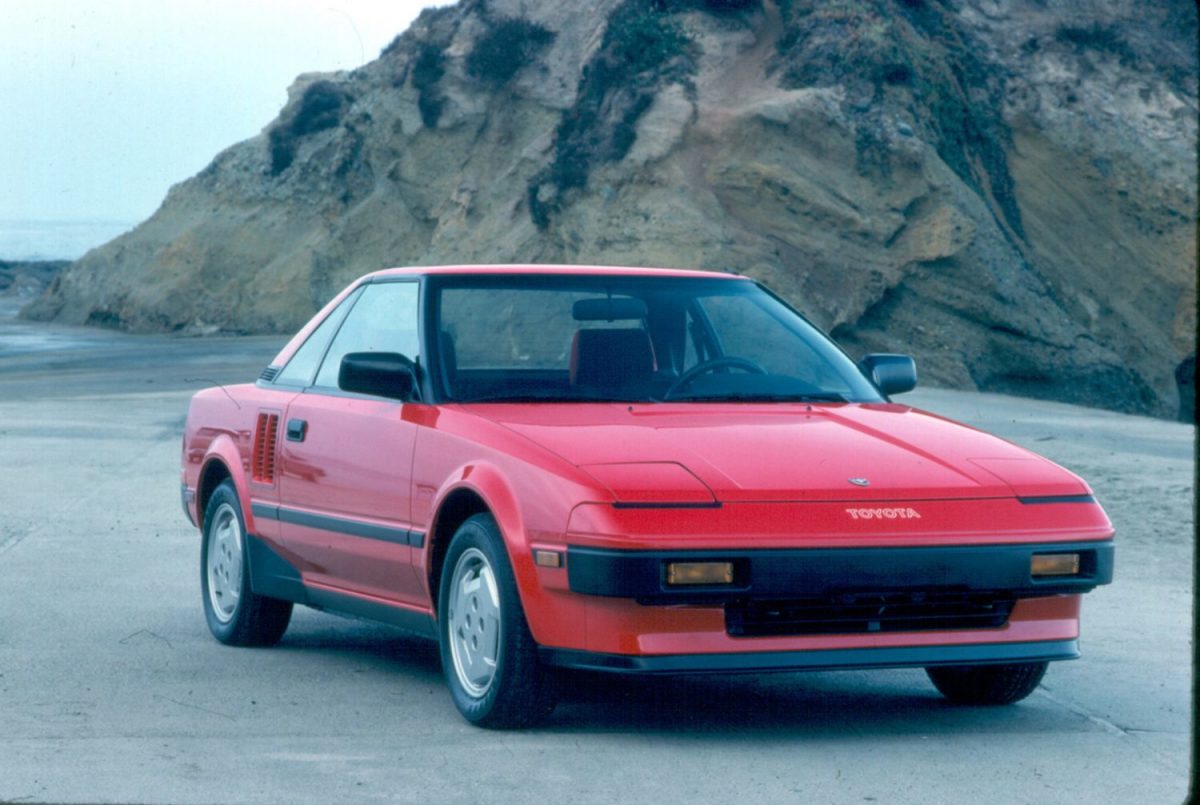
The late 1980s were a golden age for Toyota fans. You could walk into a dealership and see any manner of wackadoodle vehicles, such as all-wheel drive Celicas, the odd Corolla All-Trac wagon, a van shaped like a Twinkie, and the first-generation MR2, a sharply styled little doorstop of a car that offered a mid-engine exotic experience in an affordable and ultra-reliable package. That latter quality wasn’t something widely associated with sports cars at the time.
Unlike the Miata, the MR2 wasn’t some exercise in Carnaby Street nostalgia, it was an exercise in mechanical sophistication. This was a cutting-edge sports car: Light, nimble, massively communicative, and, in some forms, actually fast. The base engine was a 4A-GE DOHC 1.6-liter inline four-cylinder, rather exotic for its time. These engines only pushed out 115 horsepower but did it right up the 7,500 RPM redline. Still, they could only hit 60 mph in 8.5 seconds. A five-speed manual transmission was standard and fitted to most examples, but Toyota added a four-speed automatic in 1986.
Three years after it launched, the MR2 got the power boost that many people thought it needed. Toyota bolted a supercharger in place, and the engine delivered 145 hp, transforming the car into something that could hit 60 in just 6.5 seconds, which was dramatically quicker for its day.
At the time, there was just a handful of competitors, including the Pontiac Fiero (powered at first by a grim “Iron Duke” four-cylinder from the 1970s, then later a more appropriate tiny V6) and the aging Bertone X1/9, formerly a Fiat and now built by the famous coachbuilder after Fiat had given up on the U.S. market. The latter was a terrific little car, but it was way more expensive, not as fast, and even with Bertone’s improved quality, not as well made.
Toyota had spent years working with Lotus, all the way back to the 1960s. The first-generation MR2’s Macpherson strut/Chapman strut suspension system was designed by Lotus engineer Roger Becker, and it handled as if directly connected to the driver’s brain. At the time the first-generation MR2 was designed, Toyota actually owned part of Lotus.
In addition to the coupe body style, the car was also offered with a T-bar roof. It wasn’t quite as nifty and cheap as the later Miata’s folding top, but it did provide an open-air feel at a time when convertibles were rare due to 1970s and 1980s safety legislation concerns, and the “convertible-light” style didn’t corrupt its trademark angular bodywork and edgy spoiler. For the 1987 model year, the new MR2 got a fairly comprehensive facelift that included engine, suspension, and interior mods.
Like later cars, specifically the W20 series, the W10 MR2s are rock reliable, and their biggest area of concern is rust. They can rust pretty much anywhere (pay particular attention to the sills), and many of the compartments trap water. Corrosion is less of a concern in sunny climes, but inspect carefully if you live in an area with salty roads. Worn suspension parts, bum alternators, and worn transmissions are usually the most significant mechanical issues. The second gear synchro can wear out, and very worn manual transmission might periodically pop out of fifth gear—a sure sign a rebuild is needed.
Happily, the first-gen MR2 was a big seller, and since it’s slower and less sinuous looking than the later second-gen model, you can still purchase them for pretty reasonable money. The most expensive one sold at auction went for $51k, and that was a supercharged five-speed with just 31,000 miles. Most first-generation MR2s in good shape sell for about $12,000 to $20,000 today. It’s possible to find worn ones for much less, even as little as $5,000 for a decent runner in need of modest amounts of refurbishing.
Related Topics

by Craig Fitzgerald
Craig began his automotive writing career in 1996, at AutoSite.com, one of the first online resources for car buyers. Over the years, he's written for the Boston Globe, Forbes, and Hagerty. For seven years, he was the editor at Hemmings Sports & Exotic Car, and today, he's the automotive editor at Drive magazine. He's dad to a son and daughter, and plays rude guitar in a garage band in Worcester, Massachusetts.
The content above is for informational purposes only and should be independently verified. Please see our Terms of Use for more details.


