When the Mazda MX-5 Miata first appeared in 1989, the Hiroshima-based company was already famous for making fun-to-drive-cars. From the rotary-powered cars of the 1970s through the famous RX-7 sports car and its turbocharged 1980s sedans and coupes, Mazdas had long been performers. But the MX-5 Miata was very different, a revival of a then-endangered species: a small, sporty, inexpensive two-seat roadster.
Cheap, fun, and small roadsters—mostly British and Italian—were very popular in the 1950s and 1960s but went into a long decline after that. Newer sports cars from Japan were much more reliable and practical than the British and Italian offerings, which were also threatened by safety and emissions regulations and the declining fortunes of Fiat, MG, and Triumph. In 1968, Americans could choose from a dozen cheap roadsters. In 1988, there was only one, the Alfa Romeo Spider, then in its 21st model year.
Watching as plenty of old sports cars regularly cruised by the company's then-new California design offices in the early 1980s and the old cars died off one by one, Mazda's designers, led by product planner Jim Hall, designer Tom Matano and engineer Toshihiko Hirai (a former Fiat 850 Spider owner), decided to fill this underserved niche. Thus began an eight-year project to build a new Mazda roadster with all the fun and charm of a 1960s MGB but the reliability and quality of a modern Mazda 626 sedan.
The Mazda MX-5 Miata was the result, with winsome styling, amazing handling, and rock-solid reliability. It debuted in 1989 to rave reviews and waiting lists—eventually becoming the best-selling roadster of all time. It would have been easier and cheaper to base the car on an existing front-drive design, but that would have compromised its handling. Mazda's decision to stick with rear-drive was vindicated by the market all but ignoring two front-drive competitors aimed at the same niche: the 1990s Mercury Capri and Lotus Elan M100.
The MX-5 Miata's success inspired a new generation of rival roadsters, like the BMW Z3 and Mercedes-Benz SLK, but no other automaker has ever quite equaled the Miata format at the same price point, at least not in the U.S. market. Mazda has redesigned the car four times in total since the 1989 "NA" series original (Miata owners often refer to their cars' generations as NA, NB, NC, etc., based on Mazda's internal codes). Mazda also added an optional retractable hardtop in 2006, but it has never strayed far from the basic formula. The Miata is fun, reliable, and as simple as a car can be, even in these days of touchscreens and driver-assist gear.
With their modest four-cylinder engines (never bigger than 2.0 liters or 181 horsepower), Miatas aren't all that fast in a straight line, but this is a car about finesse and fun, not quarter-mile times. They're very reliable and can rack up lots of trouble-free miles if you maintain them. Chances are good that if you shop around long enough, you'll find a clean, low-mileage example with many years of service left in it. It's a great combination of a sports car and a reliable commuter, if you can fit your life into its tiny shape.
There are many special editions, unusual colors, and some nice performance upgrade packages, too. Here, we've outlined every MX-5 Miata generation with a little advice about what to look for in each one, and what to pay. Whichever one you choose, you're in for a good time.
Mazda MX-5 Miata Buying Guide: Cost, Reliability, and the Best Years to Buy
Frequently Asked Questions
Which Mazda MX-5 Miata years are the best?
Considering its performance mission, the Mazda MX-5 Miata is a spectacularly reliable vehicle and an excellent long-term value. There have only been a few years where owners have voiced complaints, and those issues usually have more to do with the typical teething issues on an all-new design than lingering problems with the vehicle itself. That said, Miata fans tend to favor the original first-generation model (1989 to 1997) and the newest fourth-generation (2016 and newer) over the other two as the NA original has the iconic styling the second-gen NB lacks while the current ND model is lighter than the third-gen NC and faster than all the others.
What are the worst Mazda MX-5 Miata years?
There are no truly bad years in this car's history, but a few generate more complaints than others. 2006 to 2008 models and 2016 models have more complaints than all the others. These issues tend to center on body, paint, interior components, and electrical problems, but they aren't significant issues. As both eras coincide with the introduction of total redesigns of the car and don't repeat in later years, it's fair to chalk them up to working out the kinks of new designs. Most examples will have had any issues sorted out by now.
How much does a late-model Mazda MX-5 Miata cost?
A one-year-old 2025 MX-5 Miata averages around $33,800, while a three-year-old 2023 model runs about $29,900 and a five-year-old 2021 example averages roughly $26,700. Because the Miata holds its value so well, dropping back a few model years saves less than you might expect—but you still get the same rewarding drive for less than a new one.
Research Mazda MX-5 Miata Price Trends on CarGurus
Is a used Mazda MX-5 Miata a good deal?
Yes, absolutely. As long as you can handle the space constraints of the car (drivers over about six-foot-four won't fit easily and possibly not at all, there's very little cargo room, and it can feel jittery in highway cruising), there's no real downside to the MX-5 Miata. It's affordable, fun to drive, gets great gas mileage, and is solidly reliable. Many owners also tend to take care of them or buy them as second cars, so they tend to be looked after. Other performance cars are faster or more practical, but few are as fun and almost none are such a good value. The data backs that up: over the past year, used MX-5 Miata prices have climbed about 10%, well ahead of the roughly 2% rise in the broader CarGurus used-car index.
Mazda MX-5 Miata Pros and Cons
Pros:
- Playful performance and handling for low price
- Good looking and fun
- Excellent long-term reliability
Cons:
- Tiny cabin may not fit all drivers
- Cloth top models are loud inside
- Very limited cargo room
Mazda MX-5 Miata Generations
Fourth Generation (2016-Present)
The fourth-generation "ND" Miata debuted for the 2016 model year as a more refined and luxurious MX-5. Though the car looks and feels more grown-up than its predecessor, the ND Miata is still lively and athletic. Its steering reacts very quickly to inputs and offers fantastic feedback, while its suspension offers a friendlier ride quality than before.
Power comes from a 2.0-liter four-cylinder engine, at first with 155 horsepower and 148 pound-feet of torque. For model year 2019, the Miata got a refresh and a considerable boost in power, to 181 horsepower and 151 pound-feet. This is still only enough to do zero-to-60 in about 5.5 seconds, but in the light, open Miata, that feels faster than you'd think and it's much quicker than previous Miatas. Buyers can choose from six-speed manual or automatic transmissions, both driving the rear wheels. The majority of Mazda MX-5 Miata buyers choose manuals, and automatics tend to have lower resale value.
As in the previous NC generation, there are two basic bodies. The standard roadsters offer a cloth top, while the MX-5 Miata RF features a removable hardtop with buttresses and a removable targa top. The RF looks a little more aggressive than the standard convertible and it's much quieter on the highway, but it does weigh more than the cloth top version.
Speaking of the highway, that's where the one downside of the MX-5 Miata's reactive, finely-tuned chassis comes into play. This is a small, light car with a teeny-tiny wheelbase and very firm suspension damping. It can feel jittery and twitchy when cruising on the interstate, unsettled by road imperfections and big bumps. In all other settings, the car's excellent handling makes even ordinary journeys fun, and it's an excellent track day toy if you want it to be.
Currently, the MX-5 Miata is offered in Sport, Club, and Grand Touring trim packages, while the RF comes only in Grand Touring and Club trims. Mazda fits many desirable standard features, including an 8.8-inch infotainment screen with Apple CarPlay and Android Auto, and in recent years, standard automatic emergency braking and adaptive cruise control. There are many options, however, from an upgraded Bose audio system, heated seats, infotainment with wireless CarPlay and Android Auto and performance upgrades including Brembo brakes, BBS wheels, and heated Recaro sports seats.
Though the Miata is one of its signature achievements, in a sign of how dominant this car has been in the sports car world, Mazda collaborated with Fiat Chrysler Automobiles (now known as Stellantis) in 2015 to build a version for Fiat. The partnership resulted in the Fiat 124 Spider and the Abarth 124 Spider, spiritual heirs to the Fiat 124 and 2000 Spiders that were popular in the U.S. from 1967 to 1985. The "Fiata" offers different engines and more conventional, traditional styling, but isn't fundamentally all that different from the Mazda in terms of how it drives.
For 2025, Mazda created a 35th Anniversary Edition, based on the Grand Touring trim and only available with a soft top and six-speed manual. Only 300 examples were available for purchase.
The Miata competes in an odd segment these days. Because there are so few other sports cars these days, the ones that remain span a huge price range, and many are far more expensive. The Toyota Supra and Nissan 370Z are solid alternatives. The BMW Z4, Subaru BRZ, Toyota GR86, and others could also be considered. Only the BRZ and GR86 really approach the Mazda on price. There's also the Fiat 124 Spider, of course.
Of all these, the Mazda costs the least as a used vehicle and has one of the best reliability records. Aside from some issues in 2016 regarding the fitment of the retractable hardtop on the RF and minor quality and interior piece defects, this Miata gets good marks from reliability trackers like Consumer Reports. The average used price for a fourth generation ranges from around $19,300 to $33,800. A brand-new 2026 model costs $31,745 to start.
Third Generation (2006-2015)
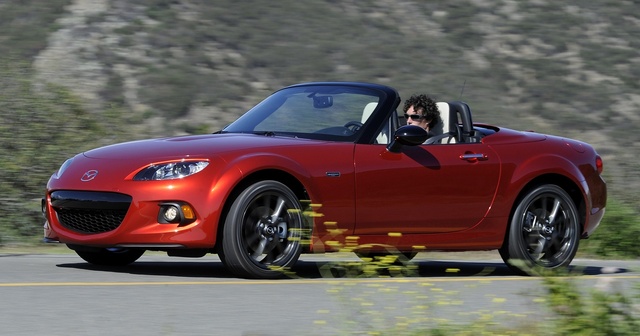
The "NC" Miata, or third-generation car, was the first to have a power-folding hard top, which greatly improved appeal for buyers who didn't want to commit to a dedicated convertible. Hardtops may weigh more, which is anathema to track warriors, but they're quieter and more secure daily drivers.
The folding top, similar to the type popularized by the Mercedes-Benz SLK-Class, is power-operated and can raise or lower in 12 seconds. A cloth top was still offered, and the only top offered on the base-model Club. The hardtop's structure also makes it slightly more confining than the soft-top version, but it makes for a quieter and more refined year-round driving experience.
U.S.-market NC models got a 2.0-liter four-cylinder engine that made 170 horsepower, sent to the rear wheels through either a five- or six-speed manual transmission. An automatic variant was available, too, but it got only 158 horsepower. As with other Miata generations, most buyers chose manuals, and automatics have lower resale values as they might be harder to sell to new owners. The NC takes a little over seven seconds to hit 60 mph.
The NC is slightly larger and heavier than earlier Miatas, which gave it a bit of a black eye among some enthusiasts. This disdain is misplaced, however, because the third-gen car is just as lively and worthwhile as its counterparts. A big upside to the NC is that its cabin is more spacious and can accommodate taller drivers. Mazda also managed to program enough fun into the car that it still felt engaging and sporty even with the automatic transmission.
Apart from the sophisticated folding top, the NC Miata is an otherwise very low-tech car. There's no infotainment screen and no backup camera, not that you need one all that badly in such a small car. The NC was considered feature-heavy and complex compared to the NB, but today seems very analog. A number of owners have added aftermarket backup cameras and infotainment units, but the car did not come this way from the factory.
The early years of this generation, 2006 to 2008, tend to draw more gripes from owners than later years, but they're generally quibbles about the power-folding top or body and interior quality issues. The NC really didn't change very much during its lifetime and later years have an exemplary reliability record. All years have low maintenance costs, and they all get about 23-24 mpg combined on regular gas.
Sub-100,000-mile NC Miatas in good condition start at around $10,000, but the vast majority of really nice ones cost about $13,000 to $18,000, depending on spec, mileage, and condition. They're all pretty good buys these days.
Second Generation (1999-2005)
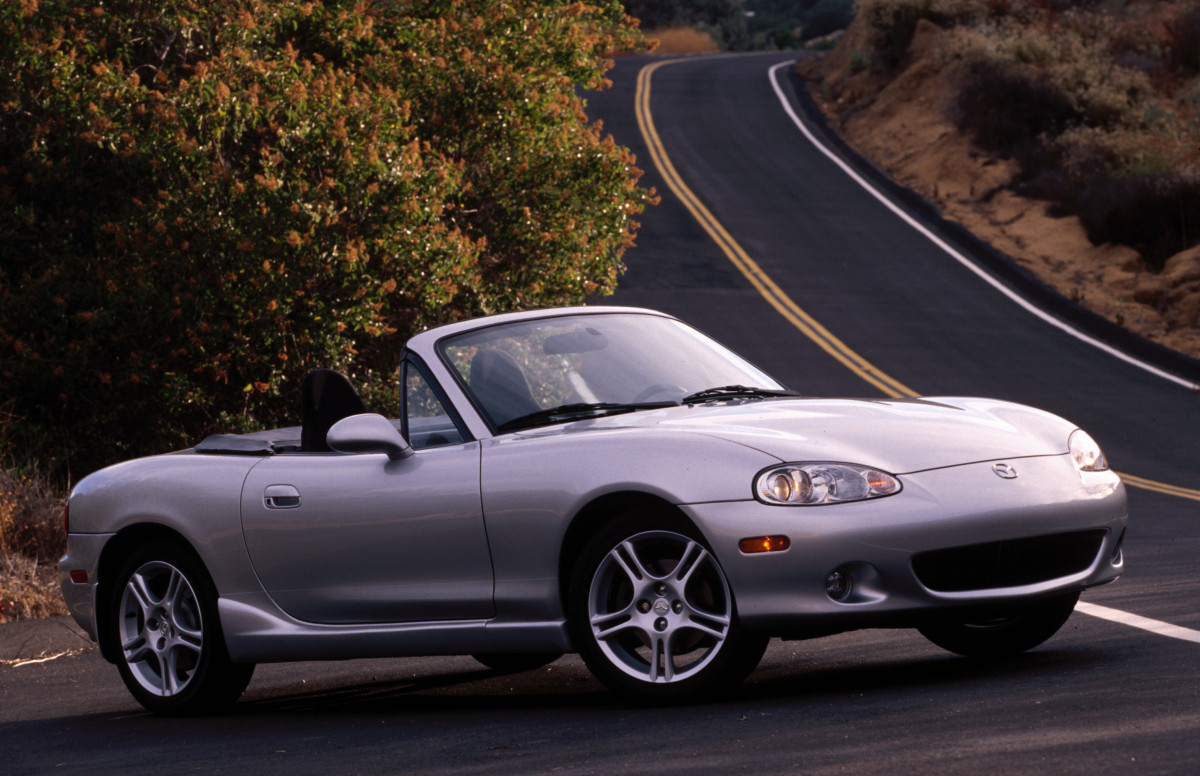
The "NB" Miata hit the streets in 1998 with styling that initially came as a surprise. The Miata's lovable pop-up headlights, which nearly defined the NA generation, were gone, and its winsome styling was made slightly more aggressive with RX-7 overtones. But Miata fans got one of the things they wanted most: more power. The NB got a 1.8-liter four-cylinder engine that made 140 horsepower from the start, and it later got even more power.
Mazda offered optional anti-lock brakes for the car, and several different wheel options, including 14- and 15-inch rims. A 10th Anniversary Model, available in 1999, got upgraded Bilstein shocks, a six-speed manual gearbox, and a Torsen limited-slip differential in addition to special blue paint. The fastest Miata yet, the Anniversary edition previewed things to come.
In 2001, Mazda gave the car a light refresh, adding variable valve timing to the engine (for 143 horsepower) and making the six-speed and Bilstein shocks optional. As in prior and later years, there were plenty of performance and convenience upgrades, including a CD changer and suspension packages, and a removable hardtop.
The wildest NB Miata, and the fastest until the current-generation model, debuted near the end of the NB's run. The MazdaSpeed MX-5 Miata was offered in 2004 and 2006 with a turbocharged version of the 1.8-liter four, making 171 horsepower and 166 pound-feet of torque. The extra power was accompanied by many mechanical upgrades, including a short-throw shifter on the standard six-speed manual, a torque-sensing limited-slip differential, a freer-breathing exhaust, a larger oil cooler and radiator, bigger wheels and performance tires, heavy-duty driveshafts, a heavy-duty clutch, and more.
Inside, the NB is a little roomier than the original NA generation, but not much. It's also not much different in terms of its look and feel. There are extras like CD changers and an upgraded audio system, but this is a pretty basic vehicle by modern infotainment standards. That's just as well, as the enjoyment is all in the driving.
Like other Miatas, the NB enjoys an excellent reputation for being reliable and low-maintenance, though at this age, it's important to check for rust. The NB is also the best deal among Miatas and maybe the best-value sports car on the market. Worn but serviceable examples can be had for as little as $4,000, while nice ones with under 100,000 miles on the clock routinely sell for about $7,500 to $10,000. You can find very nice collector-worthy examples for a little more, and Anniversary models come with a premium, but this is still a very affordable machine.
The MazdaSpeed MX-5 is a genuine collector car now, even if it's barely 20 years old, and costs more. Expect to pay $15,000 for a good one.
First Generation (1989-1998)
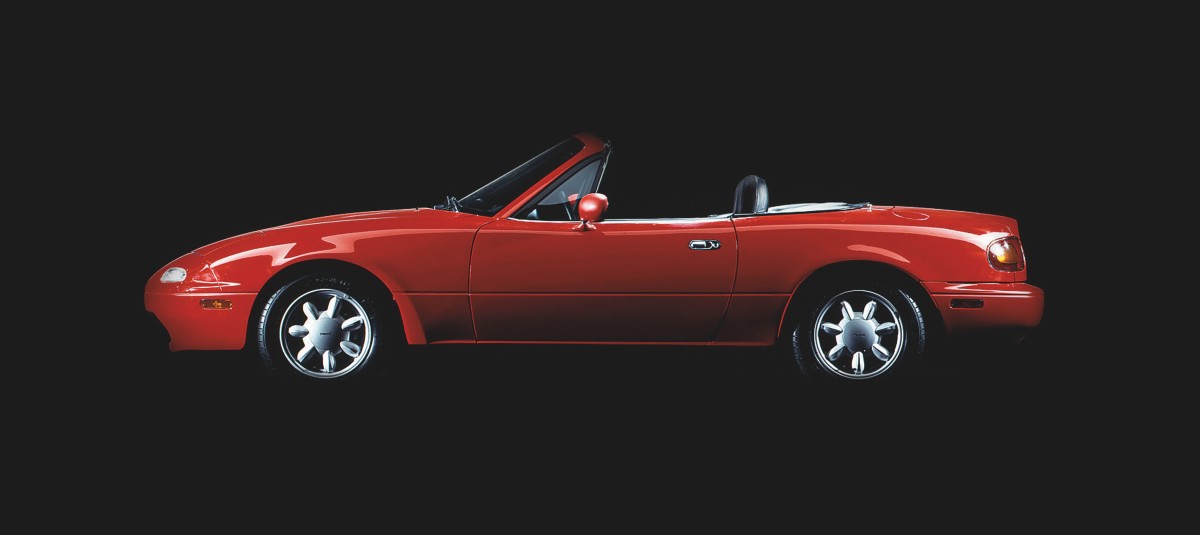
The Mazda MX-5 Miata landed in 1989 as a Japanese take on the classic British two-seat roadster, an MGB for the modern era with modern reliability. Mazda sold the Miata in Japan as the Eunos Roadster, and it became known by its internal "NA" production code. The original MX-5 used a 1.6-liter four-cylinder engine that made 115 horsepower and 100 pound-feet of torque. It came paired with a five-speed manual transmission and rear-wheel drive. An optional automatic transmission lowered engine output to 105 horsepower.
A limited-slip differential was available, but even the standard car delivered razor-sharp handling and an engaging open-top driving experience. Mazda claimed a zero-to-60-mph time of 8.6 seconds and a top speed of around 117 mph—both strong numbers for a car as small as the Miata back then. The car was instantly popular, so much so that there were waiting lists to get one for more than a year and, despite the recession of the early 1990s. It quickly proved a reliable machine, too. Many NA Miatas survive today, and many have reached very high mileages.
Mazda overhauled the Miata in 1994, giving it a more powerful engine, better safety features, and structural improvements that could better protect occupants in the event of a crash. The biggest news for enthusiasts was that the automaker fitted a new 1.8-liter four-cylinder engine, which increased output to 129 horsepower and 110 pound-feet of torque. Mazda again increased power in 1996, to 133 ponies.
Initially, the MX-5 was a basic car that lacked most creature comforts. It had no power steering or air conditioning, though its low price of $14,000 likely made up for that in the minds of many buyers. Philosophically, it was also no different from the roadsters it emulated, which were also usually pretty bare-bones inside. Mazda offered options packages to improve the situation and created several special editions over the years, including the initial Special Edition, the Sunburst (with vibrant yellow paint), the M Edition, and many more short runs of special colors.
Today, the NA Miata is a very popular entry-level collector car and performance platform. Many have been extensively modified or used hard, but this Miata was also built in larger numbers than any other, so there are many examples to choose from. When buying one, it's important to check for accident or modification damage and, especially, rust. These cars are three decades old now, so many of the issues with them are age-related, like corrosion or worn rubber and plastic components.
If you're shopping for a clean, original, sub-100,000-mile example, expect the cost of entry to be about $10,000. Some rare special editions with ultra-low mileage will go for more, but the NA Miata won't break the bank even in great shape.
Related Topics